
TechnipFMC’s Revenue and Operating Income Surge Tests Capital Allocation Amid Industry Volatility
Strong 2025 financial gains highlight TechnipFMC’s growth and innovation yet underscore exposure to energy market cyclical risks.
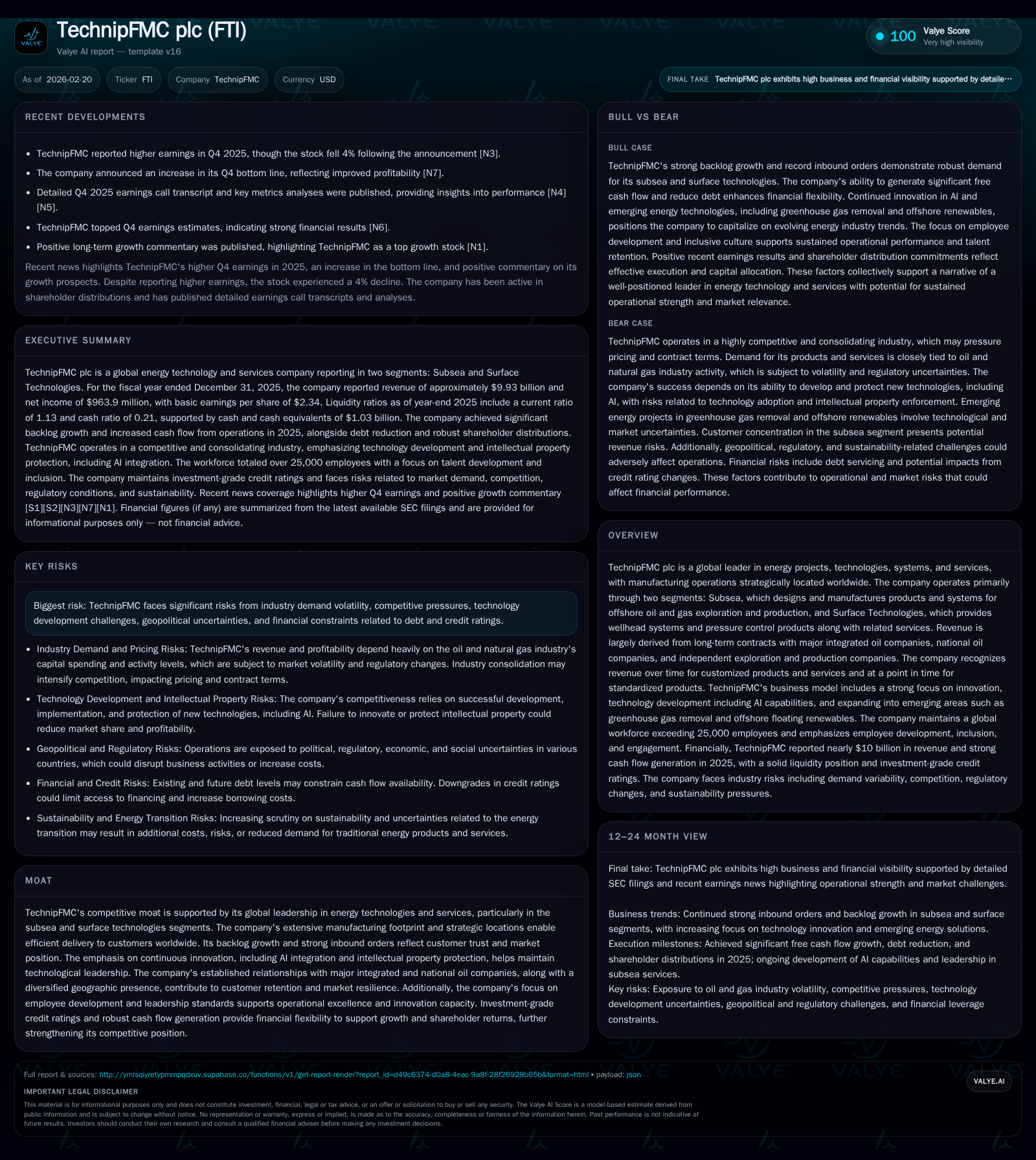
TechnipFMC plc demonstrated robust revenue growth of 9.4% and a 24.1% rise in operating income in 2025 driven by strength in its Subsea segment, supported by long-term contracts with leading oil companies. The company continues emphasizing innovation, including AI capabilities, while maintaining investment-grade credit ratings and improving free cash flow generation. However, evolving geopolitical dynamics and energy transition uncertainties pose demand risks. Capital allocation focuses on share repurchases, dividends, and sustaining liquidity via extended credit facilities. Going forward, monitoring order backlog development, contract wins, and execution efficiency will be critical indicators for sustaining momentum amid cyclical pressures.
Historical Performance and Revenue Drivers
TechnipFMC plc posted consolidated revenues of approximately $9.93 billion for fiscal year 2025, up 9.4% from $9.08 billion in 2024 [F1]. This sustained revenue growth primarily reflects increased activity in its Subsea segment, which comprises specialized offshore oil and gas exploration and production systems. The Subsea segment generated $8.67 billion in revenue (approximately 87% of total), up from $7.82 billion the prior year [S9]. Its broad portfolio of long-term contracts with integrated oil majors and national oil companies underpins this performance.
Surface Technologies, which provides wellhead systems and pressure control products as well as services related to well completion and stimulation activities, reported relatively flat revenue at $1.27 billion in 2025 versus $1.26 billion in 2024 [S9]. The product-heavy nature of Surface Technologies leads to point-in-time revenue recognition upon delivery, contrasting with Subsea’s significant over-time recognizing long-term custom projects [S22].
Operating income grew by a remarkable 24.1% year-over-year to $1.44 billion driven by margin expansion in the Subsea business owing to better pricing leverage and operational efficiencies amidst higher volume [F1]. Surface Technologies experienced some margin pressure due to competitive factors despite steady revenues [S9]. Corporate expenses and net interest costs decreased moderately reflecting improved capital structure management.
Net income also improved materially to $964 million from $843 million with tax efficiencies partially offsetting continued investments in technology development including proprietary AI tools applied across project design and operations [F1][N2]. These improvements reflect both operational execution gains and effective cost controls across global manufacturing hubs.
Historical performance (annual)
| FY | Rev ($bn) | Net ($mm) | CFO ($mm) | OpInc ($mm) | Rev YoY | Net YoY |
|---|---|---|---|---|---|---|
| 2025 | 9.9 | 964 | 1765 | 1436 | +9.4% | +14.4% |
| 2024 | 9.1 | 843 | 961 | 1157 | +16.1% | +1399.8% |
| 2023 | 7.8 | 56 | 693 | 658 | +16.8% | +152.4% |
| 2022 | 6.7 | -107 | 352 | 376 |
Note: Omitted columns lack sufficient annual XBRL coverage in the provided tags (need ≥2 annual points): Capex, Buybacks. Source: SEC companyfacts cache [F1].
Capital returns and efficiency (annual)
| FY | Div ($mm) | FCF ($mm) | ROE% |
|---|---|---|---|
| 2025 | 82 | 1447 | 28.7 |
| 2024 | 86 | 679 | 27.2 |
| 2023 | 44 | 468 | 1.8 |
| 2022 | 0 | 194 | -3.3 |
Source: SEC companyfacts cache [F1].
Note: Buybacks data prior to FY2025 not restated due to reporting changes; dividends reflect cash payments.
Future Growth Prospects
TechnipFMC's future revenue growth prospects hinge largely on the offshore energy sector's capital spending cycles alongside its ability to secure multi-year contracts with major operators [S10][N6]. Expanding subsea system deployments linked to deepwater exploration and developing fields remain pivotal demand drivers given the substantial scale of engineering content requiring advanced technology solutions.
Additional catalysts include:
- Broader adoption of AI technologies within subsea project planning and remote operations enhancing productivity.
- Expansion into emerging geographic markets such as Latin America and Africa where resource development is accelerating: Latin America accounted for over $3 billion in subsea revenue alone in recent years [S18].
- Incremental growth opportunities from greenfield projects transitioning toward more environmentally focused hydrocarbons extraction techniques.
- Incremental revenues from recurring service contracts coupled with surface technology enhancements focused on well stimulation innovation.
Constraints that could cap growth include volatility in oil prices affecting upstream budgets, intensified competition from both traditional rivals and alternative technology providers, plus geopolitical uncertainties including sanctions impacting contracts across jurisdictions [S11][S20]. The company must also navigate an evolving regulatory environment concerning AI usage and climate-related disclosures mandated in key markets such as Europe starting mid-2026 [S11].
Forecasts, Milestones & Monitoring Metrics
While explicit forward guidance was limited during Q4 earnings discussions [N2], investors should monitor:
- Order backlog trends segmented by type (customized subsea vs standardized surface products) as these provide visibility into future revenue streams.
- Contract win announcements particularly among integrated oil companies shifting toward deeper offshore plays.
- Margins within subsea segments indicating successful cost control amidst expanding labor/material costs.
- Developments relating to the company's commercial paper program execution enabled post-investment grade upgrade.
- Implementation milestones for AI-enabled operational products possibly driving differentiation.
Given TechnipFMC’s significant exposure through long-term contracts recognized over time under ASC606 accounting standards, project milestones achieved directly influence reported revenues quarter-to-quarter [S22].
Returns & Capital Allocation Strategy
The company posted an estimated return on equity around 28.7% for FY2025 based on net income relative to total shareholders' equity of roughly $3.36 billion as of year-end [F1]. This strong profitability measure underscores effective asset utilization despite capex rising moderately (+12.6%) reflecting investment behind manufacturing capabilities.
Free cash flow generation nearly doubled from prior year levels reaching approximately $1.45 billion after subtracting $317 million capex from operating cash flows of $1.76 billion [F1][S25]. This enhanced liquidity enables robust capital return programs:
- Share repurchases accelerated considerably in late FY2025 totaling $918 million against board authorizations lifting total repurchase potential above $3.8 billion [S21].
- Dividends were modest but stable at about $0.20 annually per share equating to $82 million paid out in FY2025 [F1].
Liquidity remains strong; revolving credit facilities extend to five years with availability standing at full capacity ($1.25 billion), supporting both debt refinancing needs and strategic flexibility for acquisitions or working capital funding if required [S4][S5][S21]. Investment-grade credit profiles maintained after rating upgrades further lower borrowing costs fostering ongoing deleveraging initiatives.
Industry Landscape & Segment Characteristics (Analysis)
TechnipFMC operates within an industry characterized by capital-intensive offshore developments featuring high technological complexity and significant execution risk requiring extended project timelines often spanning multiple years per contract cycle — typical traits of subsea engineering firms competing globally alongside players such as FMC Technologies (legacy), Aker Solutions, and Saipem.
Subsea contract awards dominate revenues historically influenced by global drilling rig rates, discoveries of deep reservoirs necessitating advanced subsea trees and umbilicals, plus operators’ shifts toward cost optimization amid lower carbon transition ambitions prompting breakthrough automation through embedded digital twins.
Surface Technology offerings remain more commoditized but critical for well integrity—here competition centers around innovation on pressure control combined with downstream service upsell potentials where equipment leasing complements direct sales.
Manufacturing footprint distributed worldwide plays a dual role: it allows proximity servicing diverse customer geographies while exposing supply chains to macro volatility that needs continual mitigation via localized sourcing strategies and hedging programs especially considering foreign exchange variations impacting reported earnings [S23].
Risk Considerations & Regulatory Environment
Key risks encompass cyclicality inherent in oilfield services linked directly to crude prices impacting exploration capex; reliance on a limited set of major customers intensifies contract risk concentration; rapid technological change raises IP protection challenges; corruption risk persists due to operations across jurisdictions with varying legal frameworks; evolving environmental compliance demands increase operating costs especially around emissions reduction targets applicable to offshore equipment manufacturing; finally, new regulatory regimes governing AI adoption introduce unknown compliance expenses potentially affecting product rollout timelines [S11][S20][S27].
Management addresses these risks through strict Code of Business Conduct covering all employees worldwide ensuring regulatory compliance backed by continuous auditing programs alongside investment into sustainable practices embedding environmental health & safety standards into core processes [S1].
Conclusion
TechnipFMC exhibits disciplined execution against a backdrop of growing sector demand supported by multi-billion-dollar backlog contracts predominantly in the Subsea domain paired with innovation-led margin improvement efforts leveraged via scalable manufacturing capabilities globally. Free cash flow strength underpins aggressive capital distributions via buybacks balancing prudent dividend policy sustaining shareholder returns while preserving financial flexibility post-investment grade status achievement. Going forward close attention is warranted on contract pipeline developments within emerging exploration hotspots alongside monitoring integration pathways for new digital technologies intertwined with growing industry sustainability mandates shaping next-generation subsea solutions evolution.
This report is intended for informational purposes only and does not constitute investment advice or recommendations regarding TechnipFMC plc or any securities mentioned herein.
Disclaimer: This is research-only, informational analysis and not investment advice. It may include AI-generated interpretation and general industry context. Always verify important details using primary sources.

Comments