
King Resources Leverages Blockchain to Reshape Arts and Collectibles Trading
Integration of Digital Ownership Tokens introduces transparency in a nascent arts trading business amid financial and operational challenges.
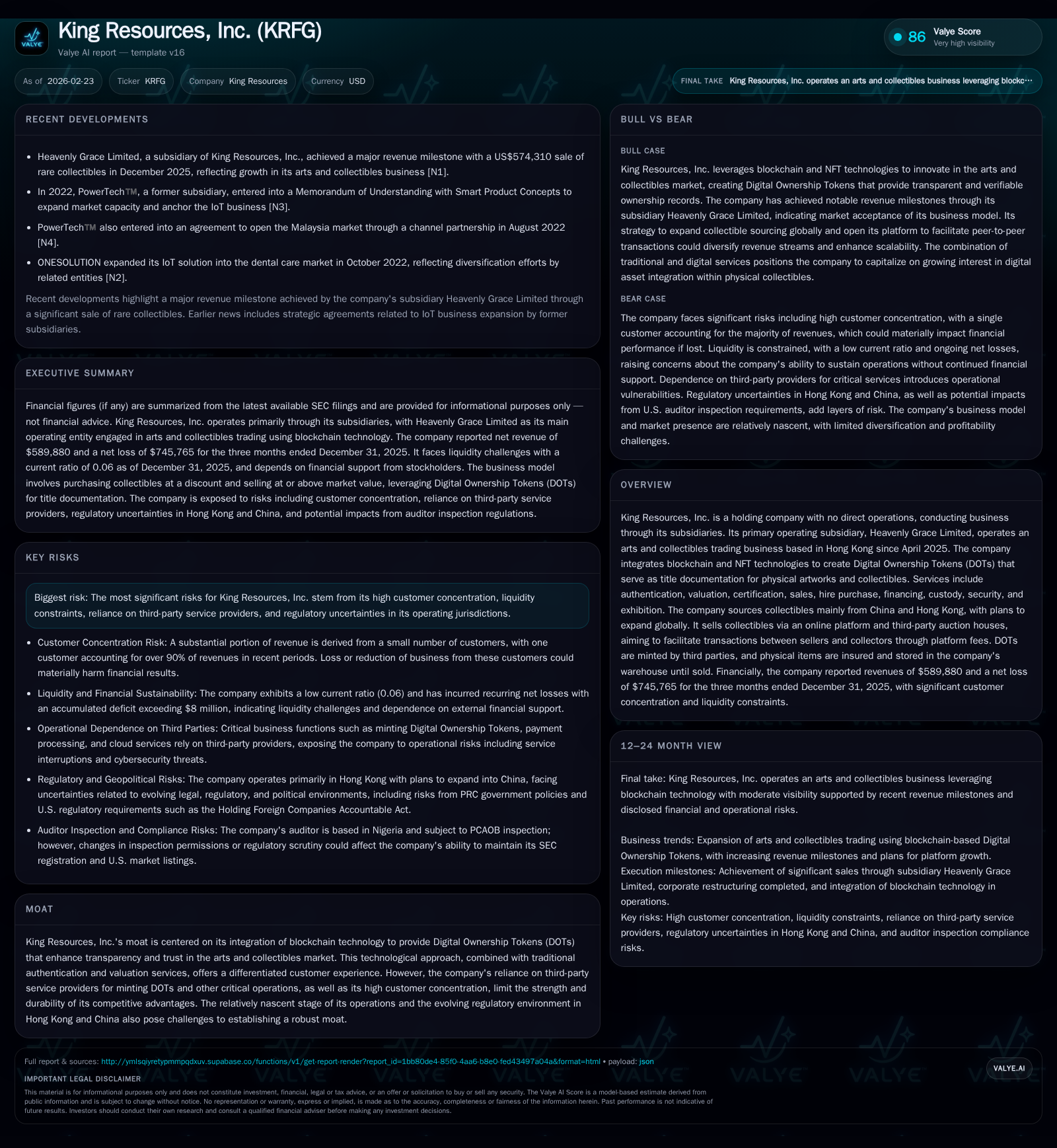
King Resources, Inc. has strategically transformed from its previous technology operations to focus on the arts and collectibles market via its subsidiary Heavenly Grace Limited since April 2025. The company employs blockchain-based Digital Ownership Tokens (DOTs) to authenticate and facilitate transactions of physical art collectibles, primarily sourced from China and Hong Kong. Although revenue showed modest year-over-year growth, operating losses persist alongside liquidity constraints and a negative equity position, underscoring challenges of scaling this innovative yet nascent business. The reliance on third-party minting services and customer concentration represent key risks as King Resources aims for platform rollout and global expansion.
From Legacy Operations to Blockchain-Enabled Innovation: King Resources’ Business Evolution
King Resources, Inc.'s transformation is marked by a dramatic pivot from its former technology-related subsidiaries toward a specialized arts and collectibles trading business. This transition crystallized in late 2024 when the company divested previous tech subsidiaries for a net gain before acquiring Heavenly Grace Limited in November 2024—a subsidiary focused exclusively on the arts sphere.
Heavenly Grace launched operations in Hong Kong in April 2025 leveraging blockchain and NFT technologies to create what it calls Digital Ownership Tokens (DOTs). These DOTs act as immutable title documents representing physical artworks or collectibles, thereby enhancing transparency and trust within traditionally opaque antiquities markets [S1][S2]. The company combines this novel digital infrastructure with conventional authentication valuation certification (AVC) services—authentication, valuation, certification—and integrates custody, security, financing options including hire purchase schemes, sale facilitation through online mechanisms plus auctions.
This sharply contrasts with prior business models centered around high power supply tech products; the strategic shift underscores King Resources’ bet on blockchain’s disruptive promise within the niche luxury assets sector.
Historical Growth and Operational Performance: Revenue, Income, and Cash Flow Trends
Financially King Resources remains in early-stage development with fluctuating results:
Historical performance (annual)
| FY | Rev ($) | Net ($) | CFO ($) | OpInc ($) | Rev YoY | Net YoY |
|---|---|---|---|---|---|---|
| 2025 | 76921 | 1948092 | -85555 | -572737 | +9.4% | +229.2% |
| 2024 | 70296 | -1507469 | -284789 | -609914 | -64.6% | -14.6% |
| 2023 | 198816 | -1315508 | -180808 | -1016459 | -48.4% | -2086.5% |
| 2022 | 385406 | -60166 | 86113 | -60166 |
Note: Omitted columns lack sufficient annual XBRL coverage in the provided tags (need ≥2 annual points): Capex, Div, FCF. Source: SEC companyfacts cache [F1].
Capital returns and efficiency (annual)
| FY | Buybacks ($mm) | ROE% |
|---|---|---|
| 2025 | -204.4 | |
| 2024 | 49.7 | |
| 2023 | 20 | 80.5 |
| 2022 | 20 | 3.5 |
Source: SEC companyfacts cache [F1].
Note: Capex data is only available for FY2022; buybacks/dividends data unavailable for analyzed periods.
Despite revenue shrinking significantly from FY2022 to FY2024 due to business restructuring before partial recovery in FY2025 (+9.4%), operating losses remain substantial. The notable positive net income in FY2025 largely reflects a one-time gain from disposing of legacy subsidiaries ($2.51M)—not recurring operational profitability [F1][S15]. Meanwhile operating cash flow remained negative at approximately $85k demonstrating ongoing cash burn.
Liquidity is critically constrained: the current ratio truely low at about 0.06 as of Dec 31, 2025 implies working capital deficits exceeding $950k while cash balances hover near just $2k [F1]. This liquidity squeeze imposes pressure on day-to-day operations impacting vendor payments or further investment.
Digital Ownership Tokens and Platform Development: New Engines for Future Expansion
King Resources’ unique proposition lies in producing Digital Ownership Tokens—blockchain-registered titles facilitating traceability for physical art pieces—minted via third-party providers rather than insourced [S2]. This reliance allows scalable token issuance without maintaining heavy internal IT infrastructure but also increases dependency risks.
The company operates an online platform designed to sell collectibles either directly or through auction houses while planning to open peer-to-peer market capabilities where collectors can transact with sellers paying platform fees without King Resources managing inventory handling workload [S2]. This approach could amplify scalability while lowering operational complexity relative to traditional brick-and-mortar trading.
From an operational standpoint adopting such a fee-for-service marketplace suggests higher gross margin potential if transaction volumes rise efficiently alongside limited fixed costs linkage—a typical advantage in platform economics. However exact timelines for platform rollout beyond initial launches remain unspecified necessitating close monitoring.
Strategic Constraints: Customer Concentration, Third-Party Dependencies, and Regulatory Risks
A critical risk killer for King Resources is its concentrated revenue base: one customer accounted for the entirety of sales in FY2025 [S15]. Such dependence exposes earnings volatility risk should that single counterpart reduce engagement abruptly. Expanding the client roster while deepening market outreach remains crucial.
Furthermore technological dependencies extend well beyond customer boundaries—the company outsources minting of DOTs along with payment processing and cloud computing infrastructure [S1][S17][S19]. Interruptions or contractual disputes with these external parties could disrupt service continuity or degrade user experience severely.
Geographical exposure to Hong Kong and China also introduces regulatory ambiguity surrounding digital assets including NFTs and property rights recordation which await clearer frameworks [S19]. Such activist regulatory landscape poses potential compliance burdens or constraints impairing competitive moat durability despite blockchain advantages.
Financial Health Analysis: Capital Structure, Liquidity Challenges, and Profitability Metrics
From a capital structure perspective King Resources shows persistent equity deficits—stockholder equity was negative nearly $953k as of March 31st 2025—though improved from prior period [F1][S4]. Such negative book equity paired with ongoing losses represents structural balance sheet weakness.
Profitability measured under traditional metrics reveals substantial challenge: calculated return on equity hovers near minus 204%, reflecting large losses against minimal net asset base . Operating cash flows remain negative signaling continued cash burn requiring external capital inflows.
Cash equivalents are nominal (~$2k), forcing dependence on shareholder advances or private placements historically documented as operational lifelines [S4][S10][S24]. No declared dividends nor evidence of share buybacks exist post-pivot aligning capital allocation towards survival rather than returns or repurchases given fragile liquidity.
Outlook and Key Milestones to Watch in the Emerging Arts and Collectibles Market
Looking ahead growth hinges on several pivotal developments:
- Expansion of collectible sourcing footprint outside China/Hong Kong aiming toward diverse global inventory,
- Successful scaling of online marketplace enabling third-party sellers with monetized transaction fees,
- Broadening client base reducing revenue concentration,
- Regulatory developments clarifying NFT/blockchain ownership legitimacy across jurisdictions.
While explicit forward guidance is absent from disclosures [S2], stakeholders should focus monitoring cadence against these milestones as signals revealing trajectory viability or emerging bottlenecks.
Capital Allocation Review: Assessing ROE, Cash Flow Management, Dividends, and Buybacks
Historically King Resources allocated roughly $20 million towards share repurchases prior to its strategic pivot—but none since given acute financial headwinds limiting discretionary spend [F1].
Capital expenditure since transition is negligible indicating no major capex-driven scale outlay beyond operating expenses; operational cash flow remains insufficient given continuing net losses though marginally better than the deep negative pervious years.
Dividend distributions are non-existent aligning with standard early-stage growth behavior prioritizing reinvestment or liquidity preservation over shareholder yield generation especially when working capital is deeply negative [F1][S15].
Overall capital deployment currently accords priority towards sustaining core business launch activities rather than aggressive growth or shareholder returns.
This analysis incorporates current SEC filings up to February 23rd 2026 reflecting King Resources’ early stage transformational status within the arts & collectibles sector employing blockchain innovations amidst complex financial dynamics. Given inherent uncertainties detailed here—including reliance on external parties plus regulatory unknowns—it is essential to observe future disclosures closely alongside commercial traction indicators before assessing longer-term fundamental outlooks.
This memo is provided solely for informational purposes without making any investment recommendations or price forecasts.
Disclaimer: This is research-only, informational analysis and not investment advice. It may include AI-generated interpretation and general industry context. Always verify important details using primary sources.

Comments