
NightFood Holdings' Strategic Integration of AI Robotics and Hospitality Assets
NightFood uniquely pairs proprietary hospitality robotics with hotel ownership to alleviate labor constraints and accelerate service efficiency.
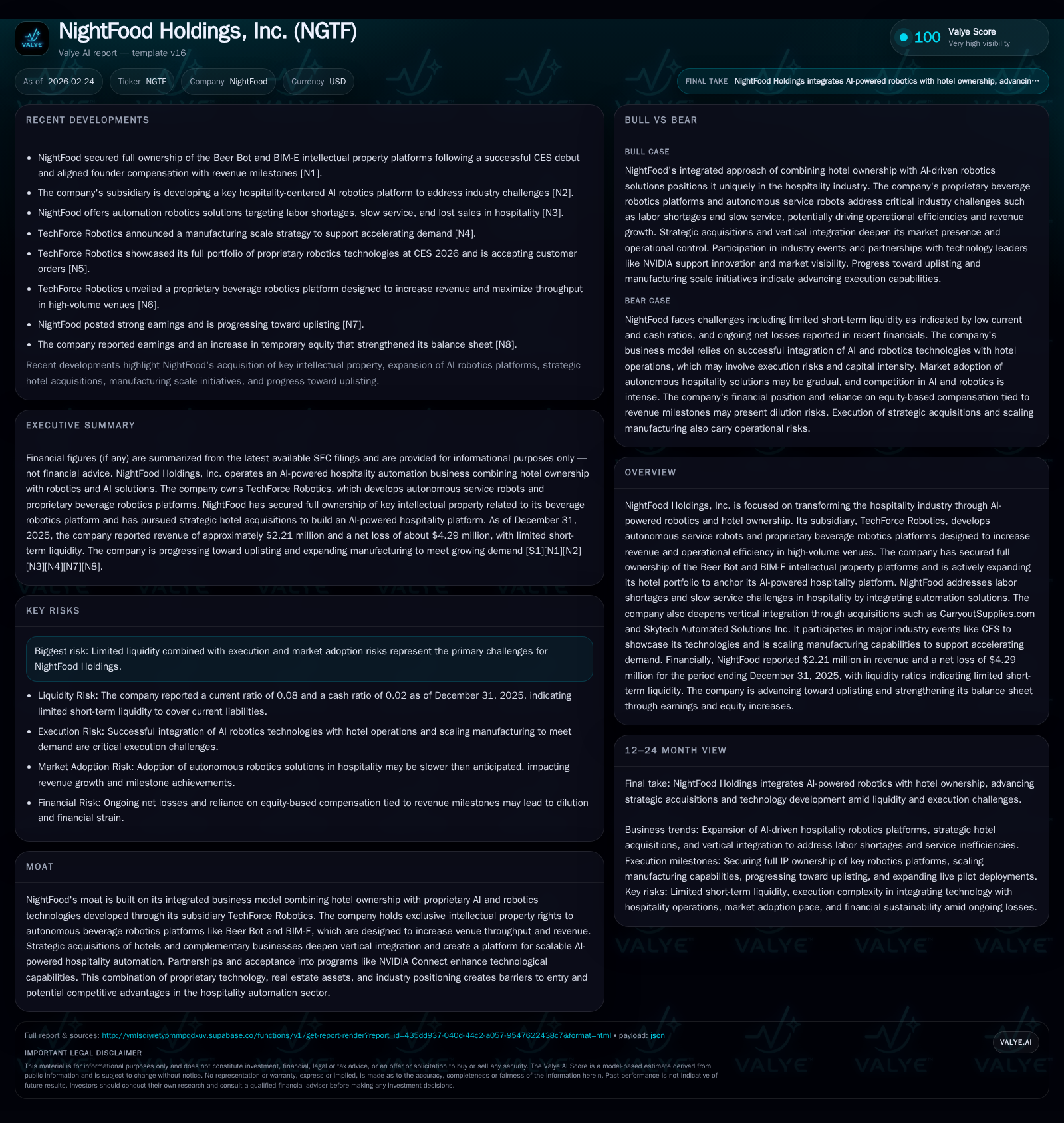
NightFood Holdings operates a hybrid business model combining autonomous beverage robotics development through its subsidiary TechForce Robotics with active hotel portfolio expansion. The company’s rapid revenue growth in recent years reflects increasing market acceptance, particularly after the successful CES 2026 showcase and acquisition of full IP rights to platforms like BIM-E and Beer Bot. However, NightFood contends with severe liquidity pressures, deeply negative earnings, and negative equity, underscoring execution and financing risks. Continued scale of robot deployments alongside hotel acquisitions aims to create a vertically integrated AI-powered hospitality platform addressing labor shortages and throughput bottlenecks.
Revenue and Profitability Evolution: Tracing NightFood’s Financial Trajectory
NightFood Holdings has experienced dramatic top-line growth in the past few fiscal years. Revenues expanded from $133K in FY2023 to $482K in FY2025 (ending June), representing more than a threefold increase (~260%) over two years, signaling early-market traction for its AI-driven hospitality robotics solutions. Including the latest partial-year figure for FY2025 of roughly $2.2 million by calendar year-end indicates accelerated revenue growth—to an estimated ~440% YoY increase compared with prior fiscal periods [F1].
Yet, this growth accompanies sharply widening losses: operating income deteriorated from -$1.8 million in FY2023 to nearly -$4.5 million in FY2025 (June year-end), while net losses deepened from -$5.7 million to almost -$8.1 million over the same period [F1]. Operating cash flow trends similarly worsened, indicating persistent negative cash generation with a CFO of -$1.6 million in FY2025 versus -$2 million two years prior.
This financial trajectory underscores the substantial upfront investment NightFood is making in R&D, go-to-market scaling, manufacturing build-out, and extending hotel operations premises necessary for its unique automation platform. Loss widening reflects fixed cost absorption challenges common in early-stage tech-integrated hospitality ventures.
Historical performance (annual)
| FY | Rev ($) | Net ($mm) | CFO ($mm) | OpInc ($mm) | Rev YoY | Net YoY |
|---|---|---|---|---|---|---|
| 2025 | 482285 | -8 | -2 | -5 | +440.2% | -150.8% |
| 2024 | 89272 | -3 | -1 | -1 | -33.1% | +43.7% |
| 2023 | 133456 | -6 | -1 | -2 | -69.9% | -127.9% |
| 2022 | 443538 | -3 | -2 | -2 |
Note: Omitted columns lack sufficient annual XBRL coverage in the provided tags (need ≥2 annual points): Capex, Div, Buybacks, FCF. Source: SEC companyfacts cache [F1].
Capital returns and efficiency (annual)
| FY | ROE% |
|---|---|
| 2025 | 46.8 |
| 2024 | 94.2 |
| 2023 | 328.3 |
| 2022 | -950.1 |
Source: SEC companyfacts cache [F1].
Note: Certain capex data only available for FY2025 end.
Harnessing Proprietary Robotics: BIM-E and Beer Bot as Growth Drivers
A cornerstone of NightFood’s strategy is owning critical intellectual property that underpins its AI-driven automation edge within high-throughput hospitality environments. The company secured exclusive rights to Beer Bot—a pioneering autonomous beverage dispensing system—and subsequently expanded this technology into the integrated robotic platform branded BIM-E (Beverages In Motion - Everywhere). After serving more than 5,000 drinks during CES 2026 showcases [N5], NightFood completed full IP ownership through a strategic asset purchase agreement [N1][S23], positioning them to capitalize on venue throughput acceleration.
These robots address two core operational bottlenecks: slow service delivery due to workforce shortages and lost sales opportunities during peak demand windows within complex service workflows requiring precise timing and volume dispensing capacity [N4]. By deploying these automated beverage solutions alongside autonomous logistics bots such as TIM-E designed for intra-venue inventory transport [N3], the company enhances overall service speed and consistency—key performance indicators highly valued by high-traffic venues such as hotels and convention centers.
The robotics technology deployment increases revenue per outlet by both elevating order fulfillment speed and reducing labor reliance during critical periods—enhancing margin potential even when factoring incremental amortization costs associated with capitalized IP development.
Hotel Portfolio Expansion: Anchoring the AI-powered Hospitality Platform
NightFood's approach integrates proprietary automation technology with ownership of physical hospitality real estate assets—a form of vertical integration designed to overcome last-mile deployment challenges commonly seen when tech companies provide hardware as a standalone solution.
The company is actively expanding its hotel portfolio to create controlled environments where AI-powered service robots can be fully optimized without traditional venue operator resistance . This strategy ensures direct control over real-world interfaces for robotics deployment including customer experience variables and back-of-house workflow integration.
Owning these venues also provides diversified revenue streams beyond licensing or SaaS-style arrangements typical of pure-play robotics firms—mitigating some end-market adoption risks while allowing experimentation with both hardware/software innovations and operational models at scale.
Recent Milestones: Full Ownership of IP and CES 2026 Showcase Impact
Key recent achievements highlight validation points along NightFood’s growth curve. The successful public demonstration at CES 2026 saw BIM-E serve over 5,000 drinks live—signaling robust prototype readiness and positive market reception within one of the industry's most visible innovation portals [N5][S14]. Shortly thereafter, NightFood’s TechForce Robotics secured full intellectual property rights related to both Beer Bot and its evolved BIM-E system via an asset purchase finalized in February 2026 [N1][S23].
This decisive consolidation of technology ownership is paired with retention of original inventors on staff via performance-linked compensation agreements aligned with incremental TTM revenue milestones—creating incentives tied directly to commercial scaling success [S21]. Such milestones are structured around equity-linked awards that could materially affect future dilution but align management on revenue acceleration achievement.
Presence at CES coupled with exclusive IP control amplify competitive moats by raising barriers to entry through technical complexity combined with locked-in human capital expertise.
Capital Structure and Liquidity: Navigating Financial Constraints
NightFood’s balance sheet reveals acute financial constraints accentuated by summary liquidity metrics signaling significant short-term stress. As of December 31st, 2025 data shows current liabilities approximately totaling $21.75 million against current assets near $1.65 million—translating to an alarmingly low current ratio around 0.08 [F1]. This imbalance points to imminent refinancing needs or further capital raises to sustain operations without material covenant breaches or insolvency risk.
The company tapped senior secured promissory notes amounting to $1.175 million at a costly annual interest rate of 15%, reflecting price pressure typical in funding constrained high-risk ventures [S5][S6]. Convertible debt instruments offering conversion at a discount or market price introduce dilution risk contingent on achieving share price thresholds.
Numerous amendments to security agreements indicate ongoing adjustments intended to accommodate this layered debt structure including pledges over subsidiaries and key assets [S7][S11]. The capital structure's complexity suggests heightened refinancing burden challenging given limited operational cash flow contributions presently.
ROE, Cash Flows, and Capital Allocation: Assessing Returns Without Dividend or Buyback Signals
Due principally to wide operating losses compounded by substantial non-operating expenses possibly including financing costs from convertible notes issuances or amortized IP costs,[F1] net income remains deeply negative (-$8.1 million FY2025). Coupled with shareholders’ equity eroding into negative territory (~-$17 million), ROE calculations become effectively uninterpretable as conventional profitability ratios cease relevance under negative equity conditions.
Operating cash flow stands negative at approximately -$1.63 million annually while capital expenditure remains modest at roughly $0.2 million—yielding a negative free cash flow near $1.83 million indicative of ongoing net cash burn despite investment moderation.
No dividends or share repurchase transactions have been disclosed in filings through early 2026 consistent with corporate priorities focused on reinvesting all available capital towards technology advancement and scaling hotel acquisition/operations rather than shareholder distributions [S20][S21][S25].
Outlook and Growth Barriers: Execution Risk Amid Market Adoption Challenges
While robust technology demonstrations at industry-leading events bolster credibility,[N4] NightFood faces substantial hurdles converting proof-of-concept into commercial scale usage across diverse hospitality venues historically slow to adopt novel automation solutions due to conservative operational cultures and variable economic sensitivity.
Execution risk also stems from integrating AI robotics across multiple units spanning autonomous drink dispensing through broader service logistics delivered by hotel-owned assets—entailing complex software-hardware interoperability challenges alongside workforce retraining requirements.
Moreover market adoption curves emphasize time lags between introduction cycles and widespread acceptance; extant labor shortage dynamics provide tailwinds but competition from legacy staffing solutions remains entrenched.
Absent explicit near-term revenue guidance or detailed rollout schedules, progress on robot deployment scale-ups combined with measured increases in owned hotel properties will serve as critical barometers tracking pathway viability going forward.
Key Metrics to Monitor: What Investors Should Watch Next
Given the overlay of technological ambition married with strained liquidity positions, several KPIs warrant vigilant observation:
- Rate of new autonomous robot installations across existing hotels reflecting practical uptake velocity.[N3]
- Achievement of incremental trailing twelve-month revenue milestones triggering equity-linked awards under the recent IP acquisition compensation scheme.[S21]
- Changes in liquidity ratios including current ratio fluctuations evidencing balance sheet stabilization or deterioration.[F1]
- Debt maturity profiles plus any amendments or new fundraising efforts highlighting refinancing capacity.[S11]
- Progression on vertical integration via hotel acquisitions benchmarked against automation deployment timelines.
- Potential regulatory or litigation developments remain minimal currently but require monitoring given novel tech application scope.[S4]
- Partnerships such as NVIDIA Connect program involvement enhancing AI platform capabilities.
In sum, NightFood’s evolution hinges on synchronized success along several axes—technology robustness validated through demonstrations; securing efficient working capital amid leveraged balance sheets; gaining traction via integrated hotel venues; and finally translating early-stage investments into scalable profit centers addressing endemic sector labor shortages.
Disclaimer: This analysis is provided solely for informational purposes based on publicly available documents without any investment advice or recommendation regarding NightFood Holdings' securities.
Disclaimer: This is research-only, informational analysis and not investment advice. It may include AI-generated interpretation and general industry context. Always verify important details using primary sources.

Comments