
eXp World Holdings’ Struggle to Sustain Profitability in a Cooling Housing Market
Macroeconomic challenges and antitrust settlements weigh on eXp’s revenue growth and profit margins amid strategic capital deployment decisions.
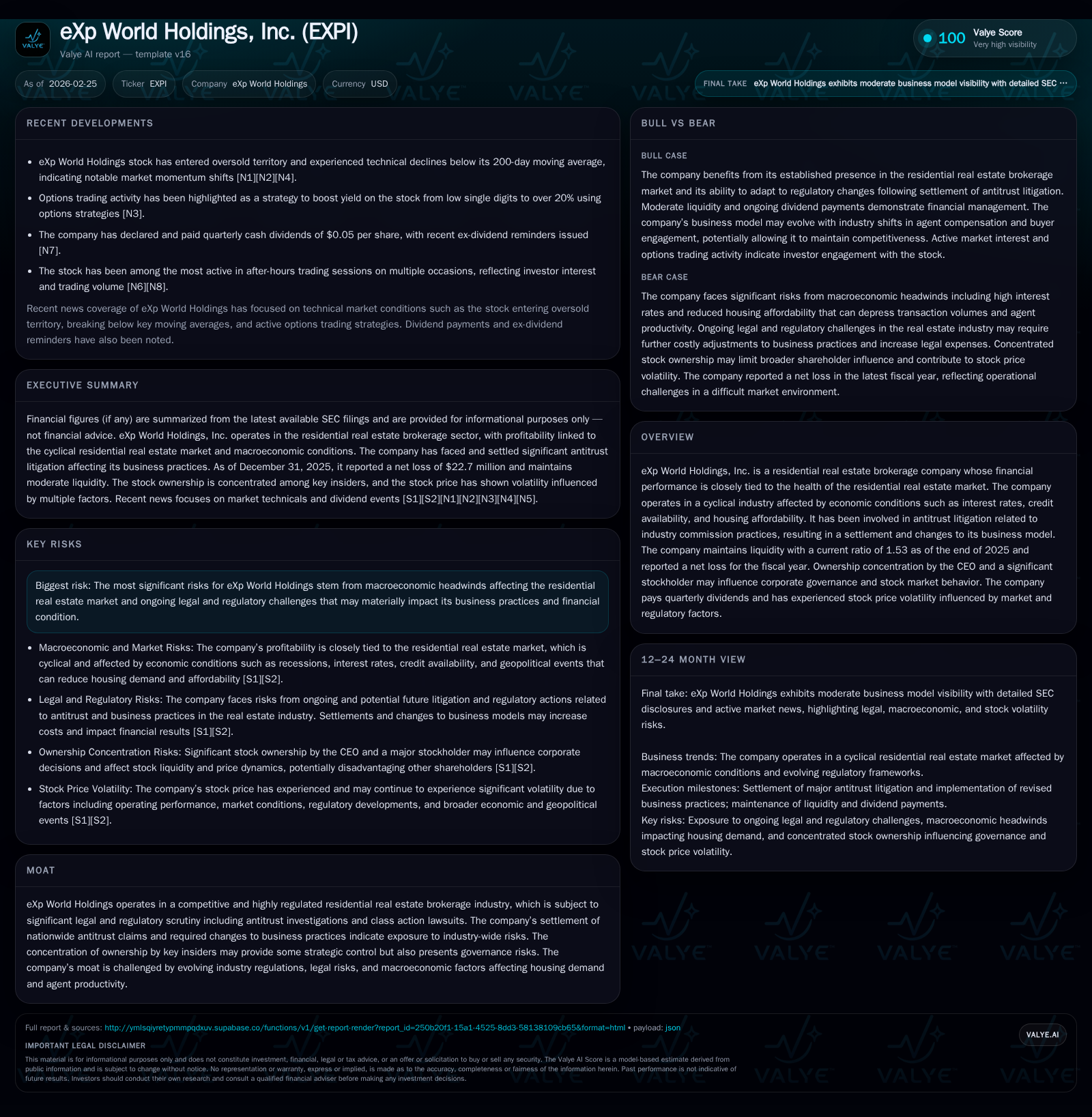
eXp World Holdings, Inc. experienced rapid revenue growth through the late 2010s, fueled by expanding market share in residential real estate brokerage. However, beginning in 2022, the company saw its profitability erode due to shrinking commission structures mandated by antitrust settlements and a downturn in housing market activity linked to rising interest rates and affordability issues. Despite net losses over the past several years, eXp has maintained strong operating cash flow and pursued shareholder returns via dividends and buybacks. Insider ownership concentration adds another layer influencing governance as the company navigates a challenging macro and regulatory environment with uncertain near-term growth catalysts.
Historic Growth Accelerated by Market Expansion but Hampered by Emerging Pressures
eXp World Holdings transformed from a niche player to a significant force in residential brokerage during FY2015–FY2018. Revenues exploded from $22.9 million to over $500 million in this period—an extraordinary compound annual growth rate exceeding 100%, propelled by rapid onboarding of agents leveraging its virtual brokerage platform. This penetration coincided with a broadly rising U.S. housing market and low interest rates that catalyzed buying appetite [F1]. During this era, the company transitioned from modest losses toward positive operating income peaks around FY2022.
However, post-2021 trends reveal a distinct inflection: revenue growth slowed sharply while operating income flipped negative sustainedly into FY2025 with a $21.5 million loss. This reversal aligns with factors squeezing commission income per transaction including evolving regulatory oversight, as well as decelerating transaction velocity amid macro headwinds affecting buyer enthusiasm [F1][S2]. Agent productivity metrics—key drivers behind eXp's top-line—have shown pressure as buyers delay or pause purchases amid affordability cycles. This dynamic signals that the company’s earlier growth engines face serious drag just as competitive intensity remains high.
Historical performance (annual)
| FY | Net ($mm) | CFO ($mm) | OpInc ($mm) | Capex ($mm) | Net YoY |
|---|---|---|---|---|---|
| 2025 | -23 | 119 | -21 | 10 | -6.8% |
| 2024 | -21 | 192 | -19 | 6 | -137.0% |
| 2023 | -9 | 209 | -16 | 5 | -158.1% |
| 2022 | 15 | 211 | 5 | 12 |
Note: Omitted columns lack sufficient annual XBRL coverage in the provided tags (need ≥2 annual points): Rev. Source: SEC companyfacts cache [F1].
Capital returns and efficiency (annual)
| FY | Div ($mm) | Buybacks ($mm) | FCF ($mm) |
|---|---|---|---|
| 2025 | 31 | 56 | 109 |
| 2024 | 30 | 141 | 185 |
| 2023 | 29 | 161 | 204 |
| 2022 | 25 | 179 | 198 |
Source: SEC companyfacts cache [F1].
Note: Revenue figures post-2018 annual are not specified directly; analysis based on related available metrics and filings.
Antitrust Litigation Settlement: Transforming Business Practices and Risk Profile
In recent years, eXp’s business model endured material constraints following the settlement of nationwide antitrust claims targeting industry-wide commission practices [S1][S2]. The legal challenge centered on allegations that traditional brokerage commission splits unduly restrained competition—practices which eXp had leveraged for rapid agent recruitment and high-margin proceeds.
The settlement mandated eXp modify its commission structures enhancing transparency and introducing less restrictive splits that raised compliance burdens while compressing gross margins on sales transactions—the core revenue mechanism for brokerages like eXp [S2]. These changes reversed prior tailwinds where eXp had enjoyed outsized profitability via highly optimized agent commission agreements facilitated by its cloud-based platform.
Rising regulatory scrutiny effectively narrowed eXp’s moat by forcing structural cost increases alongside expanded disclosure requirements that create friction relative to less regulated competitors or alternative service models within real estate tech platforms.
Macroeconomic Factors Reshaping Buyer Demand and Transaction Volumes
Compounding legal headwinds are significant macroeconomic shifts across U.S housing markets impacting buyer behavior—a primary driver of brokerage transaction volumes and therefore commission generation [S2]. Persistent high mortgage interest rates elevated monthly ownership costs; this eroded home affordability metrics crucial for first-time buyers and leveraged trades alike.
Consequently, housing inventory accumulation has emerged regionally owing to listing upticks outpacing qualified buyer participation, creating longer average selling cycles and slower turnover velocity across many submarkets [S2]. This disrupts standard buy-sell spreads critical to broker compensation frameworks reliant on brisk transactional throughput.
For eXp’s largely virtual agent base dependent on volume scalability rather than localized premium pricing strategies, these conditions translate into multi-dimensional pressure points: lower volumes mean decreased total commissions despite steady agent counts; slower sales cycles reduce commission velocity; and prolonged listings depress average prices negotiated.
Financial Performance: Revenues, Operating Losses, and Cash Flow Trends
The financial trajectory underscores these thematic headwinds: operating losses grew consistently from a positive $5.4 million in FY2022 to a negative $21.5 million in FY2025 [F1]. Net income trended downward more steeply—from $15.4 million profit in FY2022 plunging into a roughly $22.7 million loss last fiscal year—reflecting both margin erosion driven by regulatory resets plus softer top-line realizations.
Notably though, operating cash flow remains strong despite bottom-line declines—$118.6 million CFO achieved in FY2025 illustrates resilient core cash generation capability likely supported by recurring revenue streams including technology platform fees or cross-selling ancillary services beyond pure brokerage commissions [F1]. Capital expenditures fluctuated but remained moderate relative to cash flow (~$9.6 million capex last year), signaling measured reinvestment focused on sustaining platform infrastructure rather than aggressive expansion.
ROE performance contraction—to approximately -9.4% for FY2025—reflects deteriorating profitability balanced against an equity base that held reasonably stable near $243 million, limiting investor returns amid ongoing losses [F1].
Capital Allocation Approach: Stock Buybacks, Dividends, and Cash Reserves
Amid persistent net losses since FY2023, eXp has nonetheless prioritized shareholder distributions—paying consistent quarterly dividends totaling over $30 million annually most recently alongside meaningful share repurchases ($56 million in FY2025) demonstrating strategic intent to support stock price amid volatility [F1]. Return of capital commitment amid negative earnings suggests management confidence in future recovery or liquidity preference given current market valuations.
Substantial cash reserves ($124 million at end-2025) underpin this capacity to execute buybacks without immediate liquidity strain—current ratio at a healthy 1.53 further reflects solid short-term financial standing providing flexibility against near-term cyclical volatility or unexpected regulatory costs [F1][S2].
The buyback program size relative to market capitalization situates capital deployment as tactical rather than transformative; absent explicit forward guidance revisions disclosed post-settlement period implies cautious stewardship amidst uncertain near-term macro backdrop.
Ownership Concentration and Governance Dynamics in Strategic Decisions
eXp’s governance structure continues marked insider influence with CEO Glenn Sanford holding significant stock position alongside other major holders per recent filings [S2]. Such ownership concentration affords strategic control optimizing alignment for long-term vision execution but simultaneously concentrates risk especially aligning with ongoing regulatory exposures stemming from legal settlements imposing operational transformation demands.
This dual-edged insider dominance may expedite decision-making capacity yet raises investor scrutiny particularly if governance mechanisms limit minority holder protections during periods of financial distress or heightened legal uncertainty resembling dynamics common within sector peers facing analogous class action litigations.
Outlook: Monitoring Market Cycles, Regulatory Impacts, and Operating Leverage
Looking ahead requires vigilance on pivotal factors shaping eXp’s capacity to regain profitable trajectories:
- Transaction Volume Trends: Stabilization or recovery would alleviate margin compression risks inherent to lower commission pools caused by decreased sales activity [N1][N2].
- Mortgage Rate Movements: A meaningful easing could reinvigorate affordability metrics critical for buyer pool expansion underpinning brokerage revenues [S3].
- Regulatory Risk Resolution: Absent fresh litigation developments or further mandated reforms could ease compliance cost burdens allowing margin normalization post-settlement integration phase [S1][S3].
- Operating Leverage Management: How effectively eXp leverages fixed platform costs versus variable agent productivity gains will determine sustainable profit margins amid cyclical fluctuations.
Without explicit company-provided forecasts currently available publically, these indicators serve as directional monitoring touchstones aiding stakeholders’ assessments rather than definitive prognoses.
Disclaimer: This analysis is based solely on publicly available data including SEC filings and recent news reports as of February 25, 2026 ([F1], [S1]-[S3], [N1]-[N2]). It does not constitute investment advice or recommendations.
Disclaimer: This is research-only, informational analysis and not investment advice. It may include AI-generated interpretation and general industry context. Always verify important details using primary sources.

Comments