
Old Dominion Freight Line Navigates Growth Limits Amid Cost and Capacity Challenges
ODFL sustains strong profitability through operational scale while facing growth headwinds from real estate constraints, labor shortages, and equipment supply issues.
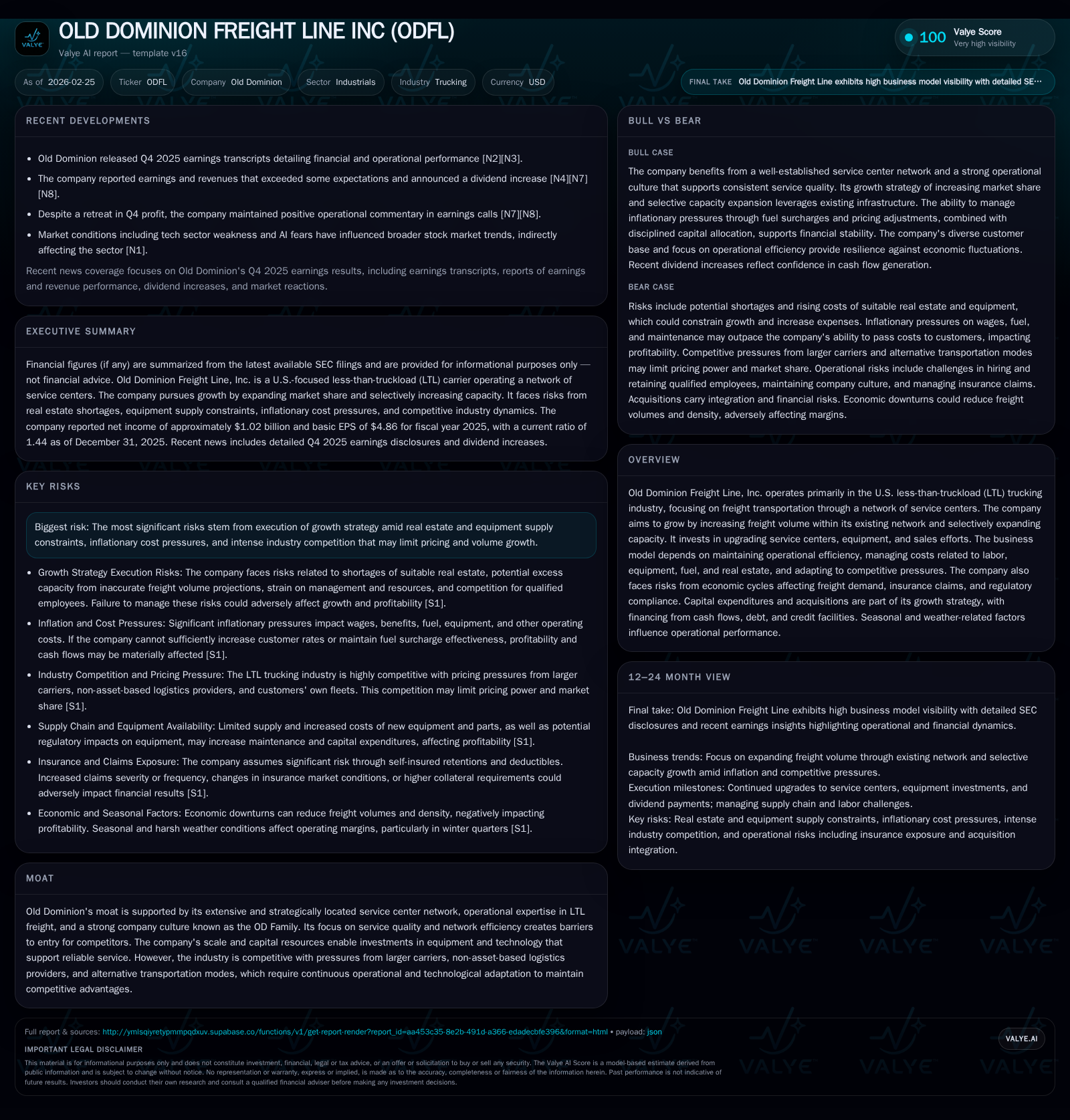
Old Dominion Freight Line (ODFL), a prominent US less-than-truckload (LTL) carrier, continues to deliver solid profitability driven by an efficient service center network. In 2025, operating income reached $1.36 billion despite an 11.8% year-over-year decline reflecting inflationary pressures and volume softness. The company’s growth strategy centers on expanding freight volumes within existing hubs and selective capacity additions, yet challenges such as real estate scarcity, labor market tightness, and equipment cost inflation persist. ODFL maintains disciplined capital allocation with robust free cash flow supporting increased dividends and substantial share repurchases. Key investor considerations include freight volume trends, fuel surcharge effectiveness, regulatory compliance costs, and labor market developments. Financial returns remain healthy with a roughly 24% return on equity in 2025 [F1][S1].
Historical Performance Overview
Old Dominion Freight Line has established itself as a leading U.S. less-than-truckload (LTL) carrier with a strategically distributed network of service centers designed to optimize freight density and delivery reliability [S27].
The company’s operating income peaked at approximately $1.84 billion in FY2022 but declined steadily over the next three years to $1.36 billion in FY2025—a decrease of roughly 11.8% year-over-year compared to FY2024 levels [F1]. Correspondingly, net income fell by 13.7% to just over $1 billion in FY2025 during margin compression driven by inflationary cost pressures and moderating shipment volumes.
Operating cash flow also reflected these trends, dropping by about 17.4% from FY2024 to FY2025. However, capital expenditures were curtailed substantially—from around $770 million annually down to $415 million—indicating a more cautious investment posture aligned with measured growth expectations [F1]. This resulted in an estimated free cash flow of approximately $955 million for the fiscal year.
Return on equity remains robust at about 24%, supported by net income generation relative to shareholders’ equity exceeding $4.3 billion as of December 31, 2025 [F1]. This demonstrates efficient capital deployment despite cyclical headwinds.
Historical performance (annual)
| FY | Net ($mm) | CFO ($mm) | OpInc ($mm) | Capex ($mm) | Net YoY |
|---|---|---|---|---|---|
| 2025 | 1024 | 1370 | 1361 | 415 | -13.7% |
| 2024 | 1186 | 1659 | 1544 | 771 | -4.3% |
| 2023 | 1240 | 1569 | 1641 | 757 | -10.0% |
| 2022 | 1377 | 1692 | 1841 | 775 |
Note: Omitted columns lack sufficient annual XBRL coverage in the provided tags (need ≥2 annual points): Rev. Source: SEC companyfacts cache [F1].
Capital returns and efficiency (annual)
| FY | Div ($mm) | Buybacks ($mm) | FCF ($mm) |
|---|---|---|---|
| 2025 | 236 | 730 | 955 |
| 2024 | 224 | 967 | 888 |
| 2023 | 175 | 454 | 812 |
| 2022 | 134 | 1277 | 916 |
Source: SEC companyfacts cache [F1].
Note: Revenue data is not available from the provided tags; table excludes metrics without sufficient data.
Business Model and Competitive Positioning
ODFL operates predominantly within the U.S LTL segment characterized by high fixed costs, regulatory complexity, and customer demand for rapid deliveries at competitive prices.
The company’s competitive moat derives from its extensive network of service centers nationwide enabling high freight density and reliable transit times uncommon among smaller carriers [S27][S6]. The "OD Family" culture fosters employee loyalty and operational discipline supporting service quality.
Continuous investments include upgrading service centers, modernizing fleet equipment—including adapting to evolving emissions regulations—and deploying advanced IT systems for routing optimization [S20][S22].
Competition remains intense from larger asset-based carriers with broader geographic reach as well as non-asset logistics providers leveraging digital platforms; maintaining pricing power while managing inflationary cost pressures is critical for customer retention [S6][S12].
Growth Strategy and Risks
ODFL aims to grow primarily by increasing freight volumes within its existing network footprint complemented by selective expansion of capacity through new or enhanced service centers and potential acquisitions [S18][N1].
Key execution risks include:
- Real estate constraints: Limited availability of suitable sites may cause congestion at key hubs elevating operating expenses [S14].
- Equipment supply: Inflationary cost increases combined with constrained availability challenge fleet renewal and expansion plans [S8][S24].
- Labor shortages: Difficulty attracting and retaining qualified drivers and technicians amid industry-wide scarcity raises wage costs and can reduce operational efficiency during training periods [S29][S25].
- Regulatory compliance: Costs related to environmental regulations, FMCSA safety initiatives like CSA scores, escalating healthcare benefits costs, and insurance claims add financial pressure [S4][S7][S13].
- Macroeconomic fluctuations: Economic downturns reduce shipment volumes impacting freight density; customers may shift to alternative modes or consolidate carriers applying downward pricing pressure [S14][S19].
These factors collectively limit near-term top-line growth despite incremental gains pursued through service improvements.
Outlook & Key Monitoring Points
While explicit guidance for fiscal year 2026 was not provided during recent earnings commentary, management highlighted key metrics including freight volume growth within existing hubs, fuel surcharge recovery amidst diesel price volatility, labor market conditions influencing driver turnover rates, and timely completion of capacity expansions as critical indicators going forward [N1][N3]. Investors should watch:
- Trends in LTL shipment volumes aligned with economic activity.
- Pricing model adjustments addressing inflationary cost recovery.
- Progress on fleet modernization vis-à-vis regulatory timelines.
- Any material acquisitions affecting scale or margins.
- Maintenance cost trends influenced by technician availability.
Capital Allocation & Financial Returns
ODFL maintains disciplined capital allocation focused on shareholder returns supported by strong cash flow generation despite earnings moderation [F1]. The significant reduction in capital expenditures in FY2025 reflects cautious investment aligned with capacity constraints.
Robust free cash flow facilitated increased dividends totaling approximately $236 million alongside substantial share repurchases exceeding $730 million—demonstrating commitment to returning excess capital amid limited reinvestment opportunities consistent with measured growth expectations [F1][N3][S26].
Return on equity remains attractive at roughly 24%, indicating efficient use of equity capital despite cyclical pressures impacting revenue growth.
Industry Context & Challenges
The LTL trucking industry faces ongoing challenges balancing rapid delivery demands against rising regulatory scrutiny concerning safety standards and environmental compliance requiring continuous capital investment cycles often constrained by supply bottlenecks . Labor shortages particularly among commercial drivers impose structural wage inflation compressing margins unless offset through pricing or productivity gains.
Fuel price volatility further complicates margin management since fuel surcharge recoveries lag actual cost changes; empty miles inherent in hub-and-spoke networks exacerbate exposure during spikes . Additionally, growing e-commerce demand variability coupled with strategic logistics investments from large platforms intensifies competition.
Conclusion
Old Dominion Freight Line exhibits solid operational strength underpinned by a broad service network coupled with prudent financial stewardship enabling sustained profitability amid challenging external conditions.
Constraints including real estate scarcity limiting capacity expansion, labor market tightness driving wage inflation, supply chain bottlenecks elevating equipment costs, regulatory compliance expenses increasing indirect costs, plus macroeconomic uncertainties curbing volume growth temper near-term outlooks.
The company’s ability to sustain strong free cash flow supports steady returns through dividends and buybacks; success hinges on navigating cost inflation via effective pricing strategies such as fuel surcharges while preserving its distinctive "OD Family" culture critical for employee retention.
Investors should monitor developments around capacity expansion progress, freight density reflecting demand resilience, regulatory impacts especially regarding emissions mandates, and execution risks related to potential acquisitions.
This analysis is based exclusively on publicly available information as of February 25th, 2026 from Old Dominion Freight Line’s SEC filings ([F1],[S#]) and recent earnings releases ([N#]). No investment advice or recommendations are provided herein.
Disclaimer: This is research-only, informational analysis and not investment advice. It may include AI-generated interpretation and general industry context. Always verify important details using primary sources.

Comments