
UBS Group AG Charts Post-Merger Profit and Capital Trajectory
UBS's financial evolution post-Credit Suisse merger showcases robust profit recovery and strategic capital deployment shaping its global wealth management leadership.
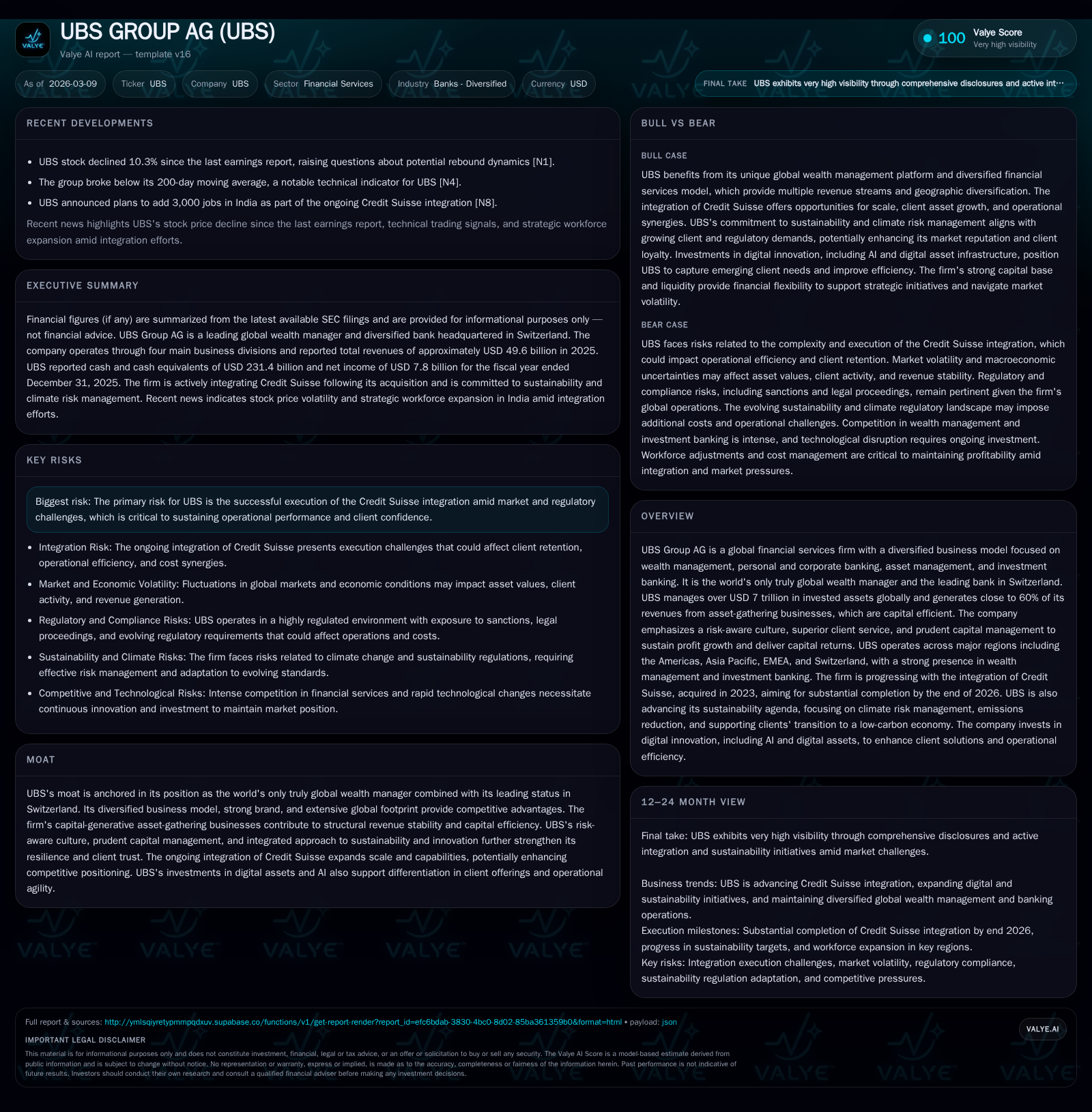
UBS Group AG has demonstrated solid growth momentum extending from its diversified business model into a post-merger era characterized by integration complexities and expanding scale. The Credit Suisse acquisition significantly boosted net income by over 50% year-over-year in 2025 and expanded the firm’s asset base beyond USD 7 trillion invested assets globally. Capital allocation reflects a disciplined approach balancing dividends, share repurchases, and regulatory capital requirements amid restructuring costs and emerging regulatory scrutiny. Going forward, operability risks tied to integration execution remain a key watch point as UBS navigates market dynamics and intensifies its wealth management dominance.
Historical Financial Performance and Key Growth Drivers
From fiscal year (FY) 2019 through FY 2021, UBS's revenues showed consistent expansion within a diversified financial services platform, rising from approximately USD 29 billion to over USD 35 billion per the latest XBRL data[F1]. This growth reflected favorable industry trends supporting wealth management services—a segment accounting for a substantial portion of UBS's revenue—and steady operating income progression.
Following the mid-2024 acquisition of Credit Suisse, UBS's consolidated revenues increased markedly to about USD 49.6 billion by end-2025 as detailed in segment disclosures[S4]. This uplift was driven by expanded client assets under management—exceeding USD 7 trillion globally—and synergies across investment banking units.
Net income followed this recovery, rebounding from approximately USD 5.15 billion in FY2024 to USD 7.8 billion in FY2025, a gain of over 50% year-over-year[F1]. This improvement was supported by cost controls, enhanced risk frameworks, and strong asset-gathering capabilities across regions.
Historical performance (annual)
| FY | Net ($bn) | Net YoY |
|---|---|---|
| 2025 | 7.8 | +51.5% |
| 2024 | 5.1 | -81.5% |
| 2023 | 27.9 | +263.7% |
| 2022 | 7.7 |
Source: SEC companyfacts cache [F1].
Capital returns and efficiency (annual)
| FY | ROE% |
|---|---|
| 2025 | 8.6 |
| 2024 | 6.0 |
| 2023 | 32.2 |
| 2022 | 13.4 |
Source: SEC companyfacts cache [F1].
*FY2024 and FY2025 figures incorporate the Credit Suisse merger impact[F1][S4].
Impact of Credit Suisse Acquisition and Integration Progress
The asset transfer from Credit Suisse completed between May and July of 2024[S7], marking a significant expansion of UBS's wealth management footprint worldwide while augmenting investment banking scale.
Integration challenges include harmonizing operations and embedding reinforced risk oversight given historical differences between the firms[S1]. Hiring initiatives focus on IT infrastructure support notably in India where UBS plans to add around 3,000 employees dedicated to integration-related technology tasks[N12]. Concurrently, workforce reductions have occurred mainly within Non-Core & Legacy divisions.
Regulatory scrutiny has intensified post-merger with ongoing investigations related to compliance matters; smooth integration execution remains essential for maintaining client confidence[S7][N1]. Completion of full operational integration is anticipated near the end of calendar year 2026.
Geographic and Segment Revenue Breakdown for FY25
Global Wealth Management led revenues at approximately USD 26 billion in FY25, up from around USD24.5 billion in FY24 with broad regional contributions: Americas (USD12.2B), Asia Pacific (USD4B), EMEA (USD4.9B), Switzerland (USD4.2B)[S4]. Personal & Corporate Banking revenues were concentrated in Switzerland at about USD9.2 billion.
Asset Management revenues remained stable near USD3.2 billion while Investment Banking grew from roughly USD10.9 billion to about USD12.3 billion benefiting from enhanced market share after the merger.
UBS attributes geographic revenue based on client domicile for wealth management and on risk management location for trading revenues consistent with internal performance evaluation[S4]. Cross-divisional collaboration between wealth management and investment banking is positioned as a growth driver.
Profitability Restoration: Net Income and Return on Equity
After integration-related cost phases especially around FY23, net income rebounded sharply by over half year-over-year reaching USD7.8 billion in FY25[F1]. Operational efficiencies combined with strong asset gathering have strengthened profitability beyond transactional business lines.
Return on equity stood at about an estimated average near 8.6%, reflecting prudent capital use policies balancing growth with regulatory capital requirements[F1]. These metrics indicate a restored path toward sustainable capital returns contingent on successful merger execution.
Capital Allocation: Dividends, Share Repurchases, and Capital Adequacy
UBS follows Swiss legal requirements mandating retention of at least five percent of annual net profits as statutory retained earnings until certain equity thresholds are met[S16]. Dividends have been maintained alongside substantial share repurchase programs under authorized schemes which included cancelling shares valued at approximately USD1.1 billion impacting shareholders’ equity classification but preserving overall equity value[S16][S20][F1].
Liquidity coverage ratios remain robust supporting UBS’s status as a global systemically important bank managing balance sheet risks prudently amid market volatility[S6][S15].
Workforce Evolution Amid Strategic Restructuring
Total full-time equivalent personnel decreased from about 112,842 at end-2023 to roughly 103,177 by end-2025 reflecting cost optimization efforts combined with winding down legacy non-core activities[S1]. Hiring focused on technology-enabled roles critical for integration success especially within India’s operations where approximately an additional three thousand employees were planned[N12][S1].
Emerging Risks: Regulatory Challenges and Integration Execution
Key risks include cybersecurity vulnerabilities, scaling operational complexities, ongoing regulatory investigations related to legacy portfolios acquired via Credit Suisse[S7][N1]. These risks emphasize the importance of governance vigilance throughout the integration phase.
Investor sentiment reflects these challenges with UBS shares trading below important technical levels such as the 200-day moving average signaling volatility despite underlying structural progress[N6][N13].
Growth Outlook: Business Drivers Versus Constraints
While specific guidance is limited beyond milestones toward merger completion expected by end-2026,[N12][S1] UBS highlights areas of focus including expanding asset-gathering streams driven by demographic trends across Americas and Asia Pacific; digital innovation leveraging AI-enhanced platforms; cross-selling synergies linking wealth management with investment banking deal flow; all balanced against restructuring costs and elevated compliance expenditures inherent to large-scale integrations.
These factors suggest moderate near-term growth tempered by cyclical pressures yet anchored on resilient wealth management foundations.
This report synthesizes facts sourced exclusively from current SEC filings ([S#]), company disclosures ([F1]), and reputable news outlets ([N#]) without speculative extrapolation or investment advice.
Disclaimer: This is research-only, informational analysis and not investment advice. It may include AI-generated interpretation and general industry context. Always verify important details using primary sources.

Comments