
UBS AG’s Strategic Evolution Following the Credit Suisse Acquisition
UBS AG leverages its global wealth management leadership and capital discipline to strengthen growth and shareholder value amidst integration challenges and digital innovation.
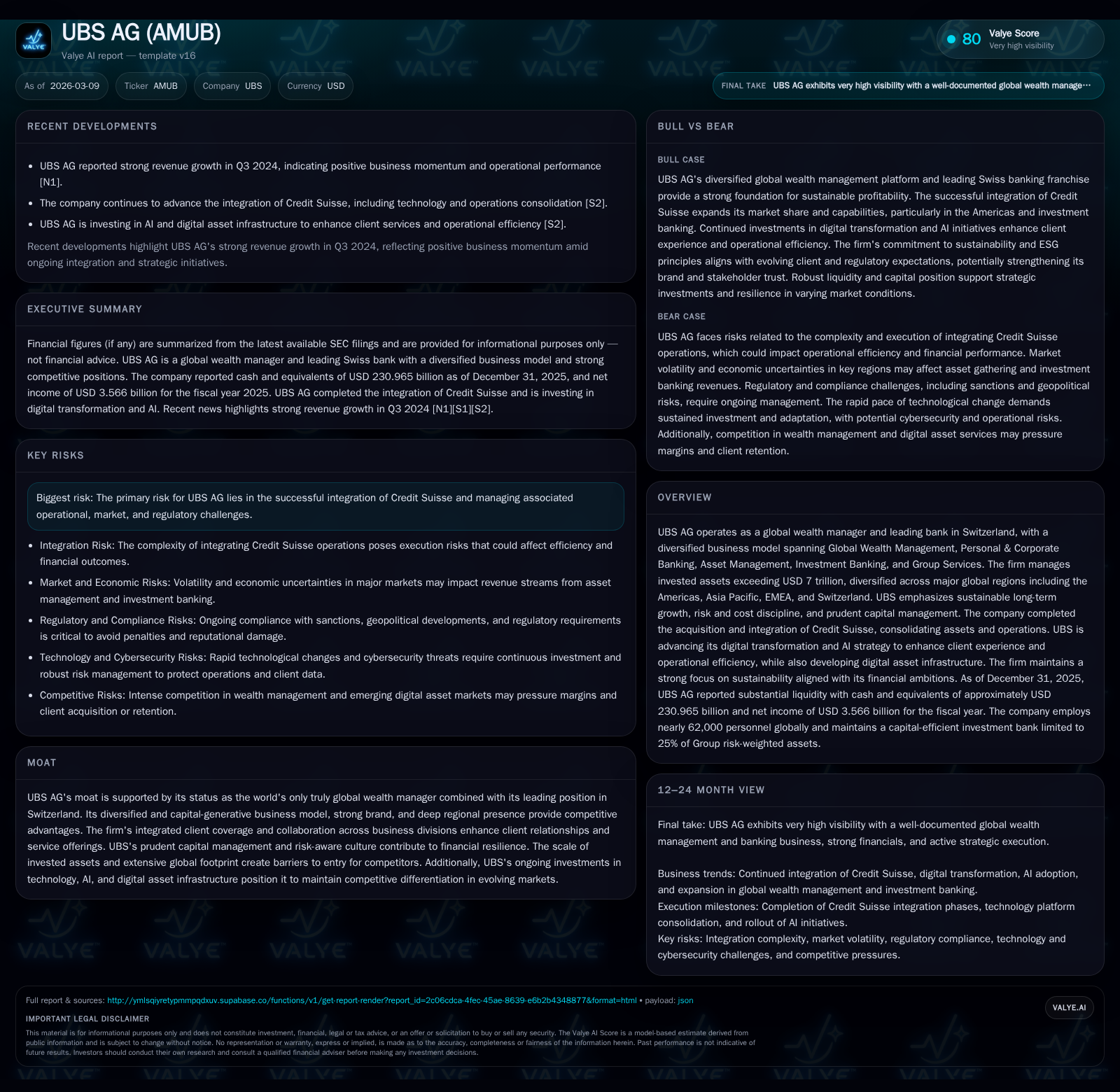
UBS AG delivered robust revenue growth of 25.2% year-over-year reaching $23.8 billion by mid-2025, alongside a doubling of net income to $3.57 billion in 2025, driven by a diversified business model anchored in global wealth management. The integration of Credit Suisse has expanded UBS’s operational scale but introduced notable integration risks, especially in personnel realignment and regulatory scrutiny. Strategic investments in AI and digital asset infrastructure aim to secure a competitive edge while a sustainability strategy aligns with evolving regulatory frameworks. Capital allocation exhibits prudent leverage management with an approximate 4% ROE and a solid cash position underpinning shareholder returns.
Historical Performance Highlights: Growth Drivers and Trends
UBS AG posted impressive financial results for the period leading up to mid-2025, with revenue rising sharply to approximately $23.8 billion—a 25.2% increase compared to the prior year [F1]. This surge marks a meaningful rebound driven largely by its diversified business model that balances several key segments. Net income reflected substantial improvement as well, doubling to $3.57 billion during the full 2025 fiscal year, indicating strong operational execution amid integration efforts [F1].
Personnel data evidences changes consistent with expanding operations post-Credit Suisse acquisition: the consolidated workforce grew from roughly 47,590 full-time equivalents (FTEs) in late 2023 to nearly 61,899 at end-2025 [S1]. Segment-wise headcount growth was uneven; Global Wealth Management increased to about 26,879 FTEs while Non-Core and Legacy segments shrank dramatically from over 1,800 FTEs previously, showcasing deliberate restructuring [S1]. This staffing pattern echoes UBS’s strategic emphasis on its capital generative divisions.
Historical performance (annual)
| FY | Rev ($bn) | Net ($bn) | Rev YoY | Net YoY |
|---|---|---|---|---|
| 2025 | 23.8 | 3.6 | +25.2% | +132.6% |
| 2024 | 19.0 | 1.5 | +9.8% | -53.8% |
| 2023 | 17.3 | 3.3 | -6.6% | |
| 2022 | 18.5 |
Source: SEC companyfacts cache [F1].
Capital returns and efficiency (annual)
| FY | ROE% |
|---|---|
| 2025 | 4.0 |
| 2024 | 1.6 |
| 2023 | 6.0 |
| 2022 |
Source: SEC companyfacts cache [F1].
The table consolidates UBS’s annual financial data emphasizing revenue expansion and net income volatility reflective of strategic structural changes [F1]. The approximate return on equity (ROE) calculated as net income divided by equity stands at about 4% in FY2025 [F1], underlining moderate profitability relative to capital deployed.
The Impact of Credit Suisse Integration on Operations and Financials
The acquisition of Credit Suisse constitutes a transformative event reshaping UBS’s scale and risk profile [N1][S1][S3]. The consolidation delivers significant scale benefits—including increased assets under management surpassing USD7 trillion globally—and expanded access to clients across regions such as Americas, Asia Pacific, EMEA, and Switzerland [S2]. However, this enlargement introduces pronounced integration risks highlighted in UBS’s official filings: complex operational harmonization challenges persist alongside heightened regulatory oversight due to legacy risk exposures inherent in Credit Suisse’s portfolios [S1].
Personnel realignment characterizes one facet of integration risk: significant contraction occurred within Non-Core/Legacy businesses—from roughly 1,804 FTEs at late-2024 to only about 349 FTEs by end-2025—reflecting active wind-down of non-core operations inherited through the acquisition [S1]. In contrast, Group functions headcount also reduced indicating attempts to streamline overhead even as core businesses absorb more resources [S1].
Despite these pressures, UBS maintains disciplined cost control ambitions coupled with proactive risk-awareness embedded within organizational culture [S2]. The balance sheet exhibits conservative leverage positioning while expanding operational complexity demands ongoing focus on compliance and governance.
Global Wealth Management and Diversified Business Model as Core Growth Engines
UBS retains its unique status as the world’s only truly global wealth manager combined with leading Swiss banking operations—a cornerstone moat that supports long-term competitive advantage [S2]. The Global Wealth Management division leads the firm’s headcount distribution at nearly 27,000 employees and anchors client coverage across individuals, institutions, and businesses worldwide [S1][F1].
This diverse yet integrated business model proves capital generative: cross-divisional collaboration enables seamless client servicing fostering share-of-wallet growth opportunities while regional diversification across continents reduces earnings volatility [S2]. Personal & Corporate Banking similarly expanded personnel steadily alongside sustained demand for tailored lending and advisory solutions [S1]. Asset Management provides complementary scale albeit at smaller employee counts reflecting its fund-based efficiency model.
The interplay between wealth management expertise backed by investment banking capabilities further bolsters UBS’s solution spectrum enabling dynamic client engagement strategies leveraging both organic growth levers and acquired scale synergies.
Technology, Digital Asset Infrastructure, and AI Initiatives Shaping the Future
UBS pursues aggressive digital transformation focusing particularly on artificial intelligence integration to optimize both client experience and internal processes [N1][S2]. These AI initiatives target enhanced personalization in wealth advisory services alongside back-office operational efficiency improvements aiming at leaner cost structures.
A notable strategic pillar encompasses development of "digital asset infrastructure," which reflects emerging sector trends around blockchain technology applications including asset tokenization platforms critical for future-proofing wealth management offerings [S2]. This positions UBS favorably amid intensifying fintech competition while demonstrating foresight into evolving asset custody models.
Such technology investments are pivotal not only for sustaining UBS’s moat but also for meeting evolving regulatory expectations regarding transparency, cybersecurity resilience, and innovative compliance frameworks.
Sustainability Strategy Aligned with Financial Ambitions
UBS embeds sustainability deeply within its corporate strategy supported by governance aligned with EU Taxonomy Regulation requirements alongside adherence to Global Reporting Initiative (GRI) standards as outlined in its most recent Sustainability Statement [S2].
The firm’s climate transition plans emphasize risk assessment methodologies addressing low-carbon transition-related impacts across portfolios while steering financing towards environmentally sustainable activities ensuring stakeholder alignment with global carbon reduction ambitions [S2].
Social responsibility efforts complement environmental commitments through human rights respect policies and supply chain scrutiny reflecting holistic ESG governance integrated into decision-making processes fostering long-term corporate resilience alongside financial goals.
Capital Allocation, Returns, and Shareholder Value Creation
At December 31, 2025 UBS reported total debt issuance of approximately $325 billion comprising predominantly unsecured obligations (87%) balanced against shareholders’ equity near $89 billion evidencing moderate leverage consistent with large-scale universal banking models [S3]. Liquidity remains robust backed by cash & equivalents exceeding $230 billion supporting both operational flexibility and capital return potential [F1][S3].
Although the company does not explicitly disclose recent dividend payments or share repurchase programs in provided filings or news releases as of March 2026, cash flow generation capabilities underscore foundation for shareholder distributions should board priorities shift accordingly [F1][S3].
The approximated ROE of about 4% reflects ongoing integration costs diluting immediate profitability but signals steady capital deployment efficiency within an expanded platform amidst market uncertainties [F1]. UBS appears committed to balancing reinvestment in technology innovation alongside calibrated returns enhancing long-term shareholder equity value.
Risks From Integration and Market Conditions: Managing Uncertainties
Integration risk remains the foremost challenge for UBS given complexities associated with merging two large banking entities each carrying substantial legacy risk books—the latter notably tied to Credit Suisse pre-acquisition exposures—and requiring extensive compliance oversight [S1][N1]. Operational disruptions during restructuring cycles may impact service continuity or elevate cost bases temporarily.
Market conditions further complicate risk outlook including volatile macroeconomic factors impinging on wealth management flows or investment banking activities; regulatory shifts intensify scrutiny necessitating fortified governance controls particularly relating to anti-money laundering (AML) protocols post-merger [S1][N1].
UBS’s disclosures emphasize ongoing mitigation efforts via disciplined risk culture embedding regular monitoring frameworks aiming at preserving financial stability whilst advancing merger-related synergies prudently.
Forward-Looking Considerations: Milestones and Areas to Watch
While explicit financial forecasts are limited due to reduced disclosure format filings, several forward-looking indicators emerge from public statements:
- Realization pace of merger synergies influencing cost efficiency metrics,
- Progression of AI-enhanced client experience platforms impacting revenue quality,
- Expansion metrics related to digital asset infrastructure adoption,
- Continued adherence to sustainability targets under evolving EU Taxonomy guidelines,
- Regulatory developments pertaining to post-integration compliance adaptations.
These milestones will be critical for assessing UBS’s ability to sustain profitable growth amid dynamic global financial landscapes; monitoring quarterly updates remains essential given these variables collectively shape strategic execution [N1][S2].
This analysis synthesizes publicly available data without offering investment recommendations or price targets. Investors should consider multiple sources before making decisions.
Disclaimer: This is research-only, informational analysis and not investment advice. It may include AI-generated interpretation and general industry context. Always verify important details using primary sources.

Comments