
Organon & Co. Faces Revenue Pressures and Patent Challenges While Extending Nexplanon Exclusivity
Organon's 2025 financials reflect operational restructuring amid competitive biosimilar markets and regulatory scrutiny.
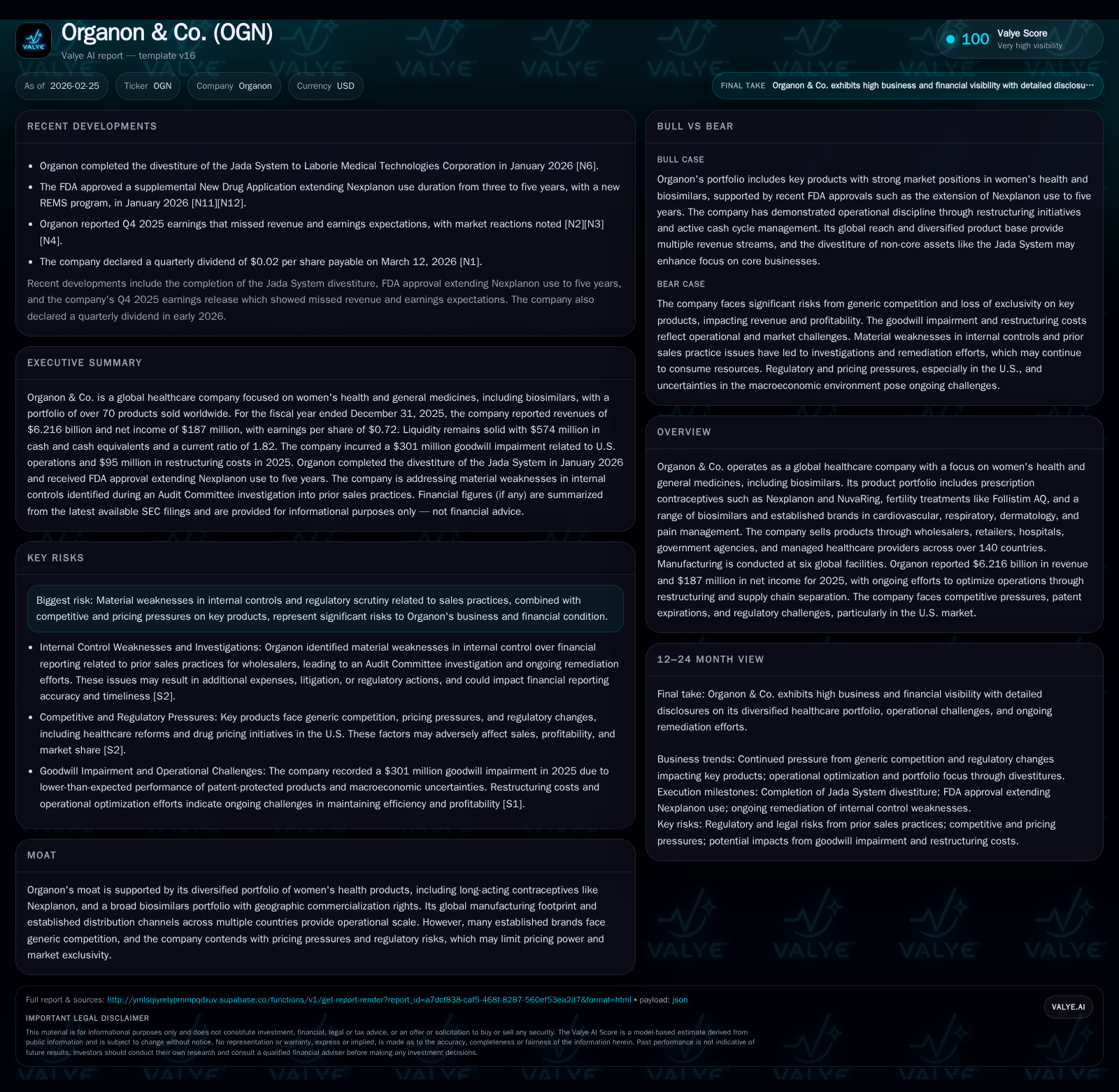
Organon & Co. reported $6.22 billion in revenue for 2025, marking a slight decline from the prior year driven by pricing pressures, patent expirations, and competitive losses in key contraceptive products. The company is pursuing growth through an expanded biosimilars portfolio and regulatory approval extending Nexplanon's use to five years, but ongoing legal and regulatory challenges along with internal control weaknesses present persistent risks. Despite reduced net income and cash flow relative to 2024, Organon continues dividend payments and aims to deleverage substantial debt while optimizing operations globally.
Historical Performance and Revenue Drivers
Organon & Co.'s topline demonstrated modest contraction in 2025 with reported revenues of $6.216 billion representing a 2.9% decrease compared to $6.403 billion in 2024 [F1]. This marks a reversal from the relatively flat growth observed between 2023 ($6.263 billion) and 2024. The deceleration was driven principally by intensified competition and pricing pressures across several product lines, including key women's health products.
The company’s contraceptive portfolio saw mixed dynamics: NuvaRing sales plunged 21% year-over-year owing to both the loss of a major customer contract in the previous year and expanding generic competition despite somewhat favorable discount arrangements within the U.S.[S1]. Marvelon/Mercilon pills experienced a milder decline (~5%), tempered by improved demand trends in Asian markets but offset by decreases regionally such as the Middle East.
Conversely, fertility treatments like Follistim AQ posted solid growth (+11% YOY), supported mainly by U.S. market demand despite headwinds from China that partly negated these gains [S1]. Biosimilars showed bifurcated performance: Hadlima (a biosimilar to Humira) surged by 60%, benefiting from increasing uptake, whereas Renflexis (biosimilar Remicade) revenues contracted by about 8%, reflecting intensified competition and discounting [S1].
The broad established brands segment encompassing cardiovascular, respiratory, dermatology, and pain management continues facing generic erosion as many products have long lost exclusivity [S17].
Historical performance (annual)
| FY | Rev ($bn) | Net ($mm) | CFO ($mm) | Capex ($mm) | Rev YoY | Net YoY |
|---|---|---|---|---|---|---|
| 2025 | 6.2 | 187 | 700 | 162 | -2.9% | -78.4% |
| 2024 | 6.4 | 864 | 939 | 175 | +2.2% | -15.5% |
| 2023 | 6.3 | 1023 | 251 | +1.4% | +11.6% | |
| 2022 | 6.2 | 917 | 196 |
Note: Omitted columns lack sufficient annual XBRL coverage in the provided tags (need ≥2 annual points): OpInc, Buybacks. Source: SEC companyfacts cache [F1].
Capital returns and efficiency (annual)
| FY | Div ($mm) | FCF ($mm) | ROE% |
|---|---|---|---|
| 2025 | 88 | 538 | 24.9 |
| 2024 | 297 | 764 | 183.1 |
| 2023 | 294 | -1461.4 | |
| 2022 | 290 | -102.8 |
Source: SEC companyfacts cache [F1].
Note: Data for operating income and net share buybacks unavailable from tags.
Net income plummeted by over three quarters year-over-year primarily due to restructuring initiatives focused on streamlining operations, severance costs, legal expenses linked to investigations into sales practices of Nexplanon in the United States, and goodwill impairment charges including an approximate $301 million goodwill write-down on the U.S reporting unit [S23][S25]. Operating cash flow weakened accordingly by more than a quarter while capital expenditures trended downward as part of efficiency drives.
Product Portfolio & Market Position
Organon's differentiated moat lies chiefly in its leadership within women's health—the portfolio centers around prescription contraceptives such as Nexplanon, NuvaRing, oral pills like Marvelon/Mercilon outside the U.S., along with fertility therapies like Follistim AQ—and a growing biosimilars franchise granting geographic commercialization rights globally [F1][S1].
Significant competitive risks stem from patent cliffs; notably Nexplanon's core rod patents expire between 2027 and 2030[S10]. The company's ability to sustain market exclusivity beyond this timeline hinges on the efficacy of litigation strategies against generic entrants—currently exemplified by ongoing patent infringement suits against Xiromed Pharma Espana's ANDA filings—and regulatory extensions successfully implemented recently through FDA approval extending Nexplanon's approved usage from three to five years[S9][N9][N10]. This latter supplement new drug application introduces a Risk Evaluation Mitigation Strategy (REMS) program aiming at reinforcing safety awareness.
Established products such as NuvaRing confront challenges both from loss of key contracts and generic competition pressuring sales trajectories downward significantly[S1]. Meanwhile, other brands like Jada (postpartum uterine bleeding control device) have exhibited healthy uptake until its divestiture early in 2026[N6], representing a strategic pruning toward core competencies.
The biosimilars segment exhibits promising growth avenues particularly through agents like Hadlima which tap into the lucrative Humira biosimilar market niche experiencing strong adoption rates globally[S1]. Renflexis faces stiffer discounting pressures especially in the U.S., although Canadian demand increased.
Growth Prospects & Constraints
Upcoming growth catalysts revolve around leveraging recent regulatory wins—primarily Nexplanon's extended label—paired with further penetration of biosimilar therapeutics internationally where cost containment initiatives drive acceptance[S1][N9]. Organon's global manufacturing footprint at six sites underpins scale advantages for supply agility amidst complex regulatory regimes.
However, downside constraints are material:
- Intense price erosion across nearly all legacy contraceptives due to generics reduces revenue visibility,
- Regulatory scrutiny amplified by prior sales practice issues raise compliance costs and risk management burdens,
- Pending litigations pose uncertain financial impacts though current accruals appear conservative,
- Drug pricing reforms particularly within U.S federal frameworks including executive directives targeting Inflation Reduction Act refinements threaten margins[S19][S20],
- Internal controls deficiencies highlight ongoing governance challenges restricting corrective pace [S2][S25].
Future organic innovation appears limited given reduced R&D intensity focusing predominantly on select pipeline projects[S22], suggesting reliance more heavily on lifecycle management, market expansion within emerging economies for hormonal therapies and fertility treatment portfolio optimization.
Capital Structure & Returns Analysis
Organon's balance sheet reveals substantial leverage with total net long-term debt approximating $8.63 billion near fiscal end 2025—a slight reduction from prior periods—largely structured through term loan facilities and secured notes maturing between 2028 and early 2030s[S14][S23][S26]. Interest rates vary around SOFR plus spread or fixed coupons ranging circa mid-single digits percent.
Cash reserves exceed half a billion dollars while current assets comfortably cover current liabilities yielding a current ratio near 1.82[F1], reflecting adequate short-term liquidity buffers.
ROE calculated approximately at close to 25% for calendar year ended December-31-2025 comes amid depressed net income relative to equity due primarily to previous balance sheet erosion reversing through retained earnings recovery post-goodwill impairments[F1]. Free cash flow after capex stands near $538 million supporting continued dividend distributions albeit at moderated levels compared with earlier years (dividends paid down considerably versus prior two years)[F1]—a cautious stance justified given fluctuating profitability.
No public disclosure on share repurchases was found limiting analysis on holistic capital returns policy.
Risks Overview
Robust disclosures emphasize several material risks:
- Regulatory investigations triggered over questionable U.S wholesaler sales practices of Nexplanon forcing restatements of prior period revenues under guidance ranges[S2][S25]; remediation remains underway without full assurance effectiveness persists.
- Intellectual property battles remain active with potential accelerated losses of exclusivity should defense fail against generics attempting pre-expiry entry[S9][S10]; such outcomes can cause significant intangible asset impairments affecting goodwill valuations accounted recently.
- Pricing pressures imposed not only by market-driven competition but also increasingly stringent government policies affecting Medicaid/Medicare rebates and managed care rebate accruals that reached $412 million at year-end[F1][S17][S24].
- Exposure to product liability claims without most product liability insurance coverage introduces contingent liabilities although presently considered remote or manageable based on known cases[S8][S11].
- Environmental remediation liabilities estimated around $16 million align with routine operational risks.[S12]
- Substantial indebtedness imposes refinancing risk especially if macroeconomic tightening pressures occur concurrently with operational setbacks[S14][S26].
What To Watch Next (Analysis)
Given absence of explicit forward guidance updates in recent disclosures, investors should monitor:
- Legal outcome developments particularly related to Nexplanon ANDA suits,
- Sales trajectories for flagship women's health products including Q1/Q2 reaction post-FDA approval extension announcement,
- Effectiveness and transparency improvements related to internal controls remediation plans agreed upon following SEC investigation,
- Progress executing cost transformation programs tied to reported restructuring measures discussed during earnings call[N1][N3],
- Competitive biosimilars adoption patterns especially regarding Hadlima market penetration dynamics outside North America,
- Potential impacts from evolving governmental drug pricing legislation or executive orders still under formulation.
Conclusion
Organon & Co.’s fiscal year ended December 31, 2025 illustrates a company operating at significant inflection points characterized by product lifecycle challenges balanced partially by regulatory extensions and emerging biosimilars strength against an uncompromising backdrop of competitive pricing erosion and reputational risk management demands stemming from internal control deficiencies and litigation exposure.
Financial performance metrics reveal pressure points manifesting through steep income declines despite relatively stable revenues supported by operational cash flows enabling continuing dividends though at lower payout levels consistent with prudent liquidity stewardship amidst heavy debt loads.
Operationally, strategic realignment toward enhancing core women's health franchises alongside selective biosimilar expansion defines the pathway forward albeit shadowed by looming patent expiration timelines requiring successful defense or business model adaptation.
Disclaimer: This report is an analyst-style summary based on publicly available financial information including SEC filings and recent news reports as of February 25, 2026. It does not constitute investment advice nor a recommendation regarding securities ownership.
Disclaimer: This is research-only, informational analysis and not investment advice. It may include AI-generated interpretation and general industry context. Always verify important details using primary sources.

Comments