
Atlas Energy Solutions’ Growth Tempered by Oil Market Cyclicality and Rising Operating Costs
AESI’s integrated frac sand and distributed power operations hinge on Permian Basin activity amid evolving logistics and capital challenges.
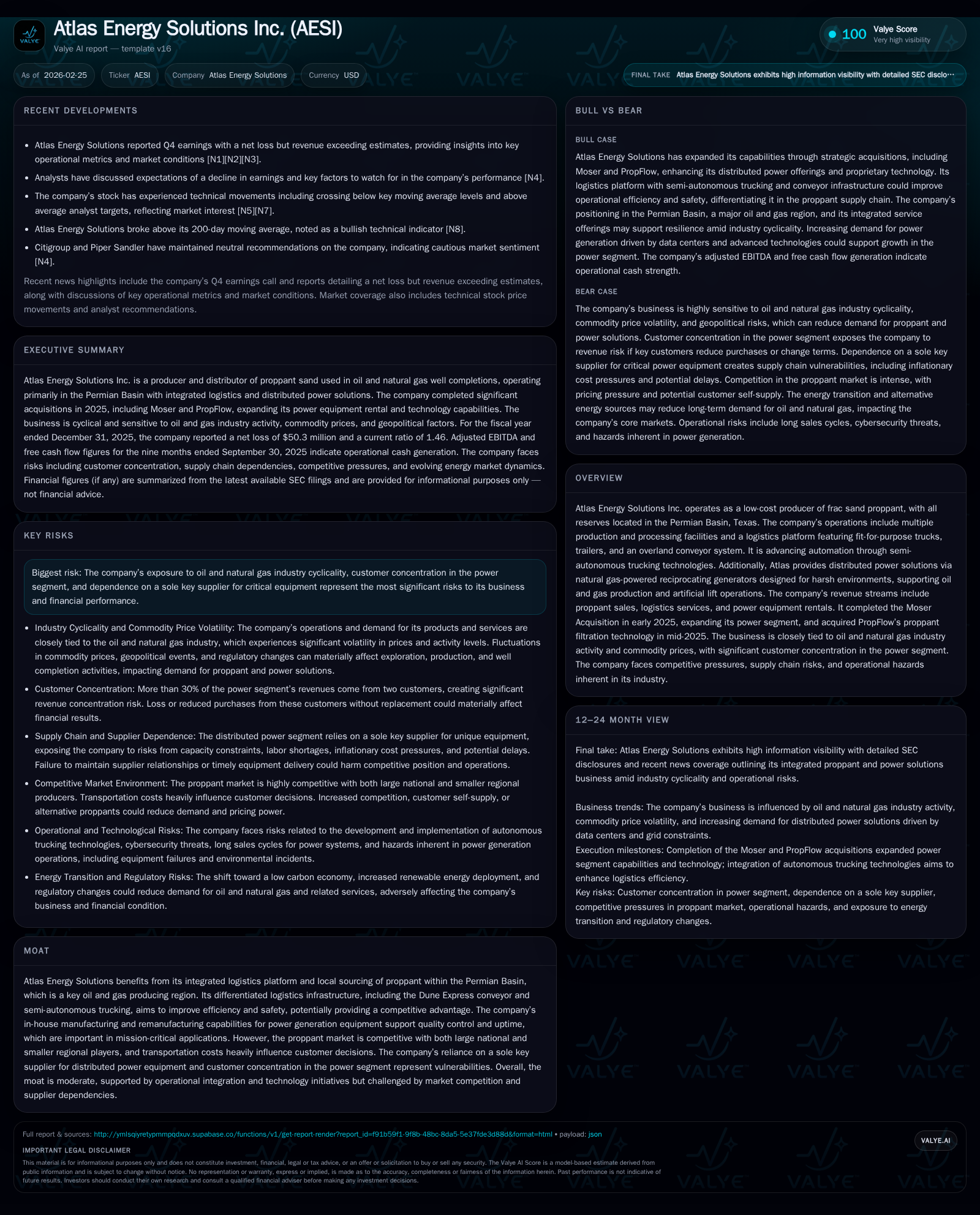
Atlas Energy Solutions Inc. (AESI) has scaled rapidly through strategic acquisitions and operational expansion in the proppant and distributed power markets. However, its 2025 financials reflect significant headwinds from oil and gas industry cyclicality, intensifying competition, and increased operating costs that undercut profitability. The company’s integrated logistics platform, centered around the Permian Basin, and recent technology acquisitions bolster future growth prospects, but leverage and earnings volatility remain key risks. Investors should monitor oilfield activity levels, new technology integration, and capital allocation priorities as AESI navigates a challenging energy sector environment.
Business Overview
Atlas Energy Solutions Inc. (AESI) is an integrated energy services company primarily focused on producing low-cost frac sand proppant sourced entirely from the Permian Basin in Texas—a prolific oil and natural gas producing region critical to U.S. hydrocarbon supply. AESI complements its sand production with logistics services featuring proprietary infrastructure such as the Dune Express overland conveyor system and fit-for-purpose trucking fleets incorporating semi-autonomous driving technologies targeting operational efficiency and safety improvements.
Further diversifying revenue streams beyond proppant sales and logistics, AESI has developed a distributed power solutions segment delivering natural gas-powered reciprocating generators tailored for harsh oilfield conditions—primarily supporting production operations including artificial lift applications. This segment was bolstered by strategic acquisitions: the Moser Acquisition completed in early 2025 expanded scale in the power space, while the mid-2025 acquisition of PropFlow introduced innovative proppant filtration technologies enhancing operational differentiation [N1][S2].
Historical Performance
AESI’s financial trajectory over recent years reveals rapid growth followed by sharp contraction amid decelerating oilfield activity and operational challenges:
Historical performance (annual)
| FY | Net ($mm) | CFO ($mm) | OpInc ($mm) | Capex ($mm) | Net YoY |
|---|---|---|---|---|---|
| 2025 | -50 | 117 | -11 | 148 | -183.9% |
| 2024 | 60 | 256 | 114 | 374 | -43.1% |
| 2023 | 105 | 299 | 265 | 365 |
Note: Omitted columns lack sufficient annual XBRL coverage in the provided tags (need ≥2 annual points): Rev, Div, Buybacks. Source: SEC companyfacts cache [F1].
Capital returns and efficiency (annual)
| FY | FCF ($mm) | ROE% |
|---|---|---|
| 2025 | -31 | -4.2 |
| 2024 | -118 | 5.8 |
| 2023 | -66 | 12.1 |
Source: SEC companyfacts cache [F1].
Note: Revenue data was not available from provided disclosures; Free Cash Flow (FCF) calculated as Cash Flow from Operations minus Capital Expenditures [F1].
Despite implied top-line growth suggested by capital expenditures and operational expansions, profitability eroded dramatically in FY2025 due to lower commodity prices impacting well completion activity volumes, increased operating costs related to integration of new assets, competitive pricing pressures on proppant products, and supply chain constraints that elevated freight costs even within localized Permian sources [S1][N2]. This resulted in operating income turning negative after two strong prior years.
Operating cash flows remained positive but fell by over half relative to prior year levels while capital expenditures moderated following intense investment phases—reflecting efforts to rightsize spending amid uncertain near-term demand.
Market Position & Competitive Moat
AESI benefits from geographic concentration with exclusive Permian Basin sand reserves affording proximity advantages critical due both to high transportation costs endemic to bulk commodities like frac sand and time-sensitive well completion schedules typical of modern E&P operators [S25]. Its integrated logistics platform combining conveyors (Dune Express), advanced trucking fleets (including semi-autonomous vehicles), and processing facilities constitutes a differentiated cost structure potentially yielding stable margins when leveraged effectively.
Its distributed power segment's combination of rig-ready natural gas generators with tailored manufacturing, remanufacturing capabilities, plus local service support creates specialized barriers against commoditized grid or diesel alternatives used elsewhere [S12]. However, this segment faces notable customer concentration risk—two customers accounted for over 30% of power segment revenues in 2025—and supplier dependency on sole equipment vendors introduces vulnerability if contingencies arise [S12][S25].
The broader proppant market remains fragmented with national giants coexisting alongside regional players; increasing vertical integration by E&P companies acquiring their own reserves or entering long-term supply contracts may limit demand growth available to third-party producers like AESI.
Operational Developments & Growth Catalysts
Key catalysts supporting AESI’s growth include:
- Leveraging proprietary logistics infrastructure automation to reduce per-ton delivered costs amidst inflationary pressures on fuel and labor.
- Expansion of distributed power offerings post-Moser acquisition aimed at addressing gaps where grid access is limited or unreliable.
- Commercialization of PropFlow’s filtration technologies improving proppant quality consistency helping secure premium pricing or differentiated contracts.
- Potential increase in well completions tied to recovery or sustained elevated crude prices; cyclical rebound directly impacts demand for sand volumes and distributed power needs.
- Ongoing deployment of semi-autonomous trucking expected to improve asset utilization materially over medium term compared with legacy manual fleets.
Nonetheless, growth prospects are tempered by risks around market volatility rooted in geopolitical tensions affecting oil prices (e.g., Middle East conflicts impacting global energy flux), technological shifts towards alternative fracturing materials or enhanced recovery techniques reducing traditional sand use intensity, plus competitive pricing pressures limiting margin expansion despite volume upticks [S1][S15].
Capital Structure & Liquidity Profile
AESI maintains a moderately leveraged balance sheet structured around:
- A $540 million Term Loan facility initiated February 2025 at ~9.51% interest rate maturing March 2032,
- A revolving Asset-Based Lending (ABL) Credit Facility recently amended to $125 million limit,
- Working capital position including cash balance of roughly $40 million alongside nearly $68 million credit availability as of year-end 2025 ensuring near-term funding capacity [S4][S6][S9][S13].
The company remains compliant with covenants including leverage ratio thresholds capped at four times EBITDA (as defined contractually), liquidity floors set above $30 million minimums, alongside coverage ratios tied to borrowing base availability ensuring measured debt management discipline [S13][S14][S16].
Free cash flow generation remains challenged due largely to ongoing investment needs for maintenance capex alongside growth initiatives especially within its power segment which requires significant equipment outlays; this has led management to suspend dividends starting Q4/2025 despite incremental raises through prior years reflecting caution amid macro uncertainty and prioritization of deleveraging plus reinvestment for future growth [S5][S8][F1].
Share repurchase activity has been minimal thus far (~$200K spent during FY2025), signaling conservative capital return policy amid fluctuating profitability and strategic reinvestment focus [F1].
Risks & Challenges
Significant risks weighing on AESI’s business model include:
- Cyclical exposure closely linked to oil & natural gas industry spending patterns which directly affect frac sand demand as well as distributed power rental cycles; prolonged price downturns can quickly suppress revenue streams.
- Customer concentration risk within the distributed power segment reliant heavily on two key customers for more than thirty percent of revenues risking abrupt revenue swings if contracts are lost or renegotiated unfavorably.
- Dependency on sole key suppliers for specialized natural gas generators presents procurement bottlenecks that could delay customer fulfillment or raise input costs adversely affecting margins.
- Competition from vertically integrated E&Ps who own their own sand reserves or logistics infrastructure reducing external sourcing opportunities.
- Geopolitical uncertainties including conflicts impacting global energy markets add volatility while supply chain disruptions elevate operational cost structures particularly freight insurance premiums given regional maritime security issues near Suez Canal shipping lanes [S1][S15].
Key Metrics & Financial Watchpoints Going Forward
No explicit forward guidance is available from recent filings or calls ([N1],[N2]). Analysts should monitor:
- Quarterly patterns of well completion activity within the Permian Basin as primary demand driver,
- Gross margin trends especially related to logistics cost management leveraging automation advances,
- Uptake rates and customer retention developments within distributed power services,
- Integration effectiveness from Moser and PropFlow acquisitions reflected in adjusted EBITDA contributions,
- Compliance with debt covenants particularly leverage ratios amid potential downturns impacting cash flow generation,
- Resumption timing or adjustments for dividend policies signaling confidence or caution on capital allocation priorities.
Conclusion
Atlas Energy Solutions illustrates an oilfield service provider balancing commodity cyclicality against asset-based competitive advantages via logistical innovation and targeted downstream expansion into distributed power generation solutions geared toward harsh environments symptomatic of upstream extraction activities.
While core operations remain deeply tied to variable oil & gas exploration dynamics shaping demand for frac sand proppants—the backbone of hydraulic fracturing—the company’s strategic moves such as integrating Moser’s fleet services capability plus novel filtration technologies aim to insulate future performance through operational differentiation.
Nevertheless, meaningful headwinds evident through FY2025 results spotlight pressures arising from commodity price swings compressing profitability coupled with rising operating expenses requiring vigilant capital stewardship.
Financially sound liquidity positioning paired with conservative incremental deleveraging amidst cautious suspension of dividend payouts underscore management's prudent approach navigating near-term uncertainty while investing selectively for longer term resilience amid evolving energy market structures.
Investors evaluating AESI must weigh these nuanced tradeoffs between cyclicality exposure moderated through innovation-led efficiencies against inherent risks embedded within specialized supply chains, customer mix concentrations, and volatile external geopolitical-economic forces impacting commodity markets worldwide.
This report is prepared solely for informational purposes without expressing any investment advice or recommendations.
Disclaimer: This is research-only, informational analysis and not investment advice. It may include AI-generated interpretation and general industry context. Always verify important details using primary sources.

Comments