
EOG Resources' Capital Discipline Balances Growth Opportunities and Commodity Price Volatility
EOG Resources combines its asset base expansion with disciplined capital allocation amid a volatile commodity price environment.
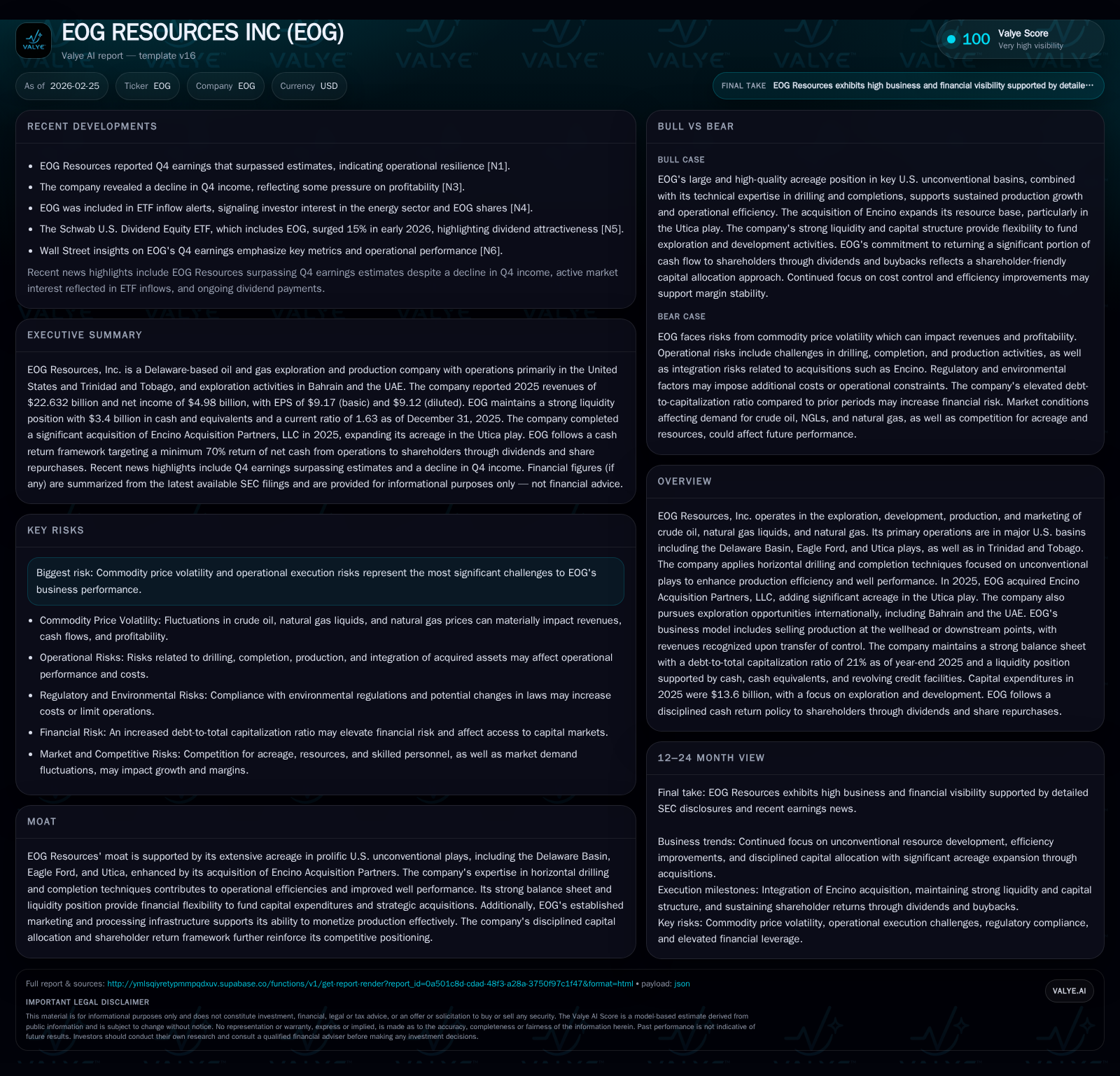
EOG Resources has experienced a modest revenue decline alongside notable earnings pressure in 2025, primarily reflecting commodity price headwinds and acquisition integration costs. The strategic $5.7 billion acquisition of Encino Acquisition Partners significantly boosted its acreage in the Utica shale play, enhancing future production potential. Despite near-term challenges, EOG maintains a robust balance sheet and strong free cash flow, underpinning its commitment to shareholder returns through dividends and share repurchases. Going forward, operational efficiency improvements and upstream asset development in core U.S. basins are key growth drivers, while exposure to commodity price cycles remains a pivotal risk factor.
Historical Performance and Growth Drivers
EOG Resources has seen steady operational progress over recent years while navigating a challenging energy market backdrop. Revenue peaked near $25.7 billion in FY2022 before contracting modestly each subsequent year to $22.6 billion in FY2025, representing an aggregate decline of roughly 12% from that peak [F1]. Operating income fell sharper, down from nearly $10 billion in 2022 to about $6.4 billion in 2025 (-36%), reflecting both macro pressures on pricing and increased costs associated with acquisitions and operations [F1]. Net income followed a similar pattern with a 22% drop to just under $5 billion in 2025 versus $6.4 billion one year prior [F1].
The company's legacy strength lies in its footprint across prolific unconventional basins such as the Delaware Basin, Eagle Ford, and Utica shale plays primarily in Texas, New Mexico and Ohio respectively [S1][S27]. The application of advanced horizontal drilling and completion techniques has been a core pillar of their strategy to boost well performance and lower unit costs, vital for competitiveness given fluctuating-price environments for oil & gas [S1][S29].
Capital expenditures have historically supported continual reserve replacement and production growth initiatives focused on these resource-rich areas, supplemented by targeted acreage acquisitions to sustain inventory depth [S1][S6]. This strategy underpins production growth, which management expects to increase crude oil output across key U.S. plays during 2026 despite near-term revenue headwinds stemming from lower commodity prices [N3][S6].
Financial Snapshot: Annual Summary (USD millions)
Historical performance (annual)
| FY | Rev ($bn) | Net ($bn) | CFO ($bn) | OpInc ($bn) | Rev YoY | Net YoY |
|---|---|---|---|---|---|---|
| 2025 | 22.6 | 5.0 | 10.0 | 6.4 | -4.5% | -22.2% |
| 2024 | 23.7 | 6.4 | 12.1 | 8.1 | -2.0% | -15.7% |
| 2023 | 24.2 | 7.6 | 11.3 | 9.6 | -5.9% | -2.1% |
| 2022 | 25.7 | 7.8 | 11.1 | 10.0 |
Note: Omitted columns lack sufficient annual XBRL coverage in the provided tags (need ≥2 annual points): Capex, Div. Source: SEC companyfacts cache [F1].
Capital returns and efficiency (annual)
| FY | Buybacks ($bn) | FCF ($bn) | ROE% |
|---|---|---|---|
| 2025 | 2.6 | 9.2 | 16.7 |
| 2024 | 3.2 | 11.4 | 21.8 |
| 2023 | 1.0 | 10.7 | 27.0 |
| 2022 | 0.1 | 10.4 | 31.3 |
Source: SEC companyfacts cache [F1].
Dividends paid data not fully available for recent years; buybacks include treasury stock repurchases reported by company.
Future Growth Prospects
A defining growth catalyst was the August 2025 acquisition of Encino Acquisition Partners for approximately $5.7 billion inclusive of net debt—a transformative deal adding ~675k core net acres concentrated in the Utica shale play [S1][N1]. The integration broadens EOG’s operational scale and drill inventory substantially within this growing Appalachian basin.
In parallel with upstream expansion via acquisitions and leasehold additions, EOG actively manages its portfolio by divesting non-core assets such as the northern Midland Basin interest sold for $165 million early in FY2026—demonstrating focus on high-return areas [S1][N3].
Operational execution improvements continue with an emphasis on enhancing drilling/completion efficiencies and well productivity gains through technology adoption and service provider collaboration agreements expected to bolster cost control amid inflationary input factors [S6].
On the international frontier, EOG is expanding exploratory activities notably via newly secured concessions in Bahrain (with initial drilling underway) and Abu Dhabi’s Unconventional Onshore Block awarded mid-2025 permitting a three-year appraisal phase before potential development partnerships with ADNOC [S1]. While international diversification offers upside optionality beyond the U.S., it also poses exploration execution risks.
Outlook Milestones & Guidance
For fiscal year ending December 31, 2026:
- Capital expenditure budget set between $6.3 billion to $6.7 billion prioritizing U.S.-based crude oil drilling programs alongside infrastructure upgrades and environmental projects [S6][S10].
- Production guidance anticipates increases in crude oil volumes with ongoing efficiency initiatives expected to support margin resilience despite continued commodity price volatility factors facing the industry broadly [N3][S3].
- Cost management levers remain critical given input cost inflation risks; agreements with drilling/completion vendors aim at securing pricing stability where feasible [S6].
Analysis: Market watchers should monitor quarterly production trends relative to guidance against prevailing commodity price swings—especially natural gas pricing impacts on Utica economics—as well as progress on international appraisal activity that could materially affect medium-term reserves growth.
Returns & Capital Allocation
A hallmark of EOG’s capital allocation philosophy is its disciplined framework targeting a minimum return of ~70% of adjusted free cash flow (operating cash flow less capital expenditures) back to shareholders via dividends and share repurchases annually—a policy implemented since fiscal year beginning in late 2023 [S10].
Despite the earnings pressure in FY2025 owing partly to Encino acquisition integration costs and softer commodity pricing offsetting production gains (net income declined 22%), strong free cash flow generation ($9.2 billion calculated as operating cash flow minus capex) equips the company to sustain generous capital returns without compromising investment for growth [F1][S10].
During calendar year 2025:
- EOG repurchased roughly $2.56 billion worth of shares under an authorized program expanded recently from $5 billion up to $10 billion total capacity—demonstrating management’s commitment to share count reduction as a capital return mechanism amidst volatile markets [S5].
- Quarterly dividend payments progressively increased—the latest declaration being $1.02 per share per quarter as of February ’26 compared with a baseline near $0.975 earlier—reflecting confidence in cash flow sustainability even amid uncertain commodity markets [S7][N1].
The company’s leverage position prudently moderated with debt-to-total-capitalization ratio increasing from around a low double-digit level (14%) at end-2024 to approximately 21% post acquisition-related financings but remaining conservatively positioned relative to many peers given the strong balance sheet liquidity buffer including over $3 billion undrawn revolver capacity plus substantial cash reserves [$3.4B] at year-end '25 [F1][S9][S18]. Fixed-rate senior notes dominate the debt profile providing predictability of interest expense.
Return on equity calculated roughly at ~16.7% (based on net income against stockholders’ equity) signals reasonable profitability sustained despite lower energy prices compared to prior peak years though somewhat down from historical highs during more favorable pricing cycles [F1].
Industry Context & Risks Analysis
In line with large-cap independent exploration & production companies focused on North American unconventionals, EOG faces cyclical swings driven by global energy demand-supply dynamics impacting realized prices for crude oil & liquids versus natural gas which continues experiencing structural headwinds regionally despite export growth via LNG terminals (analysis).
Operational execution risk remains material given the complexity of multi-basin drilling programs requiring continuous innovation in fracturing designs & completions technology alongside workforce availability challenges rising input costs – all against ESG-driven environmental regulatory scrutiny tightening globally (see risk disclosures) [S16][N14].
Acquisition integration risk is nontrivial especially managing over half a million new acres acquired through Encino amidst volatile pricing environments whereby proved reserves estimates are subject to modification based on updated geological data or shifting economic assumptions (accounting judgments detailed under SEC critical policies) [S13][S29].
International upstream exposure introduces geopolitical uncertainties inherent outside North America; however participation terms such as production sharing contracts allow staged risk mitigation through appraisal phases prior to committing development capital notably seen with Bahrain and Abu Dhabi ventures initiated in ’25–’26 cycles [S1][N3].
Conclusion
EOG Resources demonstrates a resilient business model balancing expansion through strategic acquisitions—highlighted by adding scale in the Utica shale—with rigorous operational focus designed to sustain efficiencies critical amidst persistent market volatility impacting revenues and earnings. Financial discipline remains core as evidenced by conservative leverage metrics paired with robust free cash flows enabling substantial returns via dividends combined with accelerated buybacks raising shareholder value amidst margin pressures. Key catalysts include successful Encino acreage integration outcomes coupled with drilling efficiency enhancements while international exploration efforts may provide upside optionality longer term. Investors should track quarterly updates on production volumes relative to guidance along with commodity price trajectories shaping realized margins alongside regulatory shifts influencing operating cost structures.
This analysis uses publicly disclosed SEC filings (Forms 10-K/10-Q/8-K) as well as company press releases per Nasdaq sources dated up to February ‘26 without offering investment advice or forecasts beyond those explicitly stated by company representatives or filings.
Disclaimer: This is research-only, informational analysis and not investment advice. It may include AI-generated interpretation and general industry context. Always verify important details using primary sources.

Comments