
Autodesk's Subscription Shift: Tracking Growth Momentum and Capital Strategy
Assessment of Autodesk’s fiscal 2026 growth, subscription transition, AI investments, international channel dynamics, renewal risks, and capital deployment.
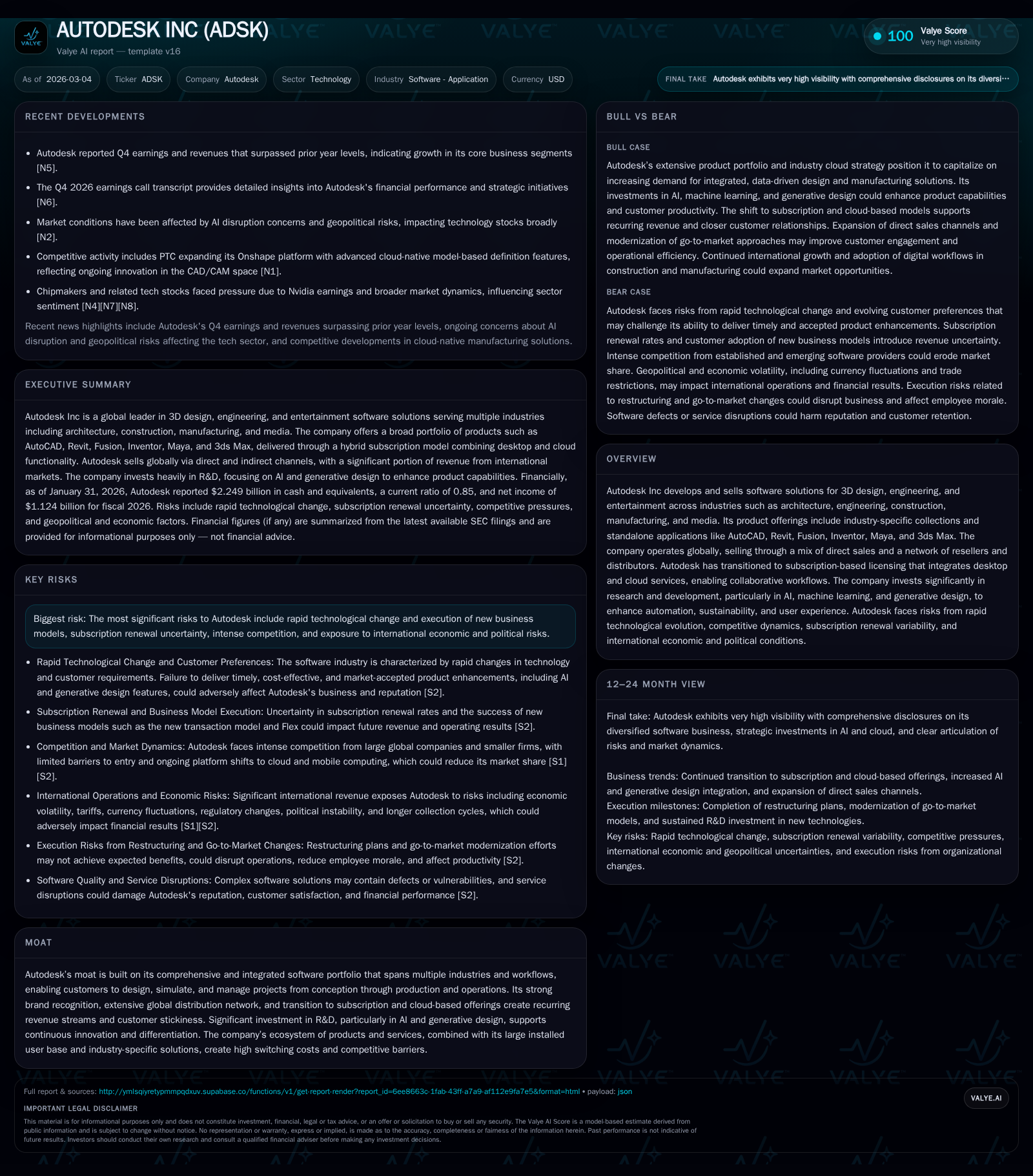
Autodesk demonstrated robust financial progress in fiscal 2026, propelled by strong recurring revenue growth underpinned by its strategic shift to subscription licensing and cloud integration. The company's significant investments in AI and generative design underpin its competitive moat, while adjustments in channel strategy and geographic exposure introduce both opportunities and risks. Although renewal rate variability and rapid tech evolution pose challenges, Autodesk's healthy free cash flow and aggressive share repurchases highlight disciplined capital allocation aimed at enhancing shareholder value.
Fiscal 2026 Performance Drivers: Revenue and Profit Trends
Autodesk closed fiscal year 2026 with total revenues of approximately $5.54 billion, marking a solid increase of about 15.7% compared to the prior fiscal year [F1]. This growth underscores the success of Autodesk’s ongoing transition toward a subscription-based business model that amalgamates desktop software with cloud-enabled services. Operating income rose even more robustly by roughly 16.5% to $1.58 billion, demonstrating continued improvement in operating efficiency amid reinvestments into product development [F1]. In contrast, net income growth was modest at around 1.1%, closing at $1.12 billion — a differential reflecting increased expenditures particularly in research and development focused on emerging technologies [F1].
Operating cash flow surged nearly 53% year-over-year to over $2.45 billion, highlighting strong underlying cash generation capacity even as capex edged up slightly to $43 million (+7.5%) reflecting sustained investment in platform scalability [F1]. These dynamics support a high-quality earnings profile characterized by strong margin expansion alongside top-line acceleration.
Historical performance (annual)
| FY | Net ($mm) | CFO ($bn) | OpInc ($mm) | Capex ($mm) | Net YoY |
|---|---|---|---|---|---|
| 2026 | 1124 | 2.5 | 1578 | 43 | +1.1% |
| 2025 | 1112 | 1.6 | 1354 | 40 | +22.7% |
| 2024 | 906 | 1.3 | 1128 | 31 | +10.1% |
| 2023 | 823 | 2.1 | 989 | 40 |
Source: SEC companyfacts cache [F1].
Capital returns and efficiency (annual)
| FY | Div | Buybacks ($mm) | FCF ($bn) |
|---|---|---|---|
| 2026 | 1402 | 2.4 | |
| 2025 | 0 | 852 | 1.6 |
| 2024 | 0 | 795 | 1.3 |
| 2023 | 0 | 1101 | 2.0 |
Source: SEC companyfacts cache [F1].
Revenue YoY calculated for FY2026 vs FY2025 from [F1]. Other years’ full revenue history unavailable.
Subscription Model Evolution and Its Impact on Recurring Revenue
A core pillar of Autodesk’s recent growth has been the strategic migration from perpetual license sales to subscription-based licensing schemes encompassing term-based subscriptions that bundle desktop software with cloud service offerings [S4][S15]. This hybrid approach enables flexible, device-independent access facilitating collaborative workflows — a notable advantage for customers operating across complex AECO (Architecture/Engineering/Construction/Operations) projects or manufacturing environments.
The company also relies on Enterprise Business Agreements (EBAs) which secure multi-year commitments bolstering revenue predictability; however, this contractual structure introduces seasonality into billings and remaining performance obligations (RPO) notably concentrated in the fourth fiscal quarter [S4][S5]. Autodesk’s new transaction model aims to further modernize go-to-market processes by deepening direct customer relationships while simultaneously leveraging data infrastructure upgrades to refine pricing consistency and buying experiences via Solution Providers [S4][S5].
Despite fostering recurring revenue stability through subscriptions, Autodesk acknowledges inherent risks linked to uncertain subscription renewal rates that may impact future results [S1][S2]. This variability requires ongoing focus on retention metrics alongside renewing product value propositions that integrate cloud enhancements sustaining high customer stickiness.
AI and Generative Design: Fueling Competitive Differentiation
With the broader design software sector rapidly evolving under technological pressures including AI disruption trends [N11][N12], Autodesk has amplified its investment in artificial intelligence research covering machine learning and generative design technologies [N13][N14]. These advances aim to automate critical design processes reducing waste and unlocking sustainable innovation pathways within customer workflows spanning construction to manufacturing [S15].
Autodesk’s AI initiatives enhance not only design optimization but also integrate sustainability considerations crucial for clients managing environmental impact alongside cost efficiency — a strategic commitment enhancing differentiation vis-à-vis peers who wrestle with commoditization amidst platform shifts toward cloud computing [S8][S13]. However, the company must simultaneously manage public perception risks around AI ethics plus comply with emergent regulatory regimes such as the EU Artificial Intelligence Act which impose transparency and governance costs [S13].
International Sales Dynamics and Channel Strategy Shifts
Geographically, Autodesk derives the majority of its net revenue from international markets across Americas, EMEA (Europe/Middle East/Africa), and APAC regions [S4][S5]. While expansion beyond the U.S provides growth diversification benefits, it simultaneously exposes the company to currency exchange fluctuations plus geopolitical uncertainties including emerging market economic cycles requiring tailored go-to-market adaptations.
Functionally, Autodesk’s channel mix continues evolving as direct transactions increase especially through its branded online store and new transactional frameworks reducing reliance on large distributors like TD Synnex whose contribution declined from nearly 39% of revenue in fiscal year ended January 31, 2024 to approximately 14% in FY2026 [S5]. Nevertheless, indirect channels including resellers remain important particularly for government sales where specialized procurement regulations apply.
The transformation is underpinned by incentive realignments aiming to optimize reseller engagement while upgrading solution providers’ roles building deeper customer intimacy [S4][S19]. Yet channel shifts bring execution challenges including distributor credit risks or potential disruptions if partners move toward competitive platforms.
Navigating Renewal Rate Variability and Market Risks
Autodesk explicitly flags several risk vectors that could undermine business performance: intense competition from global incumbents such as Dassault Systèmes or PTC plus startups offering disruptive technologies; unpredictable subscription renewals that create revenue visibility challenges; compliance costs stemming from tightening data security, privacy laws; plus geopolitical turmoil impacting international operations [S1][S2][S8][S17][S22].
Additionally, industry-wide concerns over AI deployment ethics could affect brand perception or invite regulatory scrutiny potentially raising compliance costs or slowing adoption curves [S13][N11]. The company has faced costly internal investigations recently spotlighting free cash flow reporting practices — though resolved without penalties they underscore operational risk factors demanding continuous governance vigilance [S10][S21].
Furthermore, security incidents remain an ongoing operational hazard given increased adoption of cloud services necessitating robust cybersecurity defenses to avoid reputational harm or litigation exposure [S22][S26].
Forecasting Key Milestones and Indicators to Monitor
While Autodesk does not provide precise forward revenue or margin guidance within current filings or recent earnings transcripts ([N2]), several indicators merit close observation for assessing near-term momentum:
- Subscription renewal rates especially across multi-year EBAs directly influence deferred revenue recognition patterns.
- Timing shifts in billings associated with annualized contracts can cause transient variances in quarter-to-quarter cash flows [S5].
- Adoption ramp rates of next-gen products integrating AI-driven generative tools within AECO versus Manufacturing segments point toward market acceptance of innovation roadmaps.
- Channel execution efficacy particularly balancing direct versus reseller sales penetration impacts scalability dynamics. Monitoring these parameters will illuminate whether Autodesk sustains consistent cadence in recurring revenue expansion amid an increasingly competitive environment.
Capital Allocation Priorities: Buybacks, Cash Flow, and Return Metrics
Financial stewardship at Autodesk reflects a preference for deploying excess capital through aggressive share repurchases rather than dividends which remain absent historically [F1]. In FY2026 alone, buybacks exceeded $1.4 billion compared with about $852 million the prior year signaling amplified return intent to shareholders backed by ample free cash flow exceeding $2.4 billion (operating cash flow minus capex) [F1].
Capital expenditures are modest relative to cash generation reflecting investments skewed toward scalable software platforms rather than heavy physical assets. Equity rose substantially from $2.62 billion in FY2025 to $3.04 billion at FY2026-end supporting an approximate return on equity near 37%, indicating efficient use of shareholder capital even amid heavy reinvestment cycles [F1].
This balance between funding innovation-led growth via R&D while simultaneously enabling shareholder value enhancement through buybacks is emblematic of mature SaaS/subscription model enterprises managing top-line scale alongside profitability discipline.
This report solely presents factual analysis based on SEC filings ([F1], [S#]) and corroborated news reports ([N#]). It refrains from forward-looking investment recommendations or price forecasts as per mandate constraints.
Disclaimer: This is research-only, informational analysis and not investment advice. It may include AI-generated interpretation and general industry context. Always verify important details using primary sources.

Comments