
Rigel Pharmaceuticals’ Capital-Efficient Growth Backed by Niche Oncology and Hematology Assets
Rigel Pharmaceuticals leverages a portfolio of targeted therapies to deliver strong profitability, though regulatory, competitive, and reimbursement risks remain persistent headwinds.
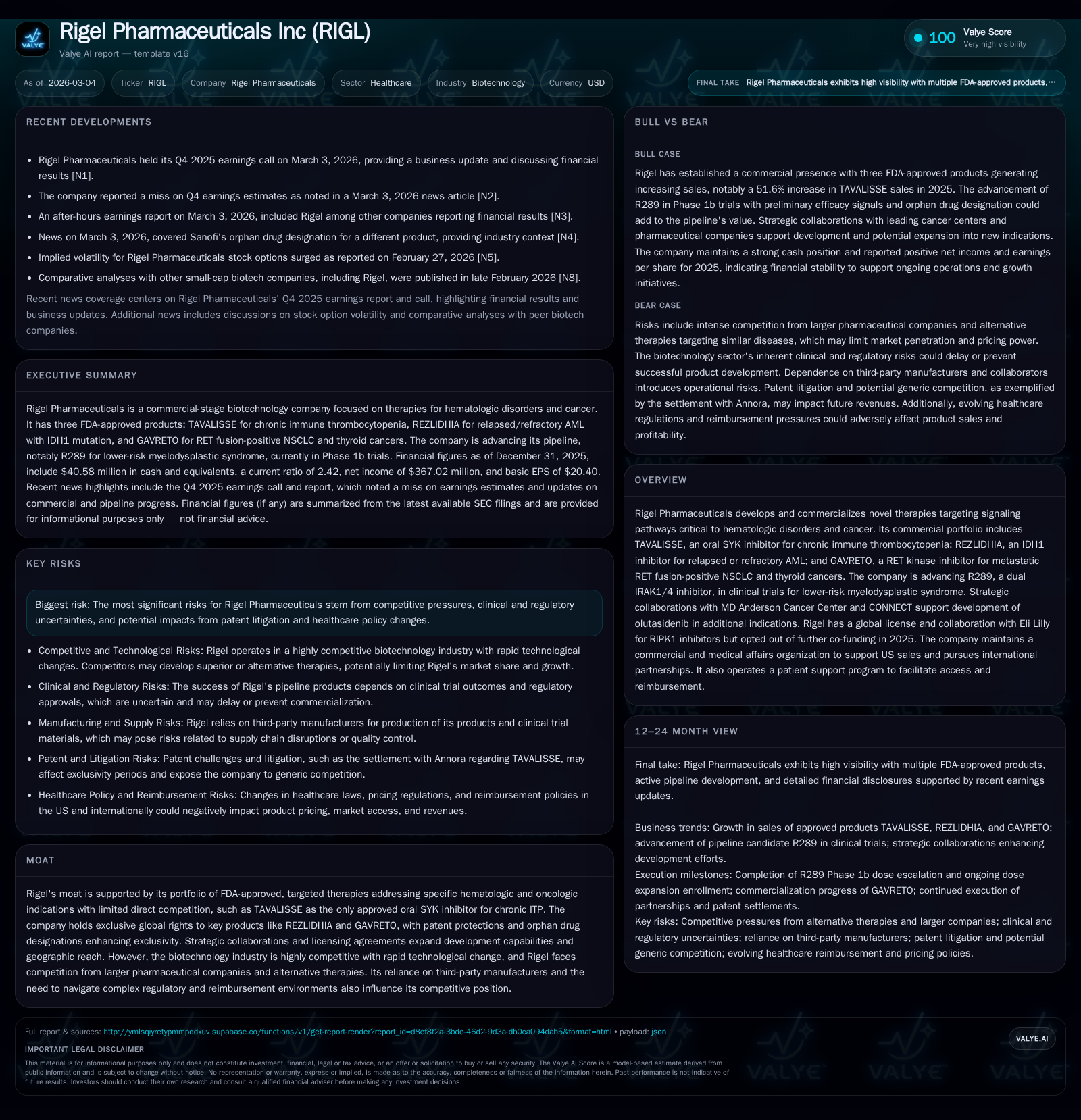
Rigel Pharmaceuticals has transformed its financial trajectory through commercializing three FDA-approved products—TAVALISSE, REZLIDHIA, and GAVRETO—that target hematologic and oncologic conditions with high unmet need. In 2025, Rigel reported a dramatic turnaround to operating and net profitability, driven primarily by rapid growth in TAVALISSE sales and leveraging cost controls. Future growth depends on advancing pipeline candidates like the IRAK1/4 inhibitor R289 and expanding indications for olutasidenib through strategic collaborations. However, competition from larger pharma, patent litigation, evolving healthcare regulations, pricing pressures, and reimbursement dynamics pose ongoing risks. Rigel’s capital allocation emphasizes reinvestment in development alongside stable liquidity without share buybacks or dividends currently.
Historical Financial Performance and Drivers
Rigel Pharmaceuticals has undergone a significant transformation over the past four years marked by progress toward profitability after a history of losses.
Historical performance (annual)
| FY | Net ($mm) | CFO ($mm) | OpInc ($mm) | Capex ($) | Net YoY |
|---|---|---|---|---|---|
| 2025 | 367 | 76 | 125 | +1999.1% | |
| 2024 | 17 | 31 | 24 | +169.7% | |
| 2023 | -25 | -6 | -20 | 450000 | +57.2% |
| 2022 | -59 | -74 | -56 | 450000 |
Source: SEC companyfacts cache [F1].
Capital returns and efficiency (annual)
| FY | FCF ($mm) | ROE% |
|---|---|---|
| 2025 | 93.8 | |
| 2024 | 531.8 | |
| 2023 | -6 | 87.6 |
| 2022 | -74 | 430.2 |
Source: SEC companyfacts cache [F1].
Source: SEC filings companyfacts snapshot [F1]
The leap into sustained operating profitability reflects successful commercialization scaling of TAVALISSE—the only oral SYK inhibitor approved for chronic immune thrombocytopenia (ITP) in adults—and ramp-up of newer assets REZLIDHIA (olutasidenib) for relapsed/refractory AML and GAVRETO (pralsetinib), targeting metastatic RET fusion-positive lung and thyroid cancers [S1][N1].
TAVALISSE net product sales grew by approximately 51.6% year-over-year in 2025 to $158.8 million driven by increased physician adoption supported by an integrated US commercial infrastructure focusing on hematologists actively treating chronic ITP patients [S1][S19]. This substantial revenue growth catalyzed positive operating leverage pushing the operating income margin substantially higher compared to years of negative returns.
Operating cash flow has mirrored this improvement fueled by better working capital management and robust earnings quality after multiple years of negative cash flow during clinical stage investments. Capital expenditure remains low at just $450k per annum reflecting Rigel’s outsourcing model for drug substance manufacturing concentrated among three active pharmaceutical ingredient (API) sites and three finished goods facilities managed through contract manufacturers [S15].
Equity grew sharply as cumulative profitability generated strong retained earnings reversal of prior losses.
Future Growth Drivers and Constraints
Looking ahead into the mid-term horizon to sustain growth momentum beyond TAVALISSE’s current market penetration involves execution across several fronts:
Pipeline Advancement: The IRAK1/4 dual inhibitor R289 is progressing through an open-label Phase 1b study targeting lower-risk myelodysplastic syndrome patients who have exhausted prior therapy options. Early signals of safety and potential efficacy will be critical milestones to watch for progression toward later-stage trials or partnership opportunities [S1][N1].
Expanded Indications: Strategic collaborations with MD Anderson Cancer Center and the CONNECT consortium aim to broaden olutasidenib’s label coverage beyond relapsed/refractory AML into additional IDH1 mutation-driven malignancies where unmet need remains high. These efforts could meaningfully extend product lifecycle value if clinical results are supportive [S1].
GAVRETO Commercialization: Since acquiring US rights from Blueprint Medicines in early 2024 for this RET kinase inhibitor indicated for metastatic RET fusion-positive NSCLC and thyroid cancers with accelerated approval status in some indications (e.g., radioactive iodine-refractory thyroid cancer), Rigel is driving uptake amid competition chiefly from Eli Lilly’s selpercatinib as well as multi-kinase inhibitors used off-label in this niche segment [S16][S20]. Sales progression will depend on competitive differentiation along efficacy/safety axes as well as payor coverage.
External Licensing & Collaboration: While maintaining global rights internally for key products such as REZLIDHIA (exclusively licensed from Forma Therapeutics/Novo Nordisk), Rigel continues to capitalize on licensing models outside core territories (through agreements like Grifols for EU/Middle East) enhancing royalty streams without direct operational costs [S19]. Its decision to cease additional co-funding with Eli Lilly on RIPK1 inhibitors signals portfolio prioritization but retains royalty upside from milestone achievements or commercial success licensed globally [S1].
Constraints that may impede growth include:
Competitive Pressures: The oncology and hematology biotechnology arena is crowded with both large pharmaceutical companies wielding extensive resources capable of developing next-generation targeted therapies but also advancing alternative modalities such as cellular therapies or bispecific antibodies which could displace small molecule incumbents [S20][N10].
Regulatory & Reimbursement Hurdles: Coverage limitations due to payer policies in the US amid evolving Medicare Part D inflation rebates rules introduced by the Inflation Reduction Act continue to create pricing pressure on branded specialty drugs including orphan-designated products . Similar reimbursement challenges manifest internationally where health technology assessment outcomes significantly influence market access durations.
Patent Litigation Risks: Ongoing IP challenges exemplified by settlement of patent infringement suits relating to TAVALISSE generics illustrate vulnerability timelines though orphan drug exclusivities buffer some risk periods until mid-next decade at least [S23][S12].
Forecasts and Upcoming Milestones to Monitor
Explicit near-term guidance detail was not published at filing date; however key upcoming catalysts include:
- Further data releases from R289 Phase 1b trials potentially supporting Advancement decisions or defining combination strategies.
- Clinical updates from MD Anderson/CONNECT collaboration evaluating olutasidenib’s activity in novel IDH1-mutant cancers beyond AML.
- Commercial traction metrics for GAVRETO beyond initial launch phases highlighting market share gains versus sets of RET-targeting drugs.
- Any regulatory submissions or label expansions surrounding existing products.
Analysts should closely monitor quarterly channel inventory trends described during earnings calls as changes here often precede shifts in reported sales figures [N1][N2]. Additionally attention to patent expiry milestone schedules post-settlement agreement will provide context on generic entry risks.
Returns Profile & Capital Allocation Discipline
Rigel represents an example of efficient capital deployment yielding robust returns over a compressed timeline:
- Approximate return on equity reached nearly 94% in FY2025 reflecting substantial earnings relative to shareholders’ equity base accrued after years of deficit carryover from heavy R&D investment phases [F1].
- Positive free cash flow generation (~$75 million estimated as CFO minus Capex) enables reinvestment into pipeline advancement while funding commercial scale expansion without reliance on equity raises or high debt burdens [F1].
- The company maintains zero share repurchases or dividend payouts indicating management focus on optimizing long-term project funding rather than immediate shareholder distributions given biotech sector norms.
- Liquidity is sound with cash & equivalents totaling $40.6 million paired with conservative current liabilities producing a current ratio over 2.4x alleviating short-term solvency concerns [F1].
Industry Context and Competitive Differentiators
In the biotechnology sector specifically addressing hematology-oncology indications driven by molecularly defined targets such as SYK inhibition or mutant IDH enzymes characterizes Rigel’s positioning within innovative therapeutics addressing narrow patient subsets.
TAVALISSE’s distinction arises from its status as the sole oral SYK inhibitor approved for chronic ITP creating a durable moat bolstered by multiple patents tightly controlling compound composition-of-matter plus formulation claims extending protection well into the late decade timeframe.[S12][S20]
Similarly strong patent estate protections covering R289 extend through mid-2040s if all pending filings succeed offering potential long runway support.[S22]
Nevertheless emerging technologies—bispecific antibodies targeting immune checkpoints or next-generation targeted degraders—are fast evolving competitive tools developers exploit creating uncertainty regarding incumbent small molecule dominance.
Market dynamics also hinge heavily on navigating increasingly stringent healthcare cost containment initiatives both stateside via affordability boards setting upper payment limits,[S8]and globally through joint health technology assessments impacting formulary listings.[S5]
Key Risks Summary
Rigel explicitly highlights various operational uncertainties comprising:
- Intellectual property challenges from generic entrants posing erosion threats post-patent expiry despite settlements extending exclusivity timelines.[S23]
- Regulatory hurdles inherent in drug approvals plus extensive post-marketing requirements including safety monitoring and labeling constraints potentially restricting market penetration.[S16][S24]
- Pricing pressures stemming from ongoing US federal pricing reforms such as Inflation Reduction Act provisions imposing mandatory rebates tied to inflation exceeding price increases impacting Medicare part B/D reimbursements.[S9][S13]
- Exposure to anti-kickback statutes/fraud enforcement under healthcare compliance laws demanding costly oversight mechanisms to avoid civil/criminal penalties compromising reputation or operations.[S17]
- Competition from pharma majors possessing superior scale/financial resources enabling simultaneous multi-candidate development driven by broader research platforms.[S20]
- Manufacturing dependency risks given outsourcer reliance requiring stringent quality control adherence without owning internal capabilities.[S15]
Conclusion: A Growth-Oriented Biotech Focused on Targeted Hematologic & Oncologic Therapies With Spotlights on Intellectual Property Strength & Cash Flow Improvement Amid Policy Risks
Since its first product launch TAVALISSE nearly a decade ago Rigel Pharmaceuticals has matured into a profitable biotech company punctuated by robust year-end financials validating commercial operational discipline integrated with innovative pipeline development strategies anchored around precision medicines addressing unmet hematology-oncology needs.[F1][S19] The leap to over $125 million operating income along with generating sizable free cash flow underlines financial health uncommon among its mid-cap peers.
However it faces multifaceted external risks related to rapid scientific advancement disrupting therapeutic paradigms coupled with evolving governmental healthcare reforms influencing pricing landscapes globally requiring careful navigation. Patent portfolios provide vital barriers preserving revenue streams but vigilance over generic insurgencies remains critical given industry trends.[S23][S20]
The coming quarters will be pivotal judging forward-looking catalysts especially advances within R289 clinical program plus cross-indication expansion efforts involving olutasidenib realized through institutional academic partnerships reflecting Rigel's strategic approach adapting within dynamic biotech ecosystems.[N1][S19]
Investors seeking insights should continue monitoring commercial execution metrics alongside updates on regulatory pathways amidst healthcare policy evolutions shaping reimbursement frameworks that ultimately govern realized product revenues worldwide.
This analysis is intended solely for informational purposes synthesizing publicly available data sources including SEC filings ([F1],[S#]) and recent news ([N#]). It does not incorporate proprietary insights nor constitutes investment advice.
Disclaimer: This is research-only, informational analysis and not investment advice. It may include AI-generated interpretation and general industry context. Always verify important details using primary sources.

Comments