
Republic Bancorp's Strategic Shift and Earnings Growth Amid Regional Banking Pressures
Republic Bancorp balances operational transformation and capital management to enhance profitability in a competitive regional banking market.
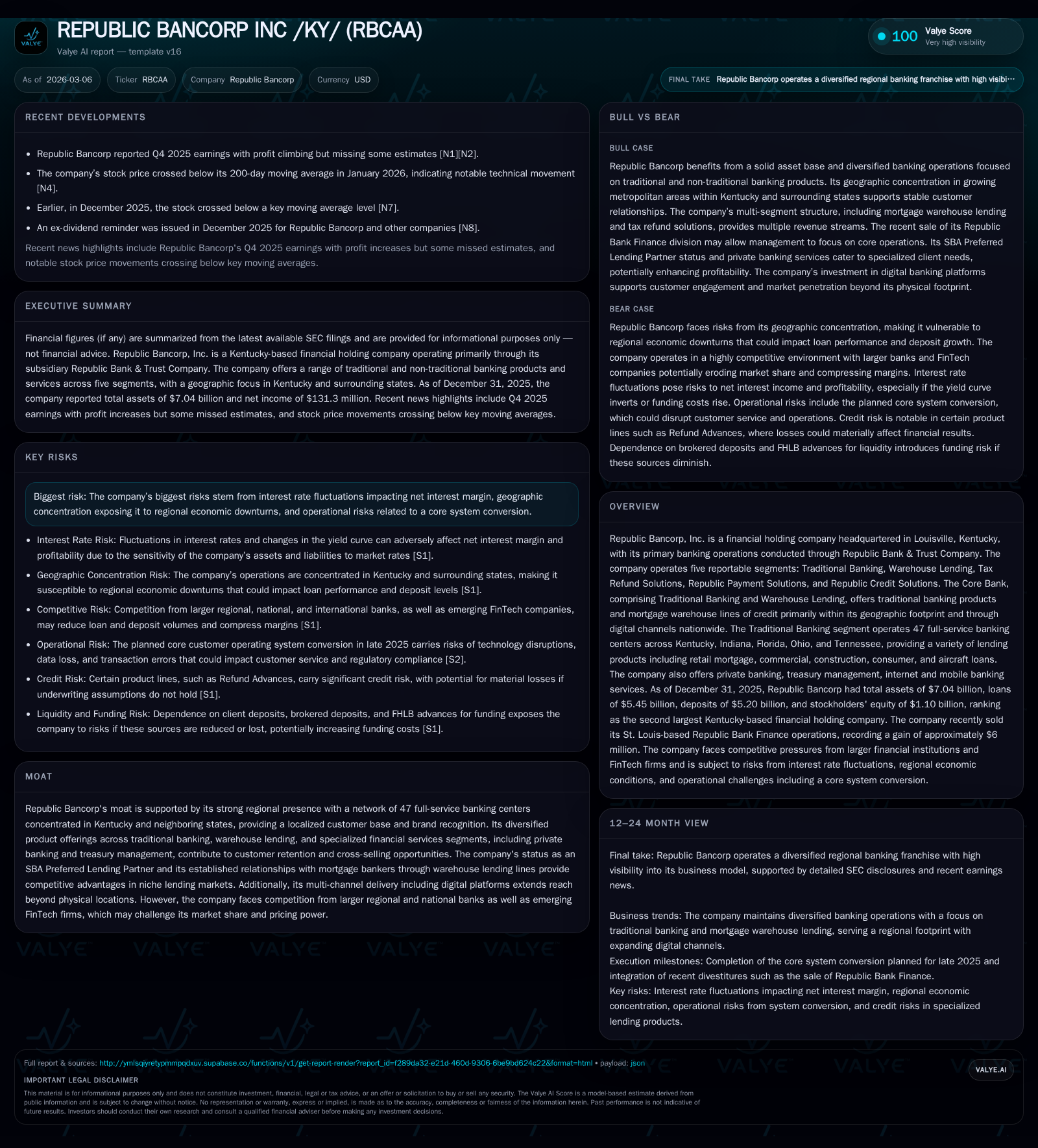
Republic Bancorp, Inc., the second-largest Kentucky-based financial holding company, has demonstrated solid revenue and net income growth driven by its diversified loan portfolio and strong presence in the core banking segment. The company is navigating operational challenges such as its recent core system conversion while strategically sharpening focus through asset divestitures. Funding cost pressures and geographic concentration present risks to net interest margins, yet prudent capital allocation and liquidity management support ongoing financial resilience. Key metrics to monitor include post-conversion operational performance, asset-liability management efficacy, and deposit stability.
Historical Revenue and Profit Growth Trajectory
Republic Bancorp’s financial performance over the past four fiscal years exhibits steady top-line expansion complemented by notable improvements in net income and operating cash flow. Specifically, FY2025 revenues increased by approximately 8.5% year-over-year to $417.5 million from $384.8 million in FY2024, continuing an upward trajectory that reflects healthy business fundamentals [F1]. Net income accelerated even more significantly, rising nearly 30% to $131.3 million in FY2025 from $101.4 million the prior year, signaling stronger profitability leverage.
Operating cash flow also grew by 12.9%, underpinning robust cash conversion capabilities necessary for reinvestment and shareholder remuneration. Capital expenditures increased by just over 22%, indicative of ongoing investments potentially related to technological upgrades or branch support infrastructure expansion.
Historical performance (annual)
| FY | Rev ($mm) | Net ($mm) | CFO ($mm) | Capex ($mm) | Rev YoY | Net YoY |
|---|---|---|---|---|---|---|
| 2025 | 417 | 131 | 168 | 7 | +8.5% | +29.5% |
| 2024 | 385 | 101 | 149 | 6 | +6.8% | +12.2% |
| 2023 | 360 | 90 | 109 | 7 | +10.3% | -0.8% |
| 2022 | 327 | 91 | 155 | 4 |
Source: SEC companyfacts cache [F1].
Capital returns and efficiency (annual)
| FY | Div ($mm) | Buybacks ($mm) | FCF ($mm) |
|---|---|---|---|
| 2025 | 34 | 0 | 161 |
| 2024 | 31 | 20 | 143 |
| 2023 | 28 | 20 | 102 |
| 2022 | 26 | 13 | 151 |
Source: SEC companyfacts cache [F1].
This consistent upward revenue movement is supported by core operations expansion captured under traditional banking products and warehouse lending activities concentrated primarily within Kentucky and surrounding states [S1]. The bottom-line surge evidences operational efficiencies captured despite the headwinds related to system upgrades described later.
Drivers Behind Republic’s Expanding Loan Portfolio and Segments
Republic Bancorp’s growth fundamentally rests upon its "Core Bank" represented by Traditional Banking and Warehouse Lending segments alongside its specialized units — Tax Refund Solutions, Republic Payment Solutions, and Republic Credit Solutions.
Traditional Banking offers a suite of lending products including retail mortgages, commercial loans (C&I), construction finance, consumer loans, and aircraft financing predominantly across five states: Kentucky, Indiana, Florida, Ohio, and Tennessee through an established network of 47 full-service branches [S1]. This footprint embeds Republic deeply into regional economies facilitating sustained client acquisition.
Warehouse Lending primarily provides short-term revolving mortgage warehouse lines supporting mortgage bankers nationwide via secured single-family first-lien residential real estate collateral [S8]. This segment fuels significant loan volume turnover as advances typically stay on credit lines for a brief period (usually two to four weeks), fostering fee income generation.
Republic holds the designation of SBA Preferred Lending Partner which expedites underwriting approvals for SBA-backed loans under the SBA "7A" and "504" programs targeting owner-occupied commercial real estate financings up to $3 million principal amounts [S4]. Such preferential status strengthens its competitive positioning securing access to low-risk commercial borrowers while minimizing credit loss exposure.
Complementary retail offerings—including private banking for high-net-worth individuals, treasury management for commercial clients, internet/mobile banking channels—broaden client touchpoints bolstering cross-selling opportunities [S11]. Moreover, efforts to selectively purchase correspondent loan portfolios augment the bank's asset mix while maintaining geographic alignment with existing markets.
Impact of Core Customer System Conversion on Operational Efficiency
In Q4 FY2025 Republic completed a major core customer operating system replacement intended to modernize transaction processing capabilities spanning account management for depositors and borrowers alike [S2]. This type of migration is inherently complex with material operational risk given the critical role such systems play in synchronizing front-end client engagements with back-office accounting.
Potential adverse impacts acknowledged in filings include:
- Transaction posting errors or delayed settlements,
- Loss or misrouting of customer data,
- Regulatory compliance scrutiny,
- Reputation risk resulting from service interruptions,
- Possible litigation exposure due to system failures.
Management outlined robust mitigation plans yet cautioned about residual uncertainties during transition periods where adverse incidents could impact earnings unexpectedly or impair client retention [S2]. As this implementation is recent relative to fiscal year close reporting dates, any efficiency gains are expected more tangibly in forward reporting cycles while near-term volatility risk requires monitoring.
Strategic Sale of Republic Bank Finance Division: Implications and Outcomes
On February 20, 2026, Republic finalized the divestiture of substantially all assets related to its Republic Bank Finance division (RBF) to CAN Capital Merchant Services Inc., following an agreement announced late December last year [S3]. The transaction yielded a net gain of approximately $6 million reported in Q1 FY2026 results [S6], improving liquidity metrics that can be redirected strategically.
This sale sharpens Republic’s business model focus toward core banking plus regulated specialty segments connected more directly with balance sheet lending activities rather than ancillary finance operations operated under RBF [S3]. The disposal removes associated credit risk lines tied to RBF leases/loans (~$82 million reclassified prior to sale) thereby providing clearer operational focus while freeing capital resources for prioritized segments.
Management commentary indicated expectations that proceeds would support investment in technology platforms (potentially accelerating innovation beyond core conversion base) or alternatively strengthen capital buffers in response to competitive funding pressures seen regionally [N1],[S6].
Interest Rate Environment and Funding Cost Pressures on Net Interest Margin
Republic’s asset-liability profile faces pronounced sensitivity challenges characteristic of regional banks operating amid flatter or inverted yield curve environments [S1]. Its interest-bearing liabilities—primarily short-duration deposits—are more interest rate sensitive comparatively than longer-duration assets such as fixed-rate mortgages or SBA loans thus creating 'gaps' that can compress net interest margin (NIM) when short-term rates rise faster than long-term yields.
Additional pressure arises from concentration risks within deposits: approximately eight percent of deposits relate to the top twenty depositors as of December-end FY2025; moreover roughly forty-one percent of total deposits exceeded FDIC insurance limits making them less stable under stress scenarios [S1,S24]. Should these sizable uninsured clients withdraw funds rapidly during periods of perceived or actual market distress – whether due to competitive lures elsewhere or macroeconomic uncertainty – the bank may face elevated wholesale funding costs or forced reliance on brokered deposits or FHLB advances at premium rates further squeezing margins.
The need for market-leading deposit rates heightens competition especially from larger regional peers or FinTech aggressors offering digital-first experiences with aggressive pricing models [S10]. Asset yield compression stemming from slower prepayment speeds on adjustable-rate products indexed primarily to SOFR/SOFR-linked indices further diminishes interest income potential without corresponding funding cost reliefs [S13,S26].
Capital Allocation Priorities: Dividends, Buybacks, and Equity Base Expansion
Republic’s equity base reached approximately $1.10 billion by end-FY2025 reflecting organic retention as well as capitalization strategies aligned with growth needs [F1]. Return on equity stands at an estimated circa 11.9%, balancing profitability against capital adequacy demands amid regulatory frameworks governing community/regional banks.
Dividend payments have progressively increased year-over-year (up about eleven percent from $30.5 million in FY2024 to $33.85 million in FY2025), demonstrating commitment toward shareholder return consistency even amid transformation initiatives [F1]. Conversely, stock repurchases declined steeply during FY2025 evidenced by a symbolic spend below $100K versus historical annual outlays exceeding $20 million previously; this shift likely reflects cautious capital preservation post-core system investment phase alongside redeployment toward organic business expansion or technology upgrades.
Free cash flow remains robust at roughly $161 million annually (operating cash flow minus capex), enabling ongoing distributions without compromising balance sheet strength despite competitive pressures on earnings stability [F1].
Liquidity and Credit Risk Management within Regional Footprint
The bank employs centralized credit underwriting via its Credit Control and Analysis Division (CCAD), applying rigorous standards focused on established well-known commercial borrowers fitting specified size ranges reflective of segment targets: Corporate Banking ($10-$35 million), Commercial Banking ($1-$10 million), CRE Banking ($5-$25 million), Business Banking (<$1 million) [S4,S5]. These controls allow granular assessment using borrower cash flow projections (incl EBITDA), collateral evaluations (property values), sponsor financial capacity assessments as well as historical credit repayment patterns.
Commercial loan portfolios diversify risk through varied asset classes–owner/nonowner occupied CRE properties include office complexes, medical facilities, retail centers along with multi-family residential units–mitigating localized downturn sensitivity somewhat within its regional footprint encompassing urban/suburban clusters across five states [S4,S10]. Structured use of fixed-rate financing supplemented by reciprocal interest rate swaps cushions volatility exposures particularly among larger projects exceeding conventional variable rate tolerances.[S4]
Consumer credit exposures contracted after ceasing new credit card issuance in mid-2024; remaining consumer loans emphasize home-equity linked products synergistic with first lien mortgages supporting collateral-centric risk frameworks [S7,S11].
The company maintains diversified funding sources combining core deposits supplemented by brokered deposits as well as Federal Home Loan Bank advances when needed ensuring liquidity buffers adequate for contingent demands despite concentration risks noted above[S24,S25].
Outlook: Key Indicators to Monitor Post-2025 Fiscal Year
Explicit forward guidance remains absent from public disclosures necessitating attentive observation of several critical metrics moving forward:
- Post-conversion operational stability including system error rates impacts on customer servicing satisfaction;
- Net Interest Margin trajectory amidst evolving rate environments particularly given yield curve flattening/inversion risks affecting asset-liability repricing dynamics;
- Loan portfolio growth segmented by Traditional Lending products versus Warehouse Lending volumes to gauge organic demand versus market penetration;
- Deposit stability focusing on uninsured concentration exposures – potential shifts precipitated either by large depositor departures or increased competition raising funding costs;
- Continued execution on cost containment especially technology integration efficiencies designed during core system overhaul undertakings;
- Credit quality trends given geographic concentration vulnerability correlated with localized economic cycles within Kentucky metropolitan Louisville/Cincinnati/Indianapolis corridors plus Florida & Tennessee markets;
- Strategic redeployment of proceeds from RBF sale into growth initiatives or capital reserves benefitting competitive positioning.[N1],[S1]
Investors should appraise quarterly earnings reports post-FY2025 closely for these variables because they will significantly shape Republic Bancorp’s near-term financial trajectory amid intensifying regional banking competition.[N1]
Disclaimer: This analysis is intended solely for informational purposes based on publicly available data from SEC filings dated up through March 6, 2026 ([F1], [S#]) and news reports ([N#]). It contains no investment advice nor recommendations regarding buying or selling securities.
Disclaimer: This is research-only, informational analysis and not investment advice. It may include AI-generated interpretation and general industry context. Always verify important details using primary sources.

Comments