
John Wiley & Sons’ Financial Resurgence and AI Investment Drive Shareholder Value
Wiley’s rebound in profitability, pivot to AI-enhanced offerings, and disciplined capital returns reshape its trajectory in academic publishing.
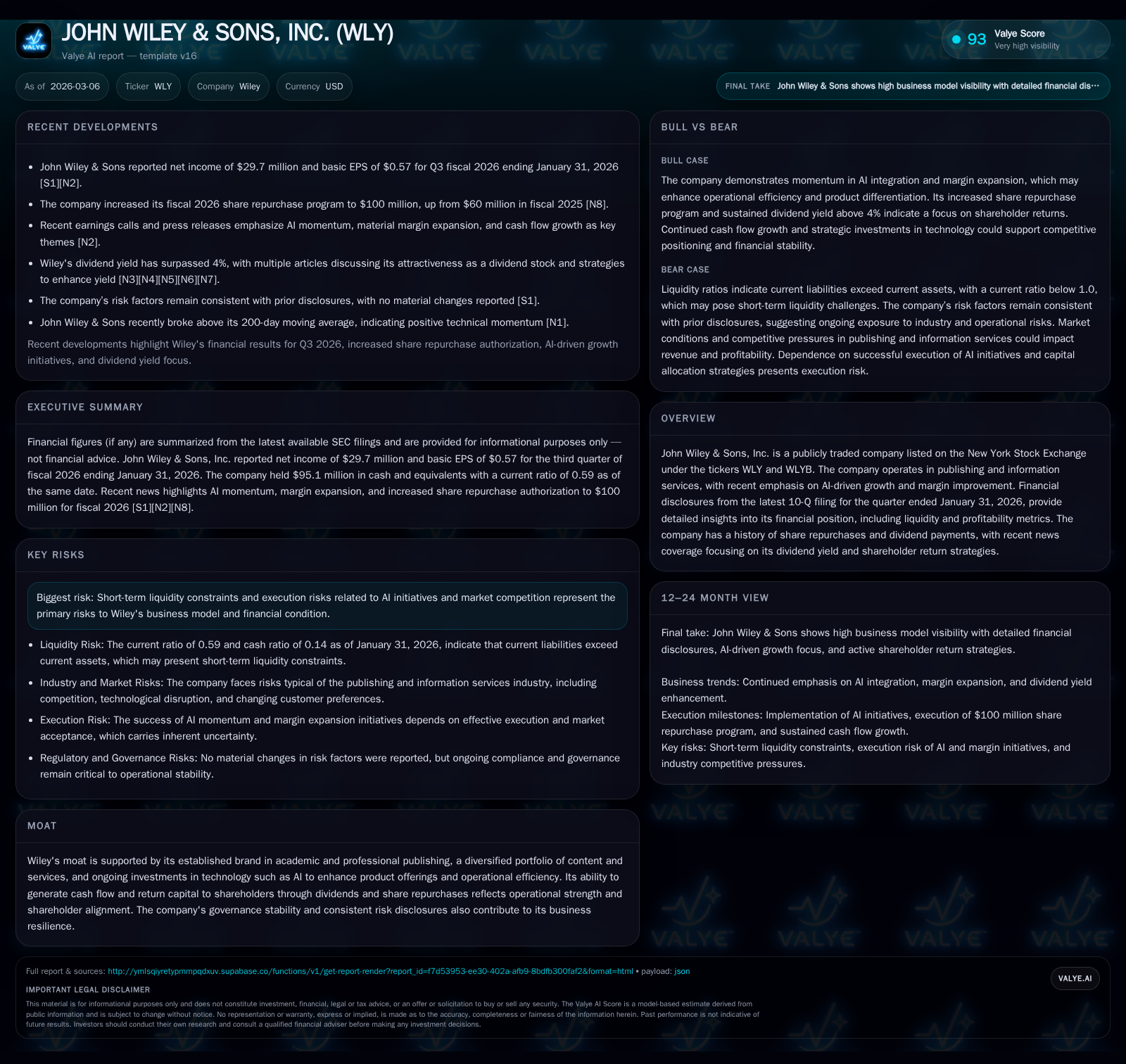
John Wiley & Sons experienced a remarkable turnaround in operating income and net earnings despite a significant decline in revenue in recent years, reflecting operational efficiencies and strategic portfolio focus. The company is increasingly leveraging AI-driven platform enhancements and automation to innovate content delivery and improve margins, positioning itself for growth in a transforming publishing landscape. Meanwhile, robust share repurchase programs and consistent dividends underscore Wiley’s commitment to returning value to shareholders. Execution risks around AI initiatives and liquidity constraints warrant ongoing attention.
Historical Trajectory: From Revenue Decline to Operating Income Surge
Over the period spanning fiscal years 2023 through 2025, John Wiley & Sons demonstrated a striking financial evolution marked by a pronounced contraction in top-line revenue paired with an outsized improvement in profitability metrics. Revenue plummeted approximately 72% year-over-year from $1.87 billion in FY2024 to $520 million in FY2025 [F1]. This dramatic decline contrasts sharply with operating income's resurgence during the same interval, which soared by nearly 324% from about $52 million to over $221 million [F1]. Net income mirrored this volatility: turning around from a substantial loss exceeding $200 million in FY2024 to a positive $84 million thereafter.
This dichotomy indicates that Wiley has likely implemented rigorous operational efficiency measures or recalibrated its portfolio strategy—possibly divesting lower-margin businesses or shifting focus towards higher-value segments—with the intent of enhancing margin resilience even as overall sales soften. Despite top-line headwinds, operating cash flow remained relatively consistent, declining only modestly by about 2% between FY2024 and FY2025 [$207M vs. $203M][F1], underscoring effective working capital management amid revenue pressures.
Historical performance (annual)
| FY | Net ($mm) | CFO ($mm) | OpInc ($mm) | Capex ($mm) | Net YoY |
|---|---|---|---|---|---|
| 2025 | 84 | 203 | 221 | 61 | +142.0% |
| 2024 | -200 | 208 | 52 | 76 | -1262.4% |
| 2023 | 17 | 277 | 56 | 81 | -88.4% |
| 2022 | 148 | 339 | 219 | 89 |
Source: SEC companyfacts cache [F1].
Capital returns and efficiency (annual)
| FY | Div ($mm) | Buybacks ($mm) | FCF ($mm) |
|---|---|---|---|
| 2025 | 76 | 60 | 141 |
| 2024 | 77 | 45 | 132 |
| 2023 | 77 | 35 | 196 |
| 2022 | 77 | 30 | 250 |
Source: SEC companyfacts cache [F1].
Note: Revenue figures for FY2025 appear significantly reduced; this may reflect a reclassification or divestiture impacting segment reporting rather than pure organic performance [F1].
AI Initiatives and Technology Investments Spearheading Future Growth
Wiley's recent disclosures and management commentary emphasize a strategic pivot toward embedding artificial intelligence within its publishing ecosystem, aiming both at augmenting product innovation and accelerating operational efficiencies [N1][S2]. The company is advancing initiatives such as deploying machine learning-enabled platforms that facilitate personalized content recommendations for academic research communities alongside streamlining peer-review workflows via automation.
This content digitization pipeline represents not only an incremental revenue opportunity but also an operational lever for scaling content dissemination without proportional increases in cost base—key for margin expansion given legacy print-heavy models entrenched across academic publishing [N1]. However, such projects carry typical execution risk headwinds endemic to technology rollouts — including integration challenges with legacy systems and user adoption thresholds [S4][S5][S6]. Furthermore, maintaining data integrity across diverse scholarly datasets requires sophisticated governance protocols.
Key Upcoming Milestones and Market Expectations to Monitor
Investors and analysts should vigilantly track developments around clear milestones slated for fiscal year 2026:
- Incremental revenue contribution from AI-powered products as percent of total top line — management commentary suggests acceleration but precise quantification remains forthcoming [N1][N2].
- Continued margin expansion linked to productivity gains attributable to technology investments highlighted during recent earnings calls [S2][N1].
- Updates on the expanded share repurchase program announced December 2025, with an increased budget of $100 million for FY2026 aimed at supporting earnings per share growth [S7].
- Stability or growth trends in dividends per share amidst earnings quality improvement trajectories [N3][N4][N5].
These watch points collectively will reflect the degree of operational leverage gained from Wiley’s digital transformation endeavors alongside capital return efficacy.
Capital Allocation Strategy: Dividends, Share Repurchases, and Liquidity Position
Wiley maintains a disciplined approach toward capital allocation that balances shareholder returns with flexible liquidity management—a critical consideration given its current ratio of approximately 0.59 as of January 31, 2026 [F1][S9]. A current ratio below one signifies working capital tightness that necessitates prudent cash stewardship yet does not necessarily denote distress if supported by robust cash flows.
The firm reported consistently strong dividend payments totaling roughly $76 million in FY2025, closely aligned with prior years despite earnings volatility [F1]. Complementing dividends is an aggressive buyback policy evidenced by repurchases scaling up from $30 million in FY2022 to over $60 million most recently [F1][S7], supported by cumulative authorization limits well above current execution levels.
Operating cash flow generation approximated $203 million against capex spending near $61 million last fiscal year yielding free cash flow near $141 million—a positive indicator underpinning sustainable shareholder distributions [F1]. Its return on equity measured about 11.2%, signaling effective use of equity financing despite sector-specific cyclicality.
Managing Risks: Execution Challenges and Short-Term Liquidity Considerations
Risk disclosures reaffirm no material changes since prior filings but reiterate ongoing concerns surrounding:
- Execution risks related to scaling AI-driven platforms amid evolving technology integration demands and competitive pressure within digital content services arenas [S4][S5][S6].
- Short-term liquidity constraints reflected by suboptimal current ratio indicating potential working capital strain requiring active management across receivables and payables cycles [S9][S10][S16].
- The interplay between rapid innovation cadence and necessary conservatism in capex allocation balancing technological ambition against financial flexibility.
These factors underscore the importance of agile governance frameworks capable of navigating uncertainty while preserving Wiley’s transformation momentum.
Wiley’s Strategic Moat in Academic and Professional Publishing
Beyond raw financials lies Wiley's entrenched position driven by decades-old brand equity prized within scholarly communities worldwide coupled with a diversified portfolio spanning education, professional content, research tools, and data services — all increasingly enhanced through digital technology investment.
Its moat benefits further from exclusive institutional relationships renewing contract cycles regularly alongside intellectual property assets that deter facile replication. Management stability combined with transparent risk communication practices reinforce investor confidence while providing strategic continuity during this tech-centric transition.
In summary, Wiley's trajectory reflects a balancing act between restructuring legacy revenue streams downward while reinvesting strategically behind AI-powered growth vectors supported by measured capital return policies—a complex but potentially rewarding path within heterogeneous academic publishing markets.
Disclaimer: The analysis is based solely on information available as of March 6, 2026. It includes no investment recommendations or price targets.
Disclaimer: This is research-only, informational analysis and not investment advice. It may include AI-generated interpretation and general industry context. Always verify important details using primary sources.

Comments