
Independent Bank Corp's Reversal: From Earnings Decline to Strategic Reset
Independent Bank Corp experienced a sharp earnings decline in 2025 but maintained robust operating cash flow while recalibrating capital allocation amid credit and liquidity challenges.
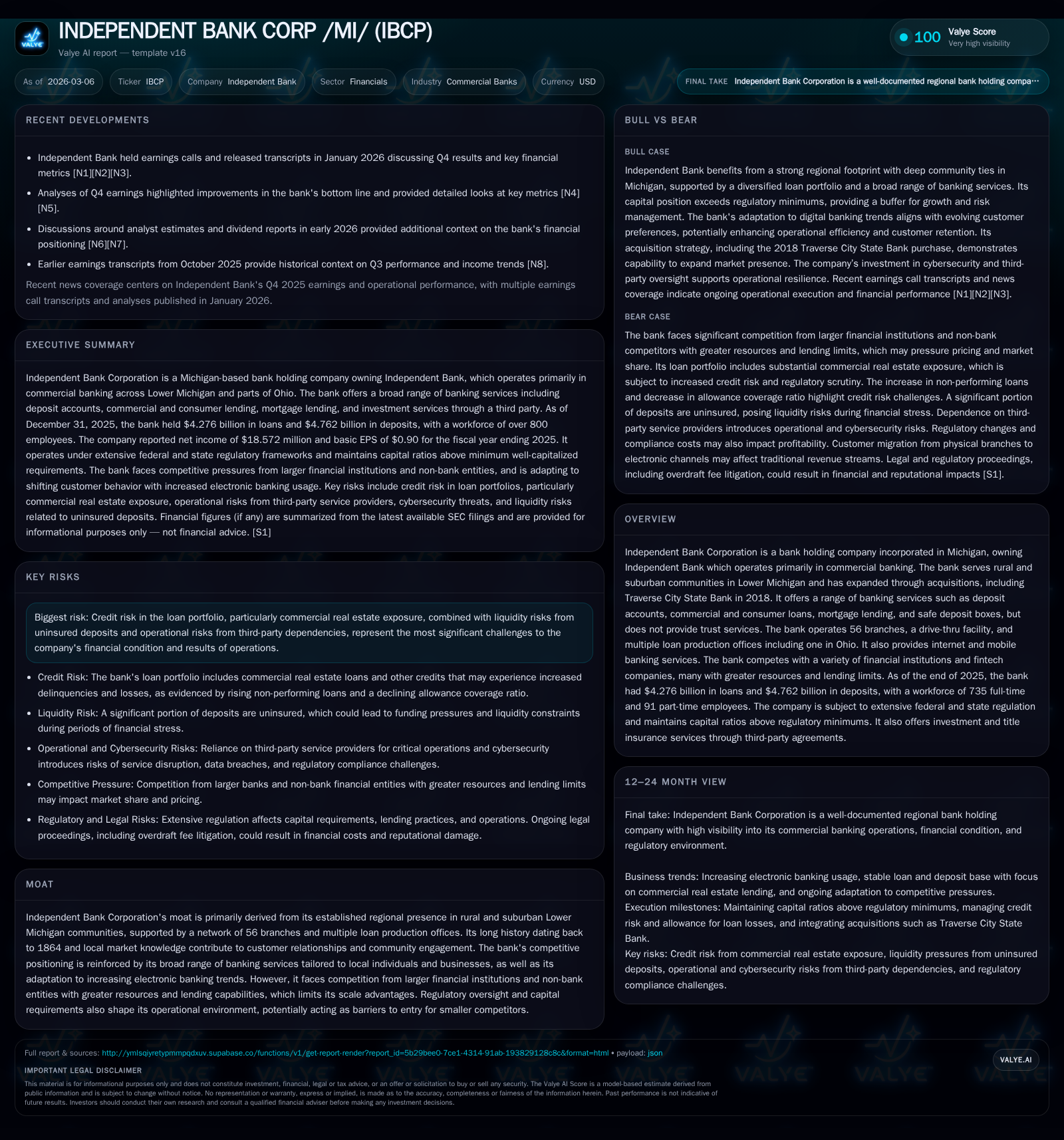
Independent Bank Corporation (IBCP), a regional Michigan-based bank holding company, reported a dramatic 72% year-over-year net income drop in fiscal 2025 despite a 21% increase in operating cash flow. The earnings pressure was driven by elevated credit loss provisions related to growing non-performing commercial real estate loans and margin compression in a competitive market. The bank’s capital position remains solid with well-capitalized Tier 1 ratios exceeding regulatory minima, enabling continued dividends and a resurgence in share repurchases. Going forward, management emphasizes strategic balance between credit risk monitoring, liquidity preservation amid uninsured deposit exposure, and targeted growth initiatives within its established regional footprint.
A Steep Downturn: Independent Bank’s Earnings and Key Growth Drivers in Recent Years
Fiscal year 2025 marked a pronounced reversal for Independent Bank Corp as net income fell sharply by approximately 72%, dropping from $66.8 million in FY2024 to $18.6 million [F1]. This collapse contrasts markedly with operating cash flow, which increased by over 21% to $76.7 million. Such divergence highlights the unusual financial dynamics the bank faced: strong underlying cash generation coexisted with significant accrual-based charges hurting bottom-line profitability.
This contraction was influenced primarily by increased credit loss provisions amidst a challenging economic environment impacting borrowers — notably concentrated within commercial real estate (CRE) segments — alongside some compression of net interest margin due to competitive pressures [N1][S1]. Capital expenditures declined year-over-year by about 18%, from $7.95 million down to $6.49 million, reflecting cautious discretionary spend against profitability headwinds [F1]. Meanwhile, shareholders’ equity grew nearly 11% from $454.7 million to just over half a billion USD, partly buoyed by retained earnings despite low income levels [F1]. Dividend payouts increased slightly despite diminished earnings power, emphasizing management's commitment to shareholder distributions [F1][S25].
Historical performance (annual)
| FY | Net ($mm) | CFO ($mm) | Capex ($mm) | Net YoY |
|---|---|---|---|---|
| 2025 | 19 | 77 | 6 | -72.2% |
| 2024 | 67 | 63 | 8 | +13.1% |
| 2023 | 59 | 76 | 6 | -6.8% |
| 2022 | 63 | 95 | 6 |
Source: SEC companyfacts cache [F1].
Capital returns and efficiency (annual)
| FY | Div ($mm) | Buybacks ($mm) | FCF ($mm) |
|---|---|---|---|
| 2025 | 22 | 12 | 70 |
| 2024 | 20 | 0 | 55 |
| 2023 | 19 | 5 | 70 |
| 2022 | 19 | 4 | 89 |
Source: SEC companyfacts cache [F1].
Table: Historical Financial Metrics Overview for Independent Bank Corp highlighting steep net income drop alongside key cash flows and capital allocation metrics [F1]
Sectoral terms such as net interest margin compression were evident as rising deposit costs amidst heightened competition squeezed spreads; simultaneously elevated credit loss provisions reflected worsening borrower performance especially in CRE portfolios pressured by higher rates and demand shifts.
Loan Portfolio Dynamics and Credit Risk: The Underlying Challenges
The deterioration in net income is closely tied to mounting credit risks within Independent Bank’s loan portfolio. At year-end 2025 non-performing loans ballooned to $23.1 million from just $6 million the prior year—a near fourfold surge—largely driven by stressed CRE exposures representing roughly a quarter of total loans ($1.055 billion out of $4.276 billion total) [S4][S10][S13]. This concentration subjects the bank to intensified regulatory scrutiny given ongoing sector stress across office properties and other sub-segments adversely affected by macroeconomic factors like interest rate hikes and tenant demand shifts.
While management increased the allowance for credit losses during the year to buffer against probable defaults it was insufficient relative to burgeoning non-performing loans—driving a steep decline in the coverage ratio from nearly 990% down to approximately 274%, signaling heightened vulnerability [S10]. Such swings underscore rising charge-offs risk as collateral values fluctuated and borrowers struggled under tighter financial conditions.
The bank employs active risk mitigation strategies including more conservative underwriting standards post-2023 banking sector turmoil and enhanced watch-list monitoring but faces inherent uncertainty given broader economic volatility and sector-specific headwinds.
Regional Footprint and Competitive Environment: Scale and Market Position
Operating predominantly across rural and suburban regions of Lower Michigan—with a network of 56 branches plus specialized loan production offices including one situated outside Michigan in Ohio—the bank maintains entrenched local market knowledge dating back to its founding in 1864 that bolsters customer relationships and community presence [S7][N2].
Nevertheless IBCP competes vigorously not only against large national banks but also against well-funded fintech entities offering scalable lending platforms with broad resource pools and lending limits often exceeding those available regionally—a dynamic exerting downward pressure on traditional product pricing including deposits and commercial loans.
A noted shift toward electronic channels has prompted investment in internet and mobile banking capabilities; concurrently branch transaction volumes decline but remain critical for service differentiation in less urbanized communities fostering loyalty—the moat thus resides chiefly in local expertise combined with service convenience rather than scale economies alone.
Capital Allocation Decisions: Balancing Dividends, Buybacks, and Investment
Despite pronounced earnings challenges reflected in subdued ROE (~3.7%) derived from net income relative to equity base [$18.6M / $503M] indicating diminished profitability returns [F1], Independent Bank resumed sizable shareholder capital return through reinstated repurchases totaling $12.43 million after no buybacks occurred during the prior year cycle [F1][S25]. Dividend payments concurrently edged up marginally reinforcing consistent payout philosophy albeit constricted by regulatory limitations on upstream dividends from subsidiary banks.
This approach signals management’s calibrated strategy prioritizing balanced capital deployment aimed at maintaining investor confidence while preserving sufficient regulatory capital buffers essential for underwriting expansion initiatives or absorbing unforeseen credit shocks given Tier 1 ratios comfortably above minimum regulatory thresholds as of December 31st 2025 [S8][F1]. Capital conservation remains paramount amid macro uncertainties constraining aggressive return enhancement but enabling tactical flexibility.
Liquidity Management Amid Market Volatility and Regulatory Demands
Liquidity represents a critical strategic focus given evolving depositor behavior post-2023 banking failures marked by rapid uninsured deposit withdrawals at peer institutions raising alarms industry-wide [S5][S23]. Independent Bank’s uninsured deposits approximated $1.176 billion accounting for nearly one-quarter of total deposits ($4.762 billion), exposing vulnerability to potential sudden outflows despite diversification efforts including contingent liquidity facilities and broad funding sources aimed at mitigating refinancing risks during stress scenarios.
Sound liquidity coverage ratios alongside compliance with stringent federal bank regulatory stress testing requirements underpin resilience yet require constant monitoring especially considering ongoing deposit insurance premium adjustments potentially influencing pricing strategies.
Furthermore operational dependence on third-party service providers introduces additional layers of risk necessitating rigorous vendor management protocols amidst increasing regulatory oversight highlighting cybersecurity importance within bank operational continuity frameworks [S13][S24].
Forward View: Prospects for Growth and Strategic Initiatives
Looking ahead management articulated during recent earnings calls intentions to cautiously expand the loan book predicated on disciplined underwriting coupled with enhancing deposit gathering capabilities leveraging regional customer trust fortified through community engagement programs ([N1],[N3]). Strategic emphasis also includes technology investments aimed at elevating digital banking adoption rates balancing traditional service values against fintech disruption realities.
However growth trajectories face constraints emanating from prevailing economic uncertainties influencing borrower creditworthiness particularly within sensitive CRE segments alongside sustained competitive intensity pressuring margin expansion capabilities; regulatory capital requirements impose further growth moderation ensuring prudential safeguards remain intact [S4],[N3].
The interplay of these forces requires nimble maneuvering encompassing agility around product innovation while maintaining foundational risk management architecture essential for sustainable franchise development.
Key Milestones Ahead: What to Monitor in Upcoming Quarters
Investors and analysts should focus on sequential quarterly updates detailing asset quality evolution particularly movements within non-performing loan balances and allowance adequacy adjustments which will signal emerging credit trends impacting profitability recovery potential ([N4],[N5]). Monitoring dividend declaration patterns alongside any shifts in capital deployment strategies provides insight into management confidence aligned with regulatory stance.
Regulatory developments related to baseline capital ratios or deposit insurance arrangements are additional catalysts likely affecting cost structures or funding profiles warranting close attention.[N4] Upcoming financial disclosures scheduled across the first half of calendar year 2026 will serve as valuable barometers validating strategic execution progress without projecting unsubstantiated targets beyond stated guidance within existing public disclosures.
Disclaimer: This analysis is based exclusively on information available through publicly filed SEC documents and verified news sources as of March 2026 without extrapolation beyond disclosed facts or issuance of investment advice.
Disclaimer: This is research-only, informational analysis and not investment advice. It may include AI-generated interpretation and general industry context. Always verify important details using primary sources.

Comments