
Hennessy Capital Investment VII: Unpacking the Journey from SPAC Formation to Public Merger
HVII is a Cayman Islands SPAC focused on industrial tech and energy transition sectors, advancing toward a transformative merger with ONE Nuclear.
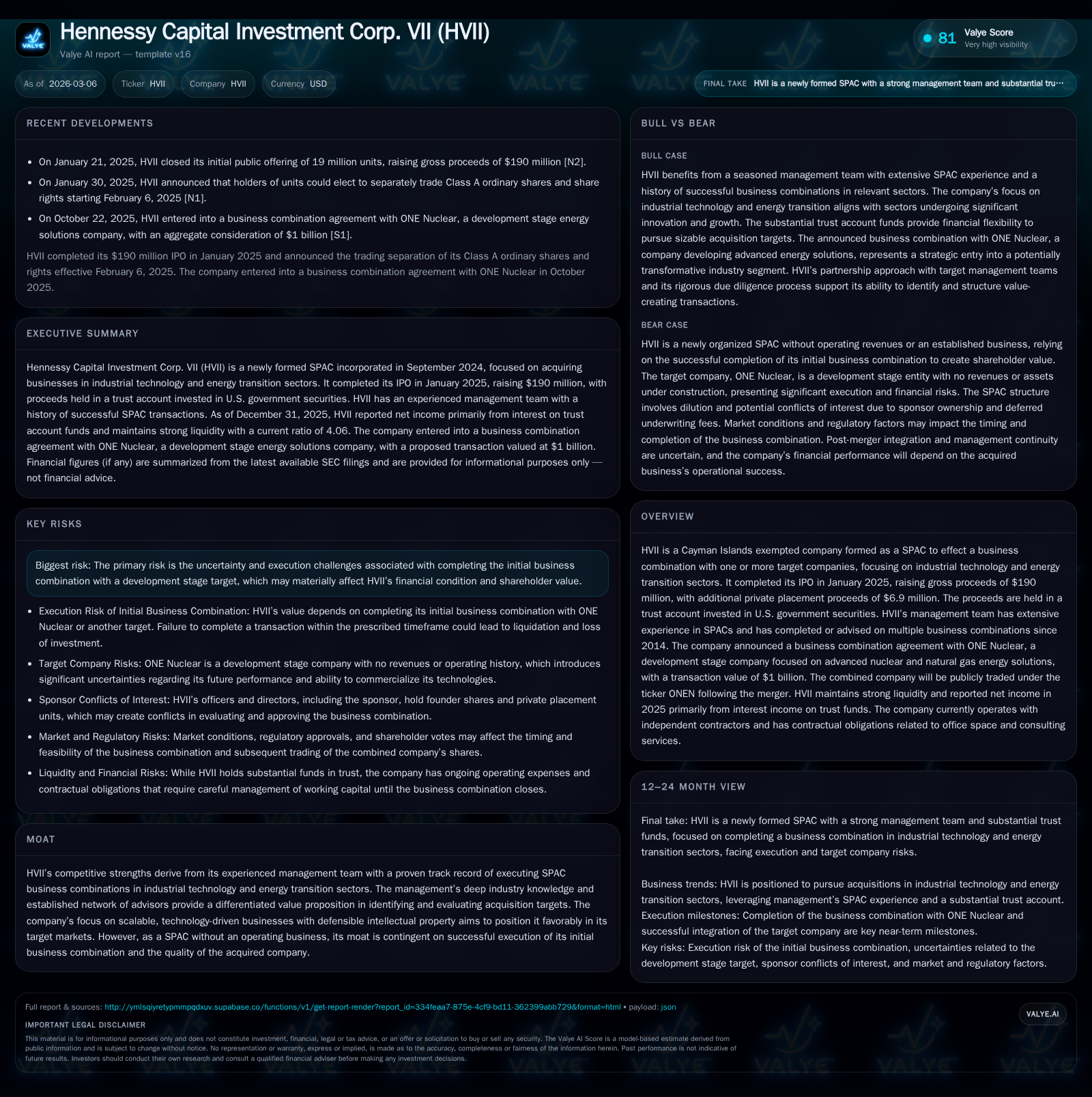
Hennessy Capital Investment Corp. VII (HVII) emerged in late 2024 as a vehicle to pursue business combinations within industrial technology and energy transition markets. Having raised approximately $197 million through its IPO and private placement in early 2025, HVII holds these proceeds in a trust account invested in low-risk U.S. treasury securities, preserving capital ahead of its initial business combination. The company has announced a transaction to merge with ONE Nuclear, an advanced nuclear and natural gas solutions developer, transitioning from a shell to a publicly traded operating entity under the ticker ONEN. HVII’s experienced management team brings strong sector know-how and prior SPAC execution track records, but the partnership carries customary challenges associated with executing deals involving development-stage targets. Financially, HVII shows typical SPAC expense patterns offset by interest income from trust assets and maintains substantial liquidity for near-term corporate activities and transaction completion.
SPAC Genesis and Capital Formation: Raising the Foundation
Hennessy Capital Investment Corp. VII (HVII) was established as a Cayman Islands exempted company in September 2024, with a mandate to facilitate mergers or similar business combinations within industrial technology and energy transition sectors [S1][S15]. The company successfully completed its initial public offering (IPO) on January 21, 2025, issuing 19 million units—including an over-allotment exercise—at $10 each, grossing approximately $190 million [S1]. Concurrently, HVII raised an additional $6.9 million through private placements sold to its sponsor and underwriters, totaling nearly $197 million of gross proceeds for capital deployment [S15].
Critically, proceeds excluding underwriting fees were deposited into a U.S.-based trust account invested conservatively in government treasury obligations with maturities capped at 185 days or money market funds adhering to Rule 2a-7 investment regulations [S1][S15]. This structure ensures investor capital protection before consummation of any business combination.
HVII incurred roughly $12.6 million in offering costs including significant deferred underwriting commissions approximating $7.6 million—a notable expense line typical of such capital raises [S15]. Management boasts seasoned expertise originating from over thirteen previous SPAC transactions targeting industrial tech and energy-transition-related companies globally since 2014—providing critical deal sourcing prowess amid competitive acquisition landscapes [S8][S21].
Financial Performance Snapshot: The First Year in Numbers
As expected for a nascent special purpose acquisition company without operating revenues, HVII posted an operating loss of approximately $3.66 million for its first full fiscal year ended December 31, 2025 [F1]. These expenses primarily comprise administrative costs related to compliance, corporate staffing (notably CFO remuneration), office leases rising mid-year to $25,000 monthly, and advisory fees linked to transaction preparation [F1][S4][S18].
Despite operational losses, HVII reported net income of about $3.69 million owing to interest income earned on the large cash balances held in its trust account invested primarily in low-risk U.S. treasuries [F1][S3]. This positive net result reflects effective capital preservation strategies rather than underlying business operations.
The company's balance sheet shows strong liquidity metrics: cash & equivalents outside the trust approximate $0.98 million; current assets total roughly $1.33 million against current liabilities near $0.33 million yielding a robust current ratio exceeding four times—signaling comfortable short-term financial flexibility pending business combination closure [F1]. Return metrics such as ROE remain negative around -40.7%, influenced by limited equity base against modest net income driven mostly by non-operational earnings at this stage [F1].
Historical performance (annual)
| FY |
|---|
| 2025 |
Source: SEC companyfacts cache [F1].
Strategic Merger with ONE Nuclear: A Growth Catalyst or Execution Challenge?
In October 2025 HVII entered into an agreement to merge with ONE Nuclear—a development-stage enterprise focusing on advanced nuclear and natural gas technologies—marking HVII’s inaugural business combination designed to transform itself from a blank-check entity into an operating publicly traded company on Nasdaq under new ticker ONEN post-merger [S1].
The targeted industry aligns squarely within HVII's stated investment thesis emphasizing energy transition technologies supported by scalable IP-driven platforms addressing critical market needs for cleaner energy solutions amid global decarbonization forces [S19]. However, focusing on development-stage targets inherently introduces execution risk including valuation uncertainty, integration complexities, funding sufficiency considerations given redemptions rights exercised by public shareholders at closing, as well as timing pressures under strict regulatory deadlines for completing initial combinations typically spanning two years post-IPO (~January 2027 threshold here) [S1][S2].
While management expertise in industrial technology sectors lends credibility toward successful navigation of these challenges accumulated over multiple prior transactions since 2014—the definitive outcome depends heavily upon ONE Nuclear’s development progress and market receptivity once public trading commences.
Industrial Technology and Energy Transition: Sector Dynamics Behind HVII's Targeting
HVII’s strategic focus concentrates on companies exhibiting defensible intellectual property within industrial technology or energy transition domains characterized by potential for scalable sustainable growth platforms enabled by automation improvements, efficiency enhancements and safety optimization technologies fundamental in contemporary manufacturing or energy industries [S19].
The management team aims to leverage differentiated technology-based innovation combined with robust platform offerings targeting high barriers-to-entry facilitated by patents or proprietary know-how—key factors deemed critical amidst increasing competition for quality acquisition targets within these capital-intensive sectors where rapid scalability requires strong managerial partnerships post-merger [S19][S21].
Given broader industry trends favoring electrification alternatives alongside specifically nuclear energy resurgence interest under decarbonization policies plus advances in natural gas integration technologies—the chosen sector alignment fits well within compelling macro tailwinds yet remains subject to regulatory constraints and technological validation risks common among early-stage ventures.
Liquidity Profile and Capital Structure: Trust Account Strengths and Constraints
As of December 31, 2025, HVII holds approximately $197 million within its segregated trust account invested conservatively per IPO agreements mostly in short-duration U.S Treasury securities that secure principal against volatility ahead of any approved business combination closing date slated by January 21, 2027 (unless extended) [F1][S4][S5].
Outside this trust balance sits close to one million dollars in unrestricted cash supporting working capital requirements as well as contractual monthly administrative expenses including office rent ($25k/month), CFO compensation ($10k/month), consulting/advisory fees (~$11k/month plus discretionary bonus), cumulatively accounting for several hundred thousand dollars annually spent while searching for suitable acquisition targets or closing transactions prior to merger finalization [F1][S4][S18].
HVII does not carry any long-term debt obligations except nominal promissory notes predominantly repaid at IPO closing; however it retains capability—though no immediate plans—to secure additional financing through equity or convertible debt instruments contemporaneously with its initial business combination if needed due to size constraints correlated with target enterprise valuations exceeding cash reserves net redemptions exercise exposure during merger consummation stages [S26][S16].
Notably, management has flagged substantial doubt about going concern existence conditional only upon failure to execute a timely business combination before mandatory dissolution date mandated by regulation—underscoring critical dependency on deal closure by January 2027 or earlier [S4][S16].
Capital Allocation Outlook: Sponsor Alignment and Investor Impact
HVII’s sponsor holds founder shares supplemented by private placement units purchased shortly after IPO totaling nearly seven hundred thousand units predominantly acquired at IPO-associated prices; crucially this sponsor position is contractually agreed upon not to exercise redemption rights during the initial business combination thus aligning insider incentives toward transaction success while limiting initial dilution potential derived from founder shares conversion anti-dilution provisions relevant post-merger capitalization adjustments occurring should excess share issuance transpire during acquisition structures [S6][S13][S14].
The SPAC structure inherently constrains payouts such as dividends or buybacks prior to completion of the initial business combination reflecting absence of operational cash flow generation requiring deployment toward identification due diligence efforts or initial target investment consideration costs rather than investor returns programs typical for established operating firms during this phase [S6][S8].
Underwriter commissions amounted to approximately four percent aggregated across cash payments including deferred portions lifted off at IPO time reducing net proceeds available; this manifest cost should be factored when considering implied returns scenarios given eventual redemption pricing for investors redeeming shares at approximately $10 plus accrued interest from trust assets minus redemption-related taxes/netting [S15][F1]. Redemption mechanisms accommodate public shareholders’ ability to exit prior to merger closing offering downside protection against unforeseen failures though potentially impacting resource availability if redemptions aggregate notably against total estimated transaction funding requirements.
Risks Embedded in Early-Stage Business Combinations: Striking the Balance
Key risks emerge principally from uncertainties inherent in consummating the initial business combination involving ONE Nuclear—a development-stage entity whose valuation metrics involve projections subject to material variability relative to later-stage companies possessing revenue history or profitability comparables.[S1] Dilution risk exists via share issuance expansions tied to deal structuring accommodating purchase prices above trust fund capacity net redemptions exercised during proximate shareholder votes or tender offers post-announcement.[S2] Additional risks include possible debt issuance encumbrances carrying seniority over equity after merger if external financing is employed.[S12]
Regulatory approvals coupled with successful shareholder votes represent critical checkpoints both enabling completion but also introducing event risk whereby failure could trigger mandatory liquidation minimizing recovery values.[S1] Moreover underwriting fee amortization reduces net merger consideration available impacting accretion assumptions relevant during valuation models applied by investors evaluating combined entity prospects.[S15]
The contingent moat described hinges extensively on navigating these transactional complexities while leveraging long-standing industry insight characteristic of management’s prior multi-decade involvement across over thirteen similar SPAC-sponsored transactions globally.[S8]
Looking Ahead: Milestones Investors Should Track
The foremost near-term milestone resides in closing the business combination within mandated timeframes set forth by Nasdaq listing rules generally requiring completion within two years from IPO effectively placing firm deadline at January 21, 2027 absent extensions approved by shareholders informed through proxy solicitations.[S1]
Investors should attentively monitor aggregate redemption requests after formal announcement disclosures which implicate available deal funding levels alongside management statements regarding supplemental financing arrangements via debt or equity expected concomitantly at merger closing.
Upon consummation trading will commence under ticker ONEN fostering scrutiny based on ONE Nuclear’s developmental progress milestones alongside broader industry dynamics encompassing regulatory developments affecting nuclear energy acceptance or natural gas transition technologies.
Sponsor behavior regarding possible open-market purchases precluding dilution effects serves as another signal reflecting confidence levels although governed strictly under insider trading policies consistent with federal securities law.[S6][S13]
Overall success predicates not only on effective deal execution but also on post-merger operational scaling capabilities bolstered through strategic partnerships that align executive leadership shared vision—components underscored repeatedly throughout HVII’s strategic communications.
Disclaimer: This report is for informational purposes only regarding Hennessy Capital Investment Corp. VII’s corporate activities and financial disclosures as publicly filed or reported; it does not constitute investment advice or recommendations.
Disclaimer: This is research-only, informational analysis and not investment advice. It may include AI-generated interpretation and general industry context. Always verify important details using primary sources.

Comments