
ANAPTYSBIO's Financial Surge and Clinical Ambitions in 2025
ANAPTYSBIO achieved a striking operating income turnaround in 2025, aligned with pipeline progress and strategic capital deployment despite ongoing clinical and operational risks.
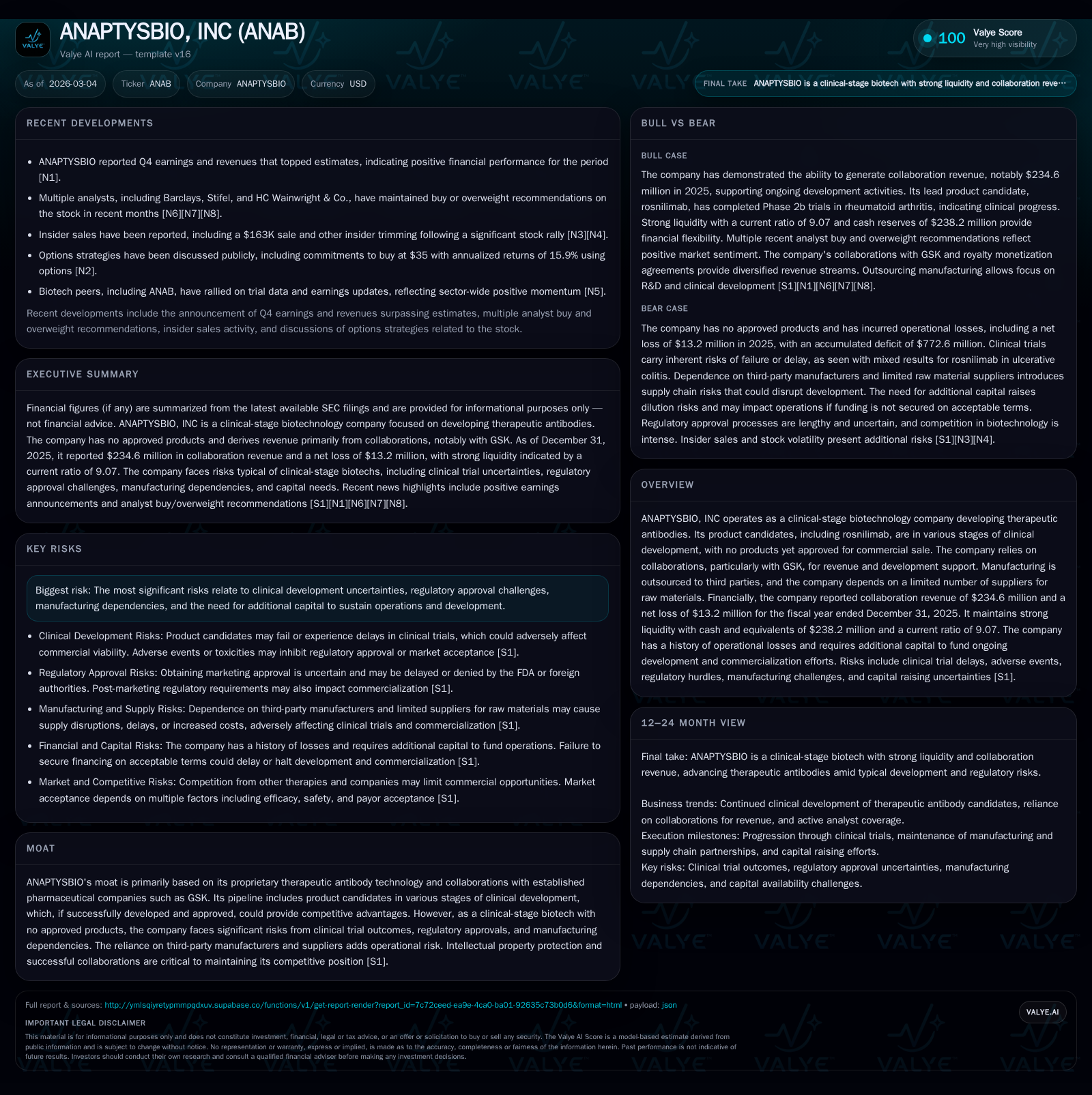
In FY2025, ANAPTYSBIO transitioned from chronic operating losses to positive operating income, driven by strengthened collaboration revenues primarily from GSK and disciplined cost management. The company’s flagship antibody candidate, rosnilimab, is positioned for potential Phase 3 advancement, marking a crucial clinical inflection point that could unlock future regulatory approvals. Despite reporting a net loss, substantial positive operating cash flow and a robust liquidity buffer of over $238 million underpin near-term development plans and buyback activity. Nonetheless, risks remain sizable around clinical trial outcomes, manufacturing dependencies on contract developers, regulatory hurdles, and ongoing intellectual property litigation.
From Operating Losses to Positive Operating Income: Fiscal 2025 Financial Performance
ANAPTYSBIO’s fiscal year 2025 marks a financial watershed moment as the company emerged from years of heavy operating losses into positive operating income territory. The company reported operating income of approximately $47.9 million for the year ended December 31, 2025, reversing a significant operating loss of $114.9 million recorded in FY2024 — reflecting an extraordinary improvement of 141.7% YoY [F1]. This leap aligns with robust collaboration revenue realized primarily through its partnership with GSK, as evidenced by the reported $234.6 million collaboration revenue stream [S1][N1].
Importantly, while ANAPTYSBIO recorded a net loss of nearly $13.2 million during the same period, this figure represents an improvement of over 90% relative to prior year losses totaling $145.2 million [F1], underscoring narrowing bottom-line deficits as operational leverage takes hold.
The transition to profitability-like operating performance was supported by an encouraging turning point in operating cash flow (CFO), which swung positive to $19.7 million from a prior negative cash burn exceeding $135 million in FY2024 [F1]. This source of internal funds highlights effective working capital management alongside increased milestone-related receipts.
Capital expenditures remained minimal at under $100,000 for the year — reflective of ANAPTYSBIO’s clinical-stage status without commercial manufacturing footprint expansion [F1]. The financial turnaround story is emblematic of maturation from early-stage biotech spending into monetizing collaborative assets.
Historical performance (annual)
| FY | Net ($mm) | CFO ($mm) | OpInc ($mm) | Capex ($) | Net YoY |
|---|---|---|---|---|---|
| 2025 | -13 | 20 | 48 | 87000 | +90.9% |
| 2024 | -145 | -135 | -115 | 358000 | +11.2% |
| 2023 | -164 | -121 | -164 | 807000 | -27.1% |
| 2022 | -129 | -74 | -115 | 358000 |
Source: SEC companyfacts cache [F1].
Capital returns and efficiency (annual)
| FY | Buybacks ($mm) | FCF ($mm) | ROE% |
|---|---|---|---|
| 2025 | 69 | 20 | -35.6 |
| 2024 | 0 | -136 | -204.9 |
| 2023 | 50 | -122 | -185.7 |
| 2022 | -74 | -49.1 |
Source: SEC companyfacts cache [F1].
Note: Collaboration revenue detailed in narrative due to absence of explicit multi-year breakdown.
Dependence on Collaborations and Outsourced Manufacturing: AnaptysBio’s Operational Model
A cornerstone of ANAPTYSBIO’s financial model remains its collaboration with GSK — generating substantial partnered revenue streams manifesting as milestone payments and reimbursements that support R&D expenditure without in-house commercial sales revenue [S1][N1]. These collaborations also serve as de-risking mechanisms by funneling externally funded development capital at scale.
On the manufacturing front, ANAPTYSBIO outsources biologics production functions entirely to third-party contract development and manufacturing organizations (CDMOs), reflecting industry-standard choices for capital efficiency during clinical-stage biotech development [S1]. This CDMO reliance introduces operational leverage but also concentrated supplier risk given limited sourcing alternatives for raw materials essential to therapeutic antibody synthesis [S24]. Such vulnerabilities could complicate clinical supply continuity or lead to escalated manufacturing costs.
The reliance on external partnerships requires meticulous supply chain orchestration across multiple stakeholders with rigorous compliance oversight ranging from current Good Manufacturing Practices (cGMP) adherence to logistics robustness to safeguard timelines vital for clinical program milestones.
Pipeline Development Spotlight: Rosnilimab and Phase Advancement Prospects
Rosnilimab is ANAPTYSBIO’s lead therapeutic antibody candidate currently being evaluated for treatment indications including rheumatoid arthritis (RA). The company is actively assessing data-driven advancement into Phase 3 clinical trials — a critical clinical inflection point that will determine the robustness of efficacy and safety profiles required for regulatory gating factors toward eventual marketing authorization [S1][N1][S3].
The successful transition into Phase 3 would represent biologic lifecycle management maturity by elevating rosnilimab from early exploratory phases through late-stage pivotal testing essential for commercialization preparedness.
Emphasis remains on both safety monitoring and adverse events data that are pivotal regulatory considerations potentially influencing approval timelines or post-marketing commitments per FDA and foreign authority norms [S22][S14].
While rosnilimab draws primary pipeline spotlight, ongoing efforts aimed at expanding candidate portfolios through licensing or internal development remain incomplete — underscoring continued dependency on key asset performance and collaborative expansion prospects [S21].
Capital Efficiency and Shareholder Returns: Buybacks, Cash Flow, and Liquidity Analysis
The pronounced operating cash flow turnaround enabled ANAPTYSBIO not only to cover operational expenditures internally but also initiate meaningful shareholder return practices via share repurchases totaling approximately $68.6 million during FY2025 — a material increase relative to negligible buyback levels just one year prior ($0.456 million) [F1]. This share repurchase program spike signals management confidence in valuation and underscores judicious capital deployment amid limited commercial product revenues.
Cash and equivalents stood robust at approximately $238 million as of year-end 2025 alongside an enviable current ratio north of 9x — collectively affording substantial liquidity cushion to finance near-term clinical investment needs without immediate external funding pressures [F1]. Capital expenditures remained subdued at just $87,000 reflecting tight capital controls typical of clinical-stage firms where product pipeline investment rather than capex drives value creation.
Returns on equity remain constrained given persistent net losses; approximate ROE computes negative at around -35.6%, consistent with early-stage biotech profiles prioritizing growth over profitability at this juncture [F1]. Going forward, cash flow efficiency combined with prudent buybacks sharply contrasts previous multi-year cash burn regimens signaling a maturing balance sheet posture.
Risks Linked to Clinical Trials, Regulatory Hurdles, and Manufacturing Dependencies
ANAPTYSBIO faces inherent sector-specific risks encompassing multiple dimensions:
- Clinical Trials: Uncertainties surrounding efficacy outcomes or discovery of unforeseen toxicities could delay or derail pending trials including rosnilimab’s Phase advancement; initial promising data may not extrapolate consistently into later stages threatening commercial viability [S1][S22].
- Regulatory Approval: Complex FDA pathways coupled with stringent post-marketing obligations impose significant hurdles; failure or prolonged review may stymie market access or inflate compliance costs substantially [S14][S18].
- Manufacturing Dependencies: Outsourced CDMO relationships while efficient pose fragility risks stemming from capacity constraints or supply chain disruptions particularly concerning critical raw materials availability essential for biologics manufacture [S24].
- Intellectual Property Litigation: Ongoing disputes notably with Tesaro/GSK affiliates create uncertainty over patent control rights crucial for competitive positioning; adverse rulings could undermine collaborations or license agreements impacting revenue streams and strategic control [S21][S25]-[S27].
- Product Liability Insurance: Rising costs limit ability to secure adequate coverage protecting against potential claims arising from clinical trial participants or eventual patients; lack thereof risks financial exposure with reputational consequences compounded by increasingly intense healthcare fraud enforcement environment encompassing Anti-Kickback Statute applications among others [S4]-[S8][S13]-[S16].
- Healthcare Reform Pressures: Legislative changes such as ACA modifications or IRA-imposed drug pricing negotiations foreshadow potential downward pressure on pricing power potentially compressing margins upon approval commercialization phases [S12][S15][S18].
Collectively these factors underscore persistent volatility intrinsic to clinical-stage biopharma entities navigating complex regulatory ecosystems amid competitive intensity.
Strategic Outlook: Milestones To Watch and Capital Needs for Commercialization
Looking ahead, pivotal milestones reside heavily around rosnilimab’s progression decision into Phase 3 trials — timely announcements here will materially influence investor sentiment and partnership dynamics given the program’s centrality within ANAPTYSBIO’s pipeline architecture [N1][N2][S3]. Positive Phase 3 outcomes would clear principal hurdles toward Biologics License Application (BLA) filing possibilities while negative results could necessitate portfolio recalibration.
Capital requirements necessary to undertake late-stage trials and establish initial commercial infrastructure remain significant though exact figures have not been explicitly disclosed; ongoing net losses denote unmet funding gaps necessitating future financing strategies—either via equity raises or extended collaborations—though liquidity suffices for near-term operations at present cash levels exceeding $238 million [F1][S1].
Investors should watch announcements relating to:
- Clinical trial enrollment progress,
- Regulatory agency interactions,
- Additional partnership agreements,
- Litigation resolution updates,
- Further share repurchase activities,
- Capital raise initiatives if any.
These constitute key catalysts guiding valuation frameworks amid fundamental milestone inflections characterizing biotechnology growth trajectories.
Conclusion: Balancing Opportunity with Risk in ANAPTYSBIO’s Biotechnology Venture
ANAPTYSBIO’s fiscal year 2025 results epitomize an inflection from persistent losses toward operational earnings positivity driven largely by structured collaboration revenue recognition alongside disciplined cost management and favorable cash flow generation regimes [F1]. The evolving narrative reflects maturation typical of biotech firms transitioning their lead biologic candidates like rosnilimab into late-stage development phases foundational for future revenue generation.
Nonetheless, this transformation exists within a context laden with multifaceted risks encompassing clinical scientific validation uncertainty, stringent regulatory landscapes requiring compliance agility, fragile outsourced supply chains reliant on scattered vendor networks vulnerable to disruption, and ongoing intellectual property litigations weighing heavily on strategic options.
Capital allocation decisions privileging buybacks amidst these dynamics demonstrate measured confidence balanced against unrelenting need for developmental investment while preserving flexibility through ample liquidity buffers.
In essence, ANAPTYSBIO typifies the cyclical nature prevalent across clinical-stage biotechnology companies where scientific breakthroughs must navigate regulatory filters successfully to convert potential into sustainable business models — investors gauging opportunity must weigh tangible progress against inherent binary risk profiles engendered by developmental pipelines lacking approved marketed products at present times.
This analysis is intended solely for informational purposes reflecting publicly available data as of early March 2026 without constituting investment advice or recommendations.
Disclaimer: This is research-only, informational analysis and not investment advice. It may include AI-generated interpretation and general industry context. Always verify important details using primary sources.

Comments