
Hinge Health Harnesses AI and Data to Transform Musculoskeletal Care Economics
HNGE leverages patented AI-powered technology and a subscription-based model to scale digital musculoskeletal care while managing significant operational losses and execution risks.
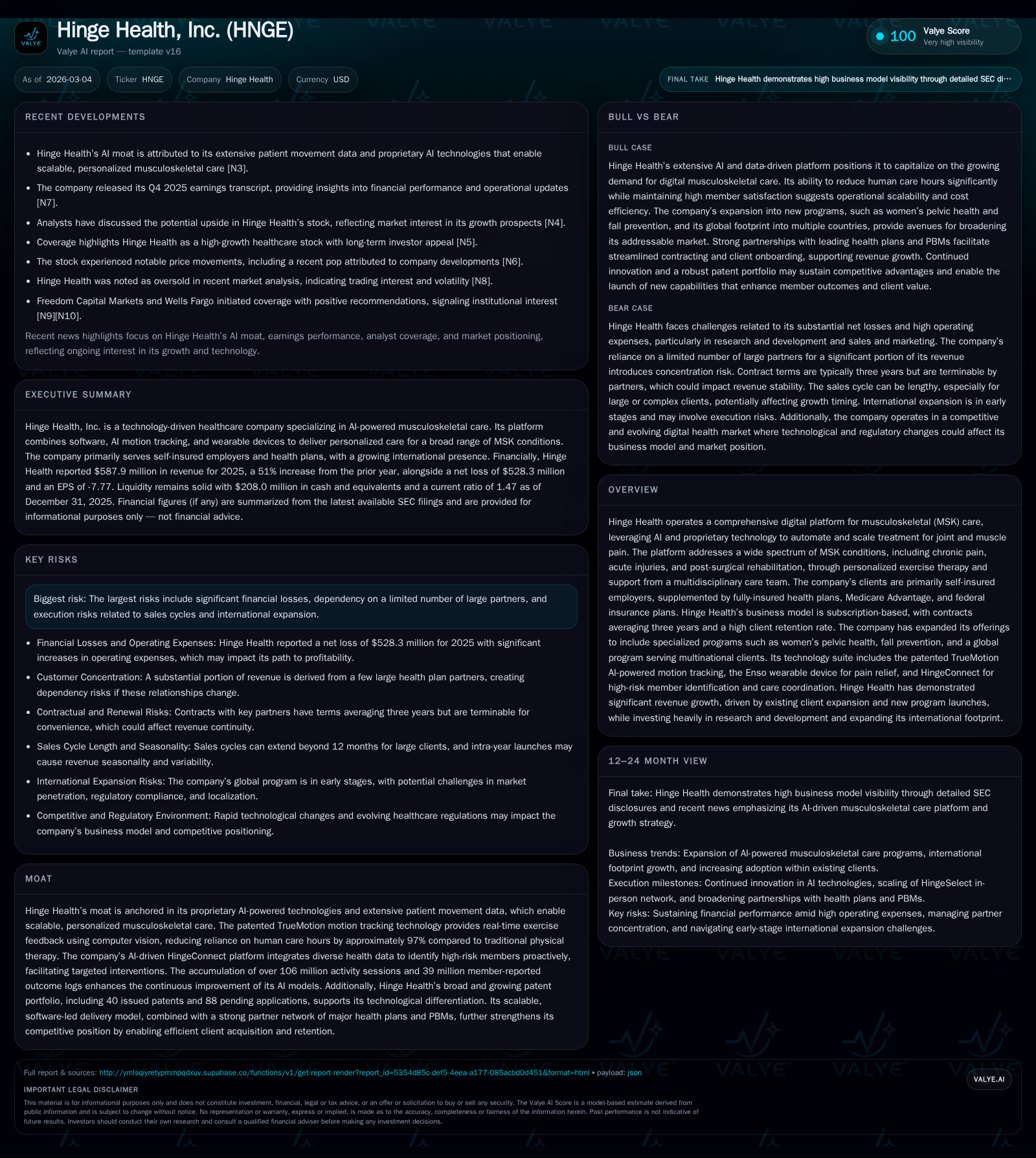
Hinge Health operates an advanced AI-driven platform targeting joint and muscle care inefficiencies, utilizing proprietary TrueMotion computer vision and electrical nerve stimulation wearables. The company’s historical growth, driven by multi-year contracts primarily with self-insured employers and large payers, has resulted in rapid revenue expansion but escalating net losses nearing $528 million in 2025. While its scalable software-led delivery model sharply reduces labor intensity, concentrated client dependencies and regulatory scrutiny pose execution challenges. Capital allocation prioritizes reinvestment over returns amid improving free cash flow metrics, with international expansion and new program launches defining near-term growth milestones.
Proprietary Technology Powers Scalable Pain Management
At the core of Hinge Health's offering is a sophisticated AI-powered platform tailored for musculoskeletal (MSK) conditions that span acute injuries, chronic pain syndromes, and post-surgical rehabilitation [S1][S20][N2]. Their patented TrueMotion technology employs proprietary computer vision algorithms enabling real-time motion tracking without sensors, delivering accurate exercise validation remotely. This not only elevates patient adherence but also drastically slashes reliance on human intervention—reducing care team hours by an estimated 97% compared to conventional physical therapy [S1]. Complementing this is their electrical nerve stimulation wearable device that integrates with their multidisciplinary care team comprising licensed physical therapists, physicians, and board-certified coaches supported by AI. This amalgamation underpins a scalable delivery model where clinical personalization meets automation.
The moat consolidates around extensive longitudinal patient movement data—over 106 million activity sessions are logged—feeding continuous machine learning improvements in outcomes [N2]. Intellectual property rights are robust: the company holds 40 issued patents with another 88 pending applications [S1]. Such breadth substantiates differentiation in a fragmented digital health space where proprietary sensor-less motion tracking remains rare.
Revenue Growth Fueled by Multi-Year Subscription Contracts
Financially, Hinge Health reported revenues reaching approximately $587.9 million in fiscal year (FY) 2025—a notable 51% increase from $390.4 million in FY24 [F1]. This growth reflects successful conversion of a pipeline anchored in multi-year subscription agreements averaging three years as of year-end 2025 [S1][S20]. The clientele predominantly comprises large self-insured employers—including public sector entities such as municipalities—as well as fully insured health plans, Medicare Advantage populations, federal insurance plans, with key partnerships involving TPAs and PBMs facilitating ecosystem integration [S1][S20].
The business model's stickiness derives from exclusivity clauses; typically, Hinge Health operates as the sole digital MSK care provider during contract tenure allowing reactivation of eligible members thereby reinforcing recurring revenues [S1]. Client retention drives stable enrollment across more than 60 strategic partners as of December 31, 2025 [F1].
Historical performance (annual)
| FY |
|---|
| 2025 |
Source: SEC companyfacts cache [F1].
*Operating income for prior year derived from EPS trends [F1][S1]
Path from Rapid Expansion to Accelerated Losses
Despite robust top-line expansion, profitability remains elusive; net loss widened markedly from $11.9 million in FY24 to $528.3 million in FY25 reflecting significant investment outlays [F1][S1][S4]. The surge is primarily attributed to accelerated R&D spending (+265% year-over-year) aimed at amplifying platform capabilities—including recent product additions—and enhancing sales and marketing efforts aimed at deepening client penetration [S16]. Share-based compensation linked with IPO-related vesting also inflated these costs.
Operating income declined accordingly reaching negative $546 million by December 2025 [F1]. While revenue growth stems from existing contracts matured prior years due to sales cycle timing nuances—and accompanying costs forecasted during ramp-up phases—the company faces pressure in balancing sustainable scaling with cost control [S16].
AI-Powered TrueMotion Reduces Care Team Hours by 97%
Among operative metrics often scrutinized within healthcare services operations is 'human care team hours' as a proxy for labor intensity; here Hinge Health’s platform has demonstrated capability to suppress this metric by approximately 97%, representing a transformative efficiency leap relative to traditional physical therapy workflows [S1]. This efficiency gain translates not only into cost mitigation for clients but also enhanced throughput potential allowing broader population coverage without commensurate clinician headcount expansion.
Client Composition: Reliance on Large Self-Insured Employers and Partners
Client concentration risk warrants attention given reliance on major self-insured employers alongside the five largest national health plans by self-insured lives plus top three PBMs by market share among partners as cited at end-2025 [S1][S20]. Inclusion of public sector self-insured entities such as state/local governments adds diversification but still implies dependency on relatively few large contracts.
Contractual relationships typically involve ecosystem intermediaries including TPAs and PBMs which facilitate contracting and operational functions like procurement and billing; this complexity embeds switching friction but simultaneously necessitates maintenance of robust partner relationships to sustain contractual renewal probabilities [S20].
Emerging Programs Expand the MSK Care Continuum
To extend competitive differentiation beyond core digital offerings, Hinge Health has launched targeted programs addressing niche clinical segments—women’s pelvic health debuted in 2022 within chronic care pathways; fall prevention programs initiated in Medicare Advantage demographics starting in 2023; recently added HingeSelect combines high-performance in-person provider networks complementing remote digital services introduced mid-2025 [S1].
These initiatives represent strategic vertical integration advancing 'end-to-end care' positioning which aims both at improving outcomes through holistic programming while continuing cost reduction objectives for clients including employers and health plans.
Capital Structure, Cash Flow Strength, and Returns Under Pressure
Post-IPO capital structure exhibits strong short-term liquidity with cash & equivalents totaling approximately $208 million as of December 31, 2025 alongside marketable securities close to $269 million [F1][S6][S10]. Current ratio stands at a solid 1.47 indicating good near-term asset coverage over liabilities.
Notably free cash flow shifted positively gaining about $179.6 million in FY25 compared to $45.2 million prior year suggesting early manifestation of operating leverage amidst scaling investments despite ongoing GAAP net losses [F1][S12]. This divergence portrays a business investing heavily while beginning to convert scale into discretionary cash generation.
Return on equity contrasts starkly negative near -296%, reflective of accumulated deficits exceeding $1 billion driven mostly by stock compensation expense accounting during growth phases [F1][S1]. No dividends or significant share buybacks have been issued given reinvestment priority though a board-approved repurchase program authorized up to $250 million remains partially utilized highlighting optionality for future capital return strategies [S6].
Scaling Challenges: Execution Risks and Regulatory Striplights
Growth carries intensifying execution risks; management acknowledges extended sales cycles inherent to enterprise healthcare clients combined with geographic expansion complexities placing strain on operational infrastructure particularly regulatory compliance frameworks across jurisdictions [S4][S5][S13].
HingeSelect’s inclusion exposes the company to heightened scrutiny—state insurance regulators periodically audit operations injecting uncertainties around compliance costs or enforcement actions which could materially impact operational practices or finances [S4][S11]. Healthcare fraud-and-abuse laws including anti-kickback statutes impose further compliance demands requiring vigilant oversight.
Future fines or legal proceedings remain possible although none presently threaten material adverse effects per disclosures; nevertheless evolving regulation—particularly relating to data privacy such as HIPAA or GDPR—and auditing environments underscore continuous risk exposure points [S13][S21][S24].
Outlook: What to Watch in Contract Wins, Engagement Metrics, and International Expansion
Looking forward absent explicit numerical guidance published recently by the company or analysts’ consensus models—caution prevails balanced against growth prospects signaled through organic client base expansions evident historically alongside new program deployments flagged in disclosures [N1][N2][N5]. Key milestones include sustained or improved contract renewal rates especially with dominant insurers and large employers; enrollment figures demonstrating member uptake retention trajectories; adoption rates of emerging ancillary programs like pelvic health or fall prevention; measures of active engagement within the TrueMotion framework signifying user adherence; concurrent monitoring of regulatory developments linked with HingeSelect constitutes an operational barometer. International expansion remains referenced narratively but lacks visible quantitative disclosure implying nascent stage requiring assessment on execution effectiveness going forward.
Wall Street interest regarding Hinge Health reflects optimism over AI moat leveraging patient movement data coupled with subscription model continuity balanced against apprehensions about persistent losses and scaling intricacies characteristic of high-growth healthcare tech firms [N5].
Disclaimer: This analysis is based entirely on publicly available financial statements ([F1]) filed SEC reports ([S#]), plus industry news sources ([N#]). It is intended solely for informational purposes regarding Hinge Health’s business fundamentals and industry context without constituting investment advice or recommendations.
Disclaimer: This is research-only, informational analysis and not investment advice. It may include AI-generated interpretation and general industry context. Always verify important details using primary sources.

Comments