
Arcturus Therapeutics: mRNA Platform Validation and Rare Disease Pipeline Progress Amid Regulatory and Market Challenges
Arcturus leverages proprietary self-amplifying mRNA and lipid nanoparticle platforms with established global regulatory approvals yet faces evolving clinical, regulatory, and commercial headwinds.
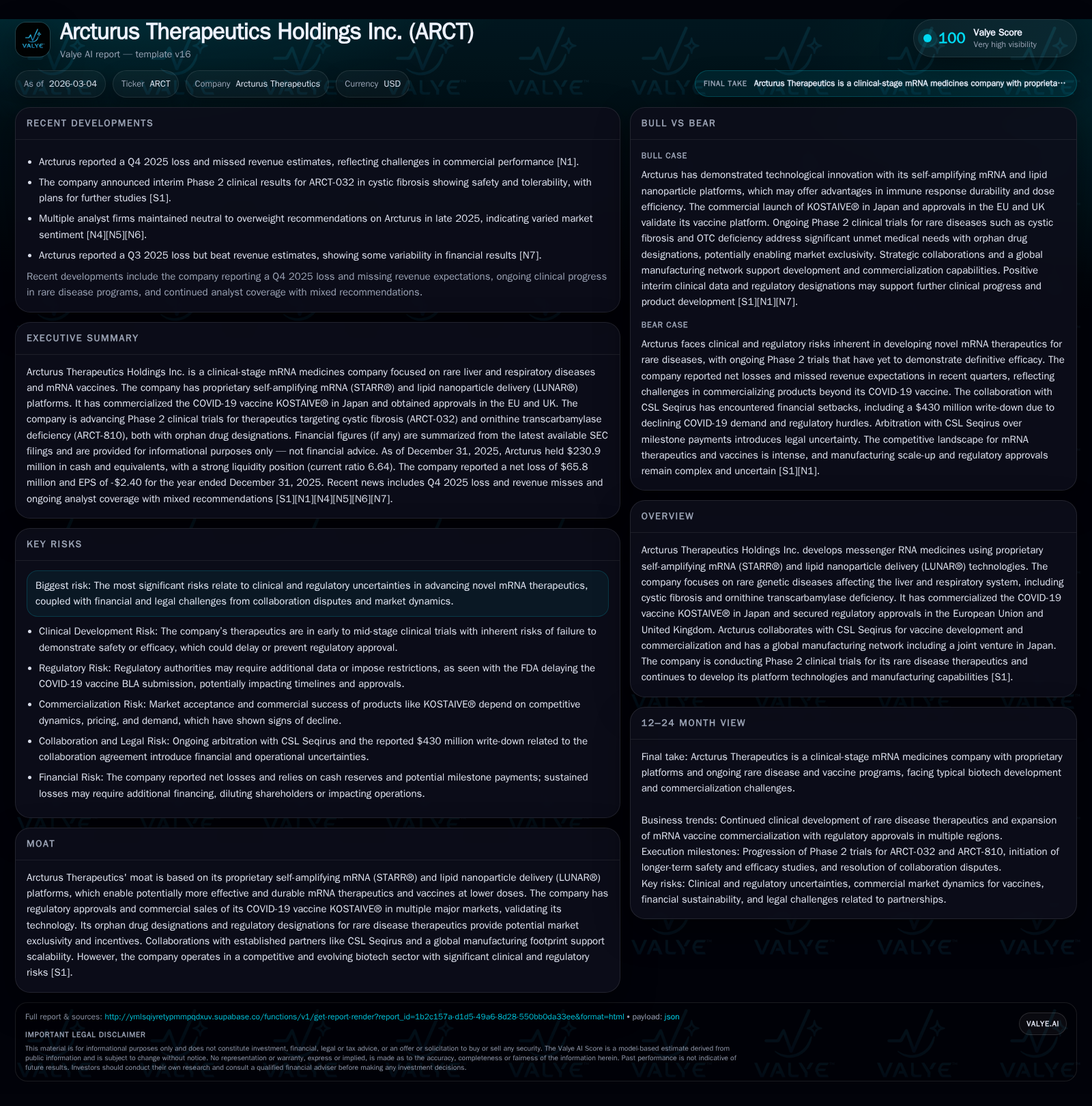
Arcturus Therapeutics Holdings Inc. has advanced its proprietary messenger RNA (mRNA) technology platforms—self-amplifying mRNA (STARR®) and lipid nanoparticle delivery (LUNAR®)—culminating in the world's first approved sa-mRNA COVID-19 vaccine, KOSTAIVE®, commercialized in Japan with regulatory approvals in Europe and the UK. The company is progressing a pipeline targeting rare genetic liver and respiratory diseases, including cystic fibrosis and ornithine transcarbamylase deficiency, through Phase 2 studies. Despite platform validation and a global manufacturing network, Arcturus faces regulatory delays in U.S. approvals and a substantial $430 million write-down related to its collaboration with CSL Seqirus amid changing COVID-19 market dynamics. Financial results for FY2025 show narrowing operating losses but persistent negative operating cash flow and free cash flow deficits, supported by strong liquidity.
Company Overview
Arcturus Therapeutics Holdings Inc. is an innovative biopharmaceutical company specializing in messenger RNA medicines using proprietary self-amplifying mRNA technology branded as STARR® combined with a lipid nanoparticle delivery system called LUNAR®. This platform aims to enhance potency while reducing dosage relative to conventional mRNA therapies. The company’s focus extends beyond infectious disease vaccines to treatments for rare genetic liver and respiratory disorders such as cystic fibrosis (CF) and ornithine transcarbamylase deficiency (OTC), which present significant unmet medical needs [S1].
Historical Growth and Performance
Commercial revenue generation began with the launch of the COVID-19 vaccine candidate KOSTAIVE® following approval in Japan in late 2024; subsequent marketing authorizations were obtained in the European Union (February 2025) and the United Kingdom (January 2026). These milestones were facilitated through a strategic alliance with CSL Seqirus, leveraging Arcturus' technological innovation alongside CSL’s established commercial infrastructure [S1][S14].
Financially, Arcturus has narrowed its operating losses over recent years. Operating income improved from a loss of approximately $95.7 million in FY2024 to around $76.3 million in FY2025—a year-over-year improvement of about 20% [F1]. Net losses decreased from roughly $80.9 million to $65.8 million over the same period.
Operating cash flows remain negative, reflecting continued investment in R&D and operations, while capital expenditures have declined sharply from $7.7 million in FY2022 to $230 thousand in FY2025, suggesting disciplined spending during scaling challenges [F1]. The balance sheet shows solid liquidity with approximately $231 million in cash against current liabilities near $36 million, resulting in a strong current ratio of about 6.6x [F1].
Historical performance (annual)
| FY | Net ($mm) | CFO ($mm) | OpInc ($mm) | Capex ($mm) | Net YoY |
|---|---|---|---|---|---|
| 2025 | -66 | -74 | -76 | 0 | +18.7% |
| 2024 | -81 | -60 | -96 | 1 | -172.3% |
| 2023 | -30 | -18 | -78 | 3 | -417.9% |
| 2022 | 9 | 32 | 12 | 8 |
Source: SEC companyfacts cache [F1].
Capital returns and efficiency (annual)
| FY | FCF ($mm) | ROE% |
|---|---|---|
| 2025 | -75 | -30.7 |
| 2024 | -60 | -33.6 |
| 2023 | -21 | -10.7 |
| 2022 | 24 | 3.5 |
Source: SEC companyfacts cache [F1].
Note: Revenue data sufficient for consistent year-over-year growth calculations is not publicly available; financials reflect transition from a primarily R&D-focused entity toward commercialization.
Proprietary Technology Platforms and Intellectual Property
The core differentiation lies in Arcturus’ STARR® self-amplifying mRNA platform, which utilizes replicon RNA technology enabling robust antigen expression at lower doses than conventional mRNA vaccines, clinically demonstrated by KOSTAIVE®. This approach may reduce production costs per dose while enhancing durability of immune responses [S1][S18].
LUNAR®, the company's lipid nanoparticle delivery system, addresses key challenges in nucleic acid medicine delivery by facilitating efficient intracellular transport while mitigating toxicity associated with older lipid formulations.
Arcturus holds an extensive intellectual property portfolio comprising more than 500 issued patents or pending applications worldwide that cover multiple facets of mRNA design, lipid chemistry, manufacturing processes, and formulation technologies [S1][S26]. This IP estate supports a broad pipeline spanning infectious disease vaccines beyond COVID-19 under collaboration agreements as well as internally developed rare disease therapeutics.
Product Pipeline Progress
COVID-19 Vaccine: KOSTAIVE®
KOSTAIVE® was the first globally approved self-amplifying mRNA vaccine for COVID-19, initially authorized by Japanese regulators followed by EU centralized approval covering all EU member states plus select EEA countries [S1][S15]. Clinical trials enrolling over 19,000 participants demonstrated robust immunogenicity against ancestral SARS-CoV-2 strains including Omicron subvariants [S11][S15][S22].
Despite approvals outside the U.S., the Food & Drug Administration delayed acceptance of the Biologics License Application due to updated requirements calling for additional clinical endpoint efficacy data aligned with evolving regulatory frameworks post-pandemic peak [S11][S16]. This delay postpones expansion into the lucrative U.S vaccine market.
Rare Disease Therapeutics Pipeline
ARCT-810 for Ornithine Transcarbamylase Deficiency (OTC)
OTC deficiency is a rare metabolic disorder without curative options aside from risky liver transplantation; standard care involves dietary restrictions that do not prevent acute crises [S13]. ARCT-810 delivers corrective mRNA via LUNAR nanoparticles targeting liver cells to restore urea cycle functionality.
Phase 2 trials conducted across Europe/UK (double-blind placebo-controlled) and the U.S. (open-label) report positive pharmacodynamic biomarkers such as reductions in plasma glutamine levels and increased ureagenesis assay readings indicative of functional improvement, alongside favorable safety at multiple dosing levels ranging from 0.1 to 0.5 mg/kg [S12][S21][S26]. Regulatory incentives include Orphan Drug Designation and Fast Track status facilitating accelerated review pathways.
ARCT-032 for Cystic Fibrosis
This inhaled therapeutic delivers CFTR mRNA directly to airway epithelial cells aiming to restore functional protein expression even among patients unresponsive to existing CFTR modulators.
Interim Phase 2 data demonstrated good tolerability after daily dosing over four weeks without significant adverse events attributable to treatment; exploratory AI-based imaging analyses suggested reductions in mucus burden—supporting further clinical evaluation planned for extended durations in early-to-mid 2026 [S13][N1].
Pandemic Influenza Vaccine Candidate (ARCT-2304)
Supported by a BARDA contract valued up to $63 million, this sa-mRNA vaccine candidate targeting H5N1 influenza completed Phase 1 trials showing favorable safety and durable immunogenicity up to eight months post-vaccination across age cohorts; it benefits from FDA Fast Track designation positioning it well for further development stages [S18][S26].
Collaborations & Manufacturing Network
The partnership with CSL Seqirus grants them global exclusive rights for research, development, manufacturing, and commercialization of sa-mRNA vaccines targeting COVID-19, influenza, pandemic preparedness pathogens plus three additional infectious diseases [S19]. Arcturus received upfront payments totaling $200 million with potential development milestones exceeding $1.3 billion and commercial milestones over $3 billion.
Manufacturing capacity is diversified geographically through established relationships with contract development and manufacturing organizations including Aldevron, Catalent, Recipharm, Polymun Biosciences plus the ARCALIS joint venture based in Japan that supplies commercial vaccine doses domestically since October 2024 [S9][S14][S16]. Investments focus on process yield optimization, impurity reduction, stability enhancements including lyophilized product formats that extend shelf life.
Legal Proceedings & Risks
Clinical risks remain inherent given novel therapeutic modalities coupled with small patient populations typical of rare disorders constraining trial designs.
Regulatory uncertainty increased following FDA's indefinite delay on BLA submission for KOSTAIVE prompted by revised guidance necessitating confirmatory efficacy studies consistent with mid-2025 updated standards [S11][S16].
Financial risk emerged when CSL Seqirus recorded a $430 million write-down tied to their collaboration agreement citing reduced COVID-19 incidence globally alongside stricter U.S regulations impacting milestone expectations payable to Arcturus [S1][N1]. An ongoing arbitration before the International Chamber of Commerce addresses disputed milestone payments linked to European marketing authorizations [S4].
Additionally, Arcturus initiated litigation alleging trade secret misappropriation against AbbVie et al., which adds legal complexities though currently not materialized into significant financial impact [S4].
Financial Analysis & Capital Allocation
Despite recent commercialization efforts anchored by KOSTAIVE’s launch primarily within Japan starting Q4 2024:
- Operating income loss narrowed by approximately 20% year-over-year from -$95.7 million in FY24 to -$76.3 million in FY25.
- Net loss decreased nearly 19% from -$80.9 million to -$65.8 million over the same timeframe.
- Operating cash flows remained negative at approximately -$74 million compounded by minimal capital expenditures (~$0.23 million), indicating tight fiscal discipline amid ongoing R&D investment [F1][N2].
- Free cash flow remained substantially negative near -$74.5 million.
- Total equity declined sequentially reflecting net loss absorption but liquidity was maintained robustly at over $230 million cash supporting runway given limited debt exposure [F1][S10].
- No dividends or share repurchases occurred; capital allocation focused on advancing pipeline programs and manufacturing capabilities.
Outlook & Monitoring Points
Looking ahead beyond FY25:
- Key near-term milestones include completion of expanded dosing cohorts for ARCT-032 cystic fibrosis trial evaluating longer-term safety/efficacy endpoints anticipated during H1–H2 2026.
- Continued enrollment completion plus pediatric study design discussions for ARCT-810 OTC deficiency slated for mid-2026 underpin clinical advancement prospects.
- Resolution of FDA guidance on confirmatory studies for KOSTAIVE’s U.S approval remains critical for market entry timing.
- Arbitration outcome regarding milestone payments from CSL Seqirus expected around Q3/Q4 2026 may materially influence partnership dynamics or financial outlook.
- Ongoing BARDA-supported influenza vaccine candidate development offers diversification opportunities beyond COVID-focused products.
- Platform improvements aimed at next-generation lipid nanoparticles targeting enhanced efficacy/safety profiles could broaden indication scope.
In summary, Arcturus presents validated innovative technology platforms combined with tangible early-stage commercial traction but navigates complex regulatory landscapes amid sustained financial losses typical of pioneering biotech ventures focused on novel nucleic acid medicines.
This report is based solely on publicly available filings as of March 4th, 2026 and does not constitute investment advice.
Disclaimer: This is research-only, informational analysis and not investment advice. It may include AI-generated interpretation and general industry context. Always verify important details using primary sources.

Comments