
Crexendo’s Incremental Revenue and Efficiency Gains Signal Stability in Cloud Communications
Steady revenue increases, operating margin improvements, and a balanced capital allocation approach underscore Crexendo’s stable position amid sector and regulatory pressures.
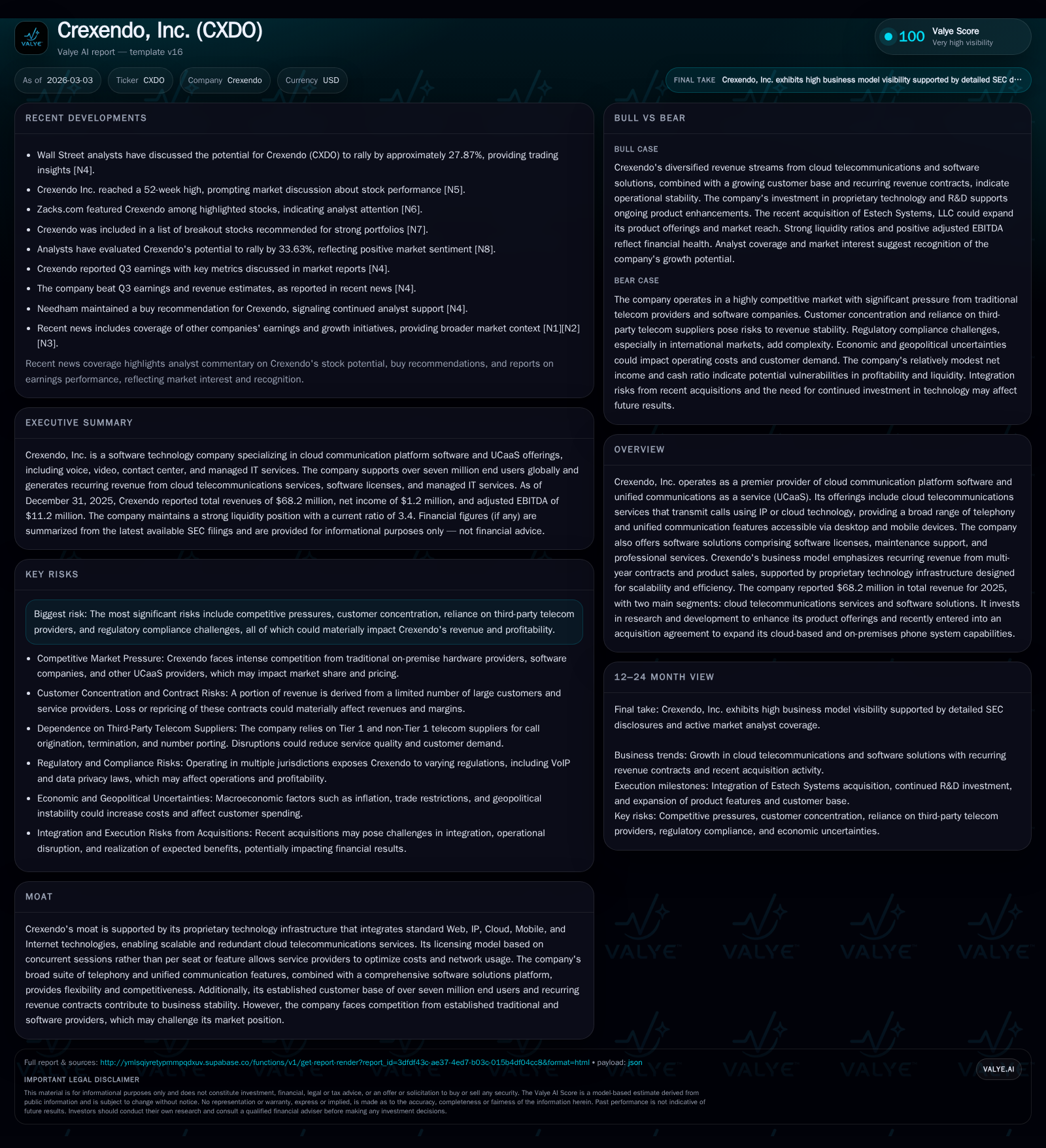
Crexendo, Inc. showcased a solid financial rebound from significant losses in 2022 to modest profitability by 2025, driven by robust growth in its cloud telecommunications services and software solutions. Its licensing model based on concurrent sessions and multi-year contracts underpin recurring revenues, while disciplined capex and rising operating cash flows have strengthened its free cash flow profile. Challenges persist from stringent regulatory environments, intense competition, and operational complexities which could cap future growth. Monitoring subscription renewals and innovation outcomes will be critical for sustained momentum.
Revenue Growth Trajectory: From Losses to Moderate Profitability
Crexendo's financial history over the past four years illustrates a marked recovery emanating from significant operative deficits into positive but modest profitability. Revenue progressed from a modest base of approx. $11.4 million in FY2022 to $68.2 million in FY2025, representing an overall rapid scale-up primarily between FY2023 and FY2024 followed by steady growth of around 12% year-over-year into 2025 [F1]. This trajectory has been sustained by an expanding customer base that includes over seven million end users served through more than 240 cloud telecom platform subscribers alongside its direct retail channels [S19]. The company’s contractual structure emphasizes multi-year agreements lasting typically between three to five years, affording some revenue visibility even as quarterly fluctuations persist due to seasonality and enterprise sales cycle dynamics.
The transition to positive net income is equally striking; after enduring losses surpassing $32 million in FY2022 driven partly by goodwill impairment triggered by pandemic-related headwinds, Crexendo recorded net profits of approximately $1.22 million by the close of FY2025—reflecting a remarkable turnaround bolstered by operating leverage and expanding economies of scale [F1][N1]. This improvement reflects both volume expansion and cost controls bearing fruit.
Historical performance (annual)
| FY | Rev ($mm) | Net ($mm) | CFO ($mm) | OpInc ($mm) | Rev YoY | Net YoY |
|---|---|---|---|---|---|---|
| 2025 | 68 | 1 | 9 | 1 | +12.0% | +140.2% |
| 2024 | 61 | 1 | 6 | 1 | +329.5% | +731.1% |
| 2023 | 14 | 0 | 3 | 0 | +23.8% | +100.2% |
| 2022 | 11 | -33 | 0 | -35 |
Source: SEC companyfacts cache [F1].
Capital returns and efficiency (annual)
| FY | Div ($) | FCF ($mm) | ROE% |
|---|---|---|---|
| 2025 | 9 | 1.9 | |
| 2024 | 0 | 6 | 1.0 |
| 2023 | 130000 | 3 | 0.1 |
| 2022 | 462000 | -1 | -78.6 |
Source: SEC companyfacts cache [F1].
Segment Performance: Cloud Telecommunications vs. Software Solutions
Crexendo operates two primary business segments: cloud telecommunications services and software solutions — each leveraging distinct technologies yet unified under its proprietary IP/cloud communication framework [S10][S19].
The cloud telecommunications business transmits voice calls via IP or cloud protocols converting traditional voice signals into digital packets that can move seamlessly across multiple device types including desktop applications and mobile endpoints. This segment benefits from concurrent session-based licensing rather than conventional per-seat or per-feature billing models—a significant differentiator allowing service providers to oversubscribe their networks efficiently by purchasing licenses based on peak simultaneous use rather than installed base alone. This licensing flexibility offers customers notable cost optimization opportunities which enhances Crexendo's competitive positioning within the highly commoditized UCaaS market.
Conversely, the software solutions division aggregates revenues from software license sales, maintenance contracts, and professional services bundled often into subscription packages with separate performance obligations recognized accordingly per ASC606 guidance [S27]. These licenses support both hosted proprietary solutions as well as self-hosted deployments through licensees requiring varied levels of support.
This bifurcation allows Crexendo to capture diverse market demand — the software segment appeals more directly to enterprises needing custom integrations and professional service components, while cloud telecommunications emphasizes scalable recurring revenue via subscription-based telephony features accessible ubiquitously across devices.
Operational Efficiency and Profitability Enhancements
The operational leap between FY2024 and FY2025 is underscored by an approximate doubling (80.8%) of operating income reaching $1.13 million compared to prior year figure of roughly $626k [F1]. This gain evidences improved cost discipline combined with growth-driven operating leverage within cloud infrastructure investments and sales expansion.
Simultaneously Crexendo reduced capital expenditures significantly — quarterly capex dropped to an average annual level of only about $18k in FY2025 down from nearly $289k four years earlier — showcasing robust capex efficiency emphasizing virtualization techniques over physical asset accumulation typical in traditional telecoms [F1][N1].
Operating cash flow surged almost 48% year-over-year hitting nearly $9.3 million last fiscal year highlighting strong cash realization aligned with expanding net income margins while supporting product development expenditures detailed elsewhere as substantial R&D investments targeting technology enhancements including proprietary AI integration possibilities discussed internally [S29]. The resulting free cash flow—operating cash flow less capex—was thus very healthy at over $9 million for FY2025 reflecting sound underlying business quality characteristic of mature recurring revenue models.
Future Growth Drivers and Headwinds in Cloud Communications
Crexendo's future growth avenues reside chiefly in augmenting its Cloud Telecommunications platform’s footprint via increased subscriber acquisition complemented by upselling richer functionality enabled through ongoing R&D investments dedicated largely to enhancing product scalability, security compliance capabilities, as well as integration with evolving AI frameworks anticipated as industry standard for digital communications platforms [N1][S29].
Notwithstanding these positives are headwinds grounded in established sector realities such as stiff competition from entrenched telecom players like RingCentral or Zoom who wield larger resources allowing aggressive pricing strategies potentially compressing margins [S26].
Moreover regulatory compliance remains a persistent constraint requiring active investment; Crexendo faces FCC mandates related to E911 emergency call routing which depend heavily on third-party vendor cooperation introducing latency risks impacting customer experience metrics [S12][S13]. Similarly escalating data privacy regulations including California Consumer Privacy Act enforcement necessitate ongoing policy adjustments underscoring costs linked to security protocols tied closely with reputational risk mitigation efforts described extensively across SEC filings [S14][S16][S23]. Additional industry-specific rules involving STIR/SHAKEN caller authentication mechanisms pose further operational costs but are indispensable for maintaining carrier credentials essential for uninterrupted VoIP traffic acceptance.
Macroeconomic vulnerabilities such as inflationary pressures limiting customer spending capacity coupled with fixed multi-year contracts restrict tactical pricing flexibility adding complexity in maintaining revenue growth momentum during uncertain economic cycles [S1][S11]. Vendor concentration also requires careful management given dependency on limited telecom hardware suppliers which could disrupt provision continuity if supply chains are constrained or tariffs elevate input costs [S9][S24].
Capital Allocation Focus: Cash Flows, ROE, Dividends, and Share Buybacks
Capital management reflects strategic prudence favoring reinvestment over shareholder returns currently; dividend payments ceased post-FY2023 after modest distributions totaling around $462k in FY2022 fading thereafter amid focus on bolstering balance sheet strength through retention of earnings supporting organic growth initiatives including scaling infrastructure [F1][S5].
No share repurchase programs have been executed since fiscal years ending over a decade ago illustrating preference towards funding innovation pipelines rather than buybacks despite low leverage levels implying available capacity if strategic conditions warrant action.
Return on equity remains subdued yet positive near approximately 2%, consistent with small-cap technology firms transitioning towards sustainable profitability within capital-light business models reliant heavily on intangible assets versus heavy physical plant investments typical historically within legacy telecom sectors [F1]. Balance sheet robustness manifests also via ample liquidity demonstrated by current ratio exceeding three times coverage indicating sound working capital management capable of absorbing potential short-term disruptions or opportunistic acquisitions where aligned strategically.
Regulatory and Competitive Landscape Risks
Crexendo confronts multifaceted regulatory scrutiny notably associated with legacy discontinued seminar operations triggering periodic government inquiries across federal/state/local jurisdictions without fulminating formal charges but posing latent reputational risks along with possible contingent liabilities if unfavorable resolutions materialize impacting earnings unpredictably [S4][S6][S7][S14].
Telecommunications-specific regulation enforced by bodies such as the FCC imposes extensive compliance tasks encompassing universal service fund contributions, mandated access provisioning e.g., E911 emergency connectivity requirements obliging precise coordination with external PSAP databases exposing reliance risks beyond direct control hampering guaranteed uptime service level agreements adherence potentially triggering customer credits or penalties impacting margin sustainability adversely upon outages noted within disclosures [S12][S18].
Data security requirements remain dynamically evolving landscapes with legislation like CCPA setting stringent personal data protection thresholds alongside HIPAA considerations given some customers leverage protected health information storage compounding liability exposure should breaches occur notwithstanding industry-standard systems implemented emphasizing cybersecurity best practices yet acknowledging no absolute safeguard against increasingly sophisticated cyber threats exists [S14][S23].
Competitive intensity burgeons emanating from large differentiated UCaaS incumbents backed by sizeable R&D budgets enabling frequent feature parity advancements challenging Crexendo’s innovation velocity needing constant mitigation lest disintermediation risks amplify amid fragmented customer choices compounded further by new entrants leveraging open APIs creating fragmentation requiring vigilant ecosystem development focus effectively balancing proprietary control versus integrative openness success factors detailed internally relevant for growth sustainment approaches [S26][S21].
Key Milestones to Watch: Subscription Contracts and R&D Developments
Upcoming pivotal events include renewal cycles for existing multi-year contracts generally spanning three to five years forming core recurring revenue sustenance potentially influencing subsequent top-line stability subject to retention outcomes amid pricing pressures characteristic of maturing segments where client retention is crucial given high switching costs but growing alternative options present inducement incentives demanding keen customer success initiatives closely monitored internally [N1][S29].
R&D progress represents another principal catalyst encompassing scaled investment into enhancing platform capabilities incorporating AI competencies alongside improving resiliency/security posture fundamental for long-term differentiation especially within managed IT service expansions following recent acquisition integrations signaling prospects diversification necessitating appraisal against execution risks inherent model extension exercises discussed extensively in filings ensuring transparency while indicating managerial focus projection reliability parameters.
Monitoring competitive pricing adjustments alongside regulatory environment shifts particularly relating to telephony standards reform or privacy law amendments will also be material given potential implications on product roadmap timing or cost structures possibly affecting commercial success trajectories holographically.
This analysis is based strictly upon company-reported data from official SEC filings ([F1], [S#]) and verified news releases ([N#]) without speculative assumptions beyond documented disclosures; it should serve as an informational resource without constituting investment advice or recommendations.
Disclaimer: This is research-only, informational analysis and not investment advice. It may include AI-generated interpretation and general industry context. Always verify important details using primary sources.

Comments