
Versant Media’s Post-Spin Revenue Decline and Debt-Financed Independence Challenge Profitability
Versant Media Group, newly spun off from Comcast, faces revenue headwinds amid subscriber declines, offset slightly by digital growth, while managing substantial debt and capital allocation demands.
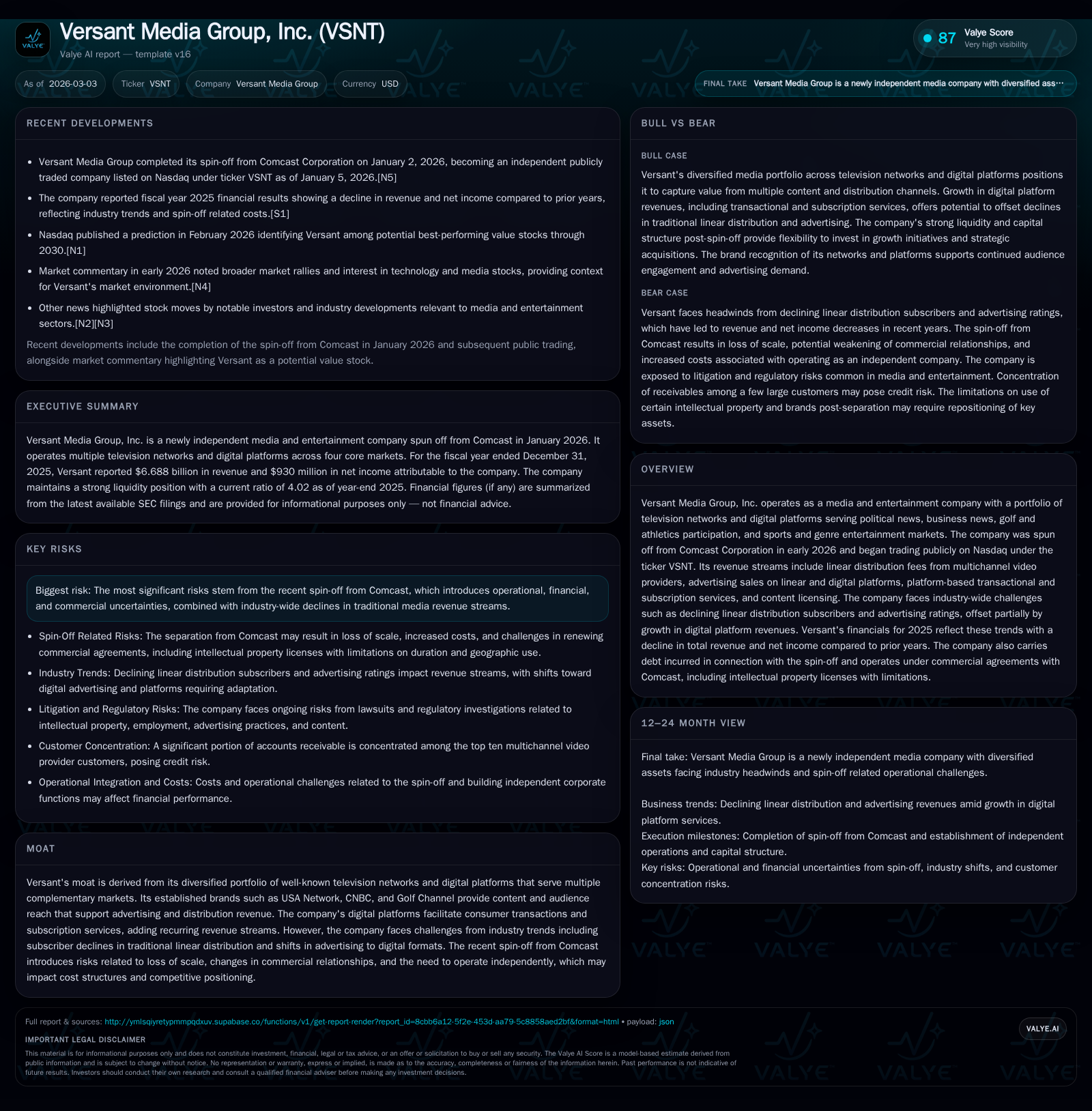
Versant Media Group began independent public trading in early 2026 following its spin-off from Comcast. Historically embedded within Comcast’s Media segment, Versant’s pre-spin financials show a steady decline in linear distribution and advertising revenues over the past three years, driven by industry-wide subscriber erosion and rating drops. Although digital platform revenues grew modestly, they remain a smaller portion of the mix. Operating income and net income fell sharply in 2025 due to these trends and increased SG&A expenses largely tied to separation activities. The company now carries $3 billion in long-term debt incurred for separation-related payments and working capital needs. Capital allocation includes a new dividend policy and a $1 billion share repurchase authorization, signaling a focus on shareholder returns despite margin pressures. Key risks revolve around reduced scale post-spin, ongoing media industry headwinds, and integration challenges of acquired businesses.
Company Overview and Spin-off Context
Versant Media Group, Inc. officially separated from Comcast Corporation on January 2, 2026, becoming an independently publicly traded entity under the ticker VSNT. Previously operating as part of Comcast's Media segment, Versant inherited a portfolio consisting primarily of well-known television networks such as USA Network and CNBC complemented by digital platforms including Fandango and GolfNow [S25]. This broad mix spans political news, business finance coverage, sports participation content, and genre entertainment.
The spin-off was accompanied by significant reshuffling of corporate structures and financial resources. Versant assumed assets and liabilities formerly shared or managed by Comcast related to its cable networks and digital platforms. The separation process necessitated transactions totaling billions of dollars financed through new debt issuances and resulted in incremental one-time separation-related costs reflected heavily in the recent financial period [S25][S26].
Historical Financial Performance (2023-2025)
From the last full annual reports within Comcast combined data through Versant's standalone preparations for spin-off, several clear trends emerge:
Historical performance (annual)
| FY |
|---|
| 2025 |
Source: SEC companyfacts cache [F1].
(Data sourced from combined filings prior to spin-off date; all figures scaled millions USD except percentages) [F1][S1][S5]
Revenue Drivers
- Linear distribution fees comprised the majority of revenue but declined consistently — down over two years primarily due to an approximate annual subscriber loss rate of roughly eight percent partially offset by contractual rate increases.
- Advertising revenue contracted meaningfully with audience ratings dropping by about seventeen percent in the latest year studied; this decline amplified EBITDA pressure.
- Digital platform revenues increased nearly four percent in the latest fiscal year driven by transactional platforms such as GolfNow catering directly to consumers.
- Content licensing revenues remained relatively stable with minor decreases.
Expense Trends
- Costs related to revenue decreased modestly following declining programming expenses reflective of sustained lower content acquisition volume or renegotiations.
- Selling, General & Administrative expenses surged substantially (+26% in the final year), mostly attributable to incremental one-time costs associated with separation activities including advisory fees and internal systems buildout for independent operation.
- Depreciation remained fairly stable indicating consistent asset base amortization.
Profitability Impact
- Operating income fell sharply (almost -31%) reflecting pressure on both top-line components coupled with elevated expense base tied to separation efforts.
- Net income similarly decreased significantly (about -32%).
- Adjusted EBITDA contracted about fifteen percent signaling challenging operational leverage transitioning out from Comcast's shared cost structure [F1][S19].
Cash Flow & Capital Expenditure
Cash flow from operating activities remains solid above $2 billion per annum but is trending downwards coinciding with profit erosion. Capital expenditures more than tripled in the most recent year likely reflecting investments necessary for independent infrastructure — IT systems expansions and facility upgrades not previously allocated directly under Versant pre-spin [F1][S17][S18].
Balance Sheet and Capital Structure Post-Separation
Versant now carries approximately $3 billion of long-term debt issued late in calendar year 2025 as part of its spin-off financing strategy:
- $1 billion Senior Secured Notes due January 2031 at a coupon rate of approximately seven point two five percent secured by substantially all company assets.
- Two term loans totaling $2 billion maturing also in January 2031 with blended interest margins ranging between roughly two point five percent to three point five percent over SOFR or base rates depending on tranche.
A revolving credit facility totaling $750 million remains undrawn providing liquidity optionality [S4][S7][S8][S10].
Current assets exceed current liabilities significantly yielding a strong current ratio near four times as of December 31, 2025. However long-term obligations remain considerable relative to equity base leaving leverage elevated even considering stable operating cash flow generation capabilities [F1].
Capital Allocation Policies & Shareholder Returns
In March 2026 (post-spin), Versant's board declared its initial quarterly dividend at $0.375 per share signaling commitment towards pay-out discipline despite transitional margin headwinds [S4][S26].
Simultaneously announced was a substantial share repurchase program authorizing up to $1 billion across multiple modalities including open market buys or block trades aiming to enhance shareholder value [S26].
This balanced approach suggests confidence in underlying free cash flow strength even as operational adjustments continue post-separation.
Future Growth Prospects & Risks
Growth Drivers:
- Continued expansion of digital platform revenues via transactional services such as ticketing (Fandango), golf bookings (GolfNow), youth sports platforms (SportsEngine).
- Monetization opportunities leveraging established network brands into newer advertising channels with more sophisticated targeting capabilities could partially offset traditional ad declines.
- Potential strategic acquisitions or partnerships aimed at filling content gaps or enhancing platform technology remain plausible growth vectors though unquantified at this stage .
Growth Constraints:
- Industry-wide secular declines in traditional pay-TV subscribers expected to persist constraining linear distribution fees.
- Advertising ratings continuing their downward trajectory reducing top-line ad revenue despite digital offsets.
- Independence from Comcast implies loss of cost synergies previously enjoyed plus exposure to negotiation dynamics with former parent now counterparty complicating commercial agreements.
- Execution risk related to integrating acquired businesses or technologies given cultural/regulatory/system differences noted among stated risks [S16].
Key Milestones & What To Watch (Analysis)
Given no formal management guidance disclosed post-spin regarding detailed forecasts or milestones beyond initial dividend/share repurchase announcements:
- Monitoring quarterly trends in linear subscriber counts versus contracted rate escalations will give earliest signals of sustainability/moderation of declines.
- Digital platform gross merchandise volume (GMV) or transaction counts growth rates would measure success diversifying revenue streams beyond legacy models.
- Operating margin improvements tracking SG&A normalization after separation-related costs dissipate expected mid-to-late fiscal periods could hint at structural profitability potential.
- Leverage ratios coupled with progress on debt amortization or refinancing efforts will be key indicators of financial flexibility post spin-off.
Summary and Outlook Considerations
Versant Media Group enters public markets bearing both legacy media sector headwinds accentuated by structural subscriber erosion across pay-TV providers along with operational complexity arising from newly independent status after decades within Comcast’s ecosystem. While digital platform growth offers encouraging diversification upside that somewhat tempers declining legacy streams, scale loss highlights efficiency challenges ahead.
Financial discipline manifesting through initiated dividends alongside aggressive share repurchases signals confidence but concurrently underscores need for prudent capital deployment given highly leveraged balance sheet funded largely through spin-off transaction-induced indebtedness. Investors should remain attentive to evolving subscriber trends on core TV brands balanced against digital expansion execution alongside cost management as performance drivers throughout this critical transition phase.
This analysis summarizes publicly reported information as of March 3rd, 2026 without offering investment advice or recommendations. It reflects reported historical data extracted directly from regulatory filings alongside informed commentary on business model implications within evolving media landscape dynamics.
Disclaimer: This is research-only, informational analysis and not investment advice. It may include AI-generated interpretation and general industry context. Always verify important details using primary sources.

Comments