
Altimmune’s Clinical Progress and Capital Strategy Shape Its Next Growth Chapter
Altimmune advances pemvidutide trials toward Phase 3 readiness while managing liquidity and financing amid clinical-stage biotech dynamics.
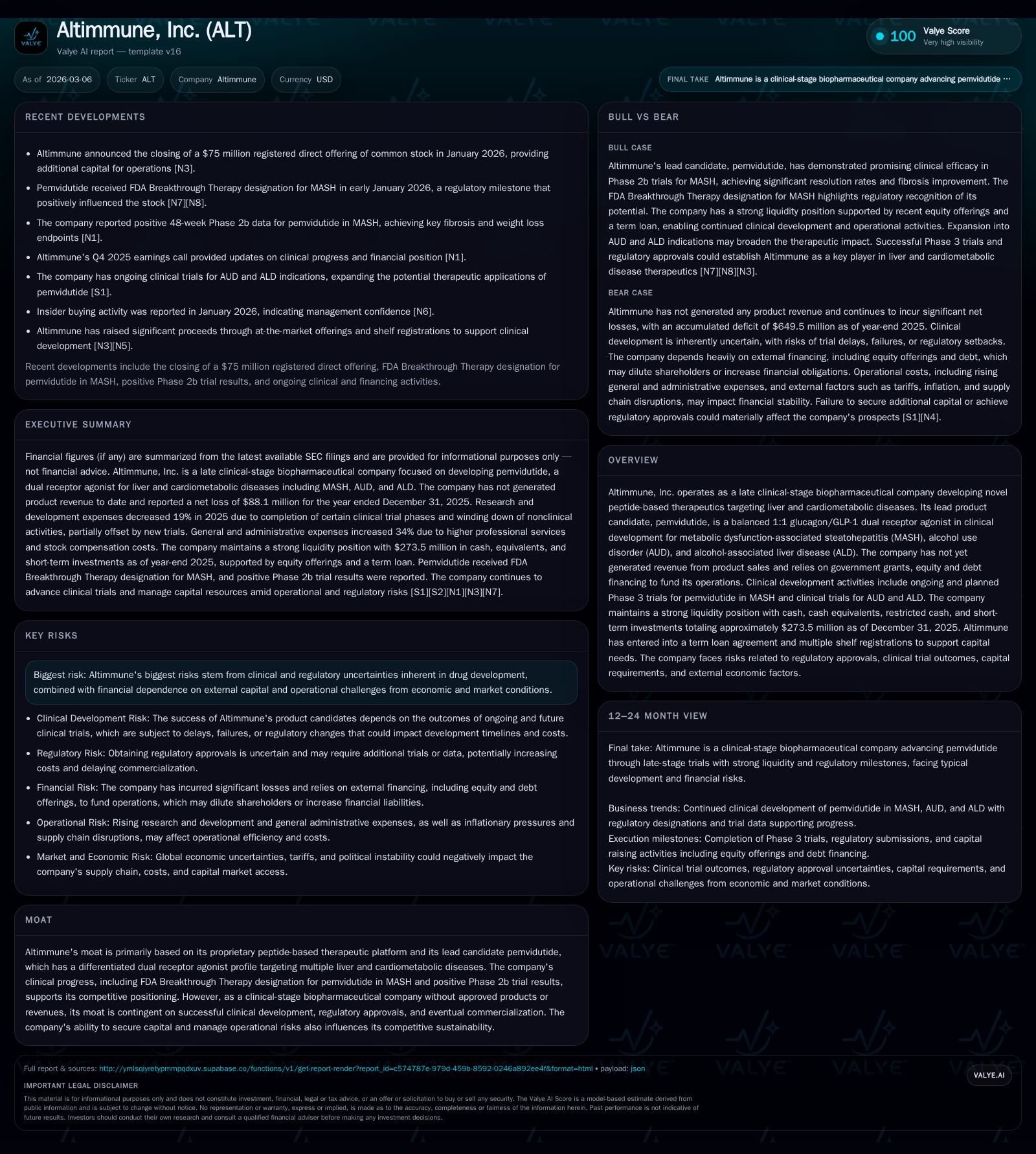
Altimmune, a late clinical-stage biopharmaceutical company, focuses on its lead candidate pemvidutide, progressing through Phase 2b results toward planned Phase 3 trials for liver and metabolic diseases. Despite no product revenues yet, the company shows modest revenue growth from grants and contracts, sustained operating losses narrowing year-over-year, and relies on a multi-tranche debt facility plus recent equity raises to fund extensive R&D programs. With a solid liquidity buffer exceeding $270 million at year-end 2025, Altimmune balances development milestones against cash burn and market uncertainties, including legal risks tied to regulatory disclosures. Investor attention should center on trial enrollment updates and capital allocation decisions in the near term.
Steady Clinical Development Progress Fuels Growth Trajectory
Altimmune’s historical growth has been predominantly driven by its intense focus on clinical advancement of pemvidutide—a peptide-based therapeutic designed as a balanced 1:1 glucagon/GLP-1 dual receptor agonist targeting metabolic dysfunction-associated steatohepatitis (MASH), alcohol use disorder (AUD), and alcohol-associated liver disease (ALD). The company successfully completed positive Phase 2b studies underscoring pemvidutide’s tolerability and efficacy signals in MASH patients, which fueled readiness for pivotal Phase 3 trials. This clinical momentum has been supported by significant investment in research and development (R&D), constituting the bulk of operating expenses. The FDA's Breakthrough Therapy designation for pemvidutide in MASH bolsters Altimmune's moat by facilitating expedited regulatory interactions and enhanced guidance during late-stage development [S1][N1].
Pemvidutide’s Differentiation in Metabolic Disease Treatment
Pemvidutide’s pharmacologic profile as a balanced dual receptor agonist distinguishes it from other agents that typically target GLP-1 receptor preferentially. This balanced activation is hypothesized to deliver broader metabolic benefits by addressing liver fibrosis pathways alongside cardiometabolic improvements. Specifically developed for MASH—a complex condition lacking approved therapies—pemvidutide also explores additional indications such as AUD and ALD where liver pathology overlaps with metabolic dysfunction. Such differentiation is critical given the heterogeneity of patient populations and therapeutic mechanisms required for success in these challenging indications [S1][N1].
Financial Performance: Losses Narrow as Revenue Grows Incrementally
Altimmune remains pre-revenue from product sales; its reported revenues reflect government grants and related contracts supporting early research activities. Fiscal year 2025 saw revenue increase over twofold to $41K from $20K in 2024—a modest base highlighting continued R&D focus rather than commercialization [F1]. Concurrently, operating losses narrowed by approximately 8.4% year-over-year to about -$94.5 million as operational efficiencies emerged despite sustained high development spending.
Operating cash flow burn remained sizeable at nearly -$67.5 million in FY2025 but improved relative to prior years indicating tighter expenditure controls or changed trial dynamics. Notably, capital expenditures declined steeply by over 75% year-over-year to about $11K reflecting scaled-back fixed asset investments [F1].
Historical performance (annual)
| FY | Rev ($) | Net ($mm) | CFO ($mm) | OpInc ($mm) | Rev YoY | Net YoY |
|---|---|---|---|---|---|---|
| 2025 | 41000 | -88 | -68 | -94 | +105.0% | +7.3% |
| 2024 | 20000 | -95 | -80 | -103 | -95.3% | -7.5% |
| 2023 | 426000 | -88 | -76 | -96 | +726.5% | -4.4% |
| 2022 | -68000 | -85 | -63 | -88 |
Source: SEC companyfacts cache [F1].
Capital returns and efficiency (annual)
| FY | FCF ($mm) | ROE% |
|---|---|---|
| 2025 | -68 | -39.2 |
| 2024 | -80 | -77.0 |
| 2023 | -76 | -45.6 |
| 2022 | -63 | -45.7 |
Source: SEC companyfacts cache [F1].
Table: Altimmune Annual Financial Performance (FY2022–FY2025) from [F1]
Capital Structure Overview: Debt Tranches and Equity Financing
Capital structure developments include a May 2025 Loan Agreement with Hercules Capital providing up to four tranches totaling $125 million—of which the first two tranches amounting to $35 million had been drawn as of December 31, 2025 [S5][S6][S7]. Interest rates for this secured revolving term loan range between approximately ~9.7% annually plus prime rate premiums. Amortization schedules extend through January 2029 with interest-only periods extended based on covenants.
Alongside debt financing, Altimmune completed a registered direct offering of common stock raising $75 million early in January 2026 amid a moderately negative equity price reaction reflecting issuance dilution concerns [N3][N4][N5]. The combined financing mix enables continued support of expensive late-stage trials while preserving covenant compliance—contingent on milestone achievements and market capitalization thresholds above $800 million [S6][S7].
Liquidity Position and Runway Considering Cash Burn Rates
Liquidity at fiscal year-end December 31, 2025 was strong with combined cash balances including cash equivalents, restricted cash, and short-term investments totaling approximately $273.5 million [S6][F1]. This provides a comfortable current ratio of around 18.55 when comparing current assets ($278 million) versus current liabilities ($15 million), signaling robust near-term solvency.
Given operating cash flow burn rates of approximately $67.5 million per year (net of capex approximately -$67.5 million annually), available liquidity suggests at least a twelve-month runway under current spending assumptions tied largely to ongoing clinical development programs without product revenues [S6][F1].
Key Risks: Clinical, Regulatory, and Shareholder Litigation Context
As typical for clinical-stage biopharma companies like Altimmune without approved products or revenues yet, key risks include drug development uncertainties encompassing clinical trial enrollment variables and regulatory approval complexities that could delay or derail potential commercialization [S4][S10].
Additionally, Altimmune faces potential shareholder litigation arising from alleged disclosure issues surrounding pemvidutide Phase 2b data with associated class action and derivative complaints filed during late-2025; these were voluntarily dismissed without prejudice but contribute to governance risk [S4][S14][S15]. Financial leverage exposes it further to covenant breaches if unfavorable events impact market capitalization or operational continuity.
What Lies Ahead: Upcoming Trial Milestones and Market Catalysts
Investors should watch for initiation timing of pivotal Phase 3 trials in the MASH indication anticipated soon after successful Phase 2b results [N1][S1]. Also relevant are trial progress reports or preliminary readouts from studies targeting AUD and ALD that extend pemvidutide’s therapeutic reach.
Potential partnership or licensing agreements leveraging pemvidutide’s differentiated mechanism could provide crucial non-dilutive financing alternatives or commercialization pathways beyond internal funding alone [N1][S1]. Although explicit milestone dates remain undisclosed publicly thus far.
Capital Allocation Strategy: No Dividends or Buybacks Amid Heavy R&D Spend
Consistent with early-stage biopharma norms focused on reinvestment into the pipeline rather than return of capital to shareholders, Altimmune declared no dividends nor share repurchase programs during FY2025 or prior periods [F1][S17]. Capital allocation prioritizes intensive R&D deployment for product candidate advancement over other uses given absence of revenue generation.
This approach aligns with sustaining operations through equity raises plus debt capital markets until potential commercialization inflection points materialize.
Investor Takeaways: Balancing High Upside Potential with Execution Risks
Altimmune rests on a scientifically differentiated platform led by its promising dual receptor agonist candidate pemvidutide progressing toward pivotal Phase 3 evaluation—a key determinant for unlocking future valuation milestones.
That said, the company operates with a negative return on equity around -39%, reflected by net losses narrowing slightly but still sizable annual deficits constraining capital efficiency [F1]. The sizable cash reserves underpin an estimated one-year runway contingent on stable burn rates but require vigilant monitoring.
Equity dilution concerns emerge amid active financing including recent direct stock offerings alongside structured term loans bearing substantial interest expense (~13% effective annual rate). Shareholder litigation episodes further underscore governance considerations investors should note prudently.
Overall valuation outcomes hinge critically on successful trial progression timelines coupled with manageable funding access balancing amid biopharma sector volatility typical for late-stage innovators transitioning toward commercialization.
This analysis is intended solely for informational purposes based on disclosed company filings and news as of March 6, 2026. It does not constitute investment advice or recommendations regarding buying or selling securities.
Disclaimer: This is research-only, informational analysis and not investment advice. It may include AI-generated interpretation and general industry context. Always verify important details using primary sources.

Comments