
PMV Pharmaceuticals Advances Rezatapopt Amid Rising R&D Investment and Cash Burn
Clinical-stage firm focuses on mutant p53 precision oncology with pivotal Phase 2 trial data shaping near-term regulatory timeline.
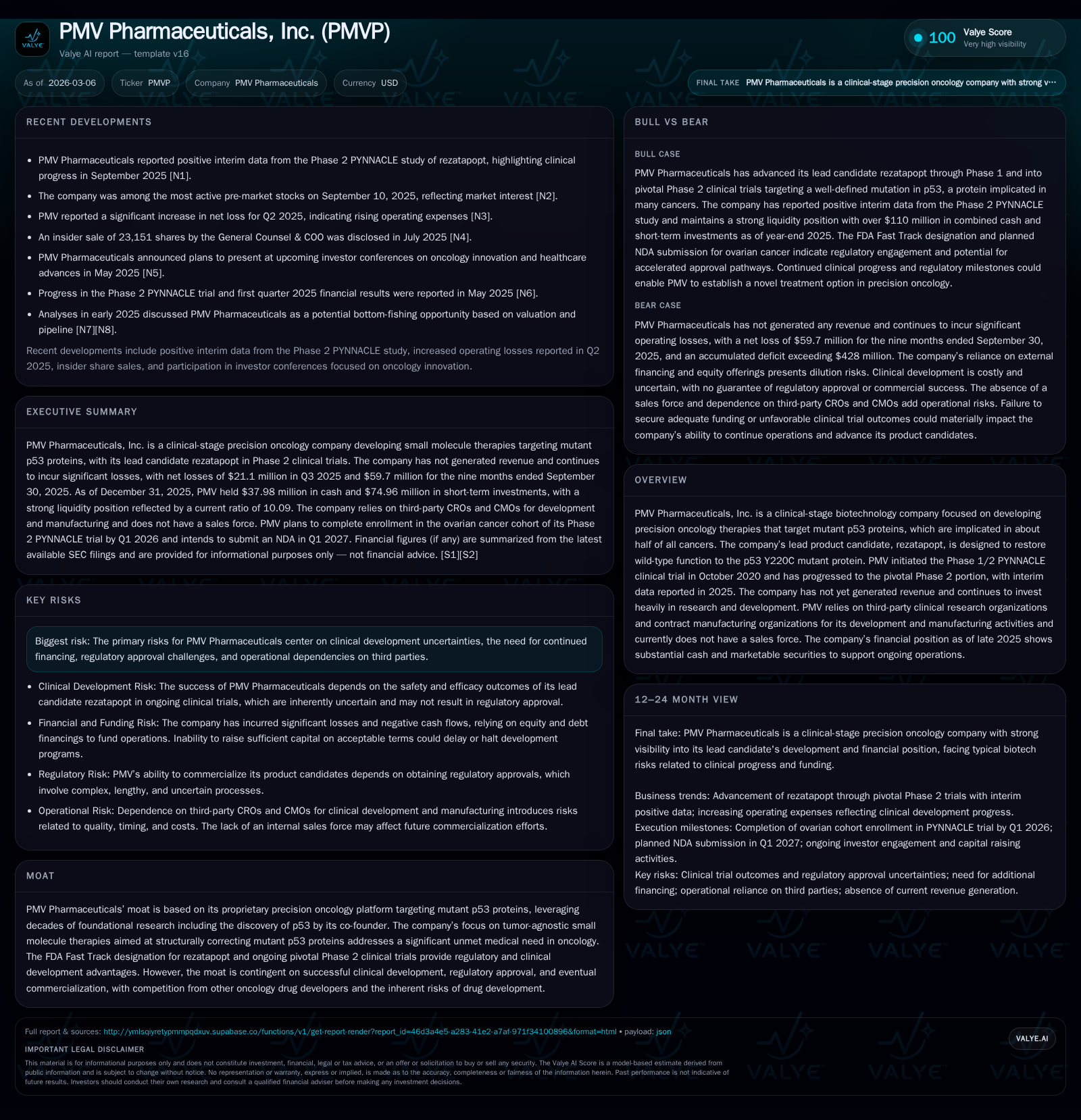
PMV Pharmaceuticals, a clinical-stage biotech company specializing in therapies targeting mutant p53 proteins, continues to advance its lead candidate rezatapopt through pivotal Phase 2 trials following FDA Fast Track designation. The company has incurred steep losses and negative operating cash flow as expected for its stage, underscored by increasing R&D expenses tied to clinical development efforts. PMV maintains a strong liquidity position with over $115 million in current assets and no revenues to date, aiming for NDA submission in early 2027 for platinum-resistant ovarian cancers harboring the TP53 Y220C mutation. Operational execution hinges on successful trial completion and securing additional financing given ongoing cash burn.
Company Overview and Scientific Position
PMV Pharmaceuticals is a clinical-stage biotechnology company developing precision oncology therapies targeting mutant p53 proteins. Known as the “guardian of the genome,” wild-type p53 functions as a tumor suppressor by inducing apoptosis or cell cycle arrest in damaged cells. Mutations that misfold or disable p53 are found in approximately half of all cancers, representing a large unmet medical need.
Founded based on foundational work by co-founder Dr. Arnold Levine who discovered p53 in 1979, PMV leverages decades of scientific insight to develop tumor-agnostic small molecules designed to restore mutant p53 proteins’ wild-type function structurally. This approach targets specific p53 mutations such as Y220C with investigational agents like rezatapopt.
Historical Financial Performance and Operating Trends
Since incorporation in March 2013, PMV has remained pre-revenue while incurring consistent losses driven primarily by escalating research and development expenses necessary for advancing its clinical pipeline.
Historical performance (annual)
| FY | Net ($mm) | CFO ($mm) | OpInc ($mm) | Capex ($mm) | Net YoY |
|---|---|---|---|---|---|
| 2025 | -78 | -74 | -86 | 0 | -32.4% |
| 2024 | -59 | -51 | -85 | 1 | +14.9% |
| 2023 | -69 | -56 | -80 | 1 | +5.9% |
| 2022 | -73 | -64 | -77 | 8 |
Source: SEC companyfacts cache [F1].
Capital returns and efficiency (annual)
| FY | FCF ($mm) | ROE% |
|---|---|---|
| 2025 | -74 | -74.2 |
| 2024 | -52 | -33.3 |
| 2023 | -57 | -30.6 |
| 2022 | -72 | -29.8 |
Source: SEC companyfacts cache [F1].
(Data reflect fiscal years ended December; amounts in millions except capex in thousands) [F1]
Net losses increased by approximately 32% year-over-year from $58.7 million in FY2024 to $77.7 million in FY2025, reflecting intensified clinical activities and personnel expansion supporting ongoing trials and regulatory preparation.
Operating income deteriorated slightly year-over-year, suggesting relatively stable fixed overhead despite operational scale-up. Capital expenditures contracted sharply by over 95%, consistent with reduced investment in physical assets as the company focuses on clinical development.
Operating cash flow deficits deepened significantly to nearly $74 million negative, tracking increased research activity absent offsetting revenue streams.
Development Pipeline and Clinical Milestones
Rezatapopt is PMV’s lead candidate targeting the Y220C mutation within TP53—a hotspot mutation associated with aggressive solid tumors across diverse histologies.
- The PYNNACLE Phase 1/2 trial began dosing patients in October 2020.
- Following an End-of-Phase-1 FDA meeting in July 2023, dose levels and design elements for single-arm Phase 2 registrational studies were agreed upon.
- First patient dosing for the Phase 2 monotherapy portion occurred in Q1 2024.
- Interim data from Phase 2 pivotal cohorts were announced between September and October 2025 at key oncology conferences.
- In March 2026, the FDA granted Orphan Drug Designation for treatment of ovarian-related cancers harboring TP53 Y220C mutations [S1][S2].
Enrollment completion for the ovarian cohort is expected by Q1 calendar year 2026 with plans underway for New Drug Application submission targeted for early calendar year 2027.
PMV discontinued a Phase1b combination arm assessing rezatapopt with pembrolizumab but continues investigator-initiated studies combining rezatapopt with azacitidine for hematologic malignancies such as AML and MDS bearing TP53 mutations [S18].
Capital Resources and Liquidity Profile
As of December 31, 2025, PMV held approximately $38 million in cash and cash equivalents alongside roughly $77 million classified as current marketable securities according to SEC filings—totaling about $115 million in current assets versus $11.4 million in current liabilities, yielding an exceptionally strong current ratio exceeding ten times [F1].
This liquidity supports ongoing heavy clinical expenditure without immediate refinancing pressures despite consecutive years of net losses.
PMV has an equity shelf registration allowing issuance up to $200 million alongside an ATM program permitting common stock offerings totaling approximately $113.8 million unused as of late-2025 [S4][S10]. The company had not drawn down these sources recently, indicating existing resources are considered sufficient through near-term milestones.
No debt is reported on balance sheets or risk disclosures, limiting leverage risk but necessitating future capital raises or partnerships ultimately for commercialization funding [S24][S25].
Research & Development Expense Analysis
R&D expenses comprise personnel costs including stock-based compensation, third-party clinical vendors such as CROs managing trial execution, manufacturing partners producing investigational drugs, regulatory consulting fees, laboratory consumables, infrastructure related to laboratory facilities, and depreciation on research equipment.
Costs are not allocated per product candidate due to shared departmental support but confirm that rezatapopt accounts for the majority given trial intensity [S15][S18].
The increase aligns with progression toward registrational studies intended for accelerated FDA review pathways validated through Fast Track designation since October 2020 and recent orphan drug status reaffirming focus within rare cancer subsets.
General and Administrative Expenses and Other Operating Items
General administrative expenses include compliance (SEC regulations), corporate governance infrastructure, legal advisory services covering IP protection critical for biotech defensibility, human resources management, investor relations communications—all showing modest increases corresponding with organizational scaling.
Interest income fluctuates seasonally based on prevailing interest rates applied to invested cash reserves within marketable securities portfolios—having declined recently reflecting lower benchmark yields [S7][S11].
Risks and Operational Dependencies
Key risks include:
- Clinical validation: Rezatapopt’s approval depends on positive efficacy/safety outcomes from ongoing trials without emergent toxicities or insufficient responses,
- Funding sustainability: Dependence on equity raises or collaborations may dilute shareholders or introduce partnership complexities,
- Regulatory uncertainty: Despite Fast Track benefits, final approval timelines remain uncertain,
- Operational reliance: Outsourcing manufacturing and CRO services entail supply chain or vendor continuity risks,
- Competitive landscape: Other oncology players developing mutant p53 or alternative targeted therapies could impact market positioning [S1][S16].
Outlook and Upcoming Milestones
PMV targets NDA submission for platinum-resistant/refractory ovarian cancer patients harboring TP53 Y220C mutations by early calendar year 2027 [S1][S2]. Enrollment progress through Q1/Q2 calendar year 2026 will be critical markers toward this goal.
Further data releases at oncology meetings post-interim updates may influence perceptions around rezatapopt’s benefit-risk profile ahead of late-stage commitments.
Liquidity management remains vital amid accelerating burn rates; announcements regarding capital raises or partnerships could extend operational runway beyond pivotal milestones.
Summary Table: Financial Snapshot (USD thousands unless noted)
| Metric | FY2025 | FY2024 | Change YoY (%) |
|---|---|---|---|
| Net Loss | -77,742 | -58,709 | -32.4 |
| Operating Income | -86,206 | -85,448 | -0.9 |
| Operating Cash Flow | -73,577 | -51,282 | -43.5 |
| Capital Expenditures | 29 | 655 | -95.6 |
| Equity | 104,712 | 176,080 | -40.5 |
| Cash & Equivalents* | 37,983 | N/A | N/A |
| Current Assets* | 115,227 | N/A | N/A |
| Current Liabilities* | 11,415 | N/A | N/A |
| *As of December-end periods [F1] |
Final Considerations
PMV Pharmaceuticals remains deeply invested in pioneering therapies addressing mutant p53-driven cancers—a scientifically challenging domain anchored by unique research heritage through its founders. The next few years are critical as rezatapopt advances through registrational validation toward potential approval marking transition from research-driven entity toward commercialization readiness—a shift contingent upon clinical success and sustained capital availability. This analysis provides information without recommendation; ongoing monitoring of clinical progress alongside financing capacity will shape PMV’s trajectory ahead.
This report synthesizes information exclusively from SEC filings dated through March 6, 2026 [F1][S1][S2][S3] without speculative additions.
Disclaimer: This is research-only, informational analysis and not investment advice. It may include AI-generated interpretation and general industry context. Always verify important details using primary sources.

Comments