
Financial Shifts and Strategic Moves in Winning Catering Group's Reorganization
Winning Catering Group, Inc. transitioned from land development to a shell company pending merger with a catering entity, redefining its business scope and capital structure.
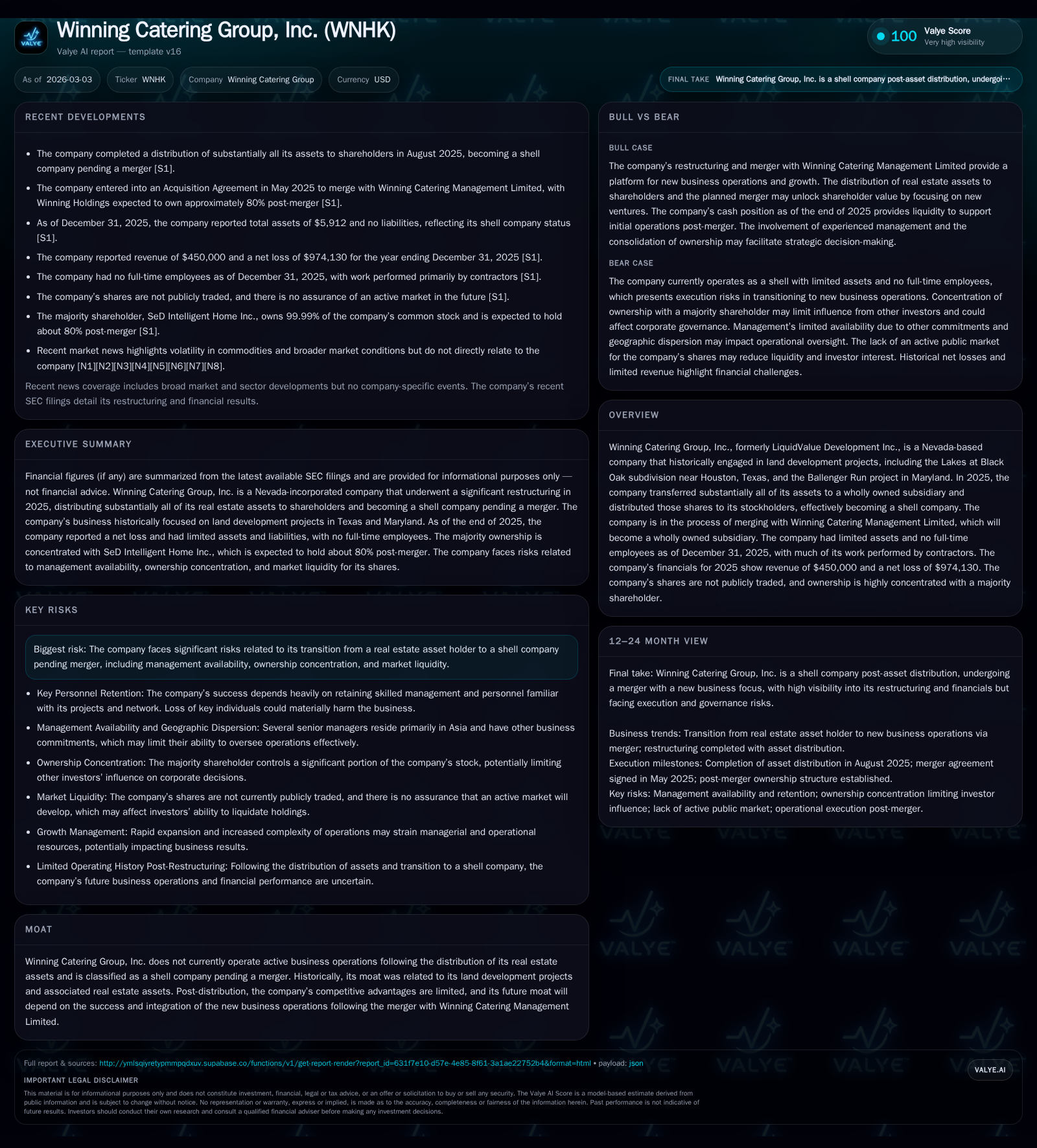
Winning Catering Group, formerly LiquidValue Development Inc., has undergone a fundamental transformation by distributing its core real estate assets via a special dividend in 2025, effectively rendering it a shell company. Historically focused on land subdivision projects in Texas and Maryland, the company experienced volatile financial performance characterized by sharp revenue fluctuations and recent operating losses. With the pending merger of Winning Catering Management Limited as a wholly owned subsidiary, ownership concentration will rise sharply, posing governance challenges amid management dispersed across continents. Investors should scrutinize forthcoming integration milestones, operational disclosures, and capital allocation strategies as the company pivots into new business domains.
Historical Revenue and Profitability: Legacy Land Development Performance
Winning Catering Group’s origins lie in land development activities managed primarily through its wholly-owned subsidiary Alset EHome Inc., focused on residential subdivision projects such as Lakes at Black Oak near Houston, Texas, and Ballenger Run in Maryland [S1][S11]. The firm recorded peak revenues of $22.9 million in fiscal year 2019 before facing declines to $18.1 million by fiscal year 2023 [F1]. Operating income similarly depicted volatility: positive operating income was noted at approximately $5.6 million in FY2023 but swung to a loss of around $1.43 million by FY2025 [F1]. Meanwhile, net income followed a similar pattern with profitable years up to 2024 ($6.7 million net income), turning sharply negative (-$974k) in FY2025 concomitant with strategic shifts [F1].
Operating cash flow provided insight into core cash generation capacity, revealing strong positive figures ($12.6M-$13M) pre-2024 but deteriorating into negative territory (-$1.2M) by end-2025 as legacy assets exited the balance sheet [F1]. The waning cash performance portends liquidity pressures aligned with the company's putative transition.
Historical performance (annual)
| FY | Net ($mm) | CFO ($mm) | OpInc ($mm) | Capex ($) | Net YoY |
|---|---|---|---|---|---|
| 2025 | -1 | -1 | -1 | 1650 | -114.6% |
| 2024 | 7 | 14 | 6 | 1650 | +7.8% |
| 2023 | 6 | 13 | 6 | 3083 | +347.2% |
| 2022 | -3 | -10 | -1 | 3083 |
Source: SEC companyfacts cache [F1].
Capital returns and efficiency (annual)
| FY | FCF ($mm) | ROE% |
|---|---|---|
| 2025 | -1 | -16477.2 |
| 2024 | 14 | 18.7 |
| 2023 | 13 | 21.5 |
| 2022 | -10 | -11.2 |
Source: SEC companyfacts cache [F1].
Note: Revenue data for some intermediate years unavailable; Capex figures stable prior to asset distribution [F1].
Key Drivers Behind Past Growth and Operational Volatility
Underlying winning's financial trajectory was its land development portfolio comprising two major projects: Lakes at Black Oak and Ballenger Run [S11][S27]. Lakes at Black Oak initially covered about 162 acres with an extension acquired later; sales unfolded via block lot dispositions largely completed by the end of 2024 [S11][S27]. The Ballenger Run project—acquired for about $15.65M—was nearing completion at time of asset divestiture with full lot sales reportedly closed [S11].
These projects generated revenue primarily through lot sales with supplemental income streams such as community enhancement fees invoiced per lot sold—typical for subdivision developers aiming to cover infrastructure costs [S27]. Additionally relevant were model home leasing activities which provided recurring rental revenue albeit temporarily; one such lease terminated early in February 2025 reflecting project wind-down dynamics [S11].
Profitability pressures arose from project lifecycle maturity as initial sales momentum slowed while fixed costs remained entrenched through marketing and administrative overheads common in residential developments nearing sellout stages.
Strategic Asset Distribution and Shift to Shell Status
Facilitating radical corporate change, Winning Catering Group executed a strategic contribution whereby all issued shares of its real estate holding subsidiary Alset EHome Inc., representing substantially all assets and liabilities related to historic activities including Lakes at Black Oak and Ballenger Run projects, were transferred on August 1st, 2025 to a newly formed wholly owned subsidiary, Alset Real Estate Holdings Inc. [S6][S10][S25].
A subsequent pro rata one-time special dividend distributed approximately $34.8 million worth of Alset Real Estate Holdings shares directly to the Company's shareholders on August 18th effectively spun off all legacy operating assets and resulted in classification of Winning Catering Group as a shell company under SEC definitions [S6][S9][S25].
This divestiture left the Company with nominal assets valued at approximately $5,912 as of fiscal year-end December 31st 2025 and no full-time employees; much operational work is now performed by external contractors indicating minimal ongoing activity beyond administrative functions [S11].
Upcoming Merger with Winning Catering Management Limited: Opportunities and Questions
The pivotal corporate event ahead is the completion of an acquisition agreement reached May 30th during fiscal year 2025 involving Winning Catering Management Limited (“Winning Group”) wherein Winning Group will merge into LVD Merger Corp., itself a wholly owned subsidiary of Winning Catering Group [S1][S25]. Upon consummation expected within anticipated timelines not specified explicitly in filings hence requiring investor watchfulness for updates —Winning Group will subsist as wholly owned subsidiary with ownership diluted such that Winning Holdings will hold roughly an estimated controlling interest near or above eighty percent of outstanding common stock [S1][S17].
This infusion aims to transform the Company's business model from land-centric holdings into active operations in catering services though operational specifics remain sparse within publicly available documentation [N/A]. Such rapid pivot raises integration complexity from both strategic execution and culture assimilation perspectives.
Ownership Concentration and Governance Risks in Transition
A salient risk factor permeating the current corporate structure stems from extreme ownership concentration demonstrated by anticipated majority shareholder control approximating eighty percent post-merger versus minority holders having constrained corporate influence [S20][S22]. This concentrated stake enables decisive control over amendments to governance documents including bylaws controlling share issuance protocols or director elections leading potentially to agency conflicts unfavorable to smaller investors.
Compounding this control scenario is geographic dispersion among leadership team members who reside primarily outside the United States (notably Asia), including co-chief executive officers managing multiple projects simultaneously thereby limiting on-the-ground oversight capacity [S18][S22]. Accordingly stakeholders face enforcement challenges related to jurisdictional complexities impacting recourse prospects against non-U.S.-resident directors or officers alleging fiduciary breaches or disputes [S18][S22].
These governance nuances underline heightened operational risks during this transitional phase when organizational coherence is critical for pursuing emergent catering business objectives.
Capital Allocation Trends: Dividends, Cash Flows, and Financial Returns
Historical capital deployment favored dividend distributions during growth phases with payments totaling over $400K-$1M around fiscal years like FY2019-FY2020; nonetheless dividends ceased thereafter coinciding with strategic redirection towards asset spin-off and operational recalibration [F1][S6][S13][S23][S25].
Operating cash flows reveal erosion shifting from multi-million positive surpluses exceeding $12M pre-spin-off toward negative cash generation close to ($1.2M) after asset disposition completion highlighting significant liquidity consumption likely associated with restructuring activities [F1]. Capital expenditures dwindled correspondingly maintaining minimal outlays underscoring lack of material reinvestment into tangible assets amid transition phase.
Return on equity metrics demonstrate acute stress reflected by implausibly negative calculated ROE approximating -16 thousand percent attributable entirely to accumulated net losses juxtaposed upon severely eroded equity base following distribution transactions [F1]. Buyback programs have been absent per record likely reflecting cautious financial posture during uncertain transformation periods.
What Investors Should Monitor Next: Forecast Indicators and Integration Milestones
In light of silent forward guidance from official filings or press releases concerning merger timing or post-merger operational targets investors are advised to monitor several focal points moving ahead:
- Timing confirmation for merger closing via SEC Form 8-K updates or press statements.
- Disclosure updates outlining management team composition changes especially key executive appointments within U.S.-based operations.
- Early operational performance indicators from Winning Catering Management Limited subsidiaries including revenue ramps or contract wins potentially revealed in subsequent quarterly filings.
- Post-merger market liquidity developments notably if public trading resumes or listing attempts occur affecting transactional fluidity.
- Continued reporting enhancements providing granular segment disclosures shedding light on catering unit economics replacing legacy real estate accounting.
- Cash runway preservation amid restructuring expenses given negative free cash flow trends observed most recently.
Surveillance for these markers will be critical given intrinsic execution risk keeping investor expectations properly calibrated until demonstrable progress emerges.
Disclaimer: This report is informational only and does not constitute investment advice or recommendations regarding securities transactions.
Disclaimer: This is research-only, informational analysis and not investment advice. It may include AI-generated interpretation and general industry context. Always verify important details using primary sources.

Comments