
Caris Life Sciences’ Molecular Platform Drives Oncology Innovation and Financial Turnaround
Caris Life Sciences leverages proprietary molecular profiling and AI to advance oncology diagnostics while achieving an operating income turnaround in 2025.
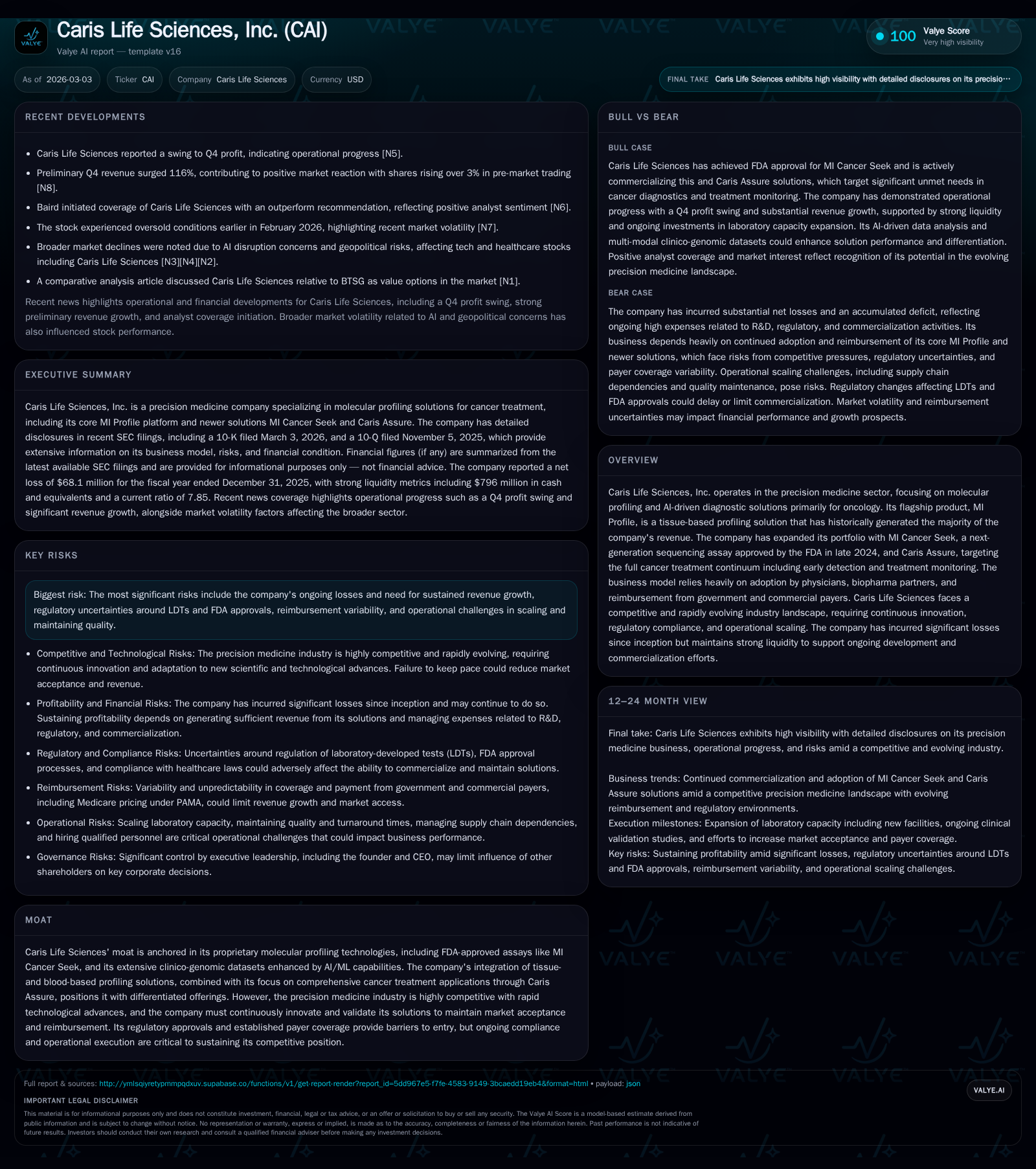
Since its founding in 2008, Caris Life Sciences has focused on developing comprehensive molecular diagnostic solutions anchored in tissue-based NGS profiling. The company’s MI Profile platform, a cornerstone of its revenue, sequenced over one million cases by the end of 2025. FDA approval of the MI Cancer Seek assay in late 2024 and the commercial rollout of Caris Assure mark significant innovation steps targeting early cancer detection and treatment monitoring. Despite persistent net losses, Caris posted a positive operating income of $45.1 million in 2025, supported by nearly $800 million in cash reserves. Key growth vectors include broader adoption of new platforms, favorable reimbursement coverage, and expansion of biopharma partnerships, while regulatory scrutiny and reimbursement dynamics remain principal risks.
Evolution of Caris’s Growth: From Tissue-Based Profiling to Multi-Modal Genomics
Founded in 2008, Caris Life Sciences has steadily built its presence as a pioneer in precision oncology diagnostics through its flagship MI Profile platform. This solution relies on whole exome sequencing (WES) and whole transcriptome sequencing (WTS) applied to tissue samples from cancer patients. The company reached a critical volume milestone by performing molecular profiling on over one million cases as of December 31, 2025 [S1].
MI Profile has driven the bulk of Caris’s revenues historically, underpinning an extensive multi-modal clinico-genomic dataset considered among the largest in oncology. This proprietary dataset fuels Caris’s AI/ML-powered analytics ecosystem, enabling continuous refinement of treatment decision frameworks [S1]. While exact annual revenue figures are not disclosed, improving operating income dynamics reflect stronger operational leverage over legacy product adoption [F1].
Despite this advancement in operating results, net income remains negative at -$68.1 million for calendar year 2025, reflecting ongoing investments and expenses [F1]. The company’s ability to transition from tissue-based single modality profiling toward integrated blood- and tissue-based genomic solutions will be vital for sustaining momentum.
Innovations Launching Future Growth: MI Cancer Seek and Caris Assure Platforms
A significant inflection occurred late in 2024 when Caris received FDA premarket approval (PMA) for its MI Cancer Seek assay—a next-generation sequencing test designed as a companion diagnostic tool employing WES/WTS tissue profiling [S1][N6]. Commercial launch began in January 2025 [N5], positioning this assay to capture incremental market share within therapeutic decision support.
Complementing this is Caris Assure, broadly commercialized starting Q1 2024, which offers blood-based WES/WTS molecular profiling targeting minimal residual disease (MRD) tracking, early detection, treatment monitoring, and therapy selection [S1][N6]. This platform aims to address the entire cancer care continuum beyond solid tumor diagnosis.
Clinical data supporting these innovations include the interim readout of the Achieve 1 study announced February 2026, which will inform future expansion across oncologic indications [N5][S3]. However, adoption hinges on sustained clinical validation and payor reimbursement acceptance—variables that inject execution risk into near- and medium-term growth prospects [S11][S13][S16][N6].
2025 Financial Results Highlight Operating Income Positive Pivot and Cash Strength
The fiscal year ended December 31, 2025 marked a pivotal recovery phase. Notably, operating income turned profitable at approximately $45.1 million despite an overall net loss due to non-operating expenses and investment-driven charges [F1][N5]. This profitability inflection signals improved cost discipline or higher contribution margins amid active platform expansion.
Caris declared robust liquidity with cash and cash equivalents totaling nearly $796 million at year-end, underpinning operational resilience [F1]. Current assets substantially exceed current liabilities ($997.8M vs. $127.1M), yielding an enviable current ratio of about 7.85 that minimizes short-term funding concerns [F1]. Free cash flow—at approximately $66.9 million—is sufficient to fund research initiatives without urgent external capital needs [F1].
Nevertheless, return on equity remains negative (-11.8%), indicating historical accumulated losses weigh on shareholder returns despite recent operational improvements [F1]. Continued momentum is necessary to sustain profitability sustainably.
Capital Deployment: Balancing R&D Investment with Healthy Free Cash Flow
Caris allocates substantial resources toward research and development activities critical for maintaining its competitive edge amid fast-evolving molecular diagnostic technologies [S28][S29]. Quarterly filings attest to meaningful R&D spending focused on assay iteration, scalability enhancements, and validation study execution.
Capital expenditures remain relatively modest relative to operational scale; consistent positive free cash flow supports this allocation strategy without stressing balance sheet capacity [F1][S28]. The firm does not currently distribute dividends nor has publicly disclosed share repurchase programs suggesting reinvestment prioritization at this stage [S28][S29].
This judicious capital management underscores an emphasis on expanding novel product capabilities while preserving liquidity buffers amidst regulatory and market uncertainties.
Navigating Regulatory and Competitive Headwinds in Precision Oncology
The regulatory environment represents a dual-edged challenge for Caris. Its key assays such as MI Cancer Seek enjoy FDA PMA clearance—a high regulatory standard conferring credibility—but maintaining compliance demands ongoing data submissions addressing interference factors like necrotic tissue or sample stability per FDA conditions outlined post-approval [S13][S15].
Additionally, uncertainty persists around lab-developed tests (LDTs) regulation under evolving FDA policies; failure to adapt could impair sales continuity or coverage eligibility [S4][S5][S6]. In parallel, government investigations such as the DOJ Civil Investigative Demand regarding Medicare's “14-day rule” compliance impose litigation risks that may incur future penalties or operational disruption [S1].
On the reimbursement front, Medicare National Coverage Determinations underpin significant payer support though price-setting reforms under PAMA introduce variable reimbursement dynamics impacting test economics unpredictably for Caris’s solutions including MI Cancer Seek (CPT code 0211U reimbursed at approximately $8,455 CLFS rate) [S9][S10][S18]. Private payers add further complexity through diverse coverage policies and benefit managers requiring robust evidence support for modality uptake.
Competition from other precision medicine providers leveraging NGS or emerging liquid biopsies intensifies pressure on technological differentiation and cost containment strategies essential to defend market position [N6].
Biopharma Partnerships Fueling Clinical Impact and Data Network Expansion
A salient driver augmenting Caris’s competitive moat is its portfolio of partnerships with leading biopharmaceutical companies such as Moderna, AbbVie, Merck KGaA, Genentech, and Xencor leveraging its multi-modal clinico-genomic database for biomarker discovery and therapeutic optimization efforts [S1].
This collaborative ecosystem reflects ’TechBio’ model synergies where proprietary patient molecular information supports drug development risk mitigation by improving target identification accuracy or patient stratification algorithms beyond standard approaches.
Such alliances transcend diagnostics revenue alone by embedding Caris deeply within translational medicine workflows—a value proposition that both diversifies income sources and reinforces recurring utilization patterns.
Investor Watchpoints: Adoption Rates, Reimbursement Trends, and Legal Risks
Key focal points for stakeholders include monitoring physician uptake trajectories for MI Cancer Seek post-PMA launch alongside clinical validation progress from studies like Achieve 1 validating Caris Assure’s utility beyond therapy selection into screening or MRD surveillance contexts [N5][N6][S3][S11].
Reimbursement climate evolution under PAMA reform cycles through mid-to-late decade dictates margin sustainability due to periodic CMS payment rate resets tied to private payer baselines introducing volatility absent volume expansion offsets [S18].
Legal developments related to Government investigations into Medicare billing practices remain unresolved; outcomes could materially impact financial results or require operational restructuring depending on scope or settlement conditions [S1]. Investors should review these compliance proceedings carefully.
Broadly speaking, continued innovation coupled with securing wide payer acceptance is essential to translate patented technologies into consistent top-line expansion capable of closing the profitability gap.
Historical performance (annual)
| FY |
|---|
| 2025 |
Source: SEC companyfacts cache [F1].
Operating income turned positive for the first time in recent years despite continuing net losses driven by significant investments; liquidity remains strong supporting strategic initiatives.
This analysis synthesizes information available up through March 3rd, 2026 from Caris Life Sciences' SEC filings including their detailed annual report (10-K), quarterly filings (10-Q), recent earnings announcement (8-K), combined with public news reports covering corporate developments and analyst commentary. It aims to present an integrated internal perspective on operational performance drivers alongside structural challenges facing the company without providing specific investment recommendations.
Any forward-looking considerations should be contextualized within disclosed regulatory risks, commercial adoption uncertainties, reimbursement variability under evolving healthcare policy frameworks, legal proceedings regarding billing compliances under Medicare guidelines including the ongoing DOJ CID investigation noted in filings.
Further monitoring milestones such as readouts from pivotal clinical validation programs like Achieve 1 or updates on coding/reimbursement policies will be critical indicators shaping Caris's trajectory beyond its recent operating income pivot.
Investors would benefit from maintaining awareness of these layered complexities intrinsic to the techbio-precision oncology diagnostic niche where rapid innovation cycles intersect with stringent regulatory standards and multifaceted payer ecosystems.
Disclaimer: This is research-only, informational analysis and not investment advice. It may include AI-generated interpretation and general industry context. Always verify important details using primary sources.

Comments