
Miami International Holdings Grows Options and Futures Volumes While Managing Profitability Challenges
MIAX expanded U.S. options contracts by 41% and modestly grew futures volume in 2025 amid rising fixed costs and ongoing competitive pressures.
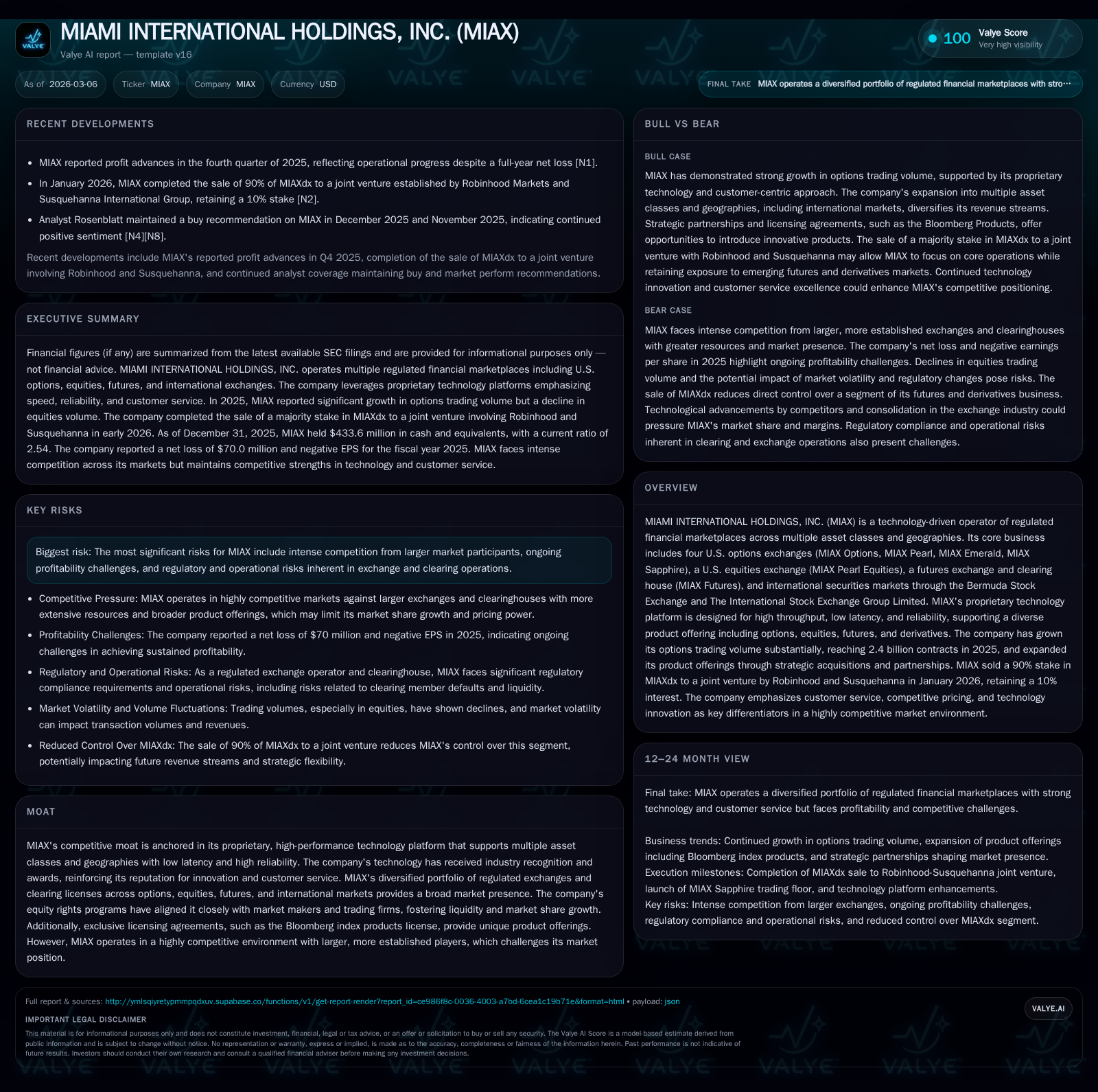
Miami International Holdings, Inc. (MIAX) sustained strong volume growth across its diverse asset classes in 2025, driven primarily by its suite of U.S. options exchanges and expansion into futures and international securities markets. Proprietary technology and strategic licensing agreements like the Bloomberg index products bolster differentiation amid an intensely competitive landscape dominated by long-established players. However, fixed-cost operating leverage and profitability challenges persist despite record transaction volumes, as reflected in a net loss for the year. The company’s future trajectory hinges on successful commercialization of new proprietary products, scaling futures market share, and leveraging international acquisitions while managing regulatory and operational risks inherent to exchange operators.
Historical Performance and Business Overview
Miami International Holdings (MIAX) built its reputation since its first options exchange launch in 2012 with a technology-first strategy focused on speed, reliability, and customer service [S1][S8]. This approach enabled sustained volume expansion driven by differentiated fee structures such as Pro Rata Customer Rebate and Maker-Taker models tailored to varied market participants [S13]. In 2025 alone, multi-listed U.S. options volume surged over 41% year-over-year to reach about 2.4 billion contracts, placing MIAX as the 13th largest global derivatives operator by volume [S17][S18][F1].
The company’s footprint extends beyond options into equities (MIAX Pearl Equities launched in 2020), futures (acquisition of MIAX Futures in late 2020), clearing services (via Dorman Trading), and international exchanges through BSX and TISEG acquisitions [S14][S16]. This diversified asset-class platform leverages MIAX’s proprietary low-latency technology stack praised for throughput and wire-order determinism that supports highly scaled execution across multiple regulated venues [S10][S11].
Recent milestones include launching MIAX Sapphire options exchange with a physical trading floor opened in Miami during late 2025 to access the remaining floor-traded volume segment [S13], plus releasing own BSX trading/clearing infrastructure supporting seamless international operations expanding into digital assets under Bermuda’s regulatory framework [S23].
Historical performance (annual)
| FY |
|---|
| 2025 |
Source: SEC companyfacts cache [F1].
(Note: Revenue not disclosed explicitly; operating income provided; net income shows loss indicating challenges in profitability despite volume growth [F1])
Drivers of Past Growth
MIAX has capitalized on order flow growth mainly within U.S. options markets via innovative volume incentive programs such as executed equity rights programs (ERPs) aligning interests of market makers with company growth [S8]. These programs rewarded fee prepayments or equity warrants tied to liquidity targets leading to increased member engagement.
Technology superiority remains core; awards including multiple "Best Trading Platform" recognitions demonstrate industry validation for reliability during volatile market conditions—a critical factor attracting institutional order flow [S10]. Expanded product offerings such as short-term weekly options introduced in early 2026 build upon retail/institutional demand for granular hedging instruments which historically catalyzed volume gains [S21].
Internationally, leveraging BSX’s expertise enabled entry into insurance-linked securities (ILS), debt instruments, hedge funds listings, as well as exploration into crypto/digital assets courtesy of Bermuda's favorable regulatory landscape adds diversification potential beyond U.S.-centric markets [S23]. The TISE acquisition extends reach into UK/European listings benefiting from proximity advantages.
On the futures front, after acquiring Minneapolis Grain Exchange-based MIAX Futures with DCM/DCO licenses, the company is evolving from predominantly ag commodities towards financial futures products expected to debut on the MIAX Futures Onyx platform in Q2 2026 [S14][S18]. This represents a strategic intent to capture more lucrative broader futures market segments alongside vertical integration through related clearing services.
Growth Prospects and Constraints
Looking forward, MIAX highlights several avenues poised to fuel growth:
- Launching proprietary Bloomberg Products including mini-futures on B500 and B100Q indices in Q2 2026 targeting broader investor segments with smaller notional exposure permits incremental product revenue streams exclusive under their license agreement [S14][S21].
- Expanding use cases on MIAX Sapphire trading floor anticipated to attract additional traditional floor traders thereby capturing niche but persistent volumes absent from purely electronic venues [S13].
- Augmenting data analytics monetization leveraging marketplace data distribution including blockchain-based arrangements such as Pyth Network tokens providing alternative revenue sources tied to proprietary data assets [S11][S23].
However, these growth opportunities coexist with significant headwinds:
- The competitive environment intensifies with established heavyweights like Cboe, Nasdaq, ICE offering extensive product suites supported by scale-driven pricing advantages forcing continuous investment commitments from MIAX in fees rebate schemes, connectivity enhancements, and client support functions [S7][S12][S17].
- Fixed cost structure inherent in exchange operations combined with regulatory compliance burden creates leverage on profit margins if trading volumes or product mix softens unexpectedly; for example MIAX reported a net loss of roughly $70 million despite positive operating income reflecting non-recurring charges or investments possibly related to technology upgrades or acquisition integrations [F1][S1].
- Regulatory uncertainties particularly affecting new proprietary licensed products such as Bloomberg indexes expose risk around approval timing or possible rule changes impacting commercialization pace or revenue recognition [S24].
- Clearing operations face concentration risks if clearing members reduce open interest or withdraw which could stress margin systems despite risk management safeguards elevated under CFTC oversight [S25].
Financial Expectations: What To Watch
While explicit revenue guidance is not disclosed in filings available today [N2], milestones worth tracking include:
- Execution success of Bloomberg Product launches targeted for Q2-Q3 2026 potentially generating distinct revenue lines separate from traditional volume fees.
- Market share movements in both core multi-listed U.S. options space where two new competitors are entering suggests a dynamic environment requiring attention amid fee model shifts.
- Adoption rates for new Short-Term Options expirations extending weekly expirations beyond January rollouts providing indication of retail/institutional appetite.
- Volume trends at MIAX Futures as expanded financial futures come online will directly influence clearing house fee growth.
- International listing activity levels at BSX/TISE post-integration reveal scalability of cross-border strategy.
- Capital markets environment broadly influencing trading activity especially volatility levels affecting options volumes typically correlated positively.
Returns & Capital Allocation
MIAX's balance sheet exhibits solid liquidity with approximately $434 million cash & equivalents at year-end 2025 against current liabilities near $337 million yielding a strong current ratio ~2.54 signaling comfortable short-term solvency [F1]. Operating cash flow remains robust with free cash flow around $145 million illustrating positive cash conversion despite accounting losses possibly stemming from amortization or stock-based compensation expenses common within tech-driven exchanges.
Dividend payments or share buybacks were not stated explicitly indicating retained earnings reinvestment prioritizing growth initiatives or balance sheet strengthening over capital returns currently [F1]. Although reported Return on Equity is negative due to net losses (-7.9%), this may reflect transitional phase investments aligned with scaling operations rather than structural profitability deficiency yet warrants monitoring for inflection points toward sustained profits as revenues mature.
Strategic Positioning & Competitive Moat
MIAX fortifies its moat via proprietary technology acclaimed for latency performance critical in today's high-frequency electronic trading milieu combined with personalized member service fostering loyalty amidst commoditized venue choices [S4][S7]. The equity rights programs have effectively synchronized incentives between MIAX and active market makers leading to liquidity aggregation benefits essential for attracting order flow.
Exclusive licensing agreements such as Bloomberg product rights permit offering differentiated instruments unavailable through competitors enhancing stickiness among certain institutional clients while steadily growing product breadth minimizes dependency risks originating from any single asset class segment.
However, scale disparities relative to dominant incumbents constrain pricing power thus reinforcing the imperative for innovation-led differentiation alongside operational excellence emphasizing system reliability especially amid heightened volatility when downtime penalties can be substantial reputationally.
Risk factors including regulatory compliance complexity spanning SEC/CFTC jurisdictions plus operational risks connected to clearing function counterparty exposures require vigilant governance frameworks amid evolving market infrastructures undergoing technological disruption including AI/blockchain experimentation under early-stage exploration internally by MIAX [S10][S18].
Conclusion
Miami International Holdings emerges as a technically advanced multi-asset marketplace operator achieving notable upward momentum across options volumes complemented by cautious expansion into futures markets and augmented by international listings providing geographic diversification benefits. Despite substantial top-line activity gains evidenced by surging contract counts reaching historical peaks last year, profitability remains elusive given increasing fixed expense absorption during this growth phase coincident with investments aimed at broadening product offerings such as Bloomberg-linked index contracts expected imminently.
Navigating intense competition from larger well-capitalized rivals necessitates continued technological enhancements paired with customer-centric service execution fostering participant retention while exploring novel revenue streams such as data analytics monetization strategies will be pivotal going forward.
Market participants monitoring MIAX should focus closely on adoption metrics related to upcoming proprietary product launches including short-term equity option expirations alongside shifts in market share within the core equities/options business lines plus progress integrating international subsidiaries that substantiate long-term scalable growth prospects amidst stringent regulatory landscapes shaping operational frameworks.
This analysis is intended solely for informational purposes regarding Miami International Holdings Inc., synthesizing available SEC filings and recent news releases without constituting any form of investment advice or recommendation.
Disclaimer: This is research-only, informational analysis and not investment advice. It may include AI-generated interpretation and general industry context. Always verify important details using primary sources.

Comments