
Ascent Industries’ Specialty Chemicals: Reshaping Growth Through Chemicals-as-a-Service
Ascent transforms into an integrated specialty chemicals provider leveraging its Chemicals-as-a-Service model amid financial recovery and market challenges.
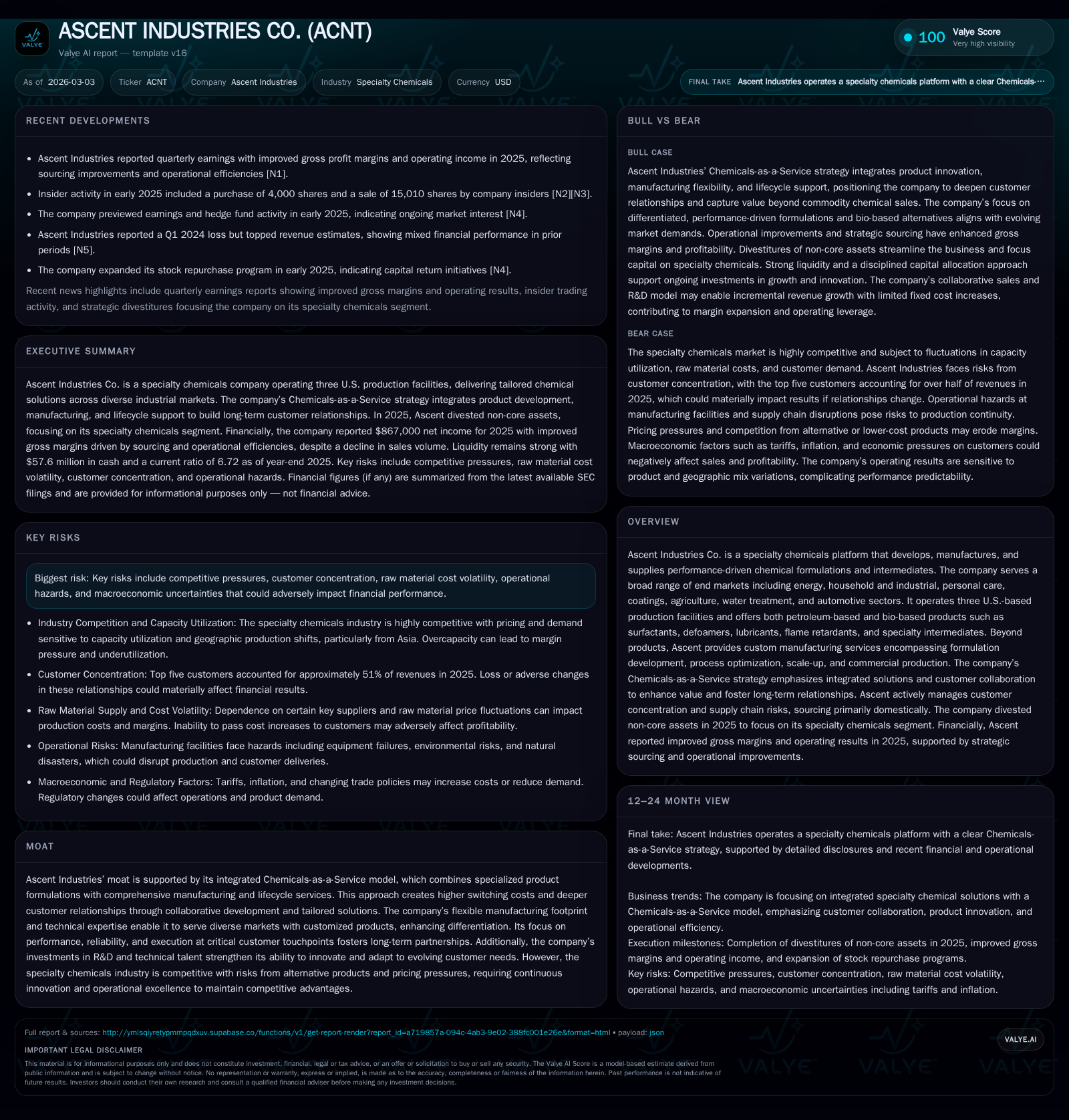
Ascent Industries Co., a specialty chemicals platform operating three U.S. facilities, has pivoted strategically to emphasize its Chemicals-as-a-Service (CaaS) operating model to drive differentiated growth. The company reported modest revenue growth in 2025 alongside ongoing operating losses, while divesting metals-related assets to focus exclusively on specialty chemicals. The CaaS strategy bundles tailored formulations with custom manufacturing and lifecycle services, aiming to deepen customer relationships and create switching costs. Customer concentration remains elevated, and risks include raw material cost volatility and competitive pressures. Capital allocation shows active share repurchases supported by strong liquidity. Monitoring operational improvements and margin stability will be key to validating the transformation.
Historical Financial Performance and Divestiture Impact
Ascent Industries Co.'s recent financial results reflect its transition toward specialty chemicals while managing legacy business exits. In fiscal year 2025, the company generated revenues of approximately $74.7 million—a modest increase of 1.4% compared to prior periods—reflecting strategic focus shifts and pricing improvements despite volume pressures [F1]. Operating income declined further into negative territory at -$7.0 million (-37.9% year-over-year), highlighting persistent profitability challenges despite gross margin expansion driven by improved raw material sourcing discipline [F1][N1]. Net income turned positive at $0.9 million following losses exceeding $13 million the prior year [F1].
This performance coincided with notable portfolio reshaping through two material divestitures: Bristol Metals sold for about $45 million in cash proceeds completed in April 2025 and American Stainless Tubing disposed for roughly $16 million in June 2025—removing legacy metals segments and aligning Ascent as a pure-play specialty chemicals platform focused on higher-value performance formulations [S1][S2][S11].
Historical performance (annual)
| FY | Net ($mm) | CFO ($mm) | OpInc ($mm) | Capex ($mm) | Net YoY |
|---|---|---|---|---|---|
| 2025 | 1 | -1 | -7 | 2 | +106.4% |
| 2024 | -14 | 15 | -5 | 2 | -222.1% |
| 2023 | 11 | 23 | -37 | 3 | -49.5% |
| 2022 | 22 | 6 | 20 | 5 |
Source: SEC companyfacts cache [F1].
Capital returns and efficiency (annual)
| FY | Buybacks ($mm) | FCF ($mm) | ROE% |
|---|---|---|---|
| 2025 | 9 | -2 | 1.0 |
| 2024 | 1 | 13 | -14.5 |
| 2023 | 1 | 20 | 10.4 |
| 2022 | 1 | 1 | 16.4 |
Source: SEC companyfacts cache [F1].
Source: [F1]
Business Model Evolution: Chemicals-as-a-Service (CaaS)
In early 2025, Ascent introduced its Chemicals-as-a-Service (CaaS) model—an integrated approach combining custom chemical formulations with comprehensive manufacturing and lifecycle services encompassing formulation development, reaction scale-up capabilities, blending and packaging logistics, regulatory support, and delivery management [S9]. This model emphasizes creating value at "moments that matter" within customer relationships where consistent performance and execution underpin long-term retention beyond commodity pricing or availability alone.
Key pillars include:
- Discovery & Development: Accelerated collaborative formulation tailored to specific applications.
- Commercial & Contracting: Simplified customer engagement through flexible contract structures.
- Manufacturing & Fulfillment: Reliable multi-purpose production enabling complex chemistries.
- Service & Lifecycle Support: End-to-end technical and regulatory assistance throughout product life.
This approach enhances switching costs and fosters trust-based partnerships within specialty chemical markets often challenged by commoditized suppliers [N1][S9]. The company's U.S.-based flexible manufacturing footprint supports customization across diverse end markets including energy and personal care.
Customer Concentration and Market Environment
Customer concentration remains a significant consideration; the top five customers accounted for about 51% of total revenues in full-year 2025—up from roughly 35% the previous year—reflecting selective portfolio pruning post-divestitures alongside intensified focus on core relationships [S14][S26]. These customers span sectors such as energy, coatings adhesives sealants elastomers (CASE), household industrial institutional (HII), agriculture, water treatment, automotive among others [S14].
The specialty chemicals industry faces global capacity utilization fluctuations—with overcapacity pressures particularly from Asia impacting pricing—and evolving demand dynamics between petroleum-derived products versus bio-based alternatives included within Ascent’s surfactants, lubricants, flame retardants portfolio [S6][S14]. Volatile raw material prices tied especially to petroleum inputs impose ongoing sourcing challenges while pricing power remains constrained due to competition from incumbents plus emerging sustainable chemistry substitutes commanding premium valuations.
Managing these dynamics requires active portfolio realignment combined with disciplined commercial execution amid muted demand exacerbated by inflationary pressures and variable tariff regimes affecting supply chains [N1][S1][S26].
Profitability Trends and Operational Efficiency
While revenue growth was modestly positive supported by pricing improvements (+10.9%), operating margins remained negative chiefly due to elevated selling general & administrative (SG&A) expenses driven by strategic talent acquisitions supporting CaaS deployment plus reclassified rent expenses and increased stock-based compensation raising overhead costs materially to about 32% of sales compared with approximately 26% previously [N1][F1].
Gross profit margins improved significantly from around 13% in the prior year to over 23%, reflecting disciplined procurement practices and streamlined product focus eliminating lower-margin SKUs [N1][F1]. However, this margin expansion was insufficient to offset higher operating expenses resulting in continued operating losses albeit narrowing year-over-year (-$7M versus larger prior deficits).
Net income returned positive for the first time since previous losses primarily due to non-cash lease modification gains combined with tax benefits arising from valuation allowance adjustments signaling improving fundamentals but offset by deteriorating operating cash flow which turned negative (-$0.5M versus +$14.7M), indicating working capital or collections pressures remain unresolved [N1][F1].
R&D Investments Driving Innovation Differentiation
A foundational element of Ascent’s transformation is sustained R&D investment focused on accelerating development cycles via integrated collaboration—expanding technical expertise—to engineer proprietary formulations addressing niche application challenges not easily replicated by commoditized competitors or simple green substitutes lacking rigorous validation [S5][S9].
Direct engagement between R&D and sales teams enables customer-aligned innovations facilitating process improvements scalable across mid-sized batch volumes supported by flexible manufacturing assets capable of complex reaction sequences or blending essential for performance-driven specialty intermediates or surfactants targeting oilfield chemicals through agrochemicals to personal care products.
This innovation pipeline fosters higher switching costs since solving initial technical problems often leads to broader product adoption embedding Ascent deeper into customer operations beyond transactional sales—a critical advantage supporting CaaS viability and differentiation [N1][S9].
Capital Allocation: Navigating Cash Flow Constraints Amid Share Repurchases
Fiscal year-end free cash flow was negative approximately $2 million (operating cash flow of -$0.519 million minus capital expenditures of $1.544 million)—the first negative figure after years of positive cash generation—reflecting reinvestment into growth initiatives despite liquidity strength providing flexibility for capital deployment [F1].
Balance sheet liquidity remains robust with cash & equivalents near $57.6 million against current liabilities around $12.3 million yielding a strong current ratio exceeding six times (6.72), supporting working capital needs plus discretionary capital returns such as share repurchases which totaled approximately $9.14 million in fiscal year 2025—a notable increase from prior years under $1 million—indicating board confidence in returning capital amid improving earnings trends though dividends have been minimal historically since last payout recorded in fiscal year 2019 [$2.3M] [F1][S23].[]
Debt levels remain low with no outstanding borrowings reported on revolving credit facilities as of late September 2025; minor insurance premium financings under $1 million mature shortly underscoring conservative leverage supporting operational agility during transformation phases [S10][S16].[]
Principal Risks Shaping Outlook in Specialty Chemicals Sector
Key risks encompass raw material price volatility influenced by global energy markets; supply chain disruptions mitigated through diversified sourcing predominantly domestic (~95%) yet reliant on some limited vendors requiring vigilance [S14][S15].[]
Customer concentration risk is material given dependence on top five clients generating half revenues; adverse changes could materially impact cash flows alongside competitive threats not only from traditional peers but also emerging sustainable chemistry entrants eroding market share or pressuring pricing demanding continuous innovation through R&D persistence [S6][S19].[]
Operational risks include environmental liabilities related to contamination or regulatory changes potentially retroactive; cybersecurity vulnerabilities amplified by AI tool adoption introducing novel compliance exposures necessitating balanced investment between innovation acceleration and reputational risk management [S17][S19],[S22].[]
Low probability but high impact events like natural disasters or pandemics could disrupt manufacturing continuity given regional facility footprint processing petrochemical derivatives requiring robust contingency planning embedded within risk management frameworks [S24].[]
Forward-Looking Indicators to Monitor Progress
Absent explicit forward guidance in filings or transcripts, key indicators include:
- Sustained earnings improvement post-Q4 FY2025 transitioning toward consistent positive operating margins evidencing CaaS commercial traction beyond initial rollout costs [N1];
- Expansion of CaaS engagements demonstrated through new contracts or renewals shifting away from transactional sales toward integrated service models;
- Gross margin stabilization amidst inflationary cost containment via advanced sourcing strategies;
- Operating expense leverage reflected by flattening SG&A growth as strategic hires mature into productivity gains;
- Capital return policy evolution balancing further buybacks against potential dividend reinstatement aligned with free cash flow recovery.
Market developments including tariff changes or competitor moves toward sustainability-oriented chemistries may accelerate pressure points prompting adaptive strategy adjustments observable through upcoming earnings disclosures or investor communications.
This analysis is provided solely for informational purposes without any explicit or implicit investment recommendations.
Disclaimer: This is research-only, informational analysis and not investment advice. It may include AI-generated interpretation and general industry context. Always verify important details using primary sources.

Comments