
CPS Technologies' Recovery from Losses Hinges on MMC Innovation and Customer Concentration Risks
After recovering from significant losses, CPS Technologies refocuses on expanding proprietary MMC applications amid concentrated sales and operational risks.
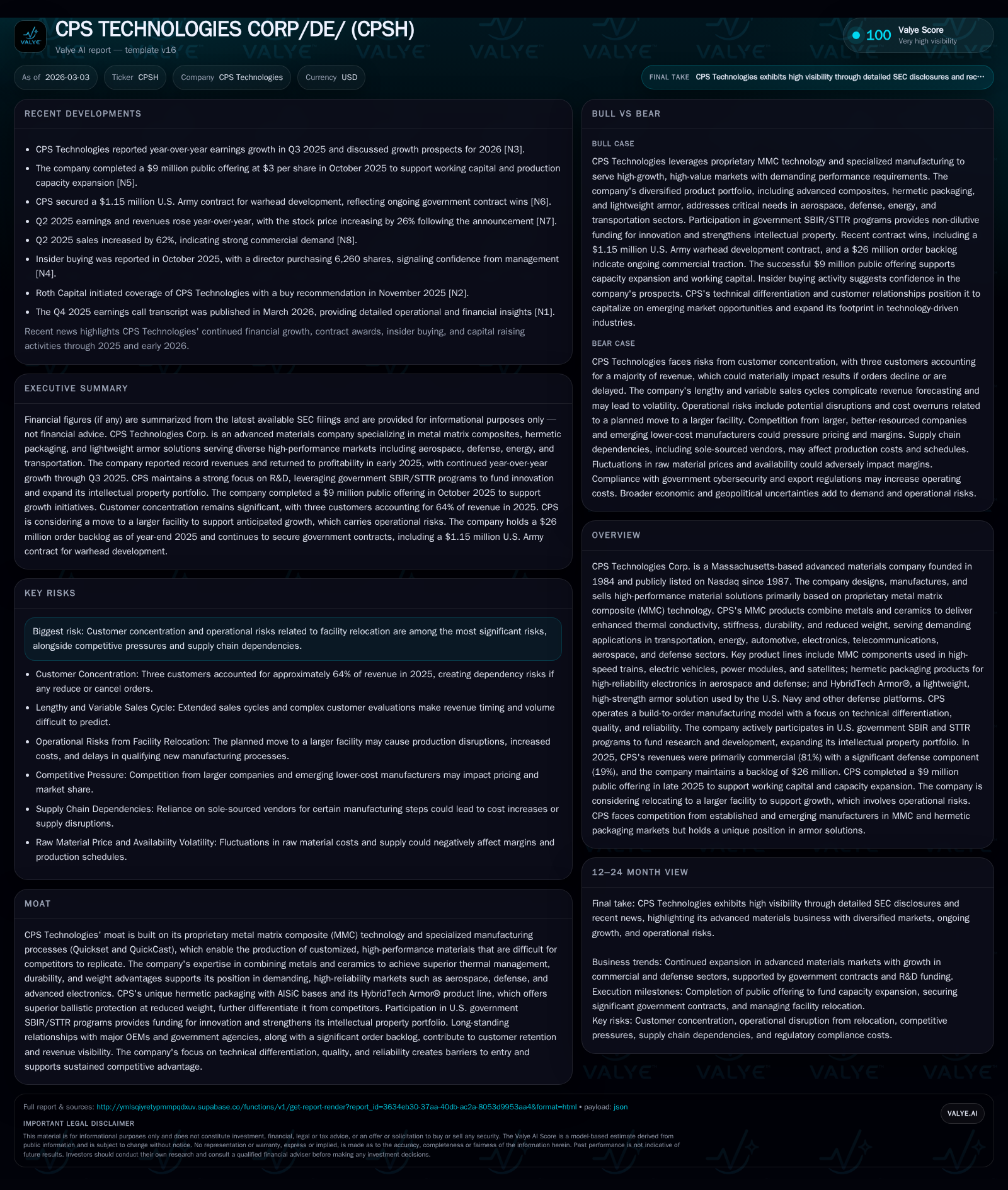
CPS Technologies Corp, an advanced materials firm specializing in proprietary metal matrix composites (MMCs), has seen volatile financial results characterized by a turnaround from a sizeable net loss in 2024 to modest net profit in 2025, driven by its niche product portfolio serving aerospace, defense, and high-reliability industrial markets. The company’s growth prospects hinge on expanding MMC solutions into defense and commercial segments such as electric vehicles and telecommunications, leveraging SBIR/STTR-funded R&D programs and new product initiatives like AlMax alloys and HybridTech Armor®. However, CPS faces risks stemming from high customer concentration—three customers accounted for 64% of 2025 revenues—and supply chain dependencies exacerbated by vendor sole-sourcing requirements. With limited operating leverage evidenced by low returns on equity and negative free cash flow in 2025, operational execution including a planned facility relocation will be key factors to monitor.
Company Overview and Historical Performance
Founded in 1984 and public since 1987, Massachusetts-based CPS Technologies Corp specializes in advanced materials with a focus on proprietary metal matrix composite (MMC) technologies combining metals and ceramics. These MMCs offer superior thermal conductivity, stiffness, durability, and reduced weight relative to conventional materials. Their functionality addresses demanding environments across multiple sectors including aerospace, defense, transportation (e.g., high-speed trains), energy infrastructure, telecommunications, automotive (notably electric and hybrid vehicles), satellites, and space exploration missions such as NASA’s Mars rovers [S1][S14].
Product lines extend beyond MMC components to include hermetic packaging solutions for high-reliability electronics used in avionics and satellites—unique offerings featuring aluminum silicon carbide bases for weight reduction—and HybridTech Armor®, an MMC-based lightweight armor solution notably adopted by the U.S. Navy for aircraft carriers’ crew-served weapon stations [S1][S14][S19].
Financially, CPS has experienced significant volatility. According to the latest SEC filings for fiscal year ending Dec. 27, 2025, revenues were approximately $14.6 million — representing a roughly 5% decrease against prior periods for which limited data exist publicly [F1]. Operating income rebounded markedly to $0.44 million from a negative $4.4 million loss in 2024 while net income swung similarly from a loss of $3.1 million to a net profit nearing $0.42 million [F1]. This swing reflects improved operational discipline following prior expense challenges.
Operating cash flow also recovered to positive territory at $244K in 2025 after previously negative flows exceeding $3 million. Nevertheless, higher capital spending ($730K) led to negative free cash flow near -$487K for the year [F1], signaling ongoing reinvestment needs possibly related to modernization or expansion plans.
Historical performance (annual)
| FY | Net ($mm) | CFO ($mm) | OpInc ($mm) | Capex ($) | Net YoY |
|---|---|---|---|---|---|
| 2025 | 0 | 0 | 0 | 730662 | +113.4% |
| 2024 | -3 | -3 | -4 | 994261 | -328.8% |
| 2023 | 1 | 1 | 2 | 718274 | -35.7% |
| 2022 | 2 | 4 | 2 | 439772 |
Source: SEC companyfacts cache [F1].
Capital returns and efficiency (annual)
| FY | FCF ($mm) | ROE% |
|---|---|---|
| 2025 | 0 | 1.7 |
| 2024 | -4 | -21.6 |
| 2023 | 1 | 7.9 |
| 2022 | 3 | 13.6 |
Source: SEC companyfacts cache [F1].
*Note: Revenue figures are mostly limited; operating income and net income show substantial volatility.
Business Model and Moat
CPS operates primarily on a build-to-order model producing highly customized MMC components tailored to specific customer drawings and long-term engagements. The company leverages two patented manufacturing processes: Quickset™ Injection Molding yielding precision components with superior properties; and QuickCast™ Pressure Infiltration enabling complex parts with high strength-to-weight ratios [S15][S25]. These process advantages create barriers difficult for competitors to replicate.
Its proprietary MMC materials underpin applications requiring precise thermal management combined with mechanical durability—for example in power electronics where silicon carbide chips operate at elevated temperatures demanding heat dissipation beyond copper's limits due to mismatch in coefficient of thermal expansion (CTE) [S9]. CPS's MMC technology has been incorporated successfully into cutting-edge platforms including high-voltage DC converter stations and wind turbine components.
Hermetic Packaging products cater especially to mission-critical aerospace electronics where protection against moisture and contaminants is paramount—used extensively on GPS satellites, Mars Perseverance rover systems, the New Horizons deep space mission beyond Pluto, among others [S19]. The distinctive AlSiC base hermetic packages offer unmatched combination of low mass and thermal performance.
The HybridTech Armor® line illustrates strategic defense applications where traditional steel armor’s excessive weight limits platform mobility while ceramic armor lacks multi-hit robustness. Embedding ceramics within a metal matrix creates panels that provide superior ballistic protection per unit weight alongside environmental durability such as salt spray resistance—a decisive factor leading to selection by U.S Navy aircraft carrier deployments starting with USS Abraham Lincoln [S19][S26]. This product line is actively being extended toward lighter armor solutions for Marine Corps Amphibious Combat Vehicles.
Market Positioning & Industry Dynamics
CPS faces competitive challenges primarily from larger international players such as Denka in Japan for MMC baseplates as well as emerging lower-cost Chinese producers poised to erode price competitiveness. For less demanding applications copper remains an acceptable alternative but loses ground as voltage levels increase requiring advanced thermal management features provided by MMCs [S16][S19].
In hermetic packaging markets competition includes domestic specialized manufacturers like Egide and Ametek; however CPS’s AlSiC offering remains unique globally [S16][S19]. The armor market is fragmented but CPS holds no direct competitors matching its light-weight ballistic capability combined with durability under harsh conditions.
Foreign exchange volatility adds margin pressure relative to foreign-based competitors that can price more aggressively when the U.S dollar strengthens—challenges compounded by sole-source vendor relationships mandated by major customers for plating or finishing steps; vendors occasionally raise prices without immediate pass-through privilege risking margin compression or potential customer defection [S1][S8].
Growth Prospects
CPS is actively pursuing diversification across several fronts:
- Expanding penetration into electric vehicle power modules leveraging MMC’s thermal advantages.
- Broadened participation in advanced telecommunications infrastructure components.
- Development of next-generation hybrid materials such as AlMax® fiber-reinforced aluminum alloys licensed exclusively from Triton Systems targeting higher strength at moderate weight premiums suitable for helicopter bearing liners—a potentially large future opportunity pending extended testing phases [S23].
- Increased defense-related contracts including Modular Radiation Shielding composites for nuclear sector funded via SBIR/STTR programs; ongoing Phase II programs address missile thermal management and controlled fragmentation warheads funded respectively by Department of Defense branches [S20][S26].
- Facility expansion near existing Massachusetts location intended to improve scale capacity though this carries risk associated with transition disruptions or delayed realization of anticipated demand growth [S12][S16].
These initiatives align with CPS’s strategy of targeting high-growth end markets demanding technical differentiation where failure costs are high—hence valuing performance over price sensitivity [S6][S7]. Nonetheless demand cycles remain volatile often subject to extended sales cycles from months up to multiple years due to customer evaluation complexities requiring end-product redesigns before adoption—a factor limiting forecast accuracy [S1][S8].
Risks & Challenges
Among the most prominent risks faced:
- Customer Concentration: Approximately three customers accounted for around two-thirds of revenues in recent years (64% in 2025 vs.58% prior), heightening exposure should any reduce or cancel orders unexpectedly or negotiate less favorable terms affecting margins significantly [S1][S5].
- Supply Chain Dependencies: Major customers’ stipulations on approved sole-source vendors create vulnerability if pricing escalates or service falters; internal capacity buffers may not fully mitigate revenue impacts if bottlenecks emerge at these external providers [S8][S28].
- Facility Relocation: While aimed at supporting longer-term growth objectives through enhanced capacity, relocation risks include operational disruptions impacting order fulfillment rate, quality issues during transition phases delaying qualification of new site products thereby potentially affecting customer confidence short term [S12][S16].
- Foreign Exchange Risk: Strengthened dollar versus currency of foreign competitors reduces CPS’s price competitiveness internationally placing pressure on margins if price reductions are required without cost offsets [S8].
- Intellectual Property: Maintaining legal protections around proprietary processes is costly; patent grants are not assured globally; infringement claims could impose costly litigations detrimental both financially and reputationally though none currently pending per disclosures [S10][S25].
- Market Volatility: The specialized nature of served markets entails cyclical fluctuations driven by government budgets for defense/electronics research funding alongside macroeconomic conditions contributing potential revenue volatility complicating expense budgeting decisions critically tied to forecast accuracy given build-to-order custom operations model [S24][S27].
- Human Capital: Retention challenges exist especially given small workforce size (~117 full time employees with majority in manufacturing/engineering) coupled with competitive pressure from larger players offering superior compensation complicating talent acquisition/retention imperatives vital for sustaining innovation velocity and operational excellence [S22][S28].
Capital Allocation & Returns
Despite modest profitability recovered recently with net income turning positive alongside operating income improvement since the deep loss in 2024 [$420K net vs -$3.1M prior], return measures remain subdued. Approximate Return on Equity based on latest available figures sits around just above 1.7%, reflecting still early recovery or inherent capital intensity with limited margins so far achieved given niche market scale constraints [$420K net / $24.6M equity] [F1].
Free cash flow was negative by nearly half a million dollars amid ongoing capex spend exceeding operational cash generation per latest annual data highlighting reinvestments either related to capacity upgrades or technology development support testing campaigns common within advanced material innovation contexts (e.g., AlMax trials). Dividend distributions or meaningful share repurchase activity appear absent recently indicating retained earnings focus towards R&D / capex investments rather than capital returns directly benefiting shareholders presently [F1],.
CPS’s R&D profile benefits significantly from Small Business Innovation Research (SBIR) / Small Business Technology Transfer (STTR) Federal programs facilitating funding support minimizing traditional R&D risk through Phase I/II awards leading often into Phase III noncompetitive government contract extensions underpinning pipeline development safeguards crucial for intellectual property maturation supporting long term business defensibility strategies [S6][S20].
What To Watch Going Forward
While explicit forward guidance was not referenced within recent disclosures or earnings calls publicly available through March 2026 transcripts,[N1] potential milestones include:
- Successful scaling of facility move minimizing disruption risks,
- Conversion of AlMax fiber-reinforced aluminum from testing into production contracts,
- Expansion order wins particularly supplemental contracts extending HybridTech Armor® deployments across additional military platforms beyond current naval applications,
- New phase III SBIR-induced commercialization contracts launching differentiated radiation shielding or missile thermal management products,
- Customer base diversification diminishing concentration risk,
- Margin improvement coping with inflationary pressures partly via automation investments improving operating leverage.
Monitoring amendments surrounding cybersecurity compliance frameworks such as Cybersecurity Maturity Model Certification vital given CPS’s role handling controlled unclassified information related to defense contracts will also be crucial as non-compliance could jeopardize partnerships incurring consequences beyond direct financial impact including contract termination.
Conclusion
CPS Technologies embodies a niche yet technically demanding materials play centered on proprietary metal matrix composites serving sectors where reliability, weight savings, performance under extreme conditions matter profoundly—from aerospace microelectronics hermetic packaging deployed deep into outer space missions through marine vessel light armor panels combat proven for the U.S Navy.
After weathering steep losses recently corrected via proficient cost control and operational realignment efforts demonstrated within FY25 results,[F1] the road ahead requires meticulous execution mitigating customer concentration vulnerabilities alongside delivering scalable growth catalyzed through innovative material advancements supported by federal R&D funding pathways. Risks tied mainly to supply chain dependencies—including sole source vendor pricing—and operational transitions like facility relocations require vigilant management balancing investment demands against constrained free cash flows. Taken together these factors underscore the complexity inherent within managing cutting-edge manufacturing integrated with multi-industry end markets pivoting heavily on long sales cycles yet promising differentiated technological moats shaping this small-cap player’s evolving trajectory.
This analysis is based exclusively on documentation filed or reported publicly up to early March 2026 including SEC filings ([F1], [S#]) and transcript sources ([N#]). It does not constitute investment advice but aims solely at objective appraisal grounded strictly within disclosed information.
Disclaimer: This is research-only, informational analysis and not investment advice. It may include AI-generated interpretation and general industry context. Always verify important details using primary sources.

Comments