
Angel Oak Mortgage REIT’s Credit-Sensitive Non-QM Focus Drives Recovery and Tests Leverage Strategy
AOMR leverages its proprietary non-QM loan access for growth but faces capital and concentration risks amid market complexity.
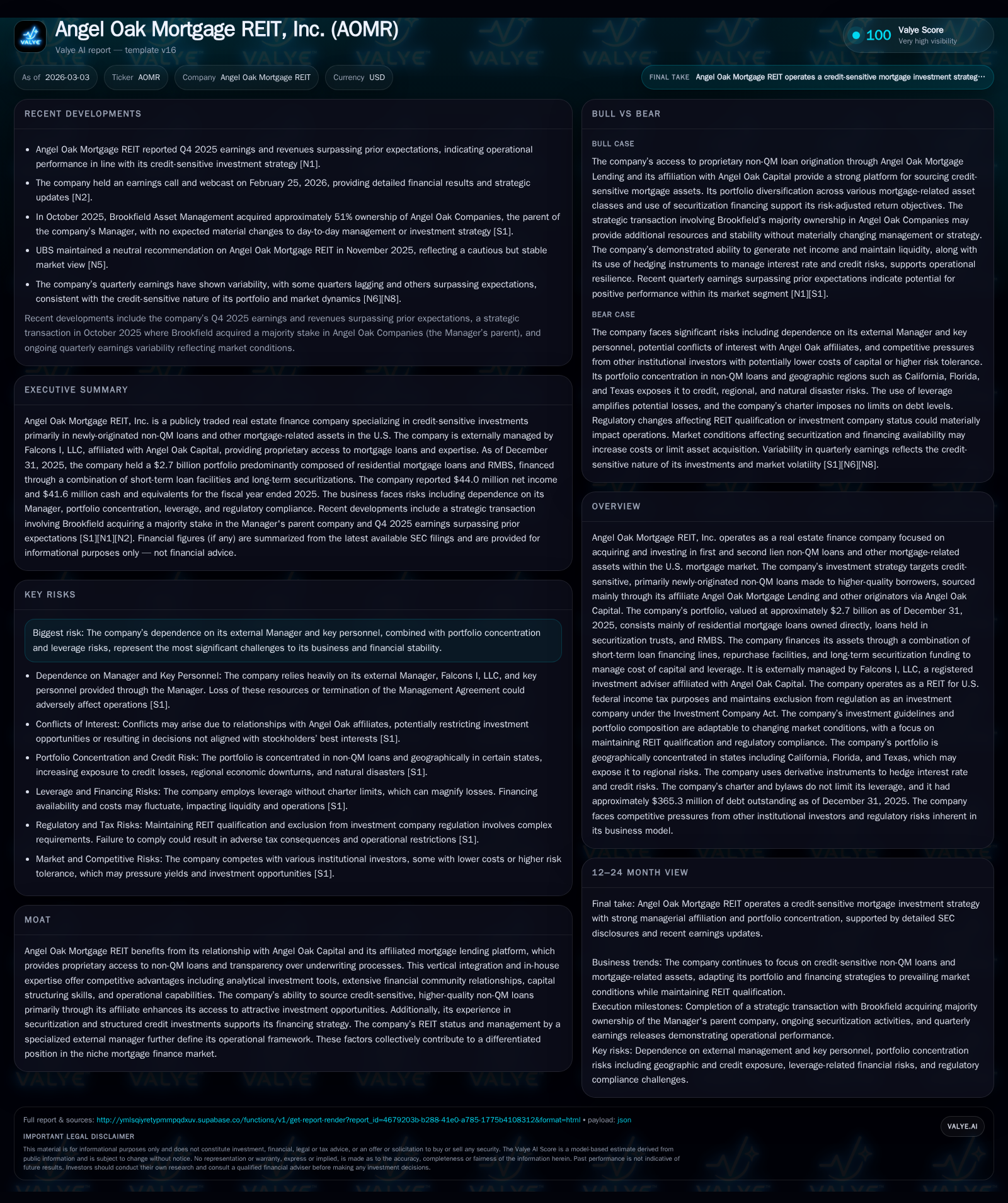
Angel Oak Mortgage REIT, Inc. (AOMR) has recovered from its significant losses in 2022, achieving a net income turnaround to $44 million in 2025 with a portfolio concentrated in credit-sensitive, newly-originated non-QM loans largely sourced through affiliated entities. The REIT’s vertical integration via Angel Oak Mortgage Lending gives it a competitive edge in sourcing and underwriting differentiated mortgage assets. However, AOMR’s aggressive use of leverage and reliance on short-term financing lines underscore risks related to liquidity, financing costs, and conflicts of interest within its external management framework. Future growth hinges on stable securitization markets, successful asset origination, and managing evolving regulatory landscapes.
Company Overview
Angel Oak Mortgage REIT, Inc. (AOMR) operates as a specialty real estate finance company concentrating on acquiring first- and second-lien non-qualified mortgage (non-QM) loans alongside other mortgage-related assets within the U.S. residential mortgage market. Established in 2018 and publicly listed since mid-2021, AOMR positions itself uniquely via its vertical integration with Angel Oak Mortgage Lending—an affiliated mortgage origination platform which supplies proprietary access to credit-sensitive loans underwritten primarily to higher-quality borrowers.
The company's strategy emphasizes originating primarily newly-originated non-QM loans through its affiliate relationships while supplementing the portfolio with other residential mortgage loans and residential mortgage-backed securities (RMBS). As of December 31, 2025, AOMR's portfolio stood at approximately $2.7 billion comprised predominantly of residential mortgages owned directly or held in securitization trusts alongside RMBS holdings [S1][S10].
Historical Performance Analysis
The path since inception has been volatile but trending positively. The firm reported a deep loss in FY 2022 (-$188 million net income), reflective of adverse credit conditions post-pandemic distortions impacting non-QM loan valuations and higher financing costs at that time. Recovery accelerated through FY 2023 ($33.7 million net income) into FY 2024 ($28.8 million), culminating in a resurgent net income of $44 million by year-end FY 2025—marking a roughly 53% increase year-over-year [F1].
However, operating cash flow has persistently been negative recently (-$407 million in 2025 versus -$221 million in 2024), highlighting the leverage-driven nature of the company's expansion strategy wherein significant acquisition cash outflows precede mortgage loan securitizations that recycle capital—a common feature among mREITs utilizing loan financing lines [F1].
Shareholder equity has seen gradual growth but remains modest at just over $267 million at FY-end 2025 after rebound from prior volatility [F1]. The table below summarizes key annual financial metrics:
Historical performance (annual)
| FY | Net ($mm) | CFO ($mm) | Net YoY |
|---|---|---|---|
| 2025 | 44 | -407 | +53.1% |
| 2024 | 29 | -221 | -14.7% |
| 2023 | 34 | 306 | +117.9% |
| 2022 | -188 | -331 |
Source: SEC companyfacts cache [F1].
Capital returns and efficiency (annual)
| FY | Buybacks ($mm) | ROE% |
|---|---|---|
| 2025 | 0 | 16.5 |
| 2024 | 20 | 12.0 |
| 2023 | 0 | 13.2 |
| 2022 | 7 | -79.4 |
Source: SEC companyfacts cache [F1].
Units: USD Millions; Net YoY % calculated for net income
Investment Strategy & Competitive Moat
AOMR’s core investment thesis centers on credit-sensitive non-QM mortgages primarily sourced through Angel Oak Mortgage Lending, which acts as its principal originator providing differentiated deal flow not generally accessible to competitors. This vertical integration facilitates enhanced underwriting transparency and pricing control tailored towards higher-credit quality borrowers within this niche lending segment.
The firm's manager—Falcons I, LLC—is an affiliate of Angel Oak Capital, itself a leader in alternative credit with extensive mortgage sector expertise spanning asset management, lending origination, structured credit investments, and capital markets execution [S22]. This integrated platform yields meaningful analytical capabilities alongside broad financial community connections that fortify AOMR's competitive positioning.
However, these intertwined relationships also create inherent conflicts of interest whereby Angel Oak Mortgage Lending must balance selling loans to AOMR against third parties; furthermore, management fees linked to affiliated entity activity may incentivize prioritizing volume over yield or risk considerations for AOMR’s portfolio [S24][S27]. This intensifies reliance upon maintaining prudent governance oversight.
Financing Structure & Leverage Profile
As a leveraged mREIT, AOMR employs a multi-tiered borrowing strategy combining:
- Short-term loan financing lines totaling approximately $219 million,
- Repurchase facilities around $54 million,
- Senior unsecured notes due in 2029 ($50 million) and 2030 ($42.5 million).
Total debt outstanding was about $365 million at par as of end-2025, supporting portfolio acquisitions costing substantially more than equity capital alone could fund [F1][S15]. The firm aims to mitigate refinancing risk by eventually converting short-term debt to fixed-rate term securitizations which provide long-duration funding; however market volatility can limit securitization timing or availability [S16][S19].
Leverage magnifies returns but exacerbates downside risks during market stress or asset underperformance—a known tradeoff for mortgage-focused REITs—especially given no maximum debt limits exist under company bylaws and investment guidelines grant discretion over leverage usage without board approval [S15][S21].
Posting collateral amid margin calls on derivative hedges or financing lines can strain liquidity; failure to meet these obligations risks accelerated debt repayment demands or forced asset sales potentially disrupting REIT qualification status with adverse tax consequences [S16][S18][S24].
Regulatory & Market Environment Considerations
Maintaining REIT qualification mandates adherence to complex income sourcing, asset composition, distribution ratios, and stock ownership concentration tests under U.S tax code provisions—a requirement vital for avoiding double taxation scenarios that would erode distributable earnings to shareholders [S10][S13].
Regulatory reforms governing asset-backed securities—especially those related to risk retention under Dodd-Frank legislation—impose ongoing obligations such as retaining horizontal or vertical slices of securitized interests limiting hedging options on these exposures; such mandates affect capital allocation efficiency [S20].[N1]
Furthermore, competition among mREITs, specialty finance companies, banks, and private funds intensifies pressure both on supply volumes of non-QM assets and their yield spreads given differing cost structures or risk appetites across market participants [S8][S28].
Macroeconomic factors including elevated interest rates can dampen refinancing activity boosting prepayment volatility; home price trends impact loan performance trajectories especially for bridge or transitional loans secured by residential real estate undergoing redevelopment where execution risk remains elevated [S25][S26].
Corporate Governance & Management Risks
All executive functions are outsourced through the external manager Falcons I LLC; AOMR maintains no direct employees which concentrates operational dependency risks on manager personnel continuity or strategic alignment especially considering overlapping interests across multiple Angel Oak-managed entities competing within similar asset classes [S1][S24][S27].
Additionally, recent partial ownership sale of Angel Oak Companies to Brookfield Asset Management introduces potential indirect governance changes—though near-term operations are expected stable per company disclosures—longer-term implications remain contingent upon future control transitions beginning in 2027 [S22].
Capital Allocation & Returns Metrics
The company returned capital sporadically via share repurchases totaling nearly $20 million in FY2024 but ceased buybacks entirely during FY2025 amid balance sheet strengthening efforts reflecting cautious capital management given market uncertainty and negative operating cash flows on an absolute basis [F1].
Estimated return on equity for FY2025 approximates a healthy 16.5% driven by improved net income though tempered by limited free cash flow generation underscoring reinvestment dependency through market accessible sources and note issuance mechanics rather than organic cash buildup alone [F1].
Dividend distributions are customary for REITs but specific payout levels or guidance were not explicitly stated within report filings or recent releases; monitoring quarterly performance updates will be informative regarding future distribution capacity given current leverage profiles combined with ongoing earnings trajectories (see analysis).
Forward-Looking Considerations & Milestones To Watch
While explicit guidance was not provided within available filings or press releases as of early-2026 reporting cycle ([N3],[N4],[N1],[N2]), several indicators will shape near-to-mid term expectations:
- Ability to access securitization markets at favorable terms enabling refinancing of short-term indebtedness,
- Stable or improving credit performance trends across non-QM loan cohorts,
- Management’s navigation of potential operational overlaps amid Brookfield’s increasing influence over Angel Oak Companies,
- Effective mitigation of regulatory headwinds surrounding risk retention compliance,
- Enhanced liquidity position balancing substantial operating cash flow deficits inherent during active loan acquisition phases.
Investor attention should focus on quarterly updates detailing ABS issuance volumes alongside commentary on changes to underwriting standards within their affiliate origination pipeline—a key source input for future growth potential.
Conclusion
Angel Oak Mortgage REIT embodies a specialized mREIT model exploiting proprietary non-QM mortgage origination insights fortified by vertical integration with Angel Oak Capital affiliates. The successful rebound from historic losses illustrates resilience amidst challenging interest rate cycles coupled with active portfolio management. Nonetheless, high leverage levels coupled with structural dependencies on external management arrangements introduce downside vulnerabilities particularly around liquidity stress events or prolonged market dislocations affecting securitizations. Continued differentiation will likely hinge on disciplined sourcing combined with adept capital structuring capable of navigating evolving regulatory landscapes while safeguarding REIT status prerequisites critical for sustaining distributions. Monitoring Brookfield’s strategic role progression will add another layer influencing governance dynamics briefly alluded to but increasingly material as ownership stakes evolve post-2026. Growth prospects remain constructive conditional upon preserving access to targeted credit-sensitive assets amid competitive pressures constraining yield expansion opportunities. AOMR offers an instructive case study within the broader mREIT space where innovation intersects with structural complexity demanding agile financial stewardship balancing growth ambitions alongside prudent risk calibrations.
This report is intended solely for informational purposes concerning Angel Oak Mortgage REIT, Inc., synthesizing publicly available financial disclosures (principally SEC filings dated through March 3, 2026) and recent news commentary without expressing any investment judgment or recommendation.
Disclaimer: This is research-only, informational analysis and not investment advice. It may include AI-generated interpretation and general industry context. Always verify important details using primary sources.

Comments