
Hyster-Yale's Turnaround Test: From Operating Loss to Integrated Energy Solutions
Examining how Hyster-Yale leveraged its global footprint and energy technology integration to counteract a sharp 2025 downturn amid cyclicality and competitive pressures.
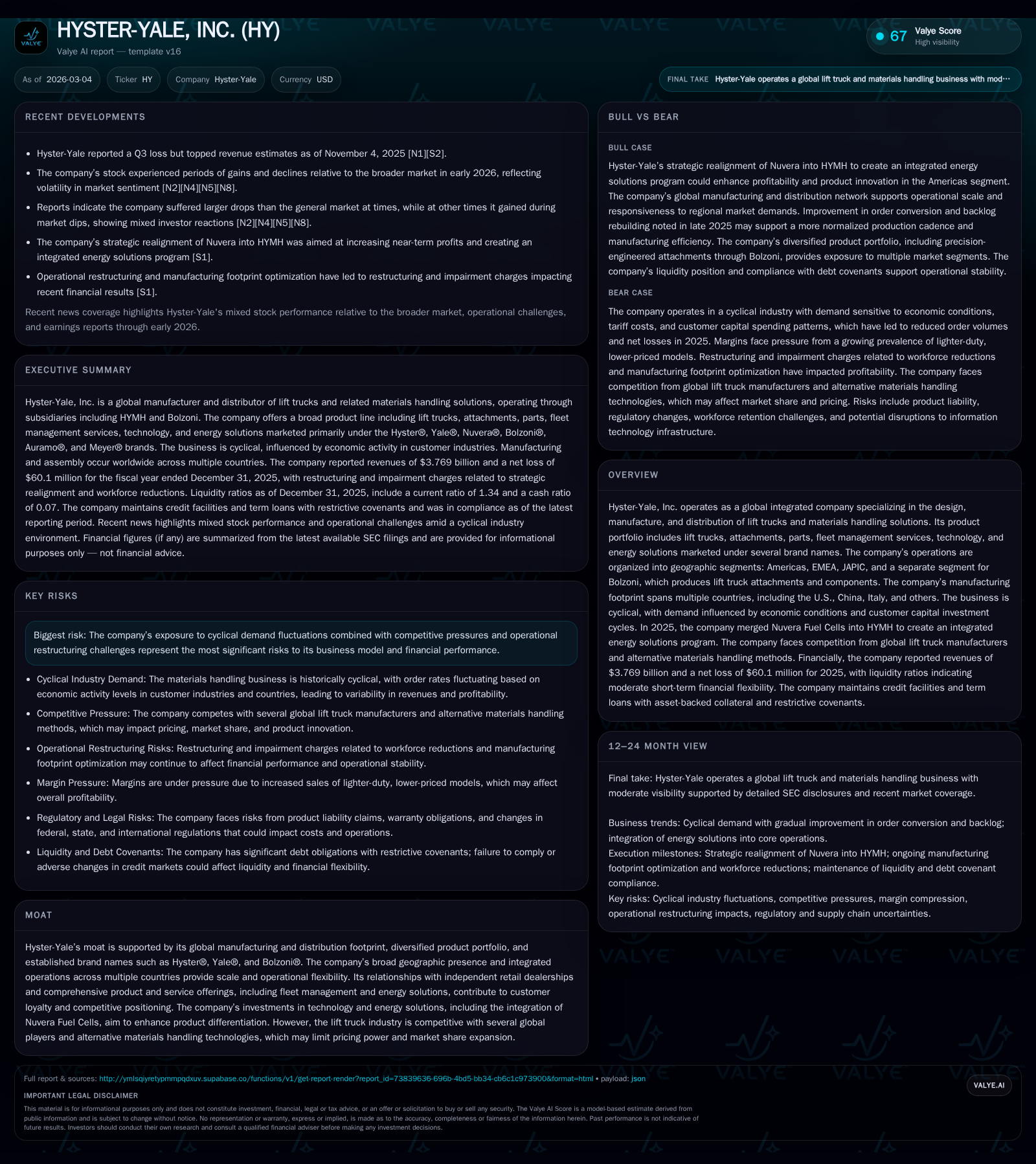
Hyster-Yale experienced a notable fiscal reversal in 2025, slipping into operating losses after consecutive profitable years. The decline primarily reflects cyclical softness in core lift truck demand intensified by economic uncertainty and competitive pricing pressures. In response, the company executed a strategic pivot by integrating Nuvera Fuel Cells into its Americas segment to build an energy solutions platform aimed at differentiating its product base and smoothing cyclical swings. Financial discipline remains key as restrictive covenants shape capital deployment while investors should monitor backlog trends, margin trajectories, and adoption of newer energy technologies for signs of recovery.
Historical Financial Performance: Declining Profitability Amid Robust Revenue Base
Hyster-Yale entered fiscal year (FY) 2025 facing a stark shift from profitability towards operating losses, underscoring the cyclicality intrinsic to its industrial equipment business. Revenues contracted by approximately 12.5%, dropping from $4.31 billion in FY2024 to $3.77 billion in FY2025 [F1]. This top-line shrinkage stemmed predominantly from lower unit volumes concentrated in the Americas and EMEA segments where key product categories witnessed softened demand amidst ongoing macroeconomic uncertainties and customer capital expenditure postponements [S17].
Operating income fell sharply, flipping from a healthy $244.8 million profit in FY2024 to a loss of $22.1 million in FY2025, reflecting not only volume declines but also margin degradation caused by price/mix pressures alongside continuing component cost inflation—terms familiar to industry practitioners faced with supply chain volatility and rising input costs [F1][S17][N5]. Net income followed suit, decreasing from a net profit of $142.3 million to a net loss of $60.1 million over the same period.
Operating cash flow also waned significantly, falling nearly 50% year-over-year to $86.1 million, although it remained positive—supporting essential working capital needs despite the top-line contraction and loss-making period [F1]. Capital expenditures saw meaningful growth, rising nearly 31% to $62.5 million consistent with management's strategic reinvestment focus into modular product development and production efficiency initiatives [F1][S6].
Historical performance (annual)
| FY | Rev ($bn) | Net ($mm) | CFO ($mm) | OpInc ($mm) | Rev YoY | Net YoY |
|---|---|---|---|---|---|---|
| 2025 | 3.8 | -60 | 86 | -22 | -12.5% | -142.2% |
| 2024 | 4.3 | 142 | 171 | 245 | +4.6% | +13.0% |
| 2023 | 4.1 | 126 | 151 | 209 | +16.1% | +269.9% |
| 2022 | 3.5 | -74 | 41 | -39 |
Source: SEC companyfacts cache [F1].
Capital returns and efficiency (annual)
| FY | Buybacks ($mm) | FCF ($mm) | ROE% |
|---|---|---|---|
| 2025 | -4 | 24 | -12.7 |
| 2024 | -14 | 123 | 30.0 |
| 2023 | 115 | 32.3 | |
| 2022 | 12 | -36.3 |
Source: SEC companyfacts cache [F1].
Table: Hyster-Yale Historical Financial Summary (FY2022 - FY2025) [F1]
Global Operations Footprint and Brand Moat Supporting Market Presence
Hyster-Yale operates as a geographically diversified manufacturer organized principally into three lift truck business segments—Americas, EMEA (Europe, Middle East, Africa), JAPIC (Japan, Asia Pacific)—alongside Bolzoni which specializes in lift truck attachments marketed under separate brand names such as Bolzoni®, Auramo®, Meyer®, and Silver Line® [S11][S14]. This global footprint underpins an extensive manufacturing network with primary assembly plants spread across the U.S., China, Italy, Germany, Finland, Brazil, and additional leased facilities bolstering design centers and parts distribution [S1][S14].
The strength of established brand names like Hyster® and Yale® coupled with broad dealership relationships affords customer loyalty critical in the competitive materials handling sector where service quality and parts availability directly influence repeat purchases.
Bolzoni’s focus on precision-engineered forklift attachments complements this portfolio by providing specialized handling solutions that enhance customer retention through integrated offerings beyond core lift trucks [S14]. Additionally, joint ventures—such as with Sumitomo NACCO Forklift Co., Ltd., co-owned at 50%, contribute regional sourcing and manufacturing synergies particularly for components supplied back to Hyster-Yale [S15].
Fleet management services and after-sales support further differentiate Hyster-Yale’s unit economics by encouraging expanded lifetime customer engagement beyond initial truck sales—a critical moat factor given industry reliance on relationship-based dealer networks rather than commoditized equipment transactions.
Hurdles in 2025: Cyclical Downturn and Operating Challenges
The pronounced decline into negative operating results for FY2025 was largely attributable to softening end-market demand exacerbated by economic headwinds prompting customers across regions to defer new investments or extend existing equipment life cycles—a classic manifestation of capex-driven cyclicality prevalent among industrial OEMs tied closely to logistics throughput volumes [N5][S18].
The lift truck market contracted notably in Q4 2025 globally albeit North America saw modest sequential growth spurring improved booking activity late in the year; however, the EMEA region lagged substantially owing to persistent order delays linked partly to a market shift toward lighter-duty lower-price forklifts where Hyster-Yale had yet limited competitive presence compared with foreign suppliers aggressively pricing these segments [S19][N1].
Price/mix impacts weighed heavily against margins as higher material costs—especially for components—could not be fully offset by price hikes due both to competitive pricing pressures and customers’ cash conservation measures pushing back against escalated end prices [S17][N5]. This dynamic contributed materially to margin compression beyond volume effects.
Operationally, this environment put pressure on utilization rates across manufacturing sites demanding prompt adjustments including workforce realignments and inventory discipline initiatives launched near year-end designed to reduce break-even sensitivity during trough demand periods [N1][S13].
Strategic Integration of Nuvera Fuel Cells: A Bet on Energy Innovation
In a strategic repositioning effective mid-2025, Hyster-Yale merged Nuvera Fuel Cells LLC into its HYMH subunit within the Americas segment with the ambition of developing an integrated energy solutions program that diversifies product offerings beyond traditional internal combustion or battery electric lift trucks into advanced fuel cell powertrains supported by proprietary technology development facilities [S14][N1].
This move exemplifies management’s approach toward structural growth drivers intended to mitigate raw cyclical exposure while positioning the company at the forefront of evolving materials handling energy platforms which increasingly emphasize sustainability and operational efficiencies.
The integration has already delivered initial cost savings ($15 million annualized as noted for restructured Nuvera operations) alongside redeployment of technical resources towards higher-growth areas aligned with emerging fuel cell applications for lift trucks—offering potential for differentiated competitive advantage as hydrogen infrastructure matures commercially across key logistics hubs [S13][N1].
Continued investment will be necessary given typical R&D cycle lengths in powertrain technology innovation; however, this initiative signals a deliberate pivot intended not only to future-proof product mixes but also expand margins through proprietary offerings less susceptible to commoditization forces that have challenged traditional truck sales.
Capital Structure, Liquidity, and Disciplined Capital Allocation
As of year-end FY2025, Hyster-Yale maintained total debt outstanding around $494 million excluding finance leases alongside equity totaling approximately $472 million resulting in moderate leverage levels constrained by loan covenants embedded within its term loan due May 2028 and revolving credit facilities maturing June 2030 [F1].
The $225 million term loan carries mandatory quarterly principal amortization since September 30, 2021 along with restrictive covenants limiting dividends or share repurchases unless consolidated net leverage does not exceed about 2.50x EBITDA equivalents at payment dates—all conditions currently met but curtailing aggressive capital returns amid ongoing losses [S4][S10].
Free cash flow remained positive near $23.6 million despite CFO decline due primarily to reduced earnings quality during downturn phases; this reflects balanced reinvestment consistent with manufacturing transformation plans centered on modular product platforms and updated IT infrastructure underpinning fleet management services [F1][S6].
Share repurchases continued modestly at about $4.5 million during FY2025 versus prior year’s more robust buybacks ($14 million), signaling defensive capital allocation dynamics tethered closely to liquidity preservation amid profitability challenges [F1]. Dividend distributions remained subject to leverage-related constraints mandated within financing agreements.
Investor Watchpoints: Orders Backlog, Margin Drivers, and Technological Differentiation
Looking forward through early-mid 2026 horizon—markedly absent formal public guidance—the pacing of order intake represents an essential signal reflecting whether customers' thawing capital expenditure caution translates sustainably into booking momentum capable of reversing production curtailments experienced through late FY2025 when backlog shrank below normalized targets (~3–4 months typical backlog) towards approximately $1.28 billion driven chiefly by declining volumes across regions but partially offset by price adjustments elevating average selling prices somewhat despite mix shifts toward cheaper models [S13][S19].
Pricing dynamics remain delicate: price increases attempt recovery of inflated input costs but face resistance from increased competition notably from Asian manufacturers specializing in lighter-duty units priced aggressively—challenging traditional high-margin core counterbalanced truck segments long favored historically by Hyster-Yale's customers [S17], motivating reliance on cost improvements achieved via footprint optimization programs underway alongside expansion into alternative powertrains like Nuvera-powered fuel cells.
Technological differentiation through enhanced fleet management services leveraging digital tools further aims at improving usage efficiencies for customers thereby strengthening lock-in effects while broadening aftermarket parts penetration contributing positively long-term unit economics given recurring revenue streams associated with service contracts versus one-off equipment sales alone.
Close monitoring is warranted on pickup pace for energy solution adoption rates alongside evolving shipping patterns as incremental shipments gradually ramp postulated trough Q1/early Q2 based on historical lead times illustrating inherent delivery lag following bookings increases reported late Q4 FY2025 highlighting cautious early signs of recovery after extended soft patch phase.
Competitive Pressures and Industry Dynamics Shaping Future Demand
The global industrial materials handling landscape comprises multiple large players competing across overlapping geographic markets providing broad arrays of lift trucks featuring diverse powertrains including diesel internal combustion engines (ICE), battery electric vehicles (BEV), hybrid options plus emerging hydrogen fuel cell powered variants increasingly seen as potential next-generation standards offering quicker refueling versus batteries particularly for multi-shift heavy usage contexts commonly encountered inside warehouses or port terminals.
Hyster-Yale operates within this fiercely competitive realm contending primarily on brand strength supported by loyal independent dealer networks delivering localized customer service complemented by comprehensive aftersales parts/supply capabilities—factors crucial given OEM withdrawal would risk significant share loss amid substitute providers aiming aggressively at lower-cost segments emphasizing lighter-duty trucks redesigned for lower upfront investment needs aligning with changing client capital strategies observed particularly during economic contractions much like those experienced throughout CY25.
Alternative material handling technologies such as automated guided vehicle systems (AGVs), robotic warehouse solutions, or conveyor systems pose indirect competitive threats substituting certain forklift applications requiring ongoing R&D efforts for OEMs including Hyster-Yale focused both on product performance improvements alongside digitalization advancements serving automation enablement pathways which may address broader warehousing productivity goals transcending simple equipment replacement cycles ultimately impacting market growth trajectories longer term.
Industrial cyclicality tied closely with logistics sector throughput combined with customers' cautious investment sentiments underlying recent results is standard industrial OEM pattern yet compounded here by tariff-related cost headwinds creating layered margin complexity warranting continuous refinement of operational posture balancing fixed cost absorption via manufacturing facility flexibility enabled through footprint rationalization efforts more pronounced than typical given macro uncertainty lingering into early calendar year '26 observed globally within supply chain corridors impacting order cadence timing reliability strictly governed by production schedule discipline emphasized tightly by management team currently executing restructuring program targeting about $40–45 million annual cost reductions from early '26 onward designed expressly for lowering break-even thresholds enhancing earnings resiliency throughout succeeding down cycles [N1][S13].
Disclaimer: This report is prepared solely for informational purposes without any recommendation regarding buying or selling securities or engaging in investment strategies related to Hyster-Yale or any other entity mentioned herein.
Disclaimer: This is research-only, informational analysis and not investment advice. It may include AI-generated interpretation and general industry context. Always verify important details using primary sources.

Comments