
ABVC BioPharma’s Strides and Setbacks in Clinical Development Drive Financial Trajectory
ABVC BioPharma’s unique licensing portfolio and partnerships underpin its clinical pipeline but also heighten regulatory and financial challenges.
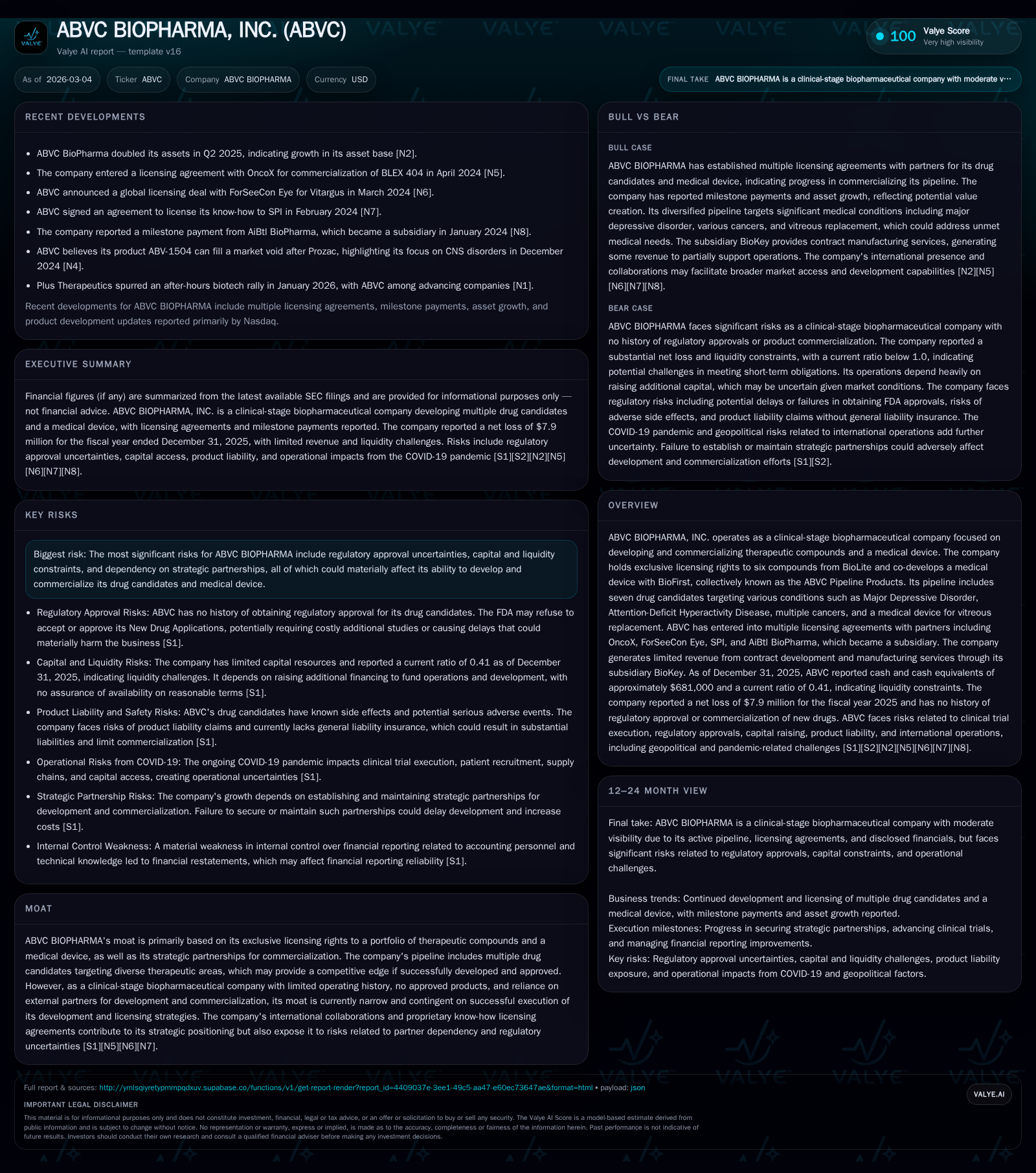
ABVC BioPharma is a clinical-stage biopharmaceutical company heavily reliant on exclusive licenses and strategic collaborations to advance a diverse drug and device pipeline. While this licensing-driven growth model offers potential for addressing varied therapeutic areas including Major Depressive Disorder, cancers, and vitreous replacement, the company faces significant execution risks from capital constraints, regulatory hurdles, and partner dependencies. Its financials reflect flat revenues with widening losses and deteriorating cash flows, underscoring the developmental-stage pressures. Critical near-term milestones will hinge on clinical trial advances and securing sustainable financing to fuel further R&D.
Historic Financial Trend Analysis Reflecting Clinical-Stage Realities
ABVC BioPharma's financial trajectory typifies the clinical-stage biopharmaceutical profile: minimal revenue generation paired with mounting operational losses rooted in intensive R&D investment. Revenues stabilized around $509 thousand in FY2024 and held flat into FY2025 [F1], reflecting reliance on contract development services through its subsidiary BioKey rather than product sales. Meanwhile, operating income declined sharply by approximately 52% YoY in FY2025 reaching negative $7.15 million as the company expanded its pipeline activities and corporate infrastructure [F1]. Net losses widened even more notably by over 61% YoY to nearly $7.9 million [F1], highlighting the growing cash burn typical of an early-stage developer with no approved products.
Negative operating cash flows worsened correspondingly with a year-over-year deterioration exceeding 65% to negative $2.99 million by FY2025 end [F1]. Capital expenditures remained nominal relative to operations (~$21k annually) but offset minimal free cash flow generation [F1]. The company's equity base showed fluctuation but ended FY2025 at approximately $11.1 million amid recent financings [F1]. These figures underscore the challenging economics of advancing licensed therapeutics from preclinical stages through costly clinical programs without commercialized assets.
Historical performance (annual)
| FY | Rev ($) | Net ($mm) | CFO ($mm) | OpInc ($mm) | Rev YoY | Net YoY |
|---|---|---|---|---|---|---|
| 2025 | 509589 | -8 | -3 | -7 | 0.0% | -61.3% |
| 2024 | 509589 | -5 | -2 | -5 | +234.3% | +53.4% |
| 2023 | 152430 | -11 | -4 | -8 | -84.3% | +36.0% |
| 2022 | 969783 | -16 | -7 | -15 |
Source: SEC companyfacts cache [F1].
Capital returns and efficiency (annual)
| FY | FCF ($mm) | ROE% |
|---|---|---|
| 2025 | -71.2 | |
| 2024 | -2 | -399.9 |
| 2023 | -4 | -125.4 |
| 2022 | -8 | -530.0 |
Source: SEC companyfacts cache [F1].
*Revenues declined sharply between FY2022 and FY2023 before stabilizing.
Clinical Pipeline Composition: Licensed Assets and Joint Development Efforts
ABVC's product development strategy hinges on exclusive licenses encompassing six drug compounds procured from BioLite alongside a proprietary medical device co-developed with BioFirst [S1]. This collection—the "ABVC Pipeline Products"—spans multiple therapeutic domains including Major Depressive Disorder (MDD), Attention-Deficit Hyperactivity Disorder (ADHD), various cancers such as Triple Negative Breast Cancer (TNBC) and Non-Small Cell Lung Cancer (NSCLC), hematologic disorders like Myelodysplastic Syndromes (MDS), plus an ophthalmic medical device targeting vitreous replacement following retinal surgeries [S1].
Each candidate remains within the clinical-stage bracket undergoing phased trials; for instance ABV-1504 completed Phase II for MDD [S1], while Vitargus (ABV-1701) represents a first-in-human ophthalmologic product designed to substitute vitreous fluid post-vitrectomy surgery [S1]. The dual modality approach—encompassing both pharmacological and device-based innovations—differentiates ABVC in a crowded biotech landscape where multiple indications require tailored clinical validations.
The licensed compounds employ active pharmaceutical ingredients sourced under stringent cGMP conditions with some depending on proprietary substances such as Yukiguni Maitake Mushroom Extract 404 critical to oncology candidates [S19]. Such biologics carry side effect profiles ranging from hematologic abnormalities to neurological symptoms requiring careful trial monitoring [S20]. This breadth places ABVC among diversified yet nascent biotechs pursuing complex regulatory pathways.
Strategic Partnerships: Linchpins for Commercialization or Risk Vectors?
Central to ABVC's operational model are its strategic alliances: licensing agreements with entities like OncoX for oncologic domains; ForSeeCon Eye supporting ophthalmologic product lines; SPI contributing manufacturing capabilities; alongside AiBtl BioPharma which serves as a wholly owned subsidiary facilitating contract research [S4][S8]. These collaborations facilitate distributed risk-taking yet simultaneously introduce exposure due to dependency on third-party execution.
The agreements involve milestone-linked payment schedules—for example BioLite's arrangement with BioHopeKing dictates up to $10 million in combined cash and equity disbursed upon achieving specific developmental benchmarks for TNBC candidate ABV-1501 and MDD drug ABV-1504 in Asian markets—underscoring the impact of partners' performance on ABVC’s financial inflows [S8]. Yet pitfalls loom large: partner disputes could stall development timelines or trigger costly litigation whereas the cessation of collaboration might force ABVC to independently fund accelerating research costs amid capital shortages [S4].
Managing these relationships mirrors broader industry realities where biotech firms rely heavily on subcontractors and co-development entities but risk dilution of control over pivotal trials and market entry strategies—a dynamic that demands sophisticated contractual oversight uncommon in companies still building foundational administrative capabilities.
Regulatory Pathways and Approval Challenges for Pipeline Advancement
Navigating regulatory approvals constitutes a formidable hurdle for ABVC’s pipeline progress. Each candidate requires exhaustive demonstration of safety and efficacy through multi-phase clinical trials aligned with FDA mandates or comparable foreign agencies’ requirements such as Japan’s PMDA or Taiwan’s TFDA where ABVC operates partly [S9][S22]. Regulatory compliance extends beyond trial data submission levels to encompass strict adherence to manufacturing protocols following current good manufacturing practices (cGMP) standards mandated by FDA regulations; lapses can result in partial suspensions or denial of marketing applications detrimental to timelines [S6][S5].
Further complexity arises owing to clinical trials conducted internationally—acceptance of foreign trial data remains subject to rigorous FDA scrutiny concerning population relevance and study conduct rigor which if deemed insufficient may necessitate repeat studies at great expense [S11]. Negative trial outcomes or newly discovered adverse effects may also compel supplemental investigations or label restrictions affecting market viability substantially [S20].
Delays inherent in this layered regulatory path risk eroding competitive advantages particularly given accelerated advancement efforts by better-capitalized rivals possessing larger patent portfolios acting on similar therapeutic targets [S27]. Consequently regulatory risk retention is among key operational stressors.
Liquidity Crunch and Capital Allocation: Current Financial Health
As of December 31, 2025, the balance sheet reveals acute liquidity pressures: cash & equivalents stand at $681 thousand against current liabilities approximating $6.16 million yielding a troubling current ratio near 0.41 signaling strained short-term solvency [F1][S13][S29]. High interest-bearing debt instruments including short-term loans and convertible notes exacerbate burdens on limited internal cash flows.
Operating cash flow deficits near $3 million annually coupled with negligible capex expenses leave free cash flow deeply negative at roughly minus $3 million annually representing a core challenge in sustaining ongoing clinical programs without external infusions [F1]. Return metrics illustrate steep losses relative to equity — estimated return on equity near negative 71%, reflecting absence of operating profitability driven largely by recurrent R&D investment outlays [F1].
Capital allocation policies currently preclude dividends or share repurchases given prevailing deficit nature—new funding rounds are vital not only for financing trials but also expanding operational structures necessary to support broader pipeline management including regulatory affairs [S13]. Strategic execution depends critically on accessing affordable capital avenues amid volatile sector sentiment heightened by persistent COVID-19 market flux impacting investor risk tolerance.
Future Growth Dynamics: What Milestones Matter Most?
Looking ahead growth trajectories revolve around advancing several pivotal clinical milestones across lead assets. These include confirming Phase II/III trial outcomes for ABV-1504 targeting Major Depressive Disorder—a critical CNS indication with extensive market potential—and ongoing oncology candidate progress notably for TNBC via ABV-1501 which addresses an underserved aggressive cancer subset [S8].
Simultaneously evidencing robust safety/efficacy data for ADHD treatment candidate ABV-1505 could unlock further partnership opportunities especially within U.S. markets requiring CRO collaborations sensitive to FDA standards [S12][S24]. For medical device Vitargus (ABV-1701), establishing sustained post-vitrectomy patient outcomes provides material value inflection points potentially fast-tracking commercial readiness pending regulatory clearances.
Upcoming milestones also entail fulfilling collaboration agreement conditions which release staged payments from partners like BioHopeKing—success here materially alleviates funding gaps but carries execution risk if timelines slip or data disappoints leading to renegotiations or terminations [S8]. Investor attention should remain fixed on trial enrollment pace recovering fully post-COVID disruptions plus announcements related to outlicensing deals that would diversify revenue sources beyond contract service incomes currently dominating modest top line figures.
R&D Efficiency and Operational Burdens in Early-Stage Biopharma
Operational maturation remains an ongoing headwind; as noted in filings ABVC continues building managerial competencies alongside establishing essential infrastructures including accounting systems and robust internal controls essential for scaled pharma operations yet still nascent relative to sector peers with longer track records [S1][S5].
Supply chain fragility surfaced markedly during pandemic periods affecting raw material acquisition—especially critical APIs like Yukiguni Maitake Extract whose shortages directly imperil oncology program continuity—illustrating vulnerability amid global disruptions requiring dual sourcing strategies presently under negotiation with Canadian suppliers aimed at mitigating single-source risk concentration [S19].
Furthermore maintaining strict cGMP compliance across multiple contract research organizations necessitates continuous audits risking pause events if breaches occur; such interruptions can cascade delaying data submissions stalling FDA review cycles while diminishing competitive positioning against faster-moving counterparts investing directly into vertically integrated manufacturing capacities [S5].
Risk Factors Central to Sustained Development and Partner Reliance
Risk exposures permeate multiple layers—from intrinsic regulatory uncertainties highlighted by potential demands for additional trials or manufacturing revalidation possibly impeding NDA success [S9]—to intellectual property vulnerabilities wherein patent applications face challenges from prior art claims competing filings or incomplete geographic coverage limiting exclusivity worldwide particularly in jurisdictions key for revenue generation such as Taiwan or China [S6][S24].
Collaboration dependency reinforces business fragility: termination or disputes over milestones can derail entire projects leaving ABVC solely accountable for ballooning development costs absent ready financial buffers forcing capital raises under unfavorable terms damaging shareholder value [S4][S8].
Additional hazards include product liability risks rooted in adverse safety signals during human trials that may emerge unexpectedly triggering patient withdrawals or litigation despite insurance policies being limited currently only covering specific trial liabilities—and cybersecurity threats due to decentralized document management that could impair confidential trade secret protections central to competitive differentiation[S5][S26].
Geopolitical tensions between China-Taiwan also inject uncertainty affecting workforce stability supply routes plus compliance obligations under U.S. Foreign Corrupt Practices Act complicating international collaboration frameworks further constraining seamless global operations essential for multisite product testing[S23].
Overall these factors delineate a narrow moat contingent upon flawless execution across scientific nodal points legal protections financing flows allied partner performance—with lapses likely precipitating severe operational setbacks.
This report synthesizes public filings alongside Valye News proprietary analysis grounded solely on verifiable data sources. It does not constitute investment advice but aims to illuminate key operational dynamics influencing ABVC BIOPHARMA’s strategic outlook within the specialized biopharmaceutical development sector.
Disclaimer: This is research-only, informational analysis and not investment advice. It may include AI-generated interpretation and general industry context. Always verify important details using primary sources.

Comments