
Civeo Corp Confronts Earnings Pressure and Contract Risks While Expanding Australian Lodges Portfolio
Specialized remote workforce hospitality services underpin Civeo's stable yet commodity-exposed revenue base.
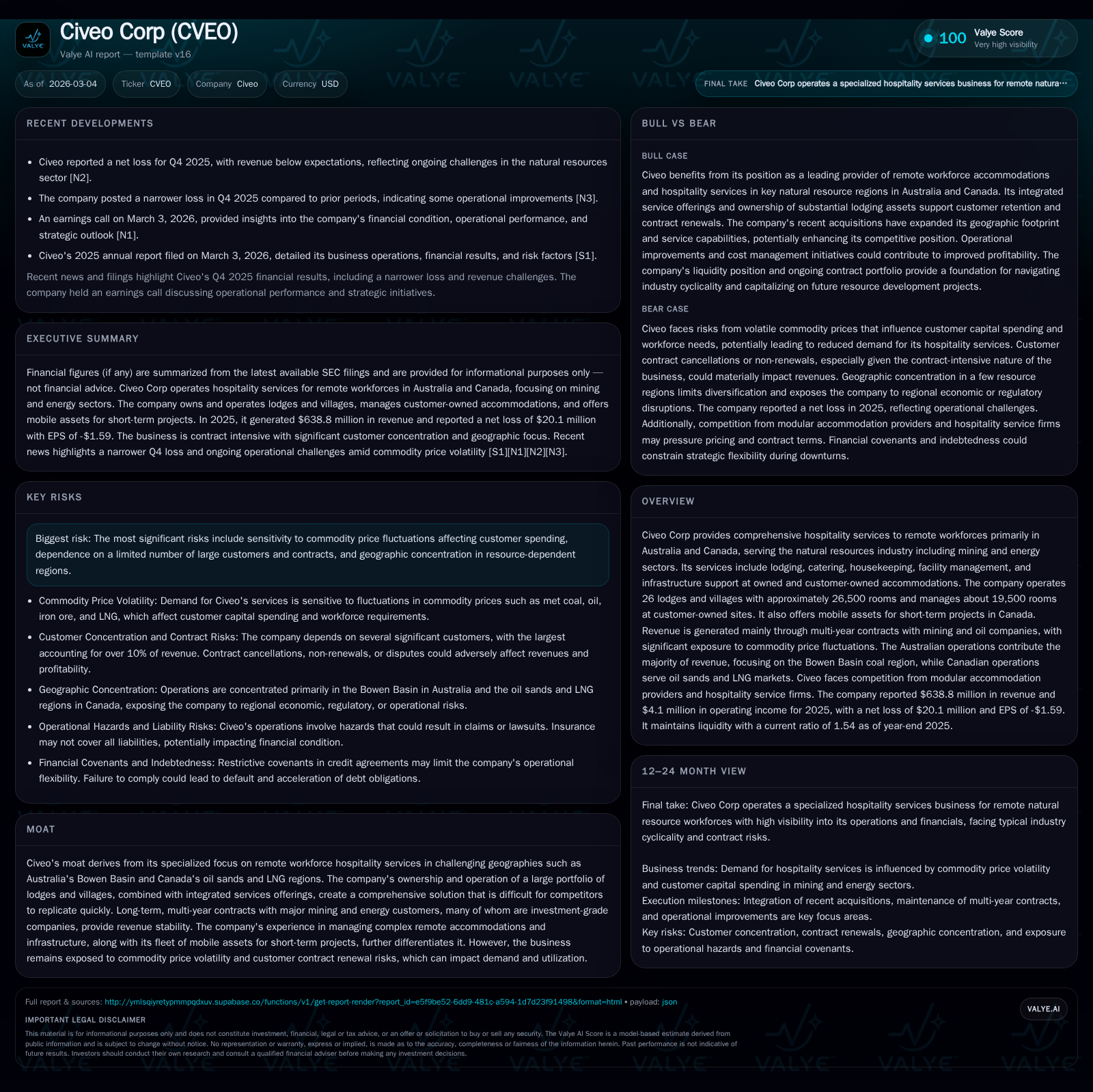
Civeo Corp operates a niche but capital-intensive business providing hospitality to remote mining and energy workforces in Australia and Canada. Its past growth reflects expansion through lodges acquisitions and contract wins in resource-heavy regions, though recent years reveal volatility in earnings and negative net income pressured by commodity cycles. Multi-year contracts and asset ownership provide a moat but expose the firm to customer concentration and contract renewal risks. The Qantac acquisition in 2025 increased Australian footprint, supporting medium-term prospects. However, earnings remain challenged as operational costs rise and customer demand fluctuates with commodity markets. Capital allocation prioritizes share repurchases over dividends amid tight liquidity metrics.
Business Overview
Civeo Corp specializes in providing integrated hospitality services—lodging, catering, housekeeping, facility management—to remote workforce populations mainly servicing the natural resources sector across Australia and Canada [S21]. The company operates a substantial portfolio of owned assets comprising 26 lodges and villages totaling approximately 26,500 rooms plus management of around 19,500 rooms owned by customers [S24]. Its service offering covers the full lifecycle of customer projects from exploration through construction to long-term production phases.
Geographically, Australia dominates with roughly 72% of revenue centered on the Bowen Basin coal region—the world’s premier metallurgical coal basin—and iron ore mines in the Pilbara region [S15][S25][S26]. Canadian operations primarily support oil sands, LNG projects, pipeline construction, and drilling activities with a mix of lodges and mobile assets [S24][S26].
Past Financial Performance
Civeo’s revenue trend reflects the cyclical nature of commodities and capital spending by its customers. Total revenue for the year ended December 31, 2025 was approximately $639 million down from $682 million in 2024, continuing a multi-year decline from $701 million reported in 2023 [F1].
Operating income slipped as well but showed some recovery to $4.1 million in 2025 from a low $1.3 million the year prior—both figures sharply down from nearly $39.5 million earned pre-pandemic in 2023 [F1]. The company reported a net loss of $20.1 million for 2025 compared to a smaller loss of $17.1 million the previous year [F1], largely impacted by margins compression from volatile demand and cost pressures.
Operating cash flow declined steeply by over 70% year-over-year to about $22.3 million but remained positive; capital expenditures were contained at roughly $20.2 million reflecting reduced growth investment as cautious market sentiment persists [F1]. Free cash flow thus decreased to near breakeven [$2.1M] after capex.
Capital structure remains moderately leveraged with $182.8 million outstanding drawn under revolving credit facilities and total current liabilities overshadowing current assets albeit maintaining a current ratio of approximately 1.54 [F1][S22]. Equity has contracted substantially from its peak to about $174 million at end-2025 owing to accumulated losses [F1].
Financial Summary
Historical performance (annual)
| FY | Net ($mm) | CFO ($mm) | OpInc ($mm) | Capex ($mm) | Net YoY |
|---|---|---|---|---|---|
| 2025 | -20 | 22 | 4 | 20 | -17.6% |
| 2024 | -17 | 84 | 1 | 26 | -156.6% |
| 2023 | 30 | 97 | 39 | 32 | +654.5% |
| 2022 | 4 | 92 | 17 | 25 |
Source: SEC companyfacts cache [F1].
Capital returns and efficiency (annual)
| FY | Div ($mm) | Buybacks ($mm) | FCF ($mm) |
|---|---|---|---|
| 2025 | 3 | 54 | 2 |
| 2024 | 14 | 30 | 57 |
| 2023 | 7 | 12 | 65 |
| 2022 | 14 | 66 |
Source: SEC companyfacts cache [F1].
Note: YoY calculations compare most recent years where applicable.
Growth Drivers and Future Outlook
Civeo’s medium-term growth hinges on several strategic factors:
Geographic Footprint Expansion: The May 2025 acquisition of Qantac Pty Ltd expanded its lodging capacity by four villages with approximately 1,368 rooms specifically within Australia’s Bowen Basin—a critical coal producing region not previously served by Civeo [N1][S25]. This deepens its dominant local presence enabling cross-selling integrated services.
Contracted Revenue Stability: Long-term multi-year contracts with mining majors such as Fortescue Metals Group Ltd. and energy players like Suncor Energy Inc.—each accounting for over 10% of revenue—provide recurring demand buffers [S9]. These contracts often feature take-or-pay or exclusivity provisions enhancing revenue predictability.
Integrated Services Offering: Beyond accommodations, Civeo leverages capability in managing ancillary infrastructure services including power generation, water treatment, communications, security and logistics—differentiators that discourage competitor encroachment focused solely on modular accommodation units [S21][S27].
However, upside is tempered by enduring challenges:
Commodity Price Sensitivity: Customer spending tightly correlates with volatile met coal prices in Australia and oil prices impacting Canadian oil sands demand [S15][S26]. Lower commodity prices dampen new project development delays renewal or cancellation of contracts.
Customer Concentration & Geographic Risk: Heavy dependence on several large customers concentrated within few resource regions exposes Civeo to contract terminations or regional disruptions including regulatory changes or labor disputes [S7][S9].
Competitive Landscape: Modular accommodation providers offer more agile short-term solutions while food service companies compete on catering alone—necessitating continuous innovation in service integration to maintain moat [S9].
Forecasts and Key Milestones to Monitor (Analysis)
No explicit forward guidance was presented for upcoming years beyond Q4 results issued March 3, 2026 [N1][N2]. Going forward investors should monitor:
- Contract renewal outcomes with major customers given their outsized revenue impact.
- Activity levels across core commodities sectors influencing occupancy rates at lodges.
- Impact of the Qantac acquisition on Australian revenues growth trajectories.
- Operating margin trends as operating costs evolve vs pricing dynamics under multi-year agreements.
- Capital expenditure levels indicating potential lodge expansions or refurbishments.
- Debt covenant compliance metrics given restrictive Credit Agreement covenants discussed in filings [S4][S22].
Returns and Capital Allocation Strategy
Civeo suspended regular dividends early in calendar year 2025 following weak cash flows but paid modest dividends totaling $3.4 million during fiscal year end; this contrasts with prior years where dividend payments were higher though uneven [F1][S14].
Share repurchase activity intensified significantly with buybacks totaling $53.6 million during fiscal year ending December ’25 compared to roughly half that amount the prior year—reflecting management focus on returning capital amidst limited organic investment opportunities due to subdued demand environment [F1][S14].
Return on equity suffers from sustained net losses; using latest net loss of $20 million against equity base near $174 million implies approximate ROE around negative -11–12% for FY25—a weak profitability profile reflecting cyclical pressures compounded by fixed asset amortization costs inherent to lodging businesses [F1].
Cash flow remains under pressure despite positive operating cash flows due to capex needs sustaining asset base; free cash flow remains minimal highlighting tight liquidity balance between investing growth initiatives and shareholder returns.
Risk Factors Summary
Among major risk exposures detailed are:
- High dependency on limited number of significant customers operating largely within cyclical natural resource sectors that face regulatory uncertainties and price volatilities [S8][S9][S11].
- Geographic concentration restricted mainly to Australia’s Bowen Basin / Pilbara iron ore regions plus Canadian oil sands/LNG terminals intensifies operational vulnerability to these localized economies or disruptions including Indigenous land claims or environmental regulations [S7][S10][S23].
- Competitive risks stem from modular accommodation vendors who may capture short-term projects more nimbly alongside traditional hospitality providers vying for outsourced facility management mandates [S9].
- Financial leverage constrained by Credit Agreement covenants limiting borrowing flexibility during downturns or credit market stresses posing refinancing risk if covenant breaches arise due to deteriorating earnings quality or weaker cash flows [S4][S13].
- Exposure to currency exchange fluctuations particularly between US$ reporting currency relative to AUD and CAD operating currencies impacting reported results unpredictably [S22].
- Environmental regulation intensification related to climate change considerations could inflate cost structures both directly through compliance expenses or indirectly via dampened customer capital investments [S10][S23].
- Legal contingencies arising from legacy claims linked to pre-acquisition operations necessitate prudent risk provisioning despite insurance coverage frameworks minimizing potential material impacts so far [S5][S20].
- Operational exposures include seasonal labor shortages or industrial disputes potentially disrupting lodge utilization and service delivery quality undermining customer relationships [S27][S18].
Competitive Moat Considerations
Civeo’s moat rests upon its scale ownership of lodges/villages enabling bundled hospitality service delivery difficult for competitors focused singularly on accommodation units or catering alone to replicate quickly at scale especially within specialized geographies like Australia's Bowen Basin or Alberta’s oil sands where logistical complexity favors established operators with deep operational know-how [Valye excerpt; S9]. The company's integrated service model supporting day-to-day needs such as utility services provides entry barriers absent among modular vendors reliant mostly on short-duration asset leasing arrangements.
While competition exists chiefly across different parts of the value chain (modular builders, catering firms), very few match Civeo’s comprehensive offering combined with long-term contracts providing demand visibility uncommon for capital intensive remote accommodations segment.
Conclusion (Analysis)
Civeo continues serving a specialized niche essential for resource operators requiring lodging solutions where traditional hotels do not exist or cost too much relative to integrated village models offering onsite amenities tailored for workforce welfare at scale across decades-long mine lives.
Recent financials reflect underlying sector volatility stressing margins amid softer demand tied closely to cyclical commodities pricing though operational improvements post Qantac acquisition may bear fruit medium term. Management's strategy prioritizes maintaining liquidity covenant compliance while returning capital via buybacks over dividends amidst cautious reinvestment stance given uncertain project pipelines. Tightly clustered customer bases invite ongoing vigilance toward renewal risks especially as competitors seek footholds through modular assets more nimble but less comprehensive. Monitoring future updates on contract awards/renewals plus operational utilization metrics will be critical gauges alongside commodity macro trends shaping real resource sector spending patterns that drive final outcomes for this hospitality specialist exposed directly yet uniquely positioned within natural resource infrastructures.
This analysis is based solely on publicly available documents including SEC filings through March 3, 2026 ([F1], [S#]), recent earnings call transcripts ([N#]), and does not constitute investment advice or recommendation.
Disclaimer: This is research-only, informational analysis and not investment advice. It may include AI-generated interpretation and general industry context. Always verify important details using primary sources.

Comments