
Horizon Technology Finance Corps's Volatile Turnaround and Merger Impact
Examining Horizon Technology Finance Corp’s financial evolution marked by narrowing losses, cash flow resurgence, and strategic merger progress.
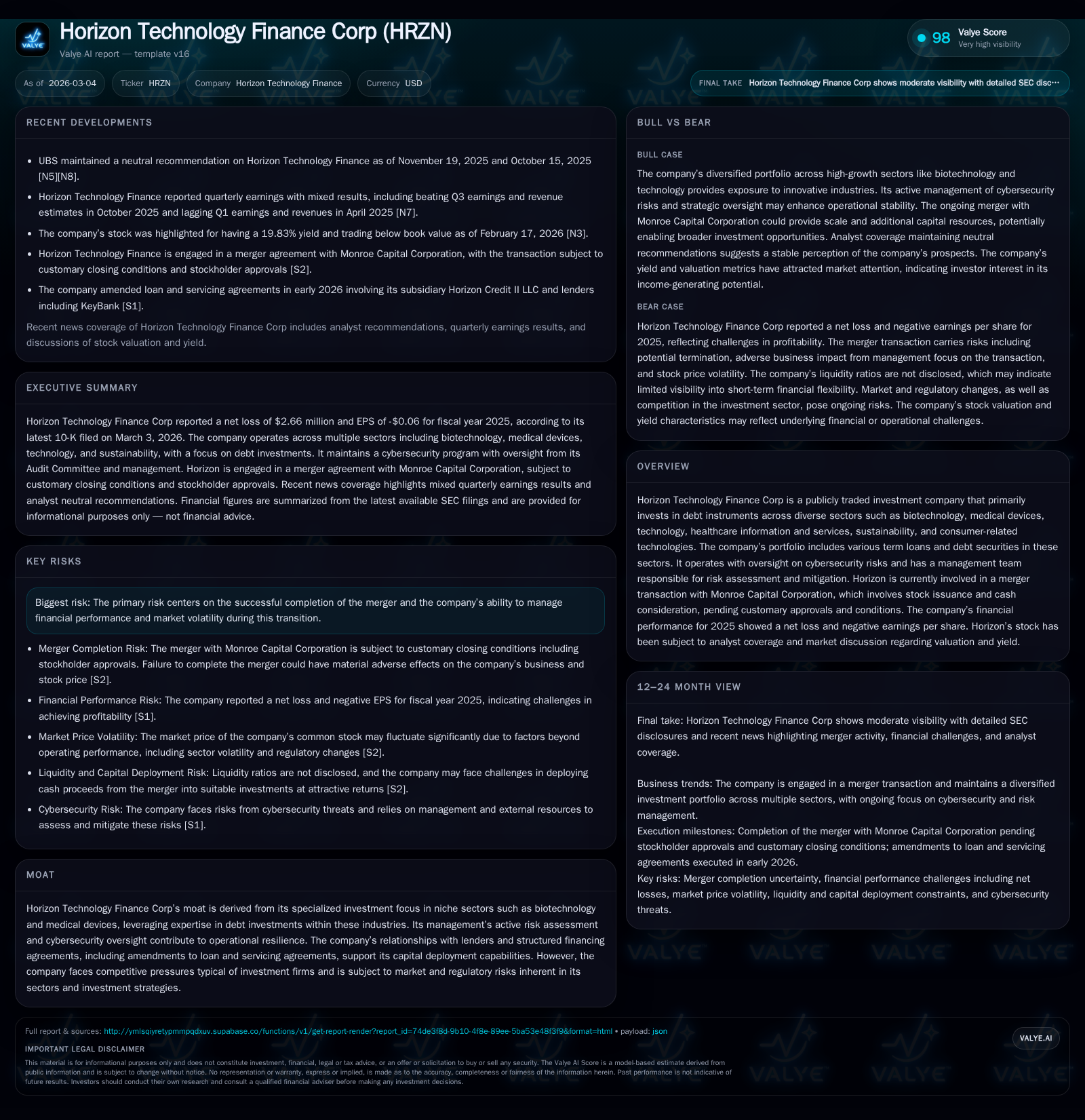
Horizon Technology Finance Corp experienced significant volatility over recent years, transitioning from a steep net loss of $17.2 million in 2023 toward a much narrower loss of $2.7 million in 2025, accompanied by a remarkable operating cash flow recovery to $56.6 million in 2025. The company’s focused debt investments across technology-driven niche sectors like biotechnology, medical devices, and sustainable energy underpin its specialized moat and risk management framework. Currently undergoing a pivotal merger with Monroe Capital Corporation involving stock issuance and cash consideration, Horizon faces key risks including transaction completion uncertainty and post-merger integration challenges. Going forward, monitoring portfolio credit quality, dividend sustainability, and the closure of merger conditions will be essential.
Financial Rebound Amid Sector-Specialized Debt Investments
Horizon Technology Finance Corp's financial trajectory over the four most recent fiscal years shows distinct volatility yet an encouraging trend towards recovery by end-FY2025. After enduring a deep net loss of approximately $17.2 million in FY2023, the company reduced this deficit substantially to about $2.7 million in FY2025 [F1]. More strikingly, operating cash flow rebounded spectacularly from a negative $5.3 million (FY2023) to a positive $56.6 million in FY2025 — representing an increase exceeding 1300% year-over-year [F1]. This inflection underscores Horizon's ability to manage operational aspects and realize improved investment income streams despite persistent reporting losses.
This rebound is underpinned by Horizon's strategic focus on high-growth debt instruments like term loans that are often indexed to prime rates within sectors requiring specialized expertise—biotechnology, medical devices, healthcare information services, sustainability-focused companies, and emerging consumer-related technologies [S1][F1]. Such specialization demands active risk assessment both at investment origination and ongoing portfolio monitoring stages because these industries typically exhibit higher regulatory complexity and developmental risk profiles.
Merger with Monroe Capital: Transaction Details and Risks
On August 7, 2025, Horizon entered into a merger agreement with Monroe Capital Corporation (MRCC), involving stock issuance combined with cash consideration contingent upon standard closing conditions including stockholder approvals [S2]. The transactions consist of an asset sale followed immediately by merger steps designed to consolidate operations effectively. Both Horizons' and MRCC boards have approved the transaction; however, termination of either the Merger Agreement or the Asset Purchase Agreement carries substantial downside risks including missed strategic benefits, valuation declines due to altered market expectations, and lost opportunity costs as management resources remain focused on transaction execution rather than alternative growth initiatives [S2].
The approval process remains ongoing as customary stockholder votes loom following announcement dates [N1][S3]. Failure to secure such approvals would imperil expected integration advantages potentially resulting in material adverse impacts on Horizon's business trajectory [S2]. The merger strategically aims to enhance capital deployment capacity through combined assets but depends heavily on execution fidelity.
Investment Portfolio Composition and Niche Sector Focus
Horizon maintains a diversified debt investment portfolio emphasizing non-affiliate term loans tied primarily to prime rate indexes distributed across its core sectors: biotechnology (e.g., KSQ Therapeutics Inc., CastleCreek Biosciences), medical devices (e.g., Conventus Orthopaedics Inc., Infobionic Inc.), software/technology platforms (e.g., BrightInsight Inc., SambaTV Inc.), sustainability-focused companies (e.g., SparkCharge Inc., Nexii Building Solutions), and consumer-related innovations [F1]. These investments include structured financing agreements tailored for growth-stage firms often requiring bespoke capital solutions that traditional lenders may avoid due to sector uncertainty.
The management team actively integrates sophisticated risk controls including cybersecurity oversight—leveraging Monroe Capital’s IT head resources—to safeguard sensitive investment data and sustain operational integrity amid increasing digital threats typical in technology-driven sectors [S1]. This governance layer forms part of Horizon's moat by contributing resilience beyond pure financial underwriting.
Operating Cash Flow Surge: Drivers and Implications
The surge in operating cash flow from modest positive levels in FY2024 ($3.9 million) to $56.6 million in FY2025 reflects enhanced cash collections from debt investments alongside prudent expense management [F1]. Improved portfolio performance likely stems from maturing loan vintages generating stable interest income coupled with disciplined underwriting reducing impairment charges.
Such heightened liquidity strength allows Horizon greater flexibility concerning distributions coverage ratio—critical for sustaining its dividend policy balancing investor yield expectations against reinvestment needs or debt servicing obligations. This positive CFO dynamic signals robust underlying cash-generative potential critical for navigating future sector volatility and funding accretive growth avenues.
Pressure on Net Income: Losses Narrow but Persist
Despite the pronounced operating cash flow improvement, net losses persisted at approximately -$2.7 million in FY2025 although significantly reduced from prior years’ deeper deficits (-$5.6 million in FY2024; -$17.2 million in FY2023) [F1]. This contrast highlights continuing pressure from non-cash accounting items such as valuation mark-to-market adjustments on debt instruments that fluctuate with market yields or credit spreads.
Additional contributing factors may include impairment charges or provisioning for potential defaults given inherent credit risk within pioneering niche sectors [N1][S1]. Hence reported earnings do not fully capture underlying economic profitability which appears more positive based on operating cash flows.
Capital Allocation: Dividends, Buybacks, and Leverage Profile
Horizon sustains substantial capital return efforts through dividends paid amounting to approximately $53.1 million in FY2025—a sizable increase from $46.4 million in FY2024—and continuous share repurchases averaging $1.9 million annually over the last four years [F1][S4]. These payouts demonstrate commitment to yield-focused investors common among business development companies deploying yield-enhanced debt strategies.
Approximate return on equity stands near -0.8%, reflecting net loss impact against equity base as differences between accrual earnings and distributable taxable income persist [F1]. Leverage metrics detailed in SEC filings denote multiple senior securities outstanding tied to securitization vehicles; these represent structured financing agreements used for capital optimization without public registration requirements , evidencing sophisticated capital architecture supporting targeted deployment.
Cybersecurity Oversight as a Risk Mitigation Factor
Given the sensitivity of proprietary loan structures and investor information within technology-centric investment portfolios, Horizon’s management institutes thorough cybersecurity governance supported by its Audit Committee’s strategic oversight role [S1]. Regular updates inform leadership about evolving threat landscapes while collaboration with Monroe’s Head of Information Technology brings enhanced expertise aiding prevention, detection, mitigation, and remediation practices for incidents impacting operational continuity.
This integration exemplifies vigilant risk management aligning operational controls with industry best practices necessary when handling cloud-enabled asset management environments hosting confidential data related to innovative borrowers across biotech and software sectors.
Outlook Considerations: What to Watch Post-Merger
Looking ahead into Horizon's post-merger phase with Monroe Capital Corporation—the integration timeline remains dependent on final customary closing conditions including stockholder approvals scheduled for special meetings [N1][S2]. Market participants should monitor:
- Completion of merger transactions without termination;
- Evolving portfolio credit quality especially within high-growth biotech/medtech holdings;
- Sustainability of dividend policies amid shifting income recognition dynamics;
- Realization of synergies enhancing scale advantages and capital deployment efficacy.
Failure factors here could materially impact business prospects while successful closure could reposition Horizon as a more nimble player within technology-specialized finance sectors offering integrated financing solutions backed by broader resource pools.
Horizon Technology Finance Corp Historical Financial Summary (FY2022-FY2025)
Historical performance (annual)
| FY | Net ($mm) | CFO ($mm) | Net YoY |
|---|---|---|---|
| 2025 | -3 | 57 | +52.8% |
| 2024 | -6 | 4 | +67.2% |
| 2023 | -17 | -5 | -181.2% |
| 2022 | 21 | -246 |
Source: SEC companyfacts cache [F1].
Capital returns and efficiency (annual)
| FY | Div ($mm) | Buybacks ($) |
|---|---|---|
| 2025 | 53 | 1900000 |
| 2024 | 46 | 1900000 |
| 2023 | 41 | 1900000 |
| 2022 | 30 | 1900000 |
Source: SEC companyfacts cache [F1]. Percent changes approximated where historical data supports calculation per fiscal year comparisons
This analysis is based solely on publicly filed SEC documents up through March 4th, 2026 ([F1],[S1]-[S29]) as well as recent market commentary ([N1]). It excludes any forward-looking statements by management not explicitly documented therein or projections unsupported by disclosed data points or filings.
Disclaimer: This is research-only, informational analysis and not investment advice. It may include AI-generated interpretation and general industry context. Always verify important details using primary sources.

Comments