
Agilent Technologies’ Strategic Realignment and Capital Discipline Drive Moderate Growth
A detailed analysis of Agilent’s restructuring, financial performance, and capital allocation reveals a steady path forward despite global challenges.
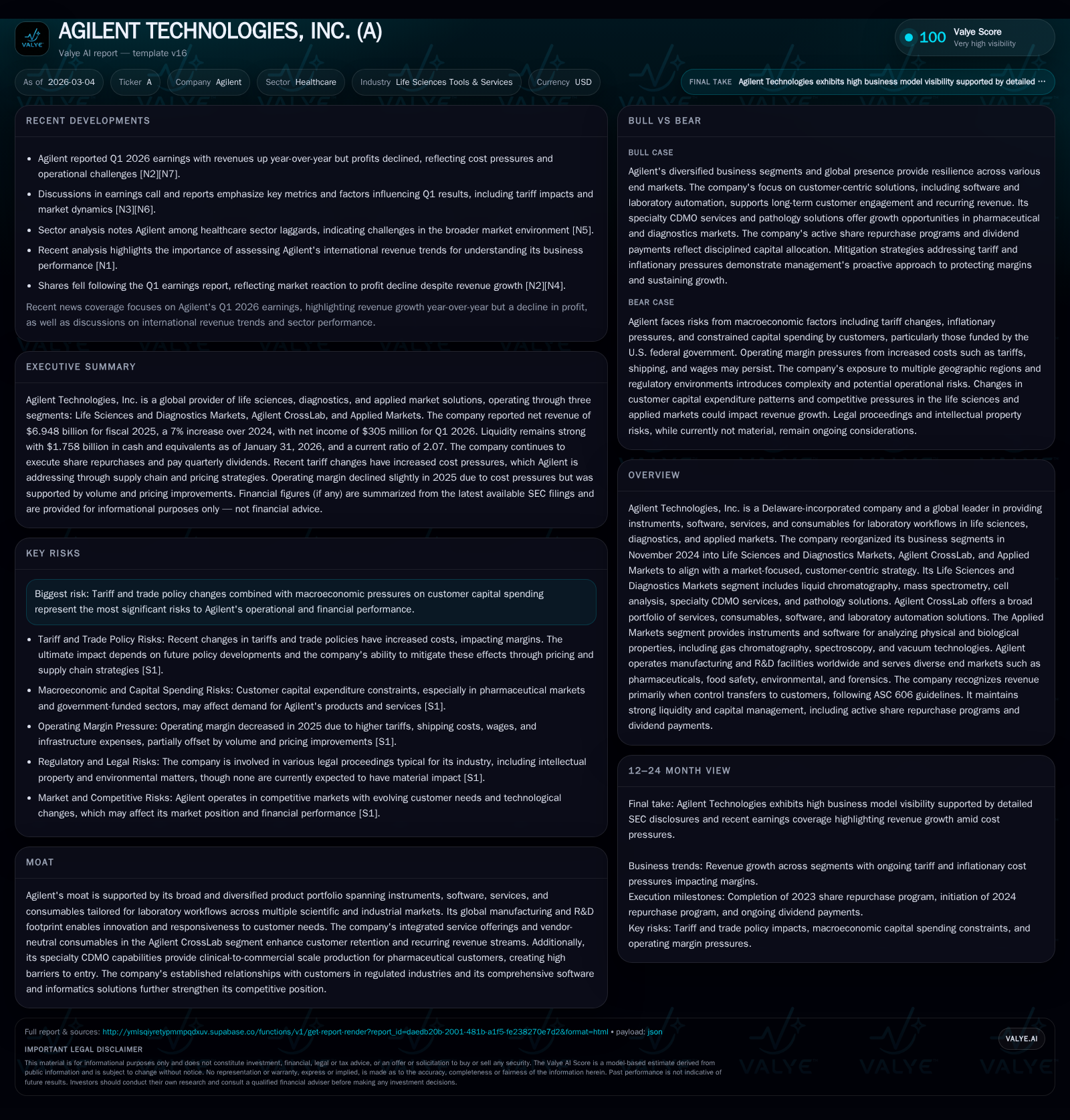
Agilent Technologies has solidified its market leadership through a major November 2024 segment reorganization aligning with a customer-centric strategy. The company’s historical five-year financials exhibit steady revenue growth with stable profitability, supported by its broad product portfolio and recurring revenue streams from services and consumables. Capital allocation remains disciplined with ongoing share buybacks and consistent dividends, yielding a robust return on equity near 19%. Key risks include tariff impacts and macroeconomic uncertainties affecting customer spending. Monitoring Agilent's execution of cross-segment synergies and international sales dynamics will be critical in upcoming quarters.
Financial Trajectory: Revenue and Profit Trends in the Past Five Years
Over the last half-decade, Agilent Technologies demonstrated resilient top-line growth combined with measured profitability shifts reflecting investments and evolving market conditions. Revenue increased from approximately $4.04 billion in FY2015 to $4.47 billion by FY2017 [F1], while operating income exhibited relative stability with $1.48 billion recorded in FY2025. This represents a mild decline of approximately 0.6% year over year compared to FY2024 where operating income stood at $1.49 billion [F1]. Net income followed a positive trajectory, rising slightly by about 1.1% to $1.30 billion in FY2025 against the prior year figure [F1].
Operating cash flows peaked in FY2024 at around $1.75 billion before contracting roughly 11% to $1.56 billion in FY2025 [F1]. Concurrently, capital expenditures increased by nearly 8%, reaching $407 million aligned with elevated R&D spending as part of strategic growth initiatives [F1][S23]. The resultant free cash flow remained healthy at roughly $1.15 billion for FY2025, underpinning the company’s capacity for returns to shareholders alongside reinvestments.
Historical performance (annual)
| FY | Net ($mm) | CFO ($mm) | OpInc ($mm) | Capex ($mm) | Net YoY |
|---|---|---|---|---|---|
| 2025 | 1303 | 1559 | 1479 | 407 | +1.1% |
| 2024 | 1289 | 1751 | 1488 | 378 | +4.0% |
| 2023 | 1240 | 1772 | 1350 | 298 | -1.1% |
| 2022 | 1254 | 1312 | 1618 | 291 |
Source: SEC companyfacts cache [F1].
Capital returns and efficiency (annual)
| FY | Div ($mm) | Buybacks ($mm) | FCF ($mm) |
|---|---|---|---|
| 2025 | 282 | 425 | 1152 |
| 2024 | 274 | 1150 | 1373 |
| 2023 | 265 | 575 | 1474 |
| 2022 | 250 | 1139 | 1021 |
Source: SEC companyfacts cache [F1].
Revenue Year-over-Year computed from referenced figures where possible; data sourced from [F1].
Segment Reorganization’s Role in Market-Centric Strategy Execution
In November 2024, Agilent implemented a strategic restructuring aimed at reinforcing its market focus per customer-centered demands [S13]. This reorganization consolidated the former Diagnostics and Genomics segment with liquid chromatography platforms to establish the Life Sciences and Diagnostics Markets segment — encompassing capabilities such as specialty CDMO services delivering clinical-to-commercial scale pharmaceutical manufacturing [S13].
Simultaneously, Chemistries, Supplies, Laboratory Automation, Software & Informatics units transitioned into the Agilent CrossLab segment distinguished by an integrated portfolio of vendor-neutral consumables, laboratory automation solutions, services, and software designed to deepen customer engagement through recurring revenue streams [S13]. The remainder of previously combined units focused on gas chromatography, spectroscopy, vacuum technologies now compose the Applied Markets segment focusing on physical and biological analysis applications [S13], [S22].
This re-orientation is positioned not only to sharpen Agilent's competitive differentiation but also enable cross-segment synergies driving value through enhanced consumable sales tied directly to installed instrument bases across verticals.
Recurring Revenue Streams Through Services and Consumables Integration
The Agilent CrossLab segment embodies a vital pillar of recurring revenues stemming from comprehensive service offerings—including consumables that are vendor-neutral—strengthening barriers against competitors reliant on proprietary ecosystems [S14], [S13]. This blend supports sticky customer relationships essential in regulated environments requiring strict compliance adherence.
Additionally, the specialty CDMO business expands high entry barriers through GMP-compliant oligonucleotide synthesis services catering to pharmaceutical clients engaged in nucleic acid therapeutics development [S13], enhancing portfolio breadth beyond instruments into high-value contract services.
Together these components facilitate predictable revenue flows insulating segments somewhat from cyclical instrument replacement volatility while leveraging digital remote service capabilities for improved customer experience metrics [S14].
International Market Dynamics and Their Impact on Sales Performance
Global geographic diversification remains integral as Americas, Europe, and Asia-Pacific each contribute distinct performance influences [N1], [S7]. Recent analysis shows mixed regional outcomes; Europe benefits notably from expansion across gas chromatography and vacuum sectors while Asia-Pacific contends with demand softness predominantly within China impacting gas chromatography and spectroscopy segments offset partially by remarketed instruments gains [S22].
Currency headwinds exerted about a one percentage point unfavorable impact on revenue growth trajectory internationally during FY2025 compounded further by localized tariff adjustments influencing cost structures [N1], [S16]. However, Agilent’s extensive manufacturing footprint spanning North America, Europe, and Asia facilitates operational flexibility helping hedge against localized supply chain disruptions [S1], thus imparting resilience amid ongoing geopolitical trade complexities.
Capital Deployment: Buybacks, Dividends, and Returns on Equity
Agilent maintains disciplined capital allocation balancing shareholder returns with strategic reinvestment needs , evidenced by dividends amounting to approximately $282 million paid in FY2025 — reflecting steady payout growth from prior years — alongside active share repurchase totaling roughly $425 million under the newly instituted $2 billion repurchase authorization initiated mid-2024 with no fixed termination horizon ,[F1].
These buybacks are sustained despite incremental excise taxes incurred due to recent legislative changes imposing a nondeductible one percent excise tax on net repurchases post-2022 encouraging prudent sizing of repurchases inclusive of tax costs [S6].
Simultaneously, return on equity calculated near 19% underscores capital effectiveness reflecting strong earnings generation relative to substantial equity base approximating $6.74 billion at fiscal year-end October 31, 2025 [F1]. Capital expenditures increased modestly consistent with elevated R&D programs targeting innovation pipelines supporting evolving end-market demands.
Analyst Views and Key Milestones to Monitor in Upcoming Quarters
Recent Q1 FY2026 results underscored some execution risk as reported earnings fell short of consensus estimates despite achieving year-on-year revenue improvements highlighting margin pressures and cost inflation challenges [N2],[N3],[N5]. Wall Street commentary emphasizes vigilance around management’s ability to navigate ongoing supply chain cost escalations while sustaining cross-segment integration progress particularly within the recently restructured segments affecting revenue composition mix dynamics [N9].
Key milestones include ramping contributions from BIOVECTRA acquisition in specialty CDMO services concomitant with close monitoring of installed base growth fueling consumables demand within CrossLab plus stringent expense controls aiming at mitigating inflation-induced margin erosion factors.
Risks from Tariffs and Macro Pressures: Assessing Operational Resilience
Significant operational risks emanate primarily from tariff policy shifts raising cost-of-goods-sold within crucial industrial supply chains particularly impacting imported component pricing which pressured margins during the latter half of fiscal year 2025 albeit mitigation efforts are underway for fiscal year 2026 operations [S17],[N1].
Further macroeconomic factors constrain customer capex plans affecting order intake visibility notably within advanced materials markets sensitive to economic cycles impacting instrument replacement rates.
Nonetheless, Agilent’s diversified international footprint across manufacturing sites distributed globally serves as a natural hedge diminishing exposure concentration risks coupled with ongoing investment in digital servicing models enhancing customer retention even amid fluctuating demand patterns.
This report is prepared solely for informational purposes incorporating data drawn exclusively from publicly available filings and credible news sources without any investment recommendation or advice.
Disclaimer: This is research-only, informational analysis and not investment advice. It may include AI-generated interpretation and general industry context. Always verify important details using primary sources.

Comments