
Eastern Company’s Engineered Solutions: Balancing Innovation and Pricing Pressure
Eastern Company leverages custom engineered solutions in commercial transportation to offset pricing pressure and tariff challenges.
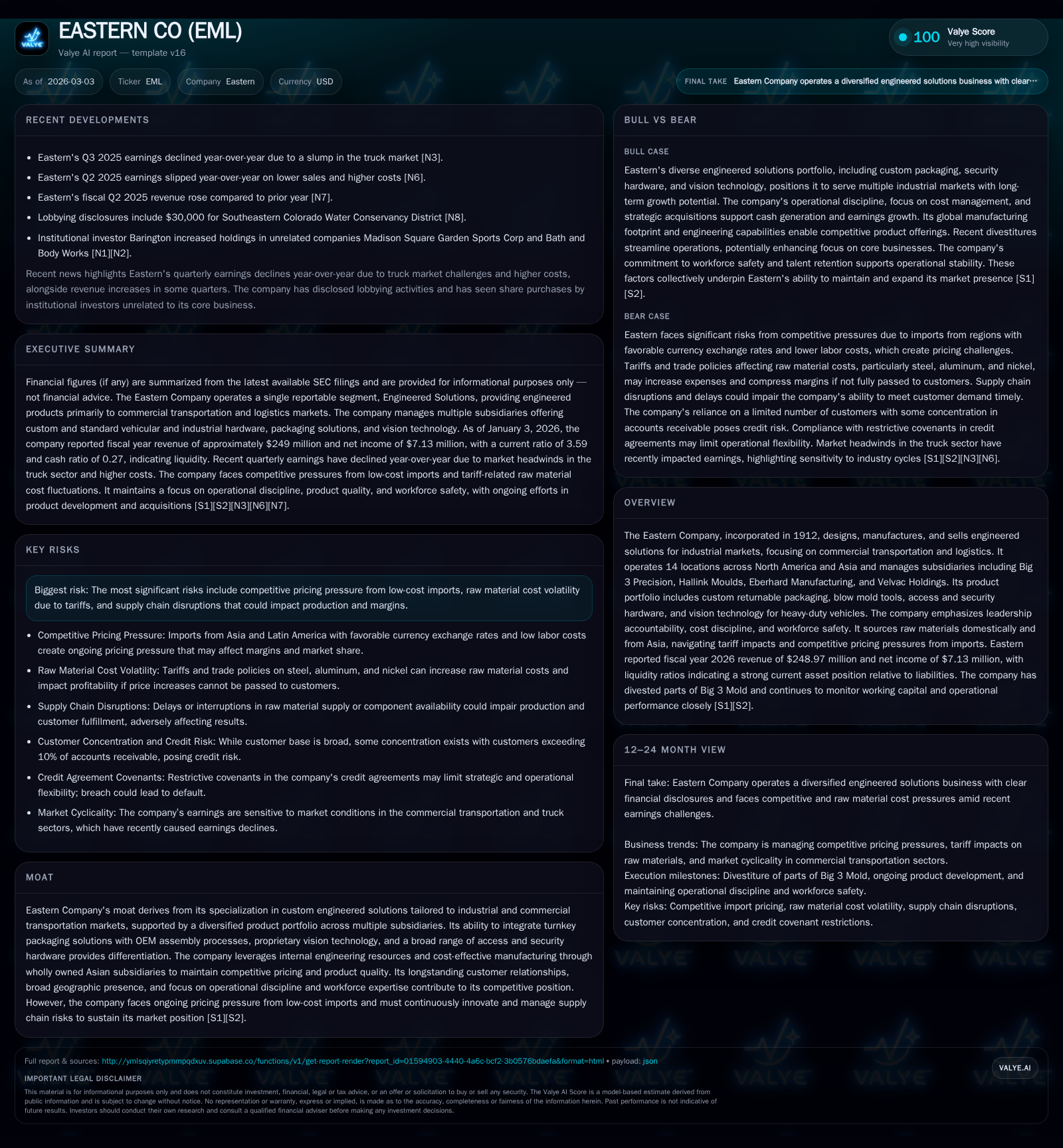
Founded in 1912, Eastern Company operates a diversified portfolio of subsidiaries delivering specialized engineered products for industrial markets mainly in commercial transportation. Despite an 8.7% revenue contraction in FY2026 driven by competitive import pricing and raw material tariff impacts, the company managed a resilient net income rebound and positive cash flow through operational discipline and cost management. Its strategic footprint across North America and Asia, coupled with innovative product lines including proprietary vision technology and turnkey packaging, underpin its enduring market relevance. Critical constraints remain import competition, supply chain risks, and tariff volatility that will shape near-term growth prospects and capital allocation decisions.
Legacy and Market Footprint: Eastern Company’s Industrial DNA
Established over a century ago in Connecticut (corporated 1912), Eastern Company has evolved into a multifaceted industrial group designing and producing engineered solutions primarily for commercial transportation and logistics markets [S1]. Operating fourteen locations across North America and Asia underscores its global operational footprint aligned with customer manufacturing bases [S1][S8]. The company’s strategy centers on leadership accountability, careful cost control, and maintaining workforce safety culture — pillars it sees as key to long-term value creation [S1]. Its diverse subsidiaries—including Big 3 Precision, Hallink Moulds, Eberhard Manufacturing, Velvac Holdings—enable breadth in product offerings from precision packaging solutions to heavy-duty vehicle optics [N1][S8]. This multi-business structure facilitates engineering integration across customer OEM assembly lines.
Revenue and Profit Dynamics: Trends and YoY Shifts Through FY2026
Historically a steady revenue generator ($279M in FY2022), Eastern faced an accelerating top-line decline culminating in $249M reported for FY2026 — an 8.7% decrease year-over-year [F1]. Operating income contracted more sharply by 47%, falling to around $10.7M from nearly double the prior comparable periods [F1]. The disproportionate drop signals significant margin compression attributed largely to competitive pricing pressures from cheaper imports and heightened raw material costs influenced by tariffs [S1][S9]. Nevertheless, net income rebounded robustly (+183%), registering just above $7.1M after loss recognition in FY2024 [F1]. This recovery while operating income slipped suggests beneficial tax treatments or lower one-time costs. Cash flow generation also softened profoundly — operating cash flow declined by over fifty percent to approximately $8.9M [F1], reflecting both earnings quality challenges and working capital dynamics.
Historical performance (annual)
| FY | Rev ($mm) | Net ($mm) | CFO ($mm) | OpInc ($mm) | Rev YoY | Net YoY |
|---|---|---|---|---|---|---|
| 2026 | 249 | 7 | 9 | 11 | ||
| 2024 | 273 | -9 | 19 | 20 | -0.3% | -199.4% |
| 2023 | 273 | 9 | 26 | 15 | -2.1% | -30.2% |
| 2022 | 279 | 12 | 7 | 14 |
Source: SEC companyfacts cache [F1].
Capital returns and efficiency (annual)
| FY | Div ($mm) | Buybacks ($mm) | FCF ($mm) |
|---|---|---|---|
| 2026 | 3 | 4 | 5 |
| 2024 | 3 | 3 | 10 |
| 2023 | 1 | 20 | |
| 2022 | 2 | 4 |
Source: SEC companyfacts cache [F1].
Table: Selected Financial Metrics FY2022-FY2026 [F1]
Subsidiary Portfolio and Product Differentiation in Commercial Transportation
Eastern Company's moat is founded on its ability to engineer custom solutions tightly integrated with OEM assembly processes across commercial transport sectors [N1][S8]. Big 3 Precision specializes in tailored returnable transport packaging that enhances production efficiencies for vehicles and durable goods through turnkey designs [S8]. Hallink Moulds focuses on innovative injection blow mold tooling serving food/beverage/healthcare industries with advanced two-step stretch blow molds [S25]. Eberhard Manufacturing contributes access hardware ranging from rotary latches to custom electromechanical systems for variegated industrial uses [S25]. Velvac Holdings adds proprietary vision technologies including mirror-cameras targeting heavy-duty truck OEMs and aftermarket segments dominant in North America [S25]. This collective ecosystem supports differentiated product synergies while facing inbound price competition primarily from importers leveraging low labor costs overseas.
Operational Headwinds: Import Competition, Tariffs, and Currency Exposure
Eastern confronts sustained pricing pressure due to imports from Asia and Latin America benefiting from favorable currency exchange rates amid lower labor costs [S17][S22]. Such dynamics erode domestic pricing power necessitating both aggressive internal engineering support and lean manufacturing practices delivered partly via wholly owned Asian subsidiaries to retain competitiveness [S17][S22]. Tariff impositions affecting raw materials amplify cost volatility complicating margin management given the limited ability to fully pass through price increases without impacting demand adversely [S13][S27]. The company manages exposure through a nuanced sourcing strategy blending domestic procurement alongside affiliated Asian suppliers calibrated to mitigate potential customs delays or cost spikes [S13][S22]. However extended supply chain disruptions including port congestions or labor disputes remain latent risks capable of inflating transit expenses or causing inventory shortages detrimental to customer service levels [S22]. Contracts vary but typically incorporate leveraged cost-plus elements where feasible; yet tariff pass-through is increasingly unpredictable.
Liquidity Strength and Capital Structure Evolution: Debt Covenants and Revolving Credit Insights
Liquidity measures underscore Eastern’s solid current asset footing relative to liabilities — as of FY2026 end the current ratio stands at a robust ~3.59 supported by nearly $74 million in current assets against $27.6 million current liabilities [F1]. Capital structure adjustments are notable with the termination of the TD Bank Credit Agreement rewarding the company access to a new $100 million five-year revolving credit facility administered by Citizens Bank launched October 2025 [S5][S16]. This facility imposes strict covenants including a senior net leverage ratio cap at 3.5x (with temporary allowance up to 4x upon acquisitions), plus an interest coverage floor of minimum 3x EBITDA coverage emphasizing conservative financial discipline underpinned by regular covenant monitoring [S5][S18]. Interest expenses fluctuate by leverage ratio influencing margins especially amid variable SOFR-based borrowings [S6][S21]. Additionally restrictive clauses curtail dividends/distributions beyond specified thresholds absent covenant compliance restricting capital flexibility but safeguarding creditor interests against excessive risk-taking or asset sales [S4][S18]. As of early FY2026 consolidated indebtedness totals ~$33.9 million excluding lease obligations indicating moderate leverage levels balanced against equity exceeding $124 million [F1].[S18]
Shareholder Capital Returns: Dividends, Buybacks, and ROE Analysis
Eastern has maintained consistent dividend payouts throughout recent years despite revenue headwinds paying approximately $2.68 million during FY2026 showing commitment to shareholder returns even as cash flows moderated significantly from prior peaks [F1][S23]. Concurrently share repurchase activity accelerated conspicuously—buybacks more than doubled from around $735k in fiscal year 2023 to nearly $3.73 million in FY2026 demonstrating proactive balance sheet management aimed at offsetting dilution or enhancing per-share economics when valuation merits align with financial covenant constraints [F1][S14][S23]. Return on equity—calculated roughly as net income divided by average equity—hovers near a modest ~5.7% currently reflecting compressed profits but consistent capital deployment geared towards sustaining shareholder value amid external pressures afflicting top-line growth potential [F1].
Strategic Outlook: Growth Prospects under Market Constraints
Management articulates focus on organic growth reinforced selectively through acquisitions complemented by targeted innovation designed specifically to counteract import pricing erosion notably via proprietary vision tech enhancements at Velvac plus continual refinement of turnkey packaging solutions at Big 3 Precision Products Inc. expanding OEM integration scope [N1][S1]. Overseas market penetration remains tentative owing partly to local customer acceptance hurdles alongside logistic complexities underscored by geopolitical trade policy shifts imposing tariff risks challenging input cost stability which mandate vigilant supply chain optimization processes maintaining competitive advantage without sacrificing margin integrity [N1][S27]. Innovations leveraging AI-enabled product enhancements could become critical barriers but require sustained investment against tightening capital budgets compelled by lower operating income trends currently observed.
Key Metrics to Watch: What Could Signal Turning Points Ahead
Investors should closely monitor changes in segment gross profit margins which directly echo success combating pricing pressures or tariff-induced cost inflation impacting profitability broadly within Engineered Solutions segment performance reports forthcoming quarterly filings will reveal if operational efficiencies gain traction post-divestitures such as partial Big 3 Mold sale-related restructuring effects still unfolding following April 30th disposal of ISBM division assets observed earlier phase of Big3 Mold realignment reflected as discontinued operations prior periods however continuing residual transitions remain apparent near term catalysts will also stem from covenant adherence particularly senior net leverage ratio trends influencing dividend/buyback flexibility alongside interest expense sensitivity linked to rate fluctuations on revolving credit facility borrowing profiles recently instituted under Citizens Bank agreement heightened awareness around cash conversion cycle movements may signal working capital stress points prerequisite for timely liquidity management success needed for discretionary capital deployment decisions.[N1][S2]
This analysis synthesizes information strictly from verified SEC filings complemented by company disclosures without conjecture beyond presented data or forward-looking guidance notions absent official confirmation. It does not constitute investment advice or recommendation but aims to provide substantive insight into Eastern Company's operational realities amid competitive industrial market dynamics as of March 2026.
Disclaimer: This is research-only, informational analysis and not investment advice. It may include AI-generated interpretation and general industry context. Always verify important details using primary sources.

Comments