
Fortitude Gold’s Operational Shift and Capital Strategy in 2025
The company’s internal mining transition and capital deployment choices inform both financial outcomes and near-term growth potential.
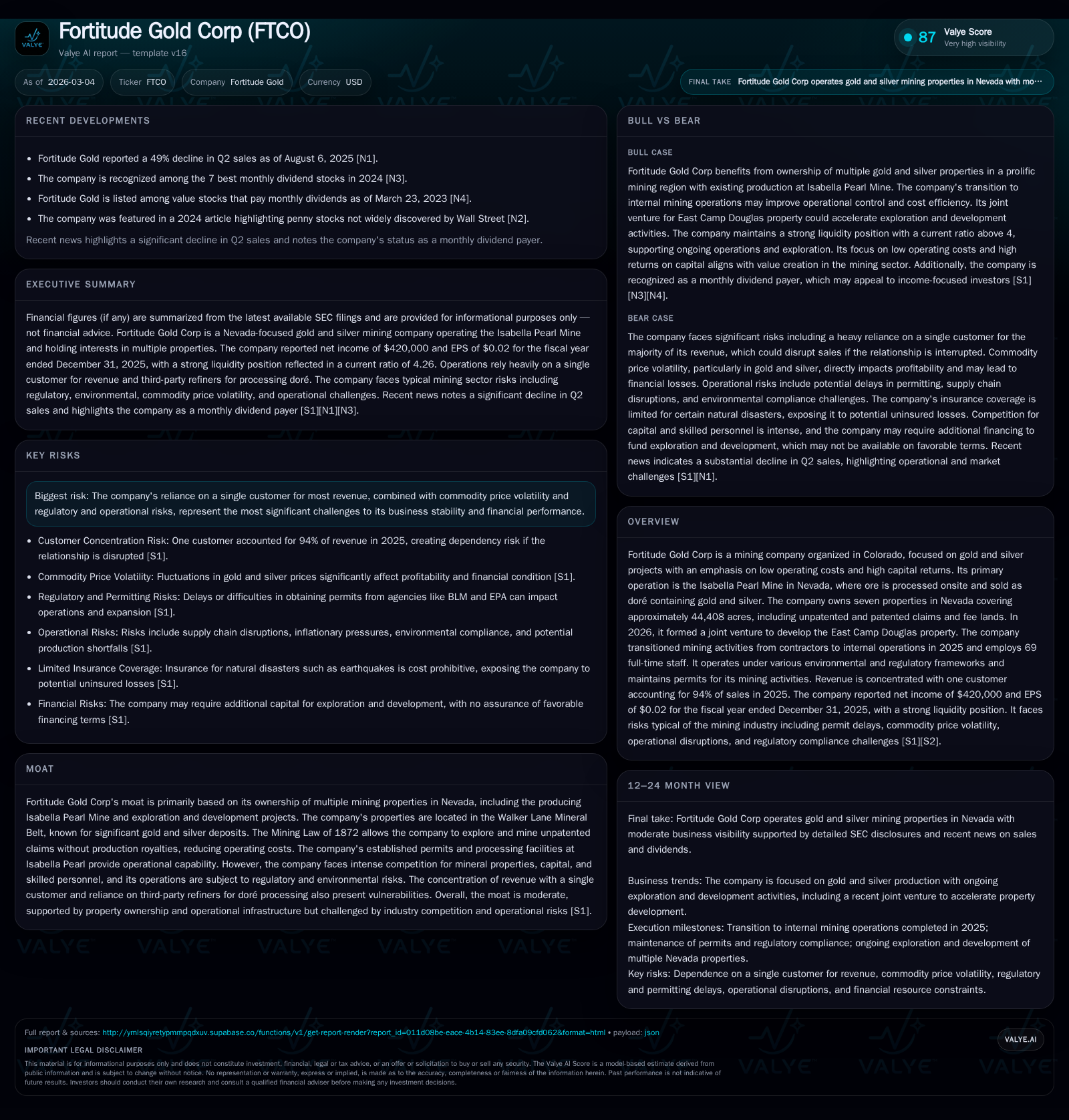
In 2025, Fortitude Gold Corp shifted from contractor-based mining to an internally managed model at its Isabella Pearl Mine, a significant operational change that influenced cost structures and staffing. Though the year saw positive net income recovery after prior losses, operating cash flow turned sharply negative, impacted by working capital and investment dynamics. The company maintains a high customer concentration risk with one entity accounting for 94% of revenues, while recent joint venture activity signals exploration-led expansion ambitions within Nevada’s Walker Lane Mineral Belt. Capital allocation prioritizes dividends despite free cash flow deficits, reflecting cautious balance amid regulatory compliance complexities.
From Contracting to In-House: The 2025 Operational Transition
Fortitude Gold Corp undertook a strategic pivot in 2025 by shifting its primary mining operation at the Isabella Pearl Mine from using third-party contractors to managing activities internally. This change marked a significant transformation in its operational model, bringing previously outsourced labor and processes under direct company control. Concomitantly, the company's full-time workforce expanded to 69 employees, including four executives who dedicate their full efforts to daily operations [S1][S6].
This move potentially offers tighter operational oversight and flexibility to optimize costs; however, it also introduces complexities such as increased fixed personnel costs and the need for robust internal management systems. Managing mine excavation, processing onsite into doré (a semi-pure alloy containing gold and silver), and associated logistics in-house heightens exposure to operational risks previously mitigated through contractual arrangements. The shift corresponds with industry practices where companies seek greater control over fluctuating contract pricing and seek efficiencies but requires successful internal capability development.
Financial Performance Review: Growth, Volatility, and Profitability
Charting Fortitude Gold’s financial trajectory over recent years reveals notable volatility shaped by operational changes and external markets. The company reported a net income of $420 thousand in FY2025 — a rebound from a net loss of approximately $2 million in FY2024 but markedly below earlier profits recorded in FY2023 ($17M) and FY2022 ($14.7M) [F1]. This stabilization into positive profitability coincided with intensified operational expenses linked to transitioning mining activities internally.
Despite this net income improvement, operating cash flow sharply deteriorated by around 96% year-over-year ending at a negative $13 million — signaling an acute liquidity strain driven largely by working capital changes or increased receivables/payables variability rather than direct earnings weakness alone [F1]. Capital expenditures were also scaled back significantly by roughly 44% to $1.94 million as management curtailed spending amid restructuring [F1].
These dynamics converged toward an approximate free cash flow deficit near $15 million in FY2025 (). Meanwhile, return on equity languished around a modest 0.4%, reflecting subdued profitability against a sizable equity base exceeding $104 million [F1].
Historical performance (annual)
| FY | Net ($mm) | CFO ($mm) | Capex ($mm) | Net YoY |
|---|---|---|---|---|
| 2025 | 0 | -13 | 2 | +120.6% |
| 2024 | -2 | -7 | 3 | -112.0% |
| 2023 | 17 | 23 | 5 | +15.9% |
| 2022 | 15 | 29 | 12 |
Source: SEC companyfacts cache [F1].
Capital returns and efficiency (annual)
| FY | Div ($mm) | FCF ($mm) | ROE% |
|---|---|---|---|
| 2025 | 6 | -15 | 0.4 |
| 2024 | 12 | -10 | -1.9 |
| 2023 | 13 | 18 | 14.1 |
| 2022 | 12 | 17 | 12.7 |
Source: SEC companyfacts cache [F1].
Note: Return on Equity approximated by dividing net income by total equity at year-end; dividend payments reflect amounts per fiscal year.
Revenue Concentration and Customer Dependence Risks
A critical vulnerability for Fortitude Gold is the concentration of revenue streams: one single customer accounted for an outsized portion—94%—of sales revenue in both FY2024 and FY2025 from its Isabella Pearl Mine output [S6]. This dependency magnifies operational risks if contractual terms sour or if that customer faces shrinking refining capacity or shifts supplier preferences.
While management mentions reviewing alternatives periodically to offset this concentration risk,[S6] such efforts appear preliminary without materialized diversification yet evident. The reliance on third-party refiners also adds a layer of external dependence since doré products require assay verification followed by refinement—a process that may face delays or interruptions impacting cash flows or price realizations [S18].
Exploration and Joint Ventures: Expanding the Nevada Footprint
The company actively pursues growth through resource expansion reflected by forming a joint venture dedicated to developing the East Camp Douglas property in Nevada during early 2026 [S1][S14]. Situated within the geologically prolific Walker Lane Mineral Belt — known for favorable ore deposits — this project aligns with Fortitude Gold’s strategy of leveraging its portfolio covering about 44,408 acres comprising patented/unpatented claims plus fee lands.
The statutory framework anchored by the Mining Law of 1872 remains advantageous here by exempting unpatented claims from production royalties,[S14] effectively lowering operating costs compared to fully leased properties elsewhere. However, success depends on securing timely permitting approvals amid a backlog impacting project schedules nationally under current federal administration policies.[S23][S25]
Such expansions not only offer upside via reserve additions but also diversify operational risk beyond Isabella Pearl.
Capital Allocation: Dividends Amid Negative Free Cash Flow
Despite substantial negative free cash flow positioning (-$14.96M calculated from operating CFO minus capex), Fortitude Gold maintained dividend distributions totaling about $5.8M during FY2025 [F1][S24]. While such payouts might appeal to shareholder income expectations historically sustained since prior years’ higher dividends,[F1] sustainability appears tenuous given ongoing cash outflows.
Return on equity remains muted at roughly 0.4%, emphasizing low profitability relative to equity levels [F1]. With declining operating cash inflows posing liquidity pressure[S10], the continuation of similar dividend policies warrants close monitoring.
No share repurchase programs were noted during this period,[S24] consistent with preserving cash reserves amid operational reorganization.
Navigating Regulatory Frameworks and Environmental Compliance
Fortitude Gold operates under complex federal (EPA), state (NDEP), and local regulations covering air/water quality controls; waste management; endangered species protection; mine safety; and reclamation obligations requiring financial bonding equivalent to projected restoration costs[S4][S5][S6]. These responsibilities impose strict operational discipline particularly around handling cyanide compounds central to gold/silver ore processing.
Non-compliance risks encompass facility shutdowns or levied fines which would materially impair results.[S6] These challenges are compounded by delays or increased stringency in permit issuance affecting exploration or construction phases[S25][S28]. Continuous oversight demands have intensified following the operational shift from contractors to internal teams.[S25]
Uncertainties around unpatented claim titles[S17] alongside evolving enforcement trends pose potential long-term tenure risks.
Outlook: Key Indicators for Monitoring Progress
Looking ahead post-2025 operations focus rests upon successfully scaling internal mining efficiencies while containing costs associated with expanded staffing levels at Isabella Pearl.
Progress on the East Camp Douglas joint venture will be an important benchmark for reserve base enhancement prospects.
Efforts toward diversifying customers or negotiating more resilient refining agreements will be crucial given persistent revenue concentration risk.[S6]
Regulatory developments including permit approval cadence under evolving federal/state guidelines must be tracked closely due to their potential impact on project timelines and cost structure.[S23][S25]
Capital discipline balancing dividend policies against improving operating cash flows represents another area critical for sustaining shareholder value metrics such as ROE.
Overall performance will hinge upon navigating market price fluctuations inherent in gold/silver commodity cycles nearly standalone due to absence of hedging programs,[S21] alongside managing operational execution risks intrinsic to mining setups converted from contractor models.[S25]
Disclaimer: This analysis is based solely on publicly available information as of early March 2026 extracted from SEC filings without predictive intent or investment recommendations.
Disclaimer: This is research-only, informational analysis and not investment advice. It may include AI-generated interpretation and general industry context. Always verify important details using primary sources.

Comments