
Sana Biotechnology’s Engineered Cell Therapy Platforms Face Development and Financial Hurdles
Sana’s hypoimmune and fusogen technologies target immune-evasive cell therapies with promising early data yet remain constrained by clinical, regulatory, and financial challenges.
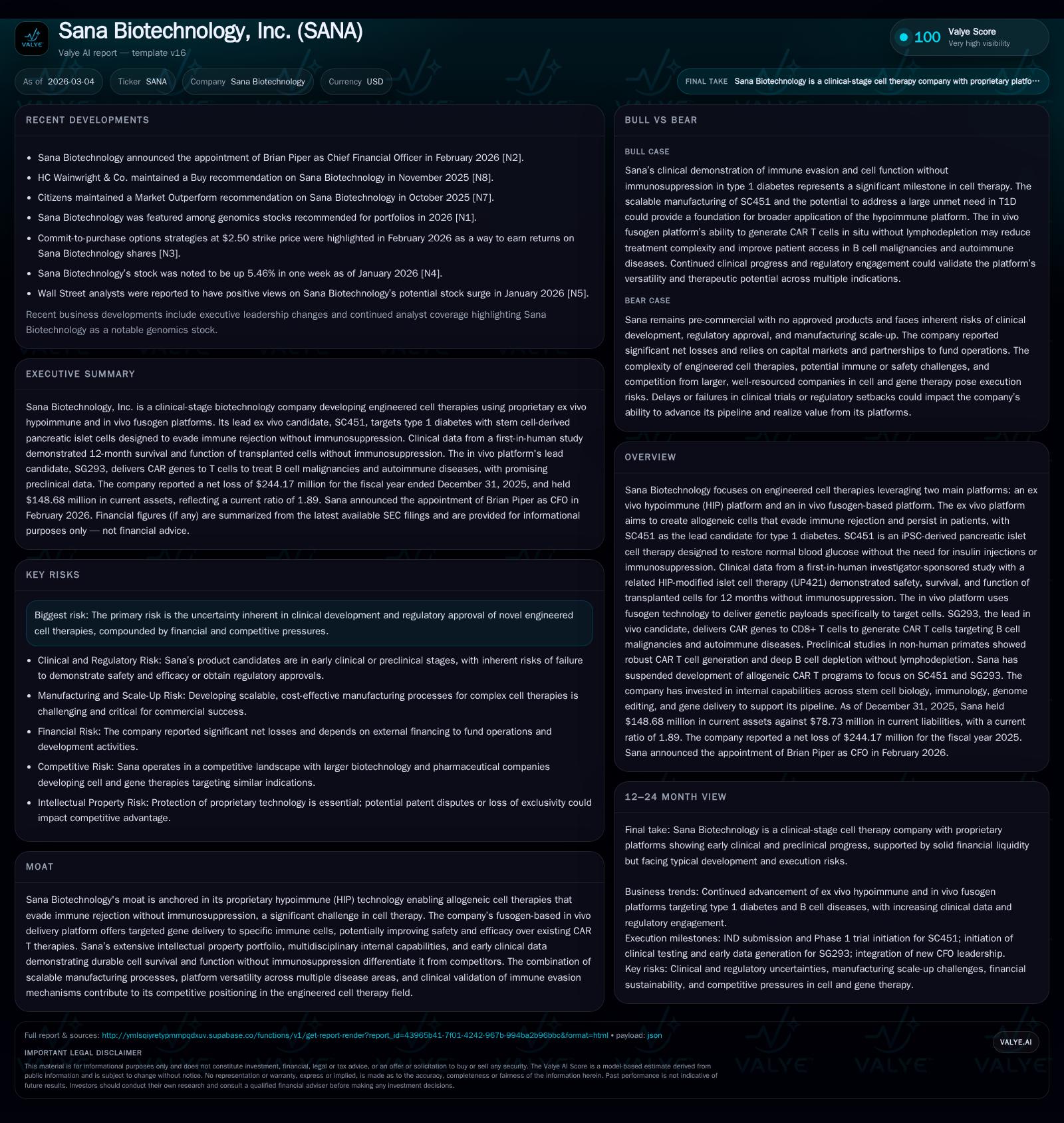
Sana Biotechnology pursues a novel approach in engineered cell therapies via its ex vivo hypoimmune platform and in vivo fusogen delivery system, with lead candidates targeting type 1 diabetes and B cell-driven diseases. Despite encouraging early clinical signals around immune evasion without immunosuppression, the company’s operations continue at a net loss, burdened by substantial cash burn and legal uncertainties. Looking forward, milestones include IND filing and Phase 1 initiation for SC451, with potential regulatory and reimbursement risks tempering prospects. Capital allocation emphasizes funding R&D given ongoing losses, supported by a cash balance of approximately $72 million as of end-2025.
Company Overview
Founded in July 2018, Sana Biotechnology focuses on developing engineered cell therapies using two primary platforms: an ex vivo hypoimmune platform (HIP) designed to create allogeneic cells that evade immune detection without requiring immunosuppressive drugs, and an in vivo fusogen-based platform that delivers gene-editing payloads directly to target T cells within the body [S1]. With diseases like type 1 diabetes (T1D), various B cell malignancies, and autoimmune disorders representing large unmet medical needs, Sana's technologies aim to fundamentally alter treatment paradigms by addressing root causes rather than managing symptoms.
Historical Performance
Since inception, Sana has prioritized research and development over commercialization revenue generation, reflected in its persistently negative operating income. The annual operating losses have trended slightly improving but remain substantial:
Historical performance (annual)
| FY | Net ($mm) | CFO ($mm) | OpInc ($mm) | Capex ($mm) | Net YoY |
|---|---|---|---|---|---|
| 2025 | -244 | -144 | -250 | 1 | +8.5% |
| 2024 | -267 | -223 | -273 | 33 | +5.8% |
| 2023 | -283 | -254 | -293 | 20 | -5.1% |
| 2022 | -269 | -290 | -273 | 21 |
Source: SEC companyfacts cache [F1].
Capital returns and efficiency (annual)
| FY | FCF ($mm) | ROE% |
|---|---|---|
| 2025 | -145 | -151.8 |
| 2024 | -257 | -106.5 |
| 2023 | -274 | -98.5 |
| 2022 | -311 | -54.0 |
Source: SEC companyfacts cache [F1].
Despite heavy losses, operating expenses moderated slightly year-over-year with an approximate 8% reduction in operating losses from FY24 to FY25 [F1]. Operating cash flow improved by more than one-third YoY but remains strongly negative as clinical programs require sustained investment [F1]. Capital expenditures plunged dramatically from $33 million in FY24 to under $1 million in FY25, indicating possible scaling back on infrastructure or refinement of production processes [F1]. Concurrently, shareholders' equity contracted markedly due to accumulated net losses eroding prior capital injections.
Business Drivers & Moat
Central to Sana's competitive positioning is its proprietary Hypoimmune (HIP) technology which genetically edits allogeneic cells to evade host immune systems without immunosuppressants — a key hurdle historically limiting durability and safety of cell therapies [S1]. This confers a potentially disruptive advantage by enabling off-the-shelf therapies less complex than autologous approaches.
Complementing this is the fusogen-based platform facilitating targeted in vivo gene delivery specifically to CD8+ T cells — enabling generation of CAR T cells internally without ex vivo manipulation [S1]. This strategy could reduce manufacturing costs and improve patient accessibility if safety profiles support it.
Further defensive advantages arise from Sana’s substantial intellectual property portfolio spanning HIP technology and fusogen delivery methods globally [S13], coupled with multidisciplinary internal capabilities covering biology, manufacturing scale-up, and translational science.
Pipeline & Clinical Progress
The lead ex vivo candidate SC451 targets T1D through transplantation of HIP-edited induced pluripotent stem cell-derived pancreatic islet cells designed to restore endogenous insulin production without immunosuppression or chronic insulin injections [S1]. An earlier related HIP-engineered product (UP421) demonstrated safety and function for at least a year post-transplant without immunosuppression in a first-in-human investigator-sponsored trial [S1], supporting the translatability of their immune evasion strategy.
SC451 is positioned for an investigational new drug application (IND) submission shortly followed by a Phase 1 trial initiation as soon as this year [S1], marking a crucial inflection point validating GMP scale manufacturing alongside clinical tolerability.
On the in vivo front, SG293 — a fusosome delivering CD19-targeted CAR genes directly into CD8+ T cells — aims to address B cell malignancies including leukemias and lymphomas as well as B cell-mediated autoimmune disorders where depletion of pathogenic B cells may be therapeutic [S1]. Clinical timeline specifics remain undisclosed but progression beyond preclinical stages is implied.
Regulatory & Market Considerations
As biological products under FDA purview, Sana's candidates face tightly regulated approval pathways involving extensive preclinical toxicology assessments followed by phased human trials evaluating safety and efficacy prior to biologics license application filings [S27]. Post-approval commitments including Risk Evaluation and Mitigation Strategies (REMS) or post-market surveillance may apply given therapy novelty and immune modulation involved [S6],[S23],[S28].
Reimbursement uncertainties persist due to prevailing trends toward price controls under U.S. healthcare reform initiatives such as Medicare price negotiation mandates effective since 2026 via the Inflation Reduction Act [S18],[S29]. Global reimbursement environments also display variability with increasing demands for cost-effectiveness analyses—factors that could constrain pricing power if Sana’s products reach market.
Legal & Intellectual Property Risks
A putative class action securities lawsuit filed in March 2025 alleges misleading public statements regarding development timelines and business prospects tied notably to their CD19-directed allogeneic CAR T program SC291 [S5],[S14]. Motions to dismiss remain pending; the company asserts vigorous defense but litigation outcomes introduce operational and reputational risk.
Patent landscapes governing gene editing, iPSC technologies, immune evasion techniques such as HIP modifications, and targeted delivery methods represent critical protection pillars but also expose Sana to challenges typical within biotech including possible interference proceedings or invalidation claims [S16],[S26].
Capital Structure & Allocation
As of December 31, 2025 Sana held approximately $71.9 million in cash and equivalents providing runway though capital consumption remains intense [F1]. Operating cash flow was negative $144 million after considering low capex outlays indicating continued reliance on equity or alternative financing sources for sustained operations.
The company does not currently pay dividends nor has announced share repurchase programs; capital allocation emphasizes funding clinical development activities while maintaining sufficient liquidity amidst uncertainty concerning timing of product commercialization [F1],[N1]. Recent appointment of Brian Piper as CFO hints at possible tightening of financial stewardship during this phase transition for the company [N1].
Future Outlook & Milestones
Key near-term catalyst includes IND filing for SC451 anticipated within this year followed by commencement of Phase 1 clinical studies — critical steps for de-risking technology validation via human data [N4],[N5],[S1]. Multiple trial readouts will need close watching as indications expand beyond T1D.
Commercialization timelines depend on successful clinical outcomes coupled with FDA review durations which can be lengthy particularly for first-in-class cellular therapies requiring assurance of long-term safety given immunomodulatory effects.
Market uptake post-approval faces headwinds if governmental payors impose restrictive coverage or pricing ceilings amid political pushback on drug costs—underscoring importance of managed access strategies incorporating real-world outcomes evidence.
Industry Context Analysis
Engineered cell therapy remains a rapidly evolving field characterized by high scientific complexity alongside challenging regulatory scrutiny due to potential off-target effects or immunogenicity risks inherent in allogeneic modalities. Sana’s HIP platform addresses a critical limitation seen in competitor approaches relying on allogeneic donors through genome engineering techniques aimed at evading host detection—a known Achilles heel for scalable off-the-shelf therapeutics.
Similarly notable is use of fusogens enabling precise delivery of gene-editing cargo directly into circulating immune effectors rather than relying on ex vivo manipulation that increases cost/logistical burdens common across CAR T manufacturers worldwide. This positions Sana with differentiated technological moats though commercial translation depends heavily on demonstrating compelling clinical benefit-risk profiles versus existing autologous CAR T therapies now established albeit expensive systemic options.
Summary Narrative Table:
| Year | Operating Income USD | Net Income USD | Operating Cash Flow USD | Capex USD | Equity USD |
|---|---|---|---|---|---|
| 2022 | -272.6 M | -269.5 M | -290.1 M | 20.9 M | 499.3 M |
| 2023 | -293.1 M | -283.3 M | -253.6 M | 20 M | 287.5 M |
| 2024 | -272.7 M | -266.8 M | -223.2 M | 33.4 M | 250.5 M |
| 2025* | -250.3 M | -244.2 M | -143.8 M | <1 M | 160.9 M |
- As reported for fiscal year ended December '25 filing [F1]
Disclaimer: This analysis reflects publicly available information up until early March '26 including SEC filings and reputable news sources without endorsement or investment recommendation regarding securities discussed herein.
Disclaimer: This is research-only, informational analysis and not investment advice. It may include AI-generated interpretation and general industry context. Always verify important details using primary sources.

Comments