
DMC Global's Turnaround: Between Tariffs Headwinds and Market Adaptation
DMC Global balances rising input costs from ongoing tariffs with strategic growth efforts across its diverse industrial segments in 2025.
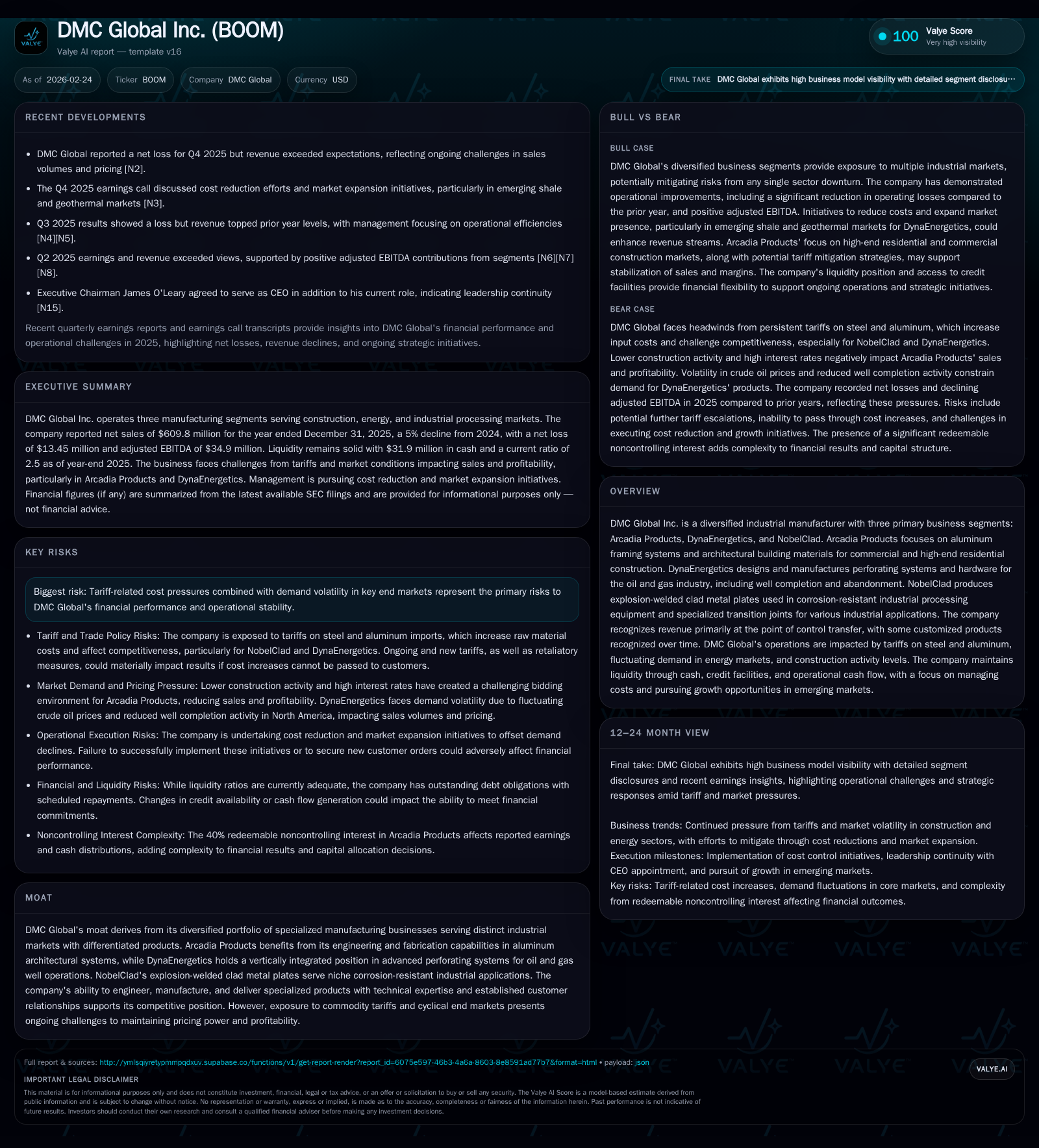
DMC Global Inc. edged close to operating breakeven in 2025 after a severe loss in 2024, driven by tariff-induced cost pressures and volatile end markets. Its three distinct segments — Arcadia Products, DynaEnergetics, and NobelClad — each face unique cyclicality challenges ranging from construction slowdowns to oil & gas market volatility. The company is pursuing efficiency programs and exploring emerging geographies to offset margin pressure amid constrained pricing power. Robust operating cash flow generation and disciplined capital allocation provide a foundation for navigating uncertainties ahead.
From Losses to Stabilization: DMC’s Recent Financial Trajectory
DMC Global’s financial performance over the past several years reveals a sharp turnaround effort marked by cyclical volatility and tariff-induced inflationary pressures. Operating income swung from a positive $30M range in 2022 to a devastating $131M loss in 2024 before almost reaching break-even with a negligible loss of $0.1M in 2025 [F1]. Net income followed a similar path—positive through early cycles but still negative at -$13.5M in the latest fiscal year despite improved operations.
This extraordinary turnaround was accompanied by stable-to-improving operating cash flow, which rose from approximately $45M in 2022 to over $53M in 2025—a healthy cash conversion despite net losses, signaling fitting working capital management amidst revenue challenges [F1]. Capital expenditures moderated slightly from nearly $19M in 2022 down closer to $16.5M last year as the company balanced investment needs with liquidity preservation.
Historical performance (annual)
| FY | Net ($mm) | CFO ($mm) | OpInc ($mm) | Capex ($mm) | Net YoY |
|---|---|---|---|---|---|
| 2025 | -13 | 54 | 0 | 17 | +85.8% |
| 2024 | -94 | 47 | -131 | 17 | -459.7% |
| 2023 | 26 | 66 | 61 | 16 | +114.4% |
| 2022 | 12 | 45 | 30 | 19 |
Note: Omitted columns lack sufficient annual XBRL coverage in the provided tags (need ≥2 annual points): Rev. Source: SEC companyfacts cache [F1].
Capital returns and efficiency (annual)
| FY | Div ($mm) | Buybacks ($mm) | FCF ($mm) |
|---|---|---|---|
| 2025 | 0 | 1 | 37 |
| 2024 | 3 | 1 | 29 |
| 2023 | 2 | 50 | |
| 2022 | 0 | 1 | 26 |
Source: SEC companyfacts cache [F1].
Note: Revenue data not disclosed in provided tags; excludes dividends paid except where indicated.
Margins corrected significantly from catastrophic impairment charges taken primarily in Arcadia Products during the prior year; normalized operational performance is now evident but margin expansion remains challenged by input cost inflation.
Segment Performance Deep Dive: Arcadia, DynaEnergetics, and NobelClad
DMC operates through three strategically distinct segments that serve very different industrial markets:
- Arcadia Products: Specializes in aluminum framing systems for commercial and high-end residential construction.
- DynaEnergetics: Provides perforating systems for oil & gas well completions as well as emerging parallel exploration technologies.
- NobelClad: Manufactures explosion-welded clad metals critical for corrosion-resistant processing equipment.
Arcadia Products
Arcadia faced headwinds due to persistently high U.S. interest rates suppressing construction activity especially in its core Western U.S markets where ~75% of sales occur [S1,S7]. Pricing struggles emerged as aluminum input costs hit multi-year highs yet could not be fully passed through given competitive tender environments [S1]. Despite this, Arcadia delivered positive operating income $4.2M in fiscal ’25 after absorbing favorable effects from reduced general & administrative expenses post goodwill impairment reversal (previously recorded large goodwill impairment charge) [S21]. However, sales declined modestly against the prior year reflecting prolonged market softness.
DynaEnergetics
This segment suffered a 6% sales decrease primarily from diminished pricing tied to industry consolidation and fierce competition within the North American shale basin—the core revenue driver representing over three-quarters of revenue domestically—with international sales impacted by project timing variations as well [S7,S27]. Operating income declined by ~36%, impacted also by lower absorption of fixed manufacturing overheads amid volume softness [S27]. Management has stated ongoing efforts focusing on downstream cost reduction measures alongside broader sales penetration targeting enhanced geothermal system projects as well as expanded presence across emerging global shale basins including Middle East markets such as Kuwait and Oman where growth pockets exist beyond traditional geographies [N3,S1].
NobelClad
Revenue dropped around 11%, burdened chiefly by diminishing U.S.-based bookings affected by tariff-related uncertainty which undercut project volume for industrial metal cladding within specialized fabrication sectors globally [S1,S27]. This was partially offset by an uptick in backlog to approximately $62.6 million entering Q4 ‘25 lifted by new chemical industry orders including historic large-scale international contracts catering to corrosive processing applications—a hallmark niche for its explosion-welded clad plate technology emphasizing superior metallurgical bonding unmatched by competitors [S1]. Operating income halved compared with ’24 but remained solid near $9.6 million with gross margins compressed due to unfavorable project mix and suboptimal fixed cost absorption on depressed volume levels [S27].
Tariff Impact and Cost Inflation: Navigating Commodity Challenges
The cost structure across NobelClad and DynaEnergetics is heavily dependent on steel plate and pipe inputs that have been materially affected by U.S.-imposed tariffs dating back several years—currently set at approx. 25% on steel imports plus retaliatory duties globally—and recent tariff expansions affecting multiple trading partners creating protracted uncertainty around supply chain continuity and cost benchmarks [S2,S7]. Although domestic sourcing has mitigated some risk exposure, proven availability constraints on certain specialized alloys remain exacerbated by elevated domestic prices reflecting broader commodity inflation coupled with freight cost escalations.
Because many customer contracts are fixed-price or have limited escalation clauses, full passthrough of raw material inflation has been restricted impairing margin leverage particularly when tariff timelines extend unpredictably or new rounds emerge unexpectedly causing internal planning challenges [S1,S2]. These factors have limited pricing power despite strategic pricing initiatives.
The company’s mitigation includes advanced procurement planning alongside pursuing tariff relief measures where possible; however, the effectiveness of such strategies varies segment-by-segment given differing customer profiles—from EPC international projects requiring tight bids (NobelClad) to evolving energy service contracts (DynaEnergetics)—and remain a key focus area going forward [N3,S1].
Market Conditions Shaping Demand and Growth Prospects
Arcadia’s prospects remain tempered amid subdued new building permits nationally heightened by weakened commercial real estate markets compounded further by prolonged elevated borrowing costs making financing less accessible for end users [S1]. This is especially acute for institutional customers who dominate commercial orders meaning cyclical recovery could be protracted.
Conversely, DynaEnergetics confronts volatile externalities revolving around fluctuating crude oil prices that influence overall rig counts directly tied to perforating system demand; lower well completion activities recorded in North America have pressured volume though early signs of renewed shale drilling interest especially via horizontal completions can offer upside potential albeit uneven timing horizons [S1,N3]. Diversification into enhanced geothermal systems represents an attractive adjacent industry leveraging existing perforating expertise but remains nascent relative scale-wise—positive but uncertain contribution expected longer term.
For NobelClad, while U.S.-based demand slowed due largely to tariff disruption affecting fabricators’ willingness or ability to commit capital spending on corrosion-resistant industrial equipment installations, international chemical plant projects are providing meaningful growth offsets buoying backlog rates at quarter-end above moderately depressed quarterly booking levels early-mid '25 thus offering visibility into near-term revenue recognition windows typically spanning under twelve months per order cycle norms [S1]. Emerging opportunities linked with accelerating U.S naval readiness programs spotlight additional potential pipeline projects that may enhance future revenues within specialty cladding applications essential for military-grade composites or transition joints used extensively across LNG shipbuilding sectors among others [S1].
Strategic Initiatives Targeting Efficiency and New Markets
Facing structural cost headwinds combined with demand volatility across segments, DMC Global accelerated implementation of targeted cost containment plans emphasizing lean manufacturing principles alongside selective strategic repositioning of portfolio assets notably ceasing marketing activities for divestment on DynaEnergetics/NobelClad divisions albeit continuing exploratory inquiries linked mainly to shareholder engagement rather than planned disposal imminency presently [S18,N3].
Additional key measures include bolstering global sales teams particularly at DynaEnergetics aiming at penetrating growing non-U.S shale fuel basins complemented with intensified product development initiatives aligned toward enhanced geothermal perforating compatibility contrasting with legacy reliance solely on fossil-fueled drilling rigs [N3,S1]. Tariff mitigation strategies span combined purchases aggregation driving volume discounts together with alternate supplier qualification processes intended to reduce dependency on tariff-exposed sources ensuring supply chain resilience subject however still vulnerable to macro geopolitical shifts impacting global trade frameworks.
Capital Structure, Liquidity, and Shareholder Returns
As of December ’25 end, total debt outstanding stood at ~$50.6 million net of issuance costs comprising term loans ($45.6 million) plus revolver borrowings ($6.4 million)—a notable reduction from ~$70+ million year prior reflecting sustained principal repayments enabled through robust operating cash flow generation aiding deleveraging efforts towards covenant targets under amended syndicated credit agreements originally sized upward for potential minority interest acquisition scenarios related to Arcadia Products noncontrolling stake buyout options exercisable post-September ’26 window [S4,S5,F1].
Leverage ratios registered ~1.22x trailing EBITDA well beneath maximum permitted (3x–3.5x temporarily adjustable based on minority stake purchase option execution), while debt service coverage remains healthy near ~3.28x minimum threshold ensuring comfort relative coverage cushions under prevailing interest rate regimes dominated by SOFR-plus-margin loan facilities structured with staged amortization maturities culminating early ’29 balloon principal paydown obligations [S4,S5,S6]. Liquidity is further reinforced via €7 million unused European credit line positioned mainly for NobelClad/DynaEnergetics European operations alongside ample unrestricted cash reserves totaling ~$31.9 million enhancing flexibility amid operating uncertainties.
Shareholder distributions paused following dividend payments totaling $2.5 million in ’24 reflecting prudence given turnaround phase but limited buybacks resumed modestly (~$1.16 million ’25) consistent with conservative capital stewardship intent maintaining balance between equity returns alongside debt reduction priorities manifesting gradual ROE improvement though still negative estimated near -5-6% aligned closely with narrower net losses over sizeable equity base [$242 million] as of year-end ’25 [F1,S26].
Investor Takeaways and What to Watch Ahead
In absence of explicit management guidance beyond qualitative commentary contained within earnings call transcripts combined with SEC disclosures analysts must rely on leading indicators including backlog levels chiefly at NobelClad whose conversion timing can signal near-term revenue momentum given project cadence typical under one-year horizons; moreover monitoring crude oil price movements alongside subsequent rig count fluctuations will provide crucial insight into trajectory shifts impacting DynaEnergetics’ core franchise demand profile per domestically concentrated footprint [N3,S1]. Additionally scrutinizing tariff environment developments including any new trade policy enactments or relaxations remains critical given their outsized influence on raw material cost bases constraining gross margins thus shaping profitability recovery pathways.
Moreover, continued execution success regarding planned efficiency improvements coupled with tangible expansion progress into geothermal platforms or underserved global shale zones will be pivotal markers denoting whether diversification strategies translate effectively into sustainable top-line growth beyond cyclical petroleum-based downturns.
This analysis synthesizes publicly available financial filings, earnings transcripts, and contemporary news releases related to DMC Global Inc., striving for objectivity without endorsing any particular investment position or recommendation.
Disclaimer: This is research-only, informational analysis and not investment advice. It may include AI-generated interpretation and general industry context. Always verify important details using primary sources.

Comments