
Crown Castle’s Post-Fiber Sale Tower Business Faces Growth Tradeoffs and Capital Reallocation
Following a major divestiture, Crown Castle focuses on its core tower infrastructure amid significant revenue contraction and capital shifts.
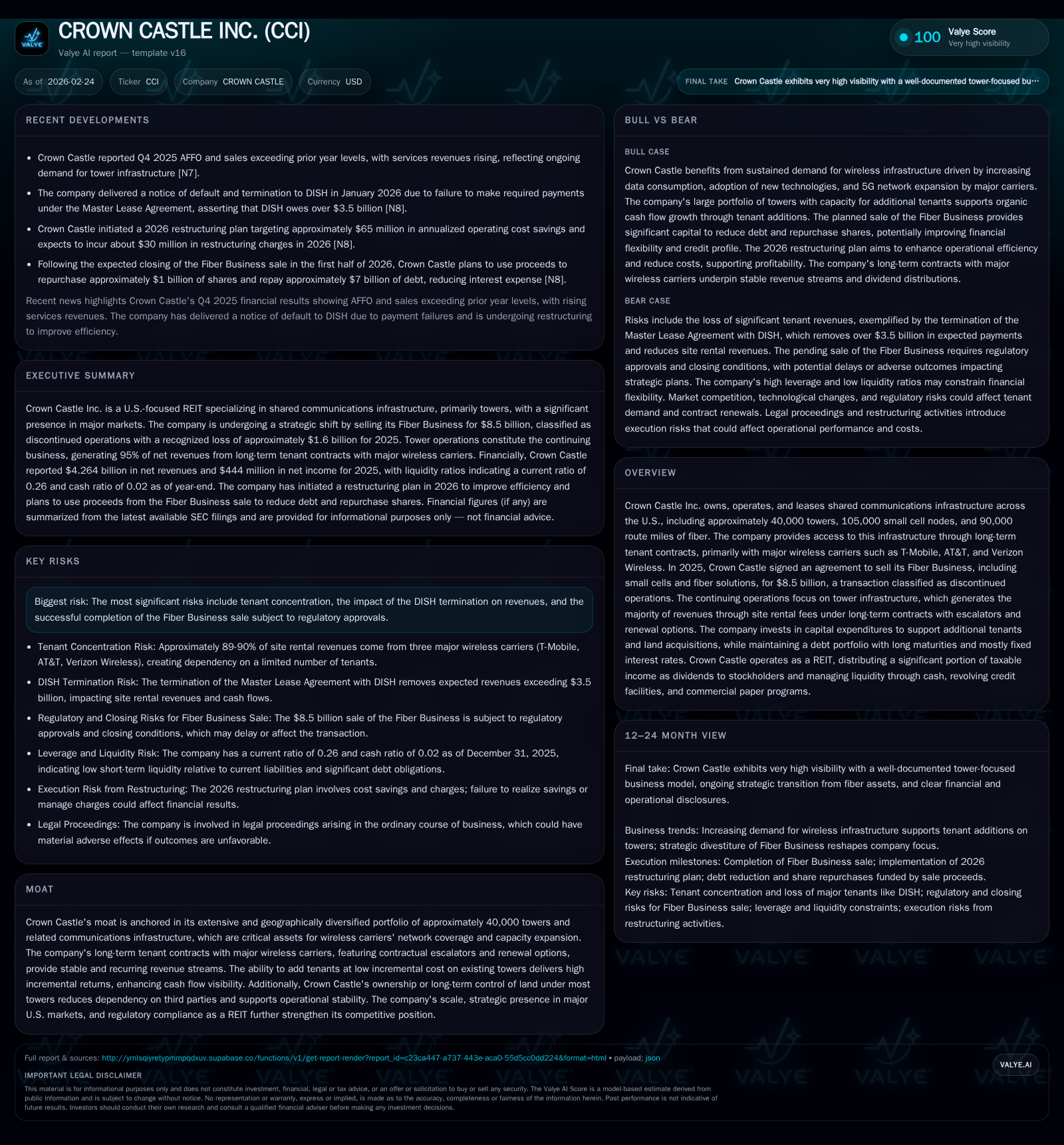
Crown Castle Inc. (CCI) has undergone a strategic transformation with the sale of its Fiber Business in early 2026, representing a significant pivot to focus predominantly on tower infrastructure. The divestiture led to a sharp contraction in consolidated revenues due to fiber operations moving to discontinued status, although operating income rebounded strongly as continuing operations stabilized. The company's future growth hinges on incremental tenant additions to its extensive U.S. tower portfolio and disciplined capital allocation, particularly debt reduction and dividend management. Upcoming milestones include closing of the fiber sale and ensuing redeployment of proceeds toward share repurchases and debt repayment. Key risks remain from tenant concentration and regulatory approval uncertainties.
Overview
Crown Castle Inc. is one of the largest U.S. owners and operators of shared wireless communications infrastructure. As of the end of 2025, it controls approximately 40,000 towers nationwide alongside small cells and fiber assets. The company typically leases space on these assets through long-term contracts with major wireless carriers including T-Mobile, AT&T, and Verizon Wireless.
In March 2025, Crown Castle signed a definitive agreement to sell its Fiber Business—including small cells and fiber solutions—to Zayo Group Holdings and EQT Active Core Infrastructure fund for $8.5 billion in aggregate proceeds. This transaction represents a profound strategic shift as the company narrows its focus exclusively to towers. The Fiber Business results were reclassified as discontinued operations effective in 2025 financial reporting [S1][S2]. Closing is anticipated in the first half of 2026 subject to customary regulatory approvals [S1][S2].
Historical Performance: Revenue and Profit Trends
The impact of categorizing fiber as discontinued operations is immediately visible in Crown Castle’s reported performance metrics. Revenues fell sharply from $6.57 billion in FY2024 to $4.26 billion in FY2025, a decline of roughly 35% driven by the Fiber segment’s exclusion from continuing operations [F1]. Within continuing operations — primarily towers — site rental revenues declined ~5% year-over-year from $4.27 billion to approximately $4 billion reflecting tenant non-renewals largely due to the T-Mobile/Sprint consolidation [S1].
Despite this steep revenue contraction, operating income turned positive by a wide margin, rising from an operating loss of $2.94 billion in FY2024 to operating income exceeding $2.07 billion in FY2025 [F1]. This stark turnaround can be attributed mainly to excluding fiber-related losses and restructuring charges that weighed heavily on prior-year results.
Net income also swung dramatically from a loss exceeding $3.9 billion in FY2024 (partly due to disposal losses) to positive net earnings of $444 million for FY2025 [F1]. Adjusted EBITDA declined modestly (~6%) reflecting streamlined tower operations but improved profitability margins.
Historical performance (annual)
| FY | Rev ($bn) | CFO ($bn) | OpInc ($bn) | Capex ($mm) | Rev YoY |
|---|---|---|---|---|---|
| 2025 | 4.3 | 3.1 | 2.1 | 182 | -35.1% |
| 2024 | 6.6 | 2.9 | -2.9 | 1222 | -5.9% |
| 2023 | 7.0 | 3.1 | 2.4 | 1424 | -0.1% |
| 2022 | 7.0 | 2.9 | 2.4 | 1310 |
Note: Omitted columns lack sufficient annual XBRL coverage in the provided tags (need ≥2 annual points): Net, ROE%. Source: SEC companyfacts cache [F1].
Capital returns and efficiency (annual)
| FY | Div ($bn) | Buybacks ($mm) | FCF ($bn) |
|---|---|---|---|
| 2025 | -2.1 | -23 | 2.9 |
| 2024 | -2.7 | -33 | 1.7 |
| 2023 | 2.7 | 30 | 1.7 |
| 2022 | 2.6 | 65 | 1.6 |
Source: SEC companyfacts cache [F1].
Note: Operating income YoY change skewed by prior-year large impairments/disposals; Capex reflects significant drop due to Fiber exit; Dividends paid are declared distributions; Buybacks relate mainly to tax withholding shares [F1]
Capital Allocation and Cash Flow
Cash flow from operations remained robust despite lower reported revenues, increasing slightly by ~4% to roughly $3 billion in FY2025 [F1]. Free cash flow (operating cash flow minus capex) expanded markedly due to sharply reduced capital spending following Fiber business classification as discontinued.
Capex plunged by over 85% year-over-year from over $1.2 billion down to just $182 million as discretionary investments slowed dramatically post-Strategic Fiber Agreement; sustaining capital expenditures on towers remained steady offsetting some reduction linked to Fiber [S14].
Crown Castle maintained substantial dividend distributions totaling roughly $2.1 billion during FY2025 after reducing dividend per share mid-year aiming at better free cash flow alignment [S18]. Share repurchases were minimal (~$23 million) mostly related to RSU tax-related withholding.
The company signaled intent post-close of Fiber transaction to deploy proceeds predominantly for debt retirement—targeting approximately $7 billion—and approximately $1 billion for share repurchases subject to board discretion [S19][S20]. Maintaining investment-grade credit metrics remains a cornerstone with total net leverage at ~5.9x within covenant limits [S22].
Operational Moat and Market Position
Crown Castle’s competitive advantage centers on its massive scale and deep presence across all major U.S. markets with around 40,000 towers strategically located often on fee-owned or perpetual easement lands that reduce dependency risk on third-party landlords [S16][S24]. Tenant contracts feature long durations with contractual escalators plus renewal options providing stable recurring cash flows largely insulated from volatile market demand fluctuations.
Incremental margins on adding new tenants or equipment upgrades at existing tower sites generally feature very high returns due to low incremental costs leveraging existing fixed assets — a defining characteristic underpinning Crown Castle’s growth model pre-Fiber divestiture.
However, key tenants remain highly concentrated: T-Mobile alone contributes approximately 40% of total revenues followed by AT&T (27%) and Verizon Wireless (22%), collectively driving nearly 90% revenue dependency exposing ongoing concentration risk [S16]. Notably, Crown Castle issued default notices terminating agreements with DISH in early 2026 after payment defaults, adding operational uncertainty related to this tenant [S16][N3].
Industry Context (Analysis)
The broader U.S telecom infrastructure sector benefits from secular growth drivers including increasing mobile data consumption fueled by video streaming, IoT expansion, and emerging technologies like AR/VR expected post-5G deployment waves.
Fiber assets often require more capital intensity but provide growing backhaul capacity critical for small cell networks which are increasingly important in dense metropolitan areas for bandwidth augmentation — an area now exited by Crown Castle raising questions about the completeness of its exposure going forward.
The ability to concurrently manage lease contracts with wireless carriers navigating network consolidations (e.g., T-Mobile-Sprint merger effects) remains crucial as these can lead to tower asset rationalizations affecting tenancy rates.
Future Growth Prospects
Crown Castle explicitly expects growth opportunities tied primarily to:
- Incremental tenants added at existing tower sites leveraging fixed cost bases [N3].
- Strategic acquisitions or buildouts targeting underserved or newly developing urban/rural regions where wireless coverage gaps persist.
- Potential operational efficiency gains following recent restructuring plans announced early 2026 reducing corporate/tower workforce headcount by about 20%, aiming at enhanced margin structures [N3][S3].
However, growth is constrained notably by negative impacts from carrier network consolidations resulting in non-renewals totaling about $204 million in site rental revenue attrition during FY2025 alone [S1]. Furthermore, the pending Fiber sale removes one growth vector associated with deploying integrated small cell/fiber solutions diminishing diversification.
Regulatory approval timing on the Strategic Fiber Transaction closure constitutes a material near-term milestone; delays or adverse conditions could disrupt capital redeployments and operational focus [S1][S2]. Additionally, customer credit risk—illustrated by DISH contractual defaults—could impair revenue visibility if further tenant contractions occur.
Forecasts and Milestones To Watch (Analysis)
Explicit company guidance outlines expectation for Strategic Fiber Transaction closure within H1 2026 alongside planned uses of proceeds focusing on aggressive debt repayment ($7B) and meaningful share buybacks ($1B), conditional upon board approvals [S19][N3]. Monitoring these events will clarify Crown Castle's financial flexibility trajectory.
Site rental revenue trends will also merit close observation as carrier consolidation dynamics evolve post-Sprint merger integration phase potentially dampening renewal volumes further beyond already observed impacts [S1][N3]. New tenant addition velocity remains critical for offsetting natural churn effects.
Capital expenditure patterns may signal whether renewed discretionary investments beyond maintenance level return amid market conditions after completion of the fiber divestiture.
Returns Analysis / Capital Efficiency Metrics
Based on reported figures for FY2025 net income (~$444 million) versus estimated shareholders’ equity dating back several years minus accumulated deficits yields an approximate return on equity near 6-7%, reflecting modest profitability post-restructuring considering REIT status constraints limiting retained earnings accumulation [F1].
Free cash flow generation remained strong supported by operational efficiencies coupled with decreased capex needs; CFO minus capex approximates nearly $2.9 billion illustrating healthy internal liquidity despite transition period stresses [F1][S14].
Dividend payout policy adjusted downward mid-2025 aiming at sustainable coverage ratios aligned with free cash flow focusing on maintaining REIT qualification but cautious with payout levels given earnings volatility [S18][S13]. Share repurchase activity has been minimal recently but poised for increment after asset sale closes.
Risks Summary
Key risk factors include:
- Tenant concentration risk accentuated by three customers accounting for nearly nine-tenths of revenues.
- Ongoing impact from network consolidations leading to contract non-renewals or reduced tenancy levels eroding site rental revenues.
- Regulatory approval uncertainties linked to Strategic Fiber Transaction delaying proceeds deployment or altering deal economics.
- Credit risks emerging from tenants like DISH defaulting potentially causing disputed accounts receivable or legal costs.
- Potential adverse changes in interest rates affecting debt servicing costs given sizeable outstanding indebtedness despite manageable maturity profile.
- Evolving technology landscapes where infrastructure solutions outside traditional towers may gain favor affecting long-term asset utility.
Conclusion
Crown Castle stands at a pivotal juncture transitioning out of fiber-based communications solutions into a leaner pure-play tower operator focused on recurring site rental contracts secured by blue-chip wireless carriers across the U.S. While this repositioning trims away revenue scale markedly amid restructuring costs reflected historically, it restores clearer earnings power reflected in positive operating results through streamlining initiatives.
Future prospects depend critically on execution around network consolidation impacts mitigation through incremental tenancy gain strategies combined with disciplined capital allocation emphasizing deleveraging funded largely via expected proceeds from the imminent fiber business sale closure early this year.
Investors should monitor closure timing for substantial liquidity inflows triggering balance sheet repair plus tactical enhancements such as share repurchases alongside evolving lease renewals within a concentrated tenant base bearing nontrivial credit risk elements thus balancing steady cash flow qualities against operational challenges inherent in telecom infrastructure portfolios.
This report is prepared solely for informational purposes reflecting analysis based on publicly available disclosures including SEC filings and recent news updates as cited herein without any recommendation or investment advice regarding Crown Castle Inc.'s securities.
Disclaimer: This is research-only, informational analysis and not investment advice. It may include AI-generated interpretation and general industry context. Always verify important details using primary sources.

Comments