
Northern Trust's Profit Decline Contrasts With Robust Cash Flow and Capital Returns in 2025
Despite a modest revenue dip and lower net income in 2025, Northern Trust sustained strong operating cash flow and intensified share repurchases.
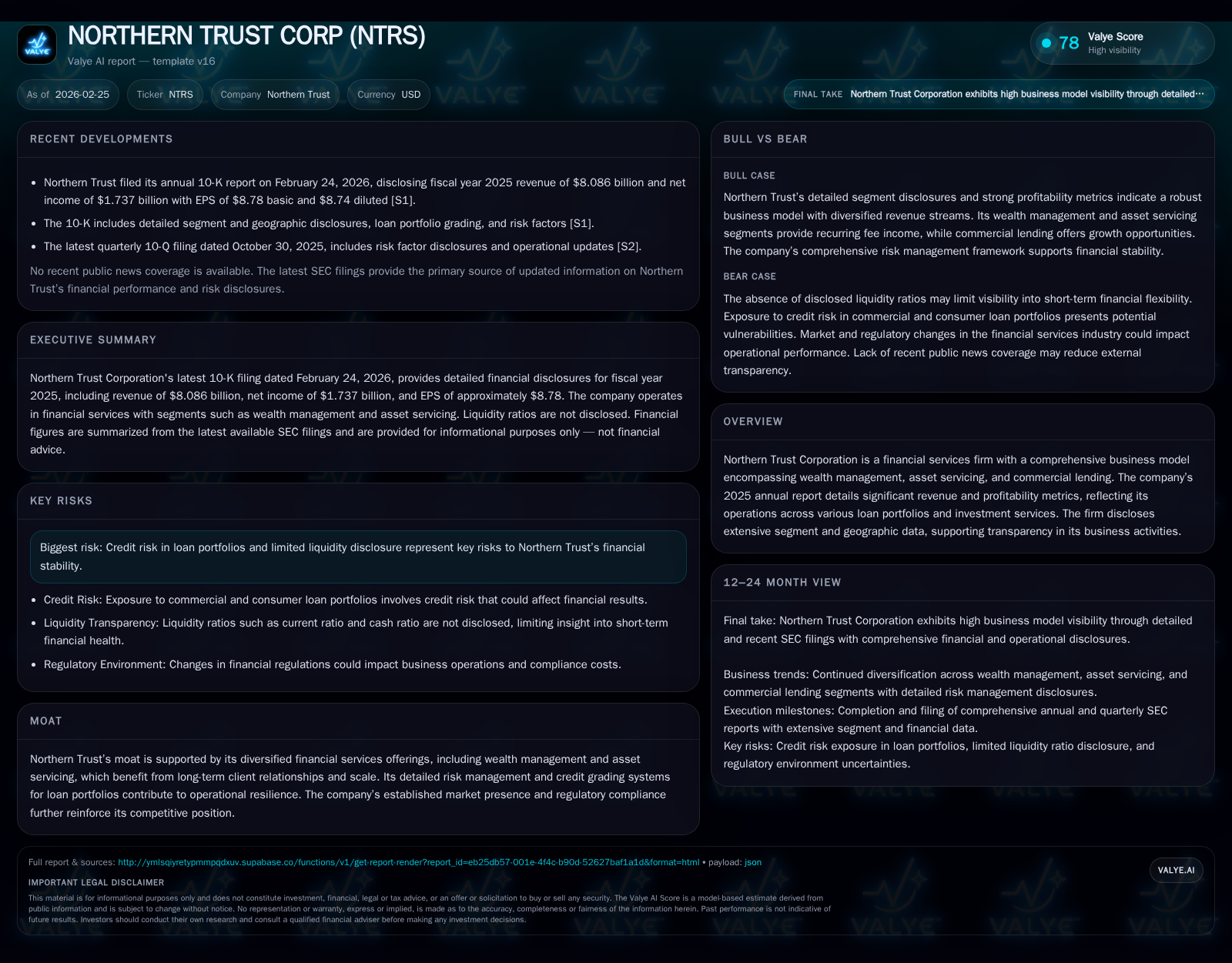
Northern Trust Corporation reported a slight revenue decline of 2.5% in 2025 compared to the prior year, alongside a 14.5% decrease in net income. However, the company demonstrated exceptional operational cash flow growth exceeding 1,200%, driving a substantial free cash flow balance. This robust cash generation supported increased capital return activities through dividends and share buybacks, reflecting disciplined capital allocation. Key risks include credit exposure within loan portfolios and liquidity transparency, while long-standing strengths reside in diversified wealth management, asset servicing, and commercial lending franchises.
Company Overview
Northern Trust Corporation (NTRS) operates as a comprehensive financial services firm with key business lines spanning wealth management, asset servicing, and commercial lending. This diversified model supports cross-selling opportunities and resilience through market cycles by balancing fee-based wealth services with interest-bearing loans [S1].
Northern Trust’s moat stems from its established client relationships across high-net-worth individuals and institutional investors, combined with advanced credit risk management protocols applied to its loan portfolio [S1]. Its longstanding regulatory compliance and strategic scale provide competitive barriers that underpin operational stability.
Historical Performance and Growth Drivers
The company posted revenues of approximately $8.09 billion in fiscal year (FY) 2025, representing a slight contraction of about 2.5% from $8.29 billion in FY2024 [F1]. This marks a pause following consecutive years of double-digit revenue growth from FY2022 through FY2024.
Net income receded to $1.74 billion in FY2025 from $2.03 billion the prior year — a notable 14.5% decline that contrasts the prior upward trajectory [F1]. The profit compression may relate to margin pressures or elevated provisions; exact drivers warrant further segment-level analysis as operating income data is not explicitly tagged [F1].
Despite earnings softness, Northern Trust achieved an extraordinary surge in cash flows from operations (CFO), leaping over twelvefold from -$486 million in FY2024 to $5.53 billion in FY2025 [F1]. This swing suggests significant non-cash adjustments or changes in working capital components possibly tied to portfolio management activities or deferred tax impacts.
Capital expenditures steadily declined by about 27% year-over-year to $74 million, reflecting moderate reinvestment into technology or infrastructure against stable business operations [F1].
This combination produced an estimated free cash flow of approximately $5.46 billion (CFO minus Capex), illustrating substantial internal liquidity generation despite headline earnings softness [F1].
Financial Summary Table
Historical performance (annual)
| FY | Rev ($bn) | Net ($bn) | CFO ($bn) | Capex ($mm) | Rev YoY | Net YoY |
|---|---|---|---|---|---|---|
| 2025 | 8.1 | 1.7 | 5.5 | 74 | -2.5% | -14.5% |
| 2024 | 8.3 | 2.0 | -0.5 | 102 | +22.4% | +83.4% |
| 2023 | 6.8 | 1.1 | 2.6 | 117 | +0.2% | -17.1% |
| 2022 | 6.8 | 1.3 | 2.4 | 129 |
Note: Omitted columns lack sufficient annual XBRL coverage in the provided tags (need ≥2 annual points): OpInc. Source: SEC companyfacts cache [F1].
Capital returns and efficiency (annual)
| FY | Div ($mm) | Buybacks ($mm) | FCF ($bn) |
|---|---|---|---|
| 2025 | 592 | 1274 | 5.5 |
| 2024 | 602 | 938 | -0.6 |
| 2023 | 622 | 348 | 2.5 |
| 2022 | 750 | 35 | 2.3 |
Source: SEC companyfacts cache [F1].
Note: Operating income is not available in provided tags.
Future Growth Prospects
Northern Trust’s ability to grow revenues beyond current levels depends heavily on expanding mandates within wealth management clients and broadening asset servicing relationships with institutional investors [S1][N4]. Strategic investments in digital platforms targeting advisor support could enhance client retention and attract new flows [N4].
Commercial lending growth might be capped by the company’s conservative credit stance amid evolving macroeconomic uncertainty and sector concentration risks noted in its loan portfolios [S1]. The firm’s detailed credit grading systems support disciplined underwriting but limit aggressive portfolio expansion.
Regulatory dynamics around liquidity reporting also present operational complexities that Northern Trust must navigate prudently without sacrificing transparency or capital efficiency [S1].
Overall, organic growth driven by scale economies in fee services combined with steady loan portfolio performance offers moderate upside potential, though external demand shocks or credit events could impose constraints.
Capital Allocation and Return Metrics
Northern Trust’s capital deployment reflects a balanced approach prioritizing shareholder returns while preserving regulatory capital buffers:
- Common dividends paid amounted to $592 million in FY2025, slightly below $602 million paid the year prior indicating stable payout policy [F1].
- Share repurchases accelerated materially to $1.27 billion from $938 million in FY2024, underscoring emphasis on buybacks amid strong cash generation [F1].
- Tangible equity rose to nearly $13 billion by end-2025 from $12.79 billion prior year-end supporting capacity for capital return programs [F1].
Derived approximate return on equity for FY2025 is circa 13.4% based on latest net income over shareholders’ equity — revealing a profitable yet measured ROE consistent with well-regulated financial institutions focused on risk-adjusted returns rather than leverage-driven amplification [F1].
Industry Context Analysis
The wealth management and asset servicing industry continues evolving with client demands for integrated digital offerings and cost efficiencies placing pressure on legacy operating models; Northern Trust’s moderate tech capex suggests prudent modernization efforts balancing innovation with expense control.
Loan portfolios face persistent credit risks influenced by real estate segment cyclicality and corporate sector volatility requiring vigilant provisioning practices; Northern Trust’s granular credit rating approach aids early problem identification but also tempers loan growth appetite.
Liquidity transparency is increasingly critical amid stricter regulatory scrutiny post-financial crisis; firms lacking detailed disclosures risk market skepticism which Northern Trust appears addressing cautiously but incompletely.
Monitoring Points Ahead (Analysis)
- Watch updates on asset servicing contract wins or expansions that could drive recurring fee inflows.
- Track changes in loan portfolio composition and allowance for credit losses as macroeconomic conditions evolve.
- Monitor regulatory developments affecting liquidity metrics disclosure impacting investor confidence.
- Observe future quarterly operating income disclosures for margin insights absent from annual filings.
- Assess capital return trajectory for sustainability amidst possible economic headwinds.
Conclusion
Northern Trust’s solid operating cash flow performance cushions the impact of recent profitability softness highlighted by its diversified yet cautious business model emphasizing wealth management scale alongside disciplined commercial lending practices. While near-term revenue pressure and credit risks pose headwinds, strong internal liquidity generation facilitated enhanced capital returns through elevated buybacks complementing stable dividend payments.
Industry trends toward digitization and regulatory pressure require nimble adaptation but Northern Trust’s entrenched market position provides buffer against disruption risks.
Disclaimer: This analysis is informational only and does not constitute investment advice or recommendations.
Disclaimer: This is research-only, informational analysis and not investment advice. It may include AI-generated interpretation and general industry context. Always verify important details using primary sources.

Comments