
AMC Entertainment's Renewal: Premium Formats and Market Reach Under Financial Duress
AMC drives revenue growth through premium offerings and expansive geography despite cash flow pressures and ongoing losses.
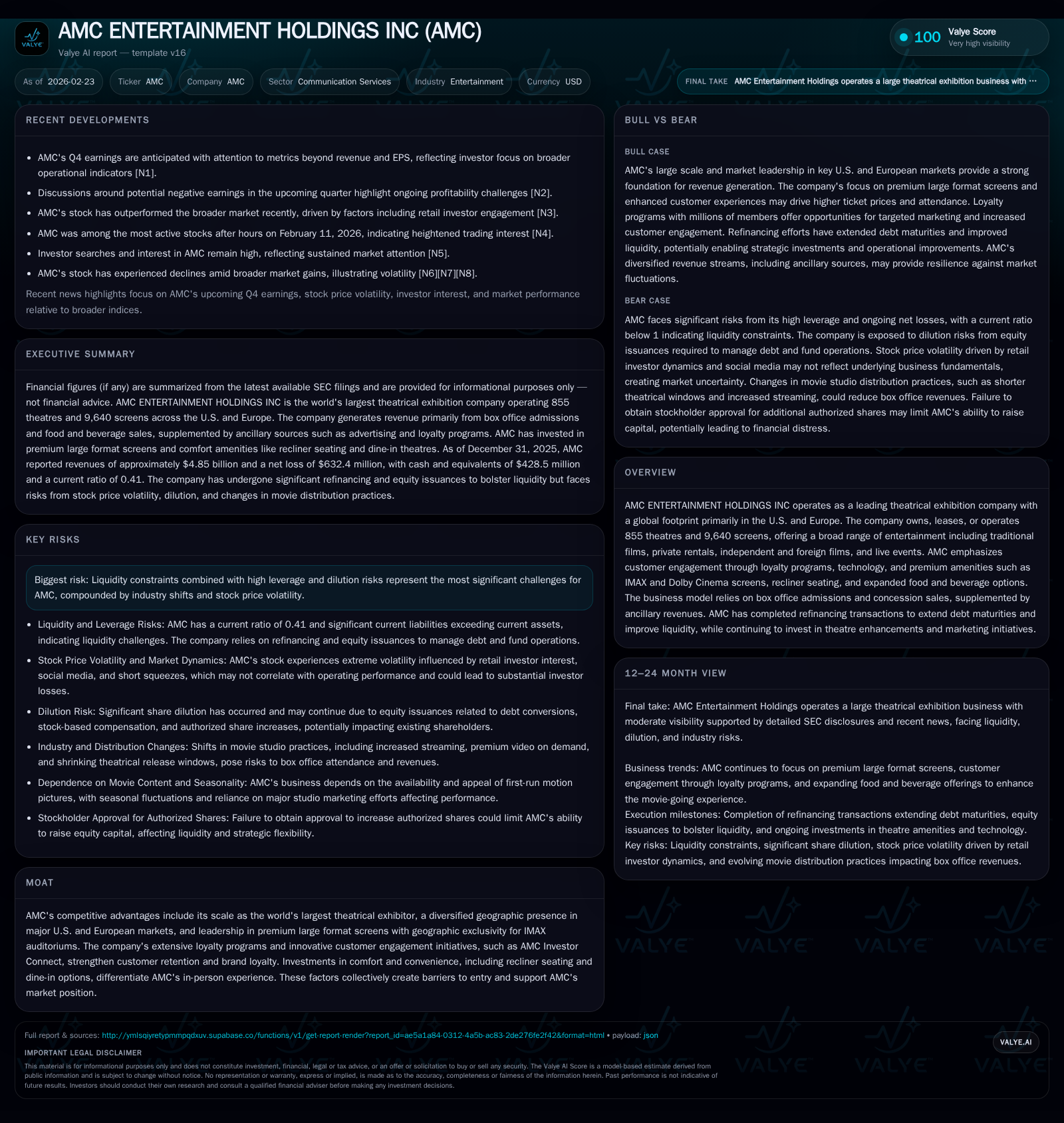
AMC Entertainment Holdings Inc. reported steady revenue gains from 2022 to 2025, fueled by recovery in box office attendance and enhanced concession sales, yet continues to face operating losses amid high capital expenditures and substantial debt loads. The company leverages its scale in the U.S. and European markets, augmenting guest engagement through technology-enabled loyalty programs and premium large format screens that deliver differentiated experiences. While AMC has made strategic refinancing moves to extend debt maturities into 2029, liquidity remains constrained with a current ratio of 0.41, highlighting ongoing financial risks. Looking ahead, growth depends on expanding premium formats, selective geographic footprint adjustments, and navigating competitive pressures from streaming platforms, all set against the backdrop of significant leverage and dilution risk.
Reversing the Trend: AMC’s Historical Financial Performance and Underlying Drivers
From the FY2022 trough during ongoing pandemic impacts, AMC Entertainment has demonstrated a noteworthy rebound in top-line revenue supported primarily by the recovery in box office demand paired with expanded concessions revenues. Revenues increased sharply by nearly 23% between FY2022 ($3.91B) and FY2023 ($4.81B), signaling normalization of movie-going activities [F1]. However, revenue growth showed signs of moderation by FY2025 with a more modest increase of around 4.6%, reaching approximately $4.85 billion [F1]. Despite these topline gains, AMC continued to report operating losses each year but notably improved its operating income trajectory from -$522 million in FY2022 to a narrow -$17 million loss in FY2025—a roughly 78% reduction in operating loss magnitude [F1]. This operational improvement reflects margin expansion initiatives but falls short of positive profitability.
Net income trends paint a cautionary picture; despite narrowing compared to the severe losses in earlier years (-$973 million in FY2022), AMC posted a sizeable net loss of -$632 million in FY2025 [F1]. This bottom-line deterioration reflects significant non-operating expenses including interest burden tied to high leverage levels. The narrowing yet persistent losses demonstrate that while operational efficiencies are materializing, financial cost structures weigh heavily on overall earnings.
Historical performance (annual)
| FY | Rev ($bn) | Net ($mm) | CFO ($mm) | OpInc ($mm) | Rev YoY | Net YoY |
|---|---|---|---|---|---|---|
| 2025 | 4.8 | -632 | -120 | -17 | +4.6% | -79.4% |
| 2024 | 4.6 | -353 | -51 | -79 | -3.6% | +11.1% |
| 2023 | 4.8 | -397 | -215 | -74 | +23.0% | +59.3% |
| 2022 | 3.9 | -974 | -33 | -522 |
Note: Omitted columns lack sufficient annual XBRL coverage in the provided tags (need ≥2 annual points): Capex, Buybacks. Source: SEC companyfacts cache [F1].
Capital returns and efficiency (annual)
| FY | Div ($) | FCF ($mm) | ROE% |
|---|---|---|---|
| 2025 | -366 | 33.4 | |
| 2024 | 700000 | -296 | 20.0 |
| 2023 | 700000 | -441 | 21.5 |
| 2022 | 700000 | -106 | 37.1 |
Source: SEC companyfacts cache [F1].
Note: Some YoY figures may be volatile due to base effects; dividend payments omitted due to limited data.
Harnessing Scale and Innovation: AMC’s Customer Engagement and Premium Amenities
At the core of AMC's strategy lies a concerted focus on customer experience enhancement anchored by technological innovation and premium amenities designed for differentiation amid intensifying entertainment options competing for consumer attention [S4][S7]. The four-tiered AMC Stubs loyalty program ecosystem—including A-List monthly subscription allowing frequent movie attendance—has cultivated approximately 39 million member households by end-2025 [S19]. This base accounted for about half the U.S market attendance during the period—demonstrating robust recurring engagement driven by subscription-based access coupled with rewards incentives.
Complementing loyalty initiatives is AMC Investor Connect (AIC), launched in mid-2021 as an innovative linkage between shareholder base (~1.8 million members globally) and cinema patronage [S7]. By capturing personalized data through mandatory registration tied to AIC participation among domestic investors who must also enroll in Stubs accounts, AMC deepens targeting precision for promotions enhancing visit frequency.
Further elevating the customer experience is AMC's heavy weighting toward premium large format (PLF) screens—an industry-critical lever for bolstering average guest spend per visit [S18]. With nearly twice the number of IMAX auditoriums held relative to the nearest competitor (96% higher per screen count) alongside exclusive geographic rights protecting local market dominance over PLF offerings as of December 31st, 2025 [S18], AMC strengthens both pricing power and brand positioning among cinephiles seeking superior audiovisual immersion.
Additional experiential upgrades include widespread adoption of electric recliner seating enhancing comfort across numerous locations plus broad rollout of expanded food & beverage menus featuring made-to-order meals alongside alcoholic beverage availability under MacGuffins lounges [S18]. These investments aim not only at top-line ticket revenue but also at lucrative ancillary concession sales which historically yield higher margins.
Geographic Footprint as Competitive Moat: U.S. and European Market Presence
AMC’s footprint spans two major reporting segments encompassing substantial theatre presence across U.S markets—with operations covering 41 states plus DC—and a complementary international circuit dominated by key European economies including the UK (103 theatres), Italy (34), Spain (35), Germany (21), Scandinavia via Nordic Cinema Group holdings (notably Sweden at 72 theatres), Ireland (11), Norway (12), Portugal (3), Denmark (2), Finland (29) [S9]. Total theatres stood at an aggregate of approximately 855 with nearly ten thousand screens as of December end-2025 [S23].
This breadth translates into meaningful strategic advantages: nearly half of the U.S population resides within a ten-mile radius of an AMC theatre supporting consistent foot traffic potential [S5]. In addition to volume scale benefits evidenced by #1 market share ownership positions in top metropolitan hubs including New York City (30 theatres), Los Angeles (57 theatres), Chicago (operator leading multiple sites), Atlanta and Washington DC—the top five US markets each command leadership status reinforcing entrenched local dominance [S5].
On the international side as well AMC holds leadership or near leadership status across major European nations with significant market shares in Sweden (#1 operator), Norway (#1), Finland (#1) alongside strong footholds in UK & Ireland highlighting high-revenue density urban catchments given population concentrations [S23]. This diversified global exposure insulates revenue streams somewhat against localized economic or regulatory variability while also facilitating cross-border synergies particularly on premium content distribution agreements.
Financial Tightrope: Debt Refinancing, Capital Structure, and Liquidity Status
Despite operational advances AMC's financial position remains notably burdened by high leverage reflecting legacy capital structures augmented through recent recapitalization efforts designed primarily to extend maturities rather than reduce absolute indebtedness levels [S6][S10].
Capital market activity throughout mid-2024 into mid-2025 saw multiple refinancing transactions whereby senior secured term loans originally slated for maturity as soon as early-to-mid-2026 were successfully rolled forward through exchanges into new facilities due as late as July 2029 [S2][S10]. Concurrently sizable early repurchases (~$414 million) of second lien notes were effected alongside issuance of exchangeable notes embedded with common stock conversion features introducing dilution considerations [S10][S12].
This constellation alters interest expense profiles somewhat; for instance new exchangeable notes pay relatively low initial coupon rates (~1.5%) but carry equity conversion exposure representing downside risk to existing shareholders through share count inflation [S12]. Since January 1st^,^2020 outstanding shares have proliferated by over five hundred million leveraging ATM sales plus conversion exercises related to convertible preferred stock settlements evidencing dilution evolution [S2].
The current ratio standing at just approximately 0.41 as of December end-2025 highlights substantial short-term liquidity pressure given current liabilities exceeding $1.7 billion versus roughly $730 million in current assets inclusive of cash balances slightly below $430 million—underscoring a narrow liquidity cushion considering looming debt service obligations [F1].[S6][S15]
Given this landscape any funding shortfall or adverse macroeconomic developments could necessitate further dilutive financings or asset dispositions constraining financial flexibility even as management pursues opportunistic debt buybacks or equity-debt swap transactions aimed at optimizing cost structure amid volatile credit markets.
Navigating Operating Losses and Cash Flow Deficits: Financial Metrics in Focus
AMC's pursuit of growth through reinvestment into theatres yields heavy capital expenditure demands sustained above $240 million annually since FY24 while simultaneously confronting persistent operating deficits complicating free cash flow generation prospects [F1].[S7]
Operating cash flows declined from annual negative $33 million in FY22 worsening dramatically into loss territory exceeding $215 million cash burn during FY23 before partial retrenchment down to negative approximately $120 million by December year-end FY25 indicating constrained core business cash generation even as revenues topped near $4.85 billion domain last fiscal year [F1].
Subtracting capex outlays reveals alarmingly negative free cash flow nearing minus $366 million last year underscoring financing dependencies required for sustaining capital maintenance plus strategic theatre enhancements emphasizing recliners and PLF upgrades whose payback horizons tend longer term [F1].[S18]
ROE analysis remains unfavorable given consistent net losses coupled with a negative shareholder equity base approximating negative $1.89 billion thus inferred returns hover near negative one-third percentages—a metric reflective more of capital structure distress than operational efficacy alone at this stage [F1].
Paths Forward: Strategic Growth Prospects and Industry Challenges
AMC outlines several levers for forward expansion centered on enhancing guest experiential value propositions including accelerating PLF deployment via expanded partnerships with IMAX®—where it maintains dominant US presence—and Dolby Cinema™ while fostering complementary adjacent opportunities such as private rentals plus increased integration of streaming service content like Netflix series finales debuted theatrically exemplified by 'Stranger Things' collaboration during FY25 [N3][S4][S18].
Selective market footprint refinement continues with strategic closure or repositioning of underperforming locations balanced against opportunities within attractive geographies targeting urban catchments exhibiting demographic viability supportive of premium pricing tolerance accompanied by marketing innovation emphasizing digital tools like mobile food ordering apps aligned with loyalty offers to deepen customer intimacy [S4][N1][N3].
However persistent challenges remain formidable—the rising prominence of streaming platforms cannibalizing traditional theatrical demand coupled with labor disruptions influencing content supply schedules creating uncertainty about release timing plus heightened investor scrutiny over liquidity adequacy amid heavy leverage restrain execution dynamics going forward [S27][N1][N2][N5].
Investor Expectations and Forecasting Key Milestones for AMC
Investor sentiment towards AMC blends cautious optimism rooted in visible revenue recovery juxtaposed with pervasive concerns surrounding sustained negative earnings visibility driven largely by high interest costs plus dilution potential stemming from newly minted exchangeable securities issued recently or potentially forthcoming amidst ongoing capital needs [N1][N2][N3].[N5]
Upcoming earnings releases represent pivotal junctures where signs of incremental margin expansion or evidence regarding cost containment will command disproportionate attention from retail investors galvanized around community-driven initiatives like AMC Investor Connect balancing skepticism about long-term viability given competitive terrain shifts.[N1]
There is currently no explicit company guidance publicly available projecting turnaround timelines; hence monitoring indicators include volume trends per PLF locations particularly IMAX performance metrics along with refinancing transaction outcomes expected intermittently over calendar year horizons will be instructive proxies assessing trajectory beyond headline revenue figures alone.[N3]
Capital Allocation Decisions: Dividends, Buybacks, and Return Profiles
Reflective of constrained free cash flow profiles combined with deleveraging imperatives AMC has suspended repurchase activities since early pandemic-era disruptions with no substantive buybacks observed post-FY2019 indicating prudent capital preservation policy geared towards liability servicing rather than shareholder returns [F1].[N14]
Dividend payments have been nominal historically lately capped roughly at $700K annually through recent years underscoring absence of distributable excess funds favoring sustainability priorities amid volatile business conditions.[F1]
Aggregate return on equity calculations reveal deeply negative returns approximating minus one third percent indicative more broadly of highly elevated financial leverage masking nascent operational improvements illustrating ongoing challenges reconciling growth investment imperatives alongside deleveraging goals without constructive free cash flow restoration.
This analysis is based on publicly available information including SEC filings and industry news sources up to February 23rd^,^2026 without incorporating confidential or non-public data pertaining to AMC Entertainment Holdings Inc.'s plans or performance drivers beyond cited disclosures.[F1][N#][S#] It does not constitute investment advice or recommendations but aims solely at presenting a grounded overview reflecting key operational metrics paired with contextual industry factors relevant for stakeholders evaluating company fundamentals under evolving market conditions.
Disclaimer: This is research-only, informational analysis and not investment advice. It may include AI-generated interpretation and general industry context. Always verify important details using primary sources.

Comments