
WEC Energy Group- Capitalizing on Midwestern Demand Surge and Renewable Expansion
WEC Energy Group leverages robust utility infrastructure investments and regulatory strategies to support strong growth from data center demand and renewable energy expansion in the Midwest.
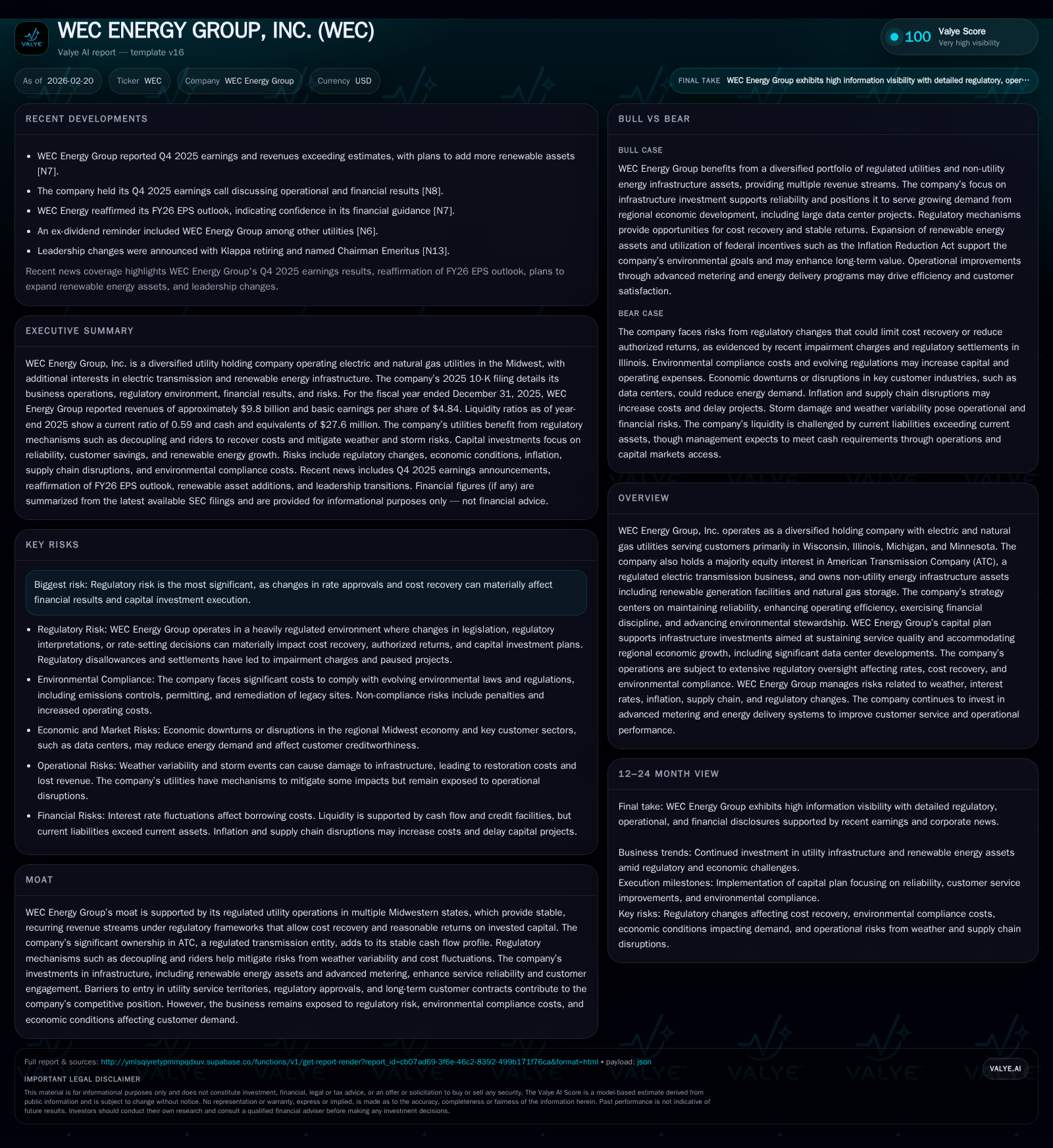
WEC Energy Group has delivered steady growth anchored by its regulated utilities and transmission holdings, posting 14% revenue growth in 2025 and maintaining solid operating income gains. The company’s $18 billion capital plan through 2030 targets significant investments in natural gas-fired generation alongside a large-scale buildout of solar, wind, and battery storage assets to meet rising regional demand, including megaprojects like Microsoft’s $20B Wisconsin data center expansion. Regulatory mechanisms such as decoupling and rider tariffs help stabilize cash flows amid weather variability and cost pressures. Looking ahead, WEC’s transition path emphasizes emission reductions with coal retirements planned by 2032 while managing capital discipline, resulting in positive free cash flow and a dividend growth track record.
Strong Historical Growth Underpinned by Regulated Utilities
WEC Energy Group has demonstrated consistent financial performance over recent years rooted in its diversified regulated utility operations across Wisconsin, Illinois, Michigan, and Minnesota alongside its majority stake in American Transmission Company (ATC). Revenues surged by approximately 14% year-over-year in fiscal year (FY) 2025 to about $9.8 billion from $8.6 billion the prior year [F1]. This acceleration reflects favorable regulatory outcomes including rate case approvals especially in Wisconsin beginning January 2025 that bolstered electric revenues notably.
Operating income also improved steadily by around 4.3% to $2.24 billion in FY2025 despite inflationary headwinds affecting operating costs. This indicates growing operational leverage and solid cost management embedded within the core utility businesses which rely on cost recovery frameworks designed to balance affordability with fair returns for shareholders under regulation [F1][S7].
The company’s net income is recorded at roughly $640 million historically referenced (circa FY2015), with limited recent disclosures precluding full current YoY trends; however management’s commentary along with stable equity base levels imply an approximate return on equity near 6.7% typical for regulated Midwestern utilities reliant on steady rate base earnings rather than high margin expansions [F1]. Cash flows from operations have scaled consistently alongside revenue growth expanding roughly 5% annually culminating in over $3.37 billion in operating cash flow in FY2025.
Historical performance (annual)
| FY | Rev ($bn) | CFO ($bn) | OpInc ($bn) | Rev YoY |
|---|---|---|---|---|
| 2025 | 9.8 | 3.4 | 2.2 | +14.0% |
| 2024 | 8.6 | 3.2 | 2.2 | -3.3% |
| 2023 | 8.9 | 3.0 | 1.9 | -7.3% |
| 2022 | 9.6 | 2.1 | 1.9 |
Note: Omitted columns lack sufficient annual XBRL coverage in the provided tags (need ≥2 annual points): Net, Capex, FCF, ROE%. Source: SEC companyfacts cache [F1].
Capital returns and efficiency (annual)
| FY | Div ($mm) | Buybacks ($mm) |
|---|---|---|
| 2025 | 1148 | 1 |
| 2024 | 1056 | 3 |
| 2023 | 984 | 17 |
| 2022 | 918 | 69 |
Source: SEC companyfacts cache [F1].
Note: Net Income details beyond FY2015 are limited; Capex annual values not fully disclosed for all years; hence omitted from table for clarity.
Regional Demand Catalysts: The Impact of Data Center Megaprojects
A key driver supporting WEC's strategic capital deployment is the pronounced load growth stemming from major data center deployments within its service territories—most notably Microsoft's announced investment exceeding $20 billion targeting southern Wisconsin data centers projected to generate up to approximately 2.6 GW of incremental electric load through the Milwaukee-to-Chicago corridor by decade-end [S1].
Furthermore, Vantage Data Centers is developing a substantial campus near Port Washington expected to contribute about an additional incremental demand upwards of potentially ~3.5 GW over time encompassing initial projections around a total of roughly ~1.3 GW plus extensions [S1]. These load expansions create what can be described as "load growth corridors" necessitating significant capacity augmentation planning.
This surge imposes a need for flexible capacity additions combined with robust grid enhancements—particularly concerning peak load management—to ensure reliability for not only these demanding customers but also the general consumer base across interconnected service regions . WEC's tariff innovation via VLC (Very Large Customer) and Bespoke Resource mechanisms aims to address these unique customer requirements while preserving equitable cost allocation across the customer base.
Capital Plan Spotlight: Renewables, Natural Gas, and Grid Enhancements
To accommodate both anticipated load growth and sustainability goals, WEC has outlined an ambitious ~$18 billion investment blueprint covering the period from fiscal years 2026 through 2030 focused heavily on expanding clean energy infrastructure alongside necessary fossil-fueled generation upgrades [S1][S8][S14].
Natural gas-fired generation represents a cornerstone element featuring approximately:
- Construction of about 3,300 MW combustion turbines (CTs), assisting with peak capacity needs;
- Installation of roughly 180 MW reciprocating internal combustion engine (RICE) natural gas units optimizing for operational flexibility;
- Development of a new natural gas lateral pipeline targeting fuel delivery improvements at the Oak Creek Power Plant (OCPP) site enabling efficient operation of new CTs.
Simultaneously, WEC plans unprecedented renewables deployment including:
- Approximately 3,850 MW utility-scale solar generation,
- Around 2,130 MW charge-capable battery storage installations enabling grid stability,
- And about 555 MW of wind farm capacity complementing intermittent renewable profiles.
These diverse investments reflect a layered approach balancing dispatchable fossil-fueled resources with zero-carbon assets aimed at reducing overall lifecycle emissions while firming renewable output—a critical requirement under Midcontinent ISO (MISO) market conditions increasingly valuing resource adequacy metrics .[S14]
Additionally, significant funding ($7.1 billion natural gas distribution plus $4.7 billion electric distribution from ’26–’30) is earmarked toward system reliability improvements including storm hardening measures essential given Midwestern climate variability risks demonstrated by elevated outage restoration costs during extreme weather events [S8].
Environmental Objectives Driving Asset Retirements and Fuel Transitions
Pivotal within WEC’s strategic narrative is its commitment to environmental stewardship targeted toward achieving net carbon-neutral electricity generation by no later than 2050 via a structured retirement timeline for coal-fired assets supported by interim technologies like co-firing natural gas blending at existing coal units—including major plants such as ERGS (Elm Road Generating Station) units—and Weston Unit Four [S1].
Since early retirements commencing around CY2018 through May CY2024 covering nearly 2,500 MW retired fossil generation capacity (notable closings: Pleasant Prairie, Pulliam plants), the plan foresees an additional ~900 MW coal capacity retirements slated through approximately CY2031 involving OCPP Units Seven/Eight plus Weston Unit Three closure schedules integrated within overall fleet modernization endeavors.
Moreover, ongoing evaluation into conversion opportunities for Columbia units one and two towards natural gas utilization highlights technology transition flexibility following impending environmental regulation changes overseen via EPA Clean Air Act mandates offering compliance pathways coordinated with capital investments aimed at long-term sustainability goals [S1].
Methane emission reductions form another key facet through strategic operational upgrades to minimize fugitive emissions along natural gas supply chains including owned underground storage facilities such as Bluewater assets located in Michigan supporting fuel supply stability.
Regulatory Context: Rate Making, Rider Mechanisms, and Risk Factors
WEC operates within complex multi-jurisdictional regulatory frameworks controlling rate setting predominantly via state public service commissions coupled with federal oversight over transmission holdings like ATC governed under FERC rules creating a measured but predictable path for cost recovery and allowed returns on invested capital [S11][S12].
Decoupling mechanisms employed particularly in Illinois natural gas subsidiaries mitigate margin variability caused by weather fluctuations—where colder/heating season temperature deviations affect usage volumes—and riders allow timely adjustments for prudently incurred costs preventing prolonged recovery lags typical in traditional ratemaking structures.
Noteworthy risks involve heightened regulatory scrutiny leading occasionally to disallowed capital costs such as ICC rulings on PGL's QIP reconciliation causing impairment charges that also influenced pacing or deferral of capital programs indicating sensitivity to regulatory interpretations affecting financial results materially if unfavorable outcomes arise unexpectedly despite best practices in prudence demonstrations [S11][S12][S26].
Tariff innovation targeting VLCs (Very Large Customers) includes bespoke resource provisions that strive to restructure cost allocations equitably amid increasing concentration risk associated with massive data center loads potentially distorting traditional rate bases if unmanaged properly.
Financial Discipline: Capital Allocation, Liquidity, and Return Metrics
Capital allocation practices are attuned toward supporting expansive investments without sacrificing balance sheet strength evidenced by access to commercial paper markets backed by revolving credit facilities ensuring short-term liquidity coverage even given periods where current liabilities outstrip current assets slightly (current ratio approx. .59 at year-end FY2025) but offset by stable cash equivalents and strong ongoing operating cash flows totaling more than $3.3 billion annually recently maintained despite aggressive capex cycles [F1][S4][S5][S6].
Debt composition includes junior notes treated partially as equity according to rating agency conventions enhancing perceived capitalization quality supporting A-level credit ratings amidst sector comparators enhancing funding flexibility.
Dividend policy displays consistent increments coupled with judicious share repurchase activity—amounts repurchased are nominal compared to dividend outlays reflecting prioritization of dividends aligned with regulated utility sector norms emphasizing stable yield generation over aggressive buybacks given heavy infrastructural investment demands pairing well with yield-sensitive investor appetites [F1].
Fiscal 2025 Performance and Year-on-Year Trends in Key Metrics
The following summarization captures key financial performance indicators evidencing company momentum:
| FY | Revenue ($bn) | Rev YoY % | Oper Inc ($bn) | Oper Inc YoY % | Net Income ($bn)* | CFO ($bn) | CFO YoY % |
|---|---|---|---|---|---|---|---|
| 2025* | 9.80 | 14% | 2.24 | 4.3% | - | 3.38 | 5.2% |
| 2024* | 8.60 | -3% | 2.15 | 13% | - | 3.21 | - |
| 2023* | 8.89 | -7% | 1.91 | -0.9% | - | 3.02 | - |
| 2022* | 9.60 | - | 1.92 | - | - | 2.06 | - |
| *Net Income figures limited due to lack of recent data points beyond FY2015; CFO reported based on GAAP net cash provided by operating activities; Capex not shown here due to incomplete series availability. |
Navigating Future Milestones: What Investors Should Monitor
Management provided reaffirmations of forward guidance including earnings per share outlook for FY26 pointing towards steady profitability underpinning execution confidence despite challenges inherent from external factors such as supply chain disruptions or regulatory uncertainties documented during Q4 earnings updates and investor calls earlier this year [N6][N7][N8][N14].
Watching closely will be:
- Regulatory progress on VLC tariff adoption reflecting how very large commercial customer loads are integrated into rate design structures impacting revenue quality;
- Timing milestones related to commissioning new CT units alongside phased operationalization of extensive solar arrays and battery storage installations influencing generation mix transitions;
- Further refinements or expansions within co-firing capabilities or coal unit conversions affecting emissions performance metrics aligned with long-term decarbonization trajectories;
- Monitoring commodity price volatility effects on fuel procurement strategies hedged partially via derivative instruments securing margin protections under highly regulated approved programs.
Overall market watchers should evaluate WEC’s ability to maintain capital program pacing vis-à-vis regulatory approvals while managing operational resilience amidst evolving demand dynamics largely shaped around emerging technology adopters requiring ultra-high reliability power supplies.
This analysis synthesizes publicly available SEC filings up to February 20, 2026 ([F1],[S#]) alongside recent earnings call disclosures ([N#]) without offering investment advice or recommendations.
Disclaimer: This is research-only, informational analysis and not investment advice. It may include AI-generated interpretation and general industry context. Always verify important details using primary sources.

Comments