
Zicix Corp’s Diversified Project Ambitions Confront Capital and Regulatory Headwinds
Zicix Corp blends international infrastructure projects with tech innovation while managing liquidity challenges and regulatory threats.
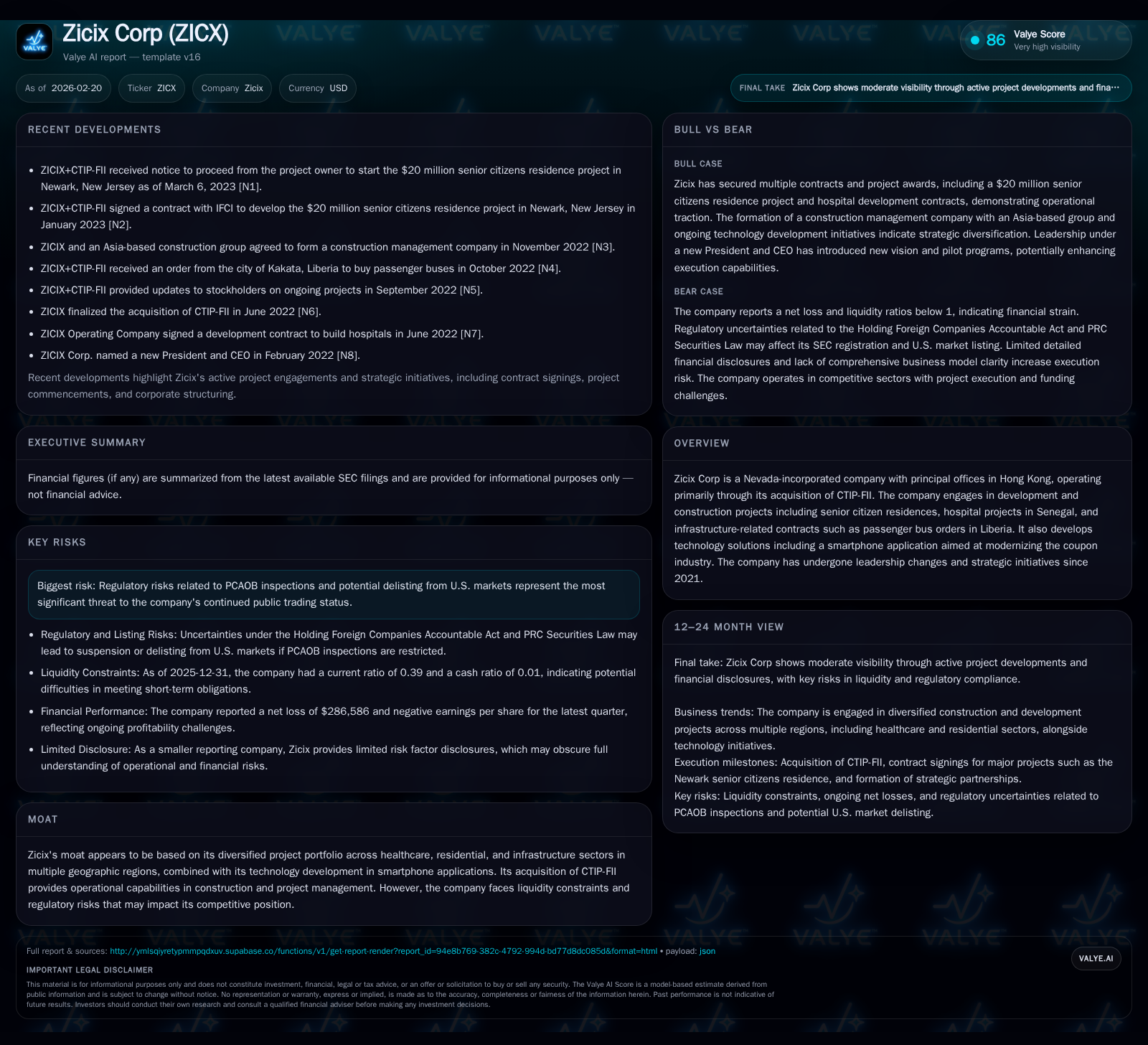
Zicix Corp operates a unique business model combining construction and development projects in African markets with technology solutions centered on coupon industry modernization. While revenues have shown modest growth, the company remains unprofitable with persistent negative operating income and net losses. Liquidity metrics highlight tight short-term solvency, underscored by a current ratio of 0.39 and negative operating cash flow. Regulatory uncertainty—stemming from U.S. audit oversight restrictions tied to foreign jurisdiction cooperation under the Holding Foreign Companies Accountable Act and China’s Article 177—poses a material risk of potential delisting. Leadership changes since 2021 indicate evolving strategic priorities but have yet to translate into stabilized performance or clearer forward guidance.
A Unique Business Mix: Infrastructure Meets Technology
Zicix Corp is an atypical public company whose footprint straddles traditional project development in emerging African markets alongside technology-driven innovation targeting retail coupon modernization. Originating from its acquisition of CTIP-FII, the company operates construction and development projects including senior citizen residential facilities and hospital developments in Senegal alongside transport infrastructure such as passenger bus orders in Liberia . This geographic diversification exposes Zicix to both high-growth potential urban infrastructure needs as well as corresponding operational complexities inherent to frontier markets.
On the technology front, Zicix has ventured into digital solutions by developing a smartphone app focused on revitalizing the coupon industry — a segment ripe for disruption given consumer preference for seamless mobile integration coupled with merchant digital engagement tools. The juxtaposition of capital-intensive physical assets development with scalable software products is unusual. However, these endeavors may also strain management bandwidth given the differing product lifecycle dynamics: construction projects typically follow long capital deployment timelines subject to government approvals and local regulations, whereas mobile app rollouts depend heavily on user adoption curves and technologically agile monetization.
The acquisition of CTIP-FII is critical operationally as it provides core competencies in project management, engineering design, procurement coordination, and compliance oversight needed for complex infrastructure builds. Successful project finance execution will require navigating typical cost overruns risks, payment delays from public entities in African jurisdictions, and ensuring sufficient working capital – all against a backdrop of rising material costs regionally (analysis).
Historical Revenue and Profit Trajectory: Tracking Improvement Against Losses
Despite its ambitious portfolio mix, Zicix continues to report unprofitable operations. The latest figures through Q3 FY2026 reveal revenue at approximately $432K — showing modest topline traction yet insufficient scale to overcome fixed costs associated with running its diversified operations [F1]. Operating income remains significantly negative at around -$210K with net losses wider at about -$287K for the same period.
Historical performance (annual)
| FY |
|---|
| 2026 |
Note: Omitted columns lack sufficient annual XBRL coverage in the provided tags (need ≥2 annual points): Rev, Net, CFO, OpInc, Capex, Div, Buybacks, FCF, ROE%. Source: SEC companyfacts cache [F1].
Note: Year-over-year comparisons are not available from provided data.
The continued operating margin compression suggests that initial project phases are either not yet revenue-generative or carry heavy upfront expenditures relative to recognized income — typical in early-stage multiyear contract execution environments where revenue recognition lags significant cash outlays (analysis). This dynamic also likely reflects expenses tied to app development activities where investment precedes mass adoption revenues.
Operating cash flows are marginally negative indicating ongoing cash absorption from core activities without offsetting inflows from financial or investing sources at this stage. Capital expenditures remain low (~$5K), consistent with limited new fixed asset purchases but highlighting constraints that may hamper scaling physical project capacity.
Liquidity Crunch and Capital Structure Pressures
Zicix faces acute short-term liquidity constraints evident from a current ratio of just 0.39 based on current assets totaling approximately $1.03 million against current liabilities near $2.63 million as of December 31, 2025 [F1]. Such a sub-0.5 ratio signals challenges meeting obligations without refinancing or asset disposals imminently.
Further exacerbating financial pressure is negative shareholders’ equity approaching -$2.09 million driven by accumulated losses eroding net worth. Persistent negative working capital conditions coupled with no reported dividends or share buybacks imply all internally generated resources are absorbed covering operating deficits or debt-related servicing rather than returning value to shareholders [F1].
From a project finance perspective, this environment reflects heightened solvency risks where vendor payments or labor expenses could be difficult to sustain absent external capital injections or improved receivables collections (analysis). With minimal capex investments underway, it appears management prioritizes preserving cash rather than expanding asset base until balance sheet health improves.
Regulatory Uncertainties from PCAOB Inspections and PRC Law
A significant headwind for Zicix involves escalating regulatory scrutiny embodied by the Holding Foreign Companies Accountable Act (HFCAA), further tightened by the Consolidated Appropriations Act of 2023 which shortened the PCAOB audit inspection grace period from three years down to two [S2,S7]. This legislation requires foreign auditors of publicly listed U.S.-registered companies to submit their practices for regular review by PCAOB authorities.
Zicix’s auditor is based in Malaysia — theoretically compliant and not currently barred from inspection — but there remain risks if Malaysian regulators subsequently restrict PCAOB access forcibly requiring an auditor change that could disrupt filings or raise audit quality concerns [S2,S5]. Additionally, interpretation uncertainties around China’s Securities Law Article 177 limit direct investigative collaboration between U.S. securities regulators and entities in China by prohibiting certain cross-border evidence gathering without high-level governmental consent [S4,S5].
This confluence creates a fraught compliance environment where inability by U.S. authorities to inspect auditing activity may trigger SEC delisting actions barring trading on U.S. platforms despite operational progress. For investors focused on regulatory delisting risk—a common concern among Chinese-affiliated issuers employing offshore auditors—these factors merit close attention.
Leadership Shifts and Strategic Direction Since 2021
Governance adjustments mark another evolution phase for Zicix as officer turnover occurred late in 2025 [S3,S8]. Notably, Secretary Miky Yuk Chee WAN resigned for personal reasons unrelated to company disputes while Chief Financial Officer Lo Wai Lin was concurrently appointed Secretary alongside his Director role responsibilities.
Such transitions suggest efforts toward streamlining corporate roles possibly aiming at internal control strengthening amid mounting external uncertainties related to liquidity management and compliance demands. While leadership continuity at CEO level remains intact under Edwin Li’s stewardship since inception reported filings, these administrative moves could impact investor sentiment given their symbolism around corporate stability.
Forward-Looking Growth Prospects: What the Company Signals
Explicit forward guidance from Zicix remains absent within recent SEC disclosures or press commentary (not available) [N/A]. Given existing capital constraints noted above coupled with high regulatory complexity, growth prospects appear contingent upon several material variables: successful execution of current infrastructure contracts especially in Senegal and Liberia; scalability of smartphone application adoption poised to modernize coupon redemption processes; timely resolution of auditor compliance risks; plus ability to secure additional working capital either via equity or debt financing channels (analysis).
Pipeline visibility is thus opaque exposing investors primarily to execution risk remaining across multiple segments simultaneously without readily forecastable revenue inflection points.
Capital Allocation and Shareholder Returns: What Numbers Show
Capital stewardship at Zicix warrants scrutiny amid persistent losses and weak balance sheet metrics documented through FY2026 Q3 results [F1]. With negative equity nearing $2.09 million alongside recurring net losses close to $287K over nine months, the implied return on equity calculation would ordinarily indicate an anomalous positive figure (~13.7%) due solely to denominator negativity rather than genuine profitability. In reality this masks ongoing value erosion.
Reported free cash flow—operating cash flow minus capex—is negative roughly $24K reflecting continuing operational cash needs surpassing limited capital investments supporting expansion. No dividends or share repurchases are evidenced demonstrating that shareholder distributions are non-existent while all available funds circulate within core operations presumably servicing obligations or funding working capital gaps.
This pattern aligns with companies in developmental stages or those facing structural financial challenges where capital budgeting discipline prioritizes survival over growth capital return cycles common in mature infrastructure firms.
Key Milestones and What to Watch Next
Investors should monitor several near-term critical inflection points potentially determining Zicix’s trajectory:
- Upcoming deadlines related to PCAOB inspection cycles mandated by HFCAA amendments impacting potential auditor validation status;
- Clarifications or policy issuances regarding PRC Article 177 implementations which may influence cross-border audit data accessibility;
- Liquidity replenishment efforts including possible capital raises or renegotiations with creditors crucial given suboptimal current ratio position;
- Progress updates on delivery milestones within ongoing construction contracts particularly hospital projects in Senegal plus transportation initiatives in Liberia which may unlock tranche payments or revenue recognition triggers;
- Technology product launch scale measures such as userbase growth or partnership announcements that could provide revenue diversification outside physical assets;
- Any further leadership changes that could alter strategic focus or governance perception among stakeholders.
Collectively these events form key focal points informing risk assessments amid prevailing operational complexity coupled with market uncertainty surrounding status as a smaller foreign issuer under tightening U.S.-China regulatory regimes.
Disclaimer: This report is prepared solely for informational purposes without any recommendation regarding buying or selling securities. It relies exclusively on published SEC filings and verified company disclosures without projecting undisclosed forward-looking details.
Disclaimer: This is research-only, informational analysis and not investment advice. It may include AI-generated interpretation and general industry context. Always verify important details using primary sources.

Comments