
Groove Botanicals: From Legacy Struggles to EV Battery Ambitions
Groove Botanicals shifts from historic operational challenges to green energy aspirations amid capital and competitive hurdles.
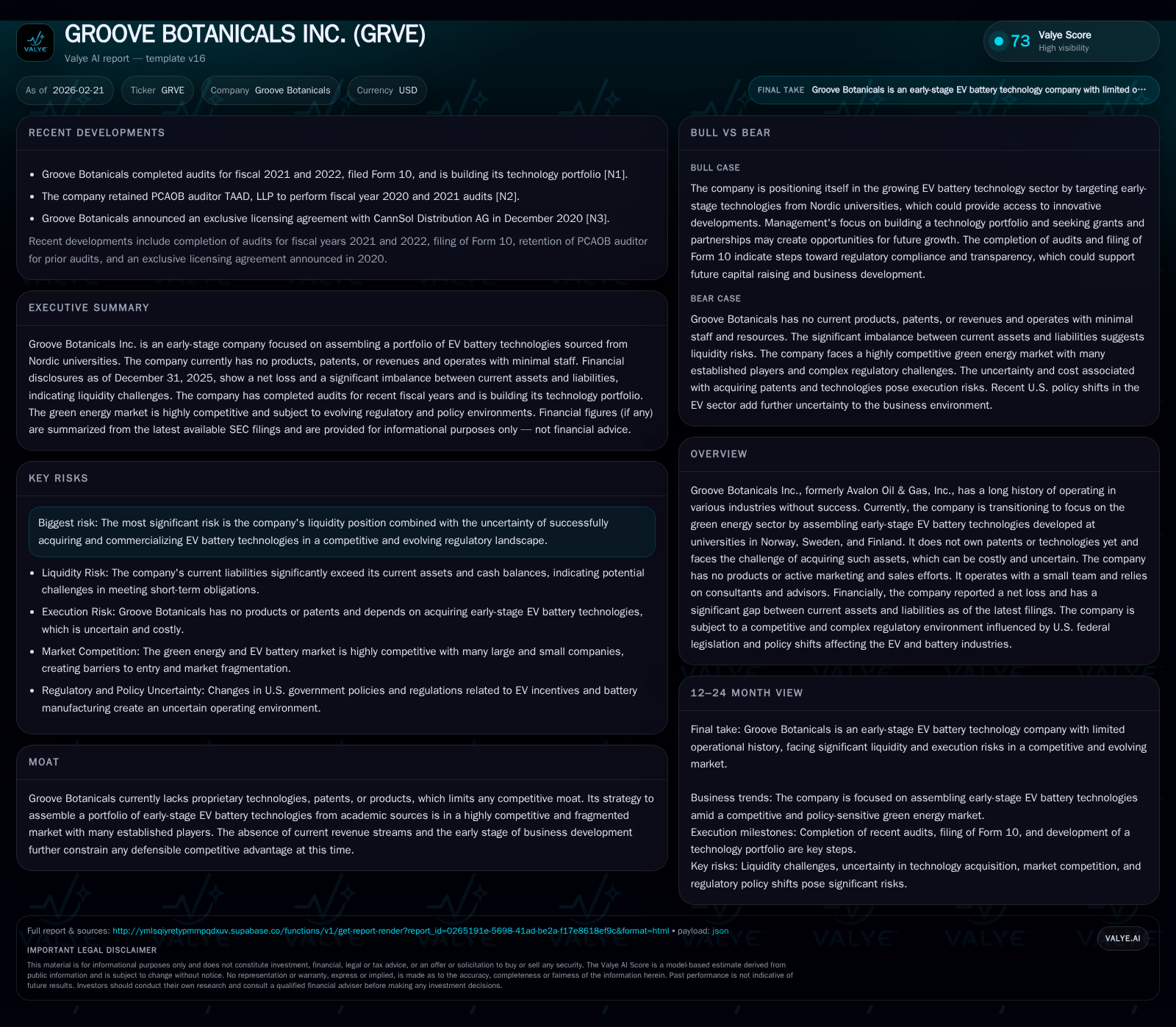
Groove Botanicals Inc., a company with a long history of unsuccessful ventures across various industries, is repositioning itself in the early-stage electric vehicle (EV) battery technology sector. Despite no current products or sales, the company aims to acquire nascent Scandinavian university-developed technologies but must overcome significant liquidity constraints and intense competition. Its financials reveal sustained operating losses and negative equity, underscoring the riskiness of its pivot. Regulatory developments in U.S. EV policy create both potential catalysts and uncertainties that will influence Groove’s path as it seeks critical milestones toward commercialization.
A Long History of Diverse Operations Without Revenue
Groove Botanicals Inc.'s operational saga is marked by numerous transformations over more than three decades without achieving profitable or sustainable growth. Founded on April 25, 1991, in Colorado as Snow Runner (USA), Inc., it initially sold proprietary snow skates under the name "Sled Dogs," dissolving that venture by 1992 [S1]. The company relocated to Minnesota in 1993, undergoing multiple rebrandings—Snow Runner, Inc. (1994), the Sled Dogs Company (1994), XDOGS.COM (1999), Avalon Oil & Gas, Inc. (2005)—reflecting shifting strategic directions. The latest renaming to Groove Botanicals, Inc. in May 2018 signaled a fresh pivot toward green energy sectors, specifically early-stage EV battery technologies [S1]. Throughout this trajectory, there has been no recorded revenue generation or meaningful product commercialization.
This progression underscores enduring operational challenges heightening risk for sustainable growth despite recent green energy ambitions.
Financial Trajectory: Operating Losses Amid Resource Constraints
Financial data portrays continued strain with little indication of turnaround yet. Operating income losses run deep though showing some improvement year over year: the most recent annual operating loss declined to approximately $130.8K from a prior $266.6K—a 50.9% improvement—yet remains deeply negative [F1]. Net losses track closely with operating losses at -$130.8K for FY2025 vs. -$202.1K in FY2024 [F1]. Operating cash flow is persistently negative (-$107.4K in FY2025), reflecting ongoing outflows associated with exploratory activities rather than revenue-producing operations [F1].
Equity erosion compounds concern as stockholders' deficit widened to nearly $1.11 million by FY2025 from -$760.6K in FY2024 [F1]. This heavily negative net worth highlights a balance sheet strained far beyond typical start-up burn rates, exposing heightened liquidity risk especially given current assets of roughly $6.26K against staggering current liabilities exceeding $1.38 million—a current ratio effectively zero [F1], a critical red flag in working capital management.
In early-stage ventures targeting capital-intensive patent acquisitions and R&D efforts, such pronounced working capital deficits elevate existential threats unless substantial recapitalization occurs promptly.
Historical performance (annual)
| FY | Net ($mm) | CFO ($) | OpInc ($mm) | Net YoY |
|---|---|---|---|---|
| 2025 | 0 | -107422 | 0 | +35.3% |
| 2024 | 0 | -86835 | 0 | |
| 2017 | 0 | -103646 | 0 | +90.3% |
| 2016 | -3 | -348922 | -3 |
Note: Omitted columns lack sufficient annual XBRL coverage in the provided tags (need ≥2 annual points): Rev, Capex, Div, Buybacks, FCF. Source: SEC companyfacts cache [F1].
Capital returns and efficiency (annual)
| FY | ROE% |
|---|---|
| 2025 | 11.8 |
| 2024 | 26.6 |
| 2017 | 24.3 |
| 2016 | 418.1 |
Source: SEC companyfacts cache [F1].
Note: Revenue and buybacks data unavailable; capex figures not reported for recent years.
Emerging Green Energy Focus: Strategy and Competitive Landscape
Groove Botanicals currently operates as a near pre-revenue entity aiming to consolidate a portfolio of nascent EV battery technologies emerging from research institutions in Norway, Sweden, and Finland [S7]. This strategic direction leverages the robust innovation ecosystems present in Scandinavia's clean tech universities but faces considerable uncertainties.
Critically, the company owns no patents or technology outright today; acquisition remains contingent on costly transactions that may fail to materialize [S7,S14]. Marketing and sales activities have yet to commence, leaving commercial viability entirely prospective.
The broader green energy technology landscape is highly fragmented with many incumbents backed by substantial R&D budgets and intellectual property portfolios . Barriers include complex battery chemistry IP landscapes, integration challenges related to battery management systems (BMS), thermal regulation innovations such as phase-change materials or solid-state components, all requiring heavy upfront investment.
This fragmentation coupled with lack of existing IP positions Groove as an emerging player without immediate defensible moats or scale advantages.
Regulatory and Market Environment Influencing Groove’s Path
U.S. federal policies provide both support frameworks and regulatory complexities shaping Groove Botanicals' potential pathway:
- The Inflation Reduction Act injects significant funding into EV manufacturing supply chains but raises technical compliance requirements for battery chemistries to qualify for incentives [S14].
- The Infrastructure Investment and Jobs Act further invests billions into charging infrastructure that indirectly incentivizes expanded EV adoption enhancing addressable markets for new battery tech [S14].
- The National Highway Traffic Safety Administration's Battery Safety Initiative focuses on improving safety standards around EV batteries covering fire risk mitigation, BMS cybersecurity protocols, and high-voltage charger fault detection—areas where emerging technologies must conform or integrate seamlessly to gain market acceptance [S15,S16].
- The Electric Vehicle Working Group (EVWG) coordinates federal stakeholder input producing timelines for recommendations on EV adoption barriers including permitting and public awareness effort which eventually influence infrastructure rollout timetables relevant for battery tech deployment [S16].
Meanwhile, ongoing political shifts introduce uncertainty. Recent policy reversals under new administrations could reduce consumer tax credits or alter domestic manufacturing incentives disrupting demand forecasts and altering competitive dynamics globally [S17].
Understanding these regulatory nuances is vital given specialized technical standards linked to cathode material compositions, electrolyte safety requirements, and thermomechanical endurance test outcomes required before commercial acceptance.
Capital Allocation Realities: Shrinking Liquidity and Shareholder Returns
Capital structure analysis reveals a company on precarious footing financially. Cash reserves barely exceed $1,400—the operational runway is minimal if burn rates approximate $100K+ annually for business development [F1,S10]. No dividends have ever been issued nor share repurchase programs undertaken reflecting absent free cash flow generation potential to reward investors [F1,S7].
Negative operating cash flows combined with anticipated acquisition costs place estimated near-term capital requirements between half a million to five million dollars to sustain growth initiatives adequately [S7]. Given severely negative equity positions exceeding one million dollars downward trend further amplifies dilution risks with any future capital raises being essential but potentially share-price dilutive.
The "burn rate" here clearly signals urgency; absent successful fundraises or asset acquisitions translating into tangible value drivers within short order would jeopardize corporate survival.
Foreshadowing: Milestones to Monitor in Technology Acquisition and Commercialization
While explicit forward-looking guidance is not provided in filings, key milestones investors should monitor include:
- Successful assembly of a viable patent portfolio through acquisitions or licensing agreements evidencing tangible progress beyond planning stages.
- Securing non-dilutive grants from entities such as Minnesota’s Department of Economic Development supporting initial technology scouting efforts.
- Initiation of marketing or sales activities signaling transition toward commercialization phases.
- Observable improvement in liquidity metrics driven by new financing rounds or strategic partnerships enabling working capital adequacy.
- Compliance alignment with evolving regulatory standards such as those defined by the NHTSA Battery Safety Initiative enhancing market credibility.
Absent achievement of these milestones within foreseeable periods would underscore ongoing risks inherent in Groove’s pivot strategy.
Disclaimer
This analysis provides an overview based solely on public filings without offering investment advice or recommendations. It incorporates disclosed facts alongside contextual industry insights while refraining from speculative assertions beyond documented information.
Disclaimer: This is research-only, informational analysis and not investment advice. It may include AI-generated interpretation and general industry context. Always verify important details using primary sources.

Comments