
MediaAlpha's Scalable Platform Drives Insurance Customer Acquisition Amid Cyclical Risks
MediaAlpha’s proprietary marketplace technology underpins recent financial turnaround despite cyclical pressures in insurance carrier spending.
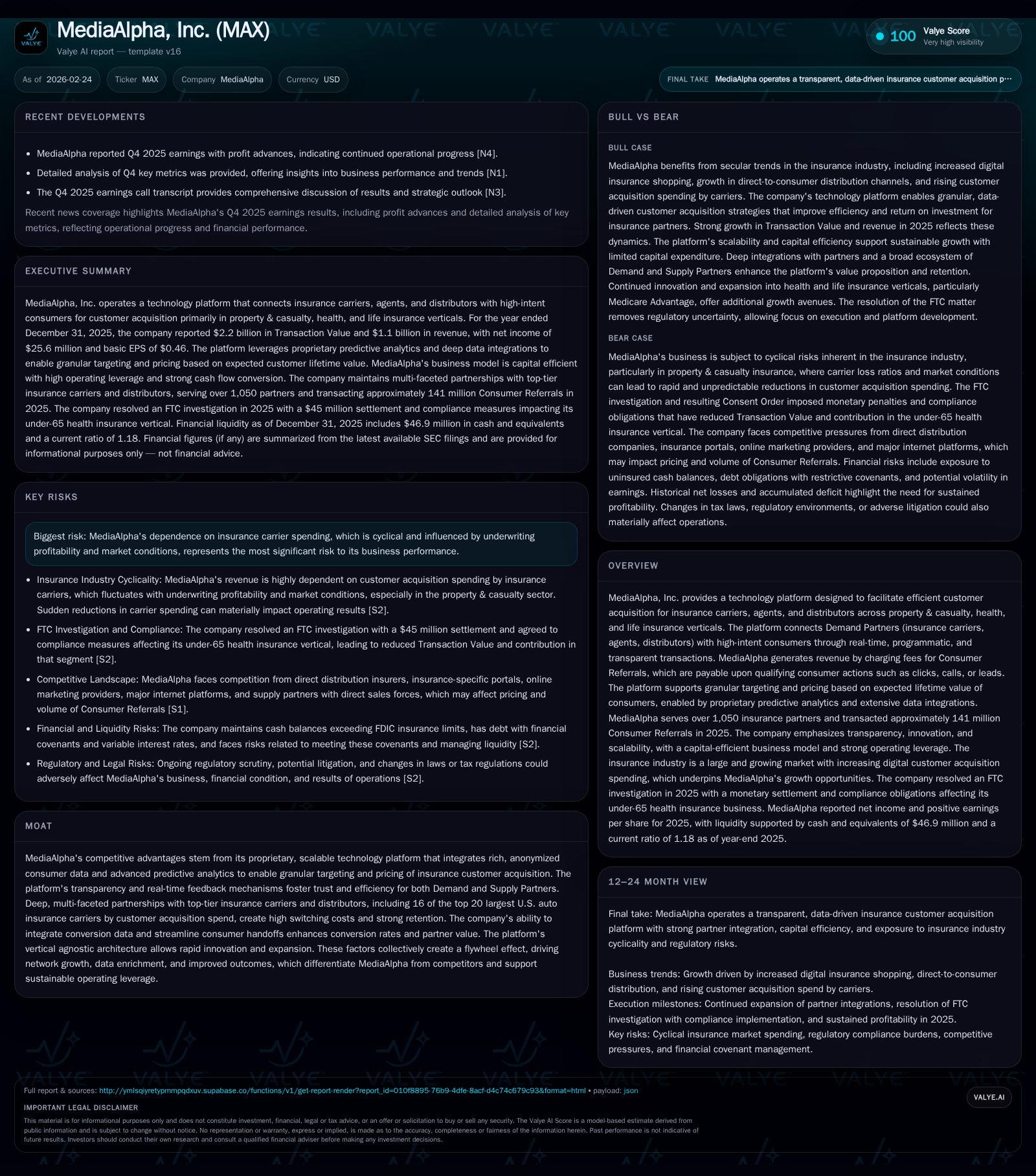
MediaAlpha, Inc. has transformed its financial trajectory from significant losses in 2022-23 to notable profitability by 2024-25, propelled by its scalable, tech-enabled two-sided marketplace connecting insurance carriers with high-intent consumers. The platform’s granular pricing and real-time bid optimization capabilities create a structural moat and drive partner retention across property & casualty, health, and life insurance verticals. Nonetheless, MediaAlpha’s revenue growth is inherently exposed to the cyclical nature of insurance underwriting profitability, particularly in auto insurance where market 'hard' and 'soft' conditions affect customer acquisition spend. Looking ahead, expansion into health and life verticals and deepening integration with partners represent growth vectors, while strong cash flow generation supports aggressive buybacks. Key metrics to monitor include referral volumes, pricing dynamics, and partner retention amid regulatory challenges and evolving market conditions.
Transformation From Losses to Profit: MediaAlpha’s Recent Financial Trajectory
MediaAlpha’s financial evolution over the last four years showcases a remarkable turnabout from sizable operating deficits to meaningful profitability. In fiscal years (FY) 2022 and 2023, operating income plunged deeply negative at -$35.4 million and -$39.9 million respectively [F1]. This aligned with cyclical downturns in the property & casualty insurance sector that pressured demand partner spend through sharply reduced customer acquisition investments.
However, by FY 2024 profitability returned with operating income hitting $42.7 million followed by $22.1 million in FY 2025 [F1]. Net income mirrored this swing: escalating from losses of -$57.7 million in 2022 and -$40.4 million in 2023 to gains of $16.6 million in 2024 and $25.6 million in the latest period [F1]. Operating cash flow surged concurrently—from $28.3 million in ’22 to $65.6 million in ’25—underscoring strong cash conversion accompanying earnings recovery.
Capital expenditures remained modest relative to historical trends ($0.34 million capex for FY25) indicating a primarily software-driven model requiring lean investment [F1]. The company also deployed nearly $47.3 million to buy back shares last year—its first repurchases post-pandemic—signaling confidence in free cash flow sustainability [F1]. Approximate return on equity flagged that despite minimal book equity ($4.16 million FY25), high net income translates into an outsized accounting ROE of roughly 615.9%, emphasizing operational leverage effects.
Historical performance (annual)
| FY | Net ($mm) | CFO ($mm) | OpInc ($mm) | Capex ($) | Net YoY |
|---|---|---|---|---|---|
| 2025 | 26 | 66 | 22 | 340000 | +54.1% |
| 2024 | 17 | 46 | 43 | 254000 | +141.1% |
| 2023 | -40 | 20 | -40 | +29.9% | |
| 2022 | -58 | 28 | -35 | 98000 |
Note: Omitted columns lack sufficient annual XBRL coverage in the provided tags (need ≥2 annual points): Rev, Div. Source: SEC companyfacts cache [F1].
Capital returns and efficiency (annual)
| FY | Buybacks ($mm) | FCF ($mm) | ROE% |
|---|---|---|---|
| 2025 | 47 | 65 | 615.9 |
| 2024 | 0 | 46 | 699.3 |
| 2023 | 0 | 392.7 | |
| 2022 | 5 | 28 | 360.6 |
Source: SEC companyfacts cache [F1].
Note: Capex data omitted for FY23 due to unavailability; Buybacks zero where none reported.
The Technology-Driven Customer Acquisition Platform: Structural Moat and Differentiation
Underpinning MediaAlpha’s turnaround is its proprietary technology platform—a two-sided marketplace connecting Demand Partners (insurance carriers/agents/distributors) with Supply Partners (carriers seeking to monetize low-value consumers or digital publishers with high-intent users). The platform facilitates real-time Customer Referral transactions where Demand Partners pay fees upon qualifying clicks, calls or leads.
This ecosystem allows highly granular consumer targeting predicated on expected lifetime value (LTV), quantified through extensive data integrations encompassing demographic/geographic attributes and behavioral signals [S16][S26]. Pricing algorithms execute real-time bid optimization calibrated by active conversion data feeds—over one hundred Demand Partners reported integrated conversion streams covering some $2 billion-plus transaction value in recent filings [S26].
The complexity of deep technical integrations raises switching costs for partners who rely on precise targeting accuracy coupled with platform transparency—a sharp departure from traditional opaque acquisition models prevalent prior [S24]. Such integration breadth creates a flywheel effect where increased partner participation enriches data inputs improving referral quality while driving volume growth.
Platform transparency affords clients unparalleled control over pricing per consumer segment while enabling instant feedback loops optimizing spend efficacy relative to expected LTV—a critical innovation fostering trust within the network [S26]. Furthermore, the versatility allowing one partner to serve both as Demand and Supply Partner enhances client lifetime value through cross-functional monetization opportunities uncommon among competitors.
By embedding consumer referral quality metrics explicitly into pricing decisions rather than a simple cost-per-click basis, MediaAlpha elevates barriers versus legacy portals or search engines reliant more heavily on commoditized traffic acquisition [S5][S6].
Navigating Insurance Market Cyclicality: Risks Impacting Demand Partner Spending
Despite technological strengths, MediaAlpha remains materially exposed to inherent insurance industry cyclicality which directly governs Demand Partner spending levels on customer acquisition services [S2][S8]. The P&C auto insurance sector—accounting for majority transaction volumes—is notably volatile.
Markets oscillate between "soft" periods characterized by low loss ratios encouraging carriers to aggressively acquire customers for market share gains versus "hard" markets where elevated loss ratios prompt rapid retrenchment prioritizing underwriting profit over growth [S2][S13]. These shifts frequently produce abrupt swings in acquisition spend which can materially compress MediaAlpha’s revenue if customers pull back suddenly.
Recent supply-chain constraints elevating automobile repair costs combined with new U.S government tariffs on auto parts threaten increased claim severity triggering hard market rebounds [S8][S13]. Consequently, tariff-induced inflation could tighten carrier budgets further stalling digital acquisition investments on MediaAlpha’s platform.
Moreover, key Demand Partners hold no exclusive long-term contractual commitments—they may cancel participation within short notice windows (30–60 days), increasing volatility risk [S1]. Regulatory inquiries such as FTC investigations into lead generation practices have also constrained under-65 health vertical activity shrinking transaction value there by tens of millions annually [S10][S12].
Growth Catalysts and Expansion Opportunities Across Insurance Verticals
Amid these cyclical pressures lie promising avenues for growth anchored by MediaAlpha’s vertical-agnostic architecture enabling swift expansion beyond core P&C into health (particularly Medicare Advantage) and life insurance domains [N1][N3][S18].
While regulatory headwinds mandated downsizing under-65 health offerings following FTC consent order compliance requirements impacted near-term volume negatively (-$79 million transaction value YoY decline), management emphasizes focus shift towards Medicare Advantage—a large and growing segment exhibiting favorable digital distribution adoption trends [S12][S18].
The platform's extensibility allows leveraging existing data science capabilities to enter adjacent markets without substantial overhead increases—critical given relatively flat headcount growth projected during scaling phases [S6][S18]. Further opportunity lies in deepening adoption among agents as dedicated teams work on pipeline expansion enhancing multi-channel engagement across Demand/Supply sides.
Enhancements planned around proprietary forecasting models grounded in increasing partner conversion integration depth may uplift volume predictability adding confidence in forward guidance absent explicit public metrics presently disclosed [N3][S26].
Financial Health and Capital Allocation: Cash Flow Strength and Share Repurchases
MediaAlpha demonstrates prudent financial stewardship marked by exceptional cash flow generation underpinning self-funded growth initiatives minimizing dependency on external capital infusions [F1][S23]. For FY25 net cash provided from operations reached an impressive $65.6 million exceeding capex needs (~$340k), yielding free cash flow close to $65 million annualized—a hallmark of operating leverage typical among scalable SaaS marketplaces [F1].
Repurchase programs accelerated meaningfully last year with nearly $47 million invested back into stock reducing outstanding float—a move signaling confidence in intrinsic value and ability to generate sustainable returns through operational improvements rather than dividend distribution absent currently available data [F1].
Accounting return-on-equity approximations highlight outsized profitability impact driven partly by depressed equity base post prior years’ cumulative losses yet sustained through positive net income improvements evidencing efficient capital deployment dynamics within platform-based business model parameters.
Key Metrics to Monitor: What to Watch in Upcoming Earnings and Industry Developments
Investors should scrutinize upcoming quarterly disclosures focusing sharply on Consumer Referral volume trends—especially referral clicks-to-lead conversion ratios—as these are leading indicators of underlying customer acquisition demand strength amid market cyclicality fluctuations [N2][N6][S29]. Pricing dynamics influenced by competitive pressure or regulatory constraints will also be telling about margin sustainability.
Partner retention poses ongoing scrutiny given non-exclusive contracts permitting abrupt termination—a risk compounded if shifts towards alternative digital channels such as AI-enhanced search or insurer-owned direct marketing diminish platform utility or pricing leverage over time [N2][S1][S14]. Attention should also be paid to announcements concerning platform innovation initiatives aimed at improving ecosystem efficiency since these can signal potential moat reinforcement or erosion depending on execution success.
Regulatory developments remain a wildcard; periodic updates around compliance adherence especially within health verticals subject to intensive oversight could influence near-term transactional throughput adversely or require operational investment impacting margins temporarily.
Competitive Positioning Among Digital Insurance Customer Acquisition Providers
MediaAlpha operates within a competitive universe spanning traditional insurer direct sales forces monetizing their own traffic, generalist internet search engine advertising platforms wielding dominant web traffic inventories (Google/Bing), specialized insurance lead generators, portals focused strictly on insurance research content, and other emerging fintech players deploying AI-driven customer matching algorithms [S5][S6][S14].
What distinguishes MediaAlpha is its integrated mix of granular data science capabilities coupled with real-time bidding functions granting both sellers and buyers transparent governance over referral quality/pricing dynamics uncommon even relative to sophisticated homegrown systems at large insurers.
Rising web traffic acquisition costs amid intensifying competition put pressure on margins industry-wide but MediaAlpha's scale advantage—evidenced by relationships spanning most major carriers—and differentiated technology stack underpin an elevated competitive barrier that new entrants find difficult to replicate promptly without significant upfront technical investment and partner onboarding complexity.
Moreover, ongoing AI advancements portend both threats via channel disintermediation but also opportunities if leveraged internally; strategic focus remains needed to maintain leadership against evolving competitors blending search-based AI product offerings with novel consumer engagement models poised potentially shifting referral price formation mechanisms going forward.
This analysis is based solely on publicly filed SEC documents dated through February 23, 2026 ([F1], [S#]), supplemented where indicated by recent news reports ([N#]). It does not constitute investment advice or recommendations.
Disclaimer: This is research-only, informational analysis and not investment advice. It may include AI-generated interpretation and general industry context. Always verify important details using primary sources.

Comments