
Summit Therapeutics' Ivonescimab Advances with Regulatory Milestones Amid Intensifying Financial Challenges
Summit Therapeutics progresses its lead oncology candidate ivonescimab through pivotal trials and regulatory filings while navigating substantial operating losses and capital requirements.
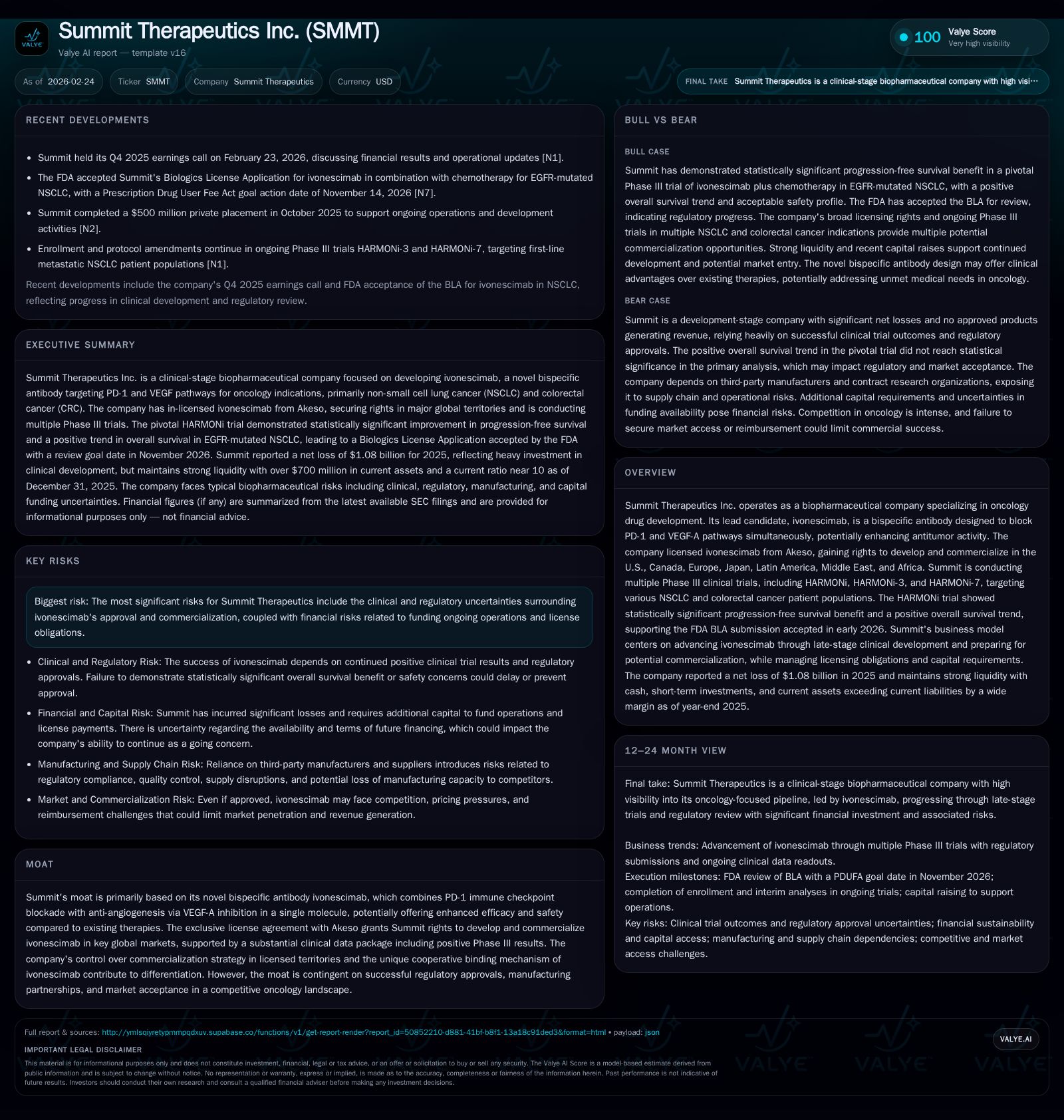
Summit Therapeutics Inc. is focused on the development of ivonescimab, a bispecific antibody targeting PD-1 and VEGF-A pathways, with positive Phase III data leading to an FDA BLA acceptance in January 2026 and a PDUFA date set for November 14, 2026. The company has expanded licensing territories across major global markets. Financially, Summit remains pre-commercial with no product revenues, reporting escalating net losses reaching approximately $1.08 billion in 2025 driven by clinical development costs and operating cash flow deficits of $323 million. While liquidity is supported by significant cash reserves and short-term investments, the absence of dividends or buybacks reflects ongoing reinvestment needs. Key risks include regulatory approval uncertainty, capital raising imperatives amid sustained losses, complex compliance environments post-Brexit and evolving EU legislation, and reimbursement pressures in competitive oncology markets.
Company Overview and Strategy
Summit Therapeutics Inc. is a biopharmaceutical company dedicated to developing innovative oncology therapies designed to address serious unmet medical needs. Its lead candidate, ivonescimab, is a bispecific antibody that simultaneously targets PD-1 immune checkpoint inhibition and VEGF-A-mediated angiogenesis inhibition—two critical pathways implicated in tumor growth and immune evasion [S1]. This dual-target approach aims to offer enhanced antitumor efficacy potentially superior to existing monotherapies or combination regimens.
The company secured exclusive rights to ivonescimab through licensing agreements with Akeso Inc., initially covering the US, Canada, Europe, and Japan (closed January 2023), later expanded via amendment to include Latin America, Middle East, and Africa territories (June 2024) [S1].
Clinical development focuses on multiple pivotal Phase III trials: HARMONi for EGFR-mutated non-squamous NSCLC post-TKI therapy; HARMONi-3 for first-line metastatic NSCLC; HARMONi-7 for monotherapy in high PD-L1 expressers; and HARMONi-GI3 for first-line unresectable metastatic colorectal cancer [S1][N1]. Topline results from the May 2025 interim analysis of HARMONi showed statistically significant progression-free survival benefits supporting the FDA's acceptance of the Biologics License Application (BLA) filed in January 2026 with a PDUFA target action date of November 14, 2026 [N7][S1].
Historical Financial Performance
Summit's financial track record reflects extensive R&D investment without commercial product revenue. Key financial data from FY2022 through FY2025 are summarized below based on reported figures [F1]:
Historical performance (annual)
| FY | Net ($mm) | CFO ($mm) | OpInc ($mm) | Capex ($) | Net YoY |
|---|---|---|---|---|---|
| 2025 | -1080 | -323 | 657000 | -387.8% | |
| 2024 | -221 | -142 | -226 | 139000 | +64.0% |
| 2023 | -615 | -77 | -610 | 128000 | -680.5% |
| 2022 | -79 | -42 | -72 | 624000 |
Note: Omitted columns lack sufficient annual XBRL coverage in the provided tags (need ≥2 annual points): Rev, Div, Buybacks. Source: SEC companyfacts cache [F1].
Capital returns and efficiency (annual)
| FY | FCF ($mm) | ROE% |
|---|---|---|
| 2025 | -324 | -163.9 |
| 2024 | -142 | -56.9 |
| 2023 | -77 | -791.5 |
| 2022 | -42 | -62.2 |
Source: SEC companyfacts cache [F1].
Note: Revenue figures have not been reported since mid-2018 reflecting pre-commercial status.
Operating losses escalated significantly between FY2022 and FY2025 due mainly to increased clinical trial expenditures culminating in the record net loss exceeding $1 billion in FY2025 [F1]. Operating cash flows remain deeply negative consistent with ongoing heavy investment burn rates. Capital expenditures are minimal relative to overall spending.
Equity growth over this period indicates capital raises supporting operations but diluting equity holders without offsetting profits [F1]. No dividends or share buybacks have been declared or paid given persistent losses and reinvestment priorities [S17][F1].
Growth Drivers and Future Outlook
Summit's anticipated path to revenue generation centers on successful regulatory approval and commercialization of ivonescimab following the FDA's expected decision by late 2026 [N7][S1]. The therapy's dual-action mechanism targets an unmet need especially among EGFR-mutated NSCLC patients who have progressed after tyrosine kinase inhibitor treatment.
Additional ongoing Phase III studies aim to expand indications into broader NSCLC populations (HARMONi-3), monotherapy settings among high PD-L1 expressers (HARMONi-7), and colorectal cancer (HARMONi-GI3), potentially broadening market opportunity pending positive outcomes [S1][N1].
Commercial preparations must navigate complex regulatory landscapes including evolving EU pharmaceutical legislation scheduled for mid-decade implementation as well as post-Brexit MHRA approval processes within the UK [S9][S23][S24]. Market access will also depend heavily on third-party payor coverage decisions amidst intensifying pricing pressures globally [S15][S16].
Risks and Challenges
Summit faces multiple key risks:
- Regulatory Risk: Approval delays or denials could materially impact timelines; ongoing compliance mandates impose operational burdens across jurisdictions including anti-kickback laws, off-label promotion restrictions, pharmacovigilance requirements, data privacy regulations like GDPR, and intellectual property uncertainties .
- Financial Risk: The company’s annual operating cash burn exceeds $300 million with no commercial revenues; dependence on external financing raises dilution risk and going-concern considerations absent successful validation or partnerships [S2][S3][F1].
- Competitive Risk: Numerous bispecific antibodies targeting PD-1/VEGF pathways are under development; differentiation depends on demonstrating superior clinical benefit-risk profiles [N1][S4].
- Reimbursement Risk: Increasing scrutiny by payors regarding cost-effectiveness may limit uptake even if approved; formulary placement and pricing negotiations pose challenges [S15][S16].
Capital Allocation and Returns
Given Summit’s pre-commercial phase status, return metrics such as ROE remain negative—approximately –164% for FY2025—reflecting large net losses relative to equity base [F1]. Free cash flow remains strongly negative at approximately –$324 million driven by operating deficits far exceeding minimal capex outlays.
The company does not pay dividends nor conduct share buybacks as all available capital is directed towards advancing clinical programs and preparing for potential commercialization initiatives [F1][S17].
Liquidity remains solid short-term supported by a current ratio near 9.87 derived from over $225 million cash plus $488 million short-term investments against relatively low current liabilities totaling approximately $73 million as of year-end 2025 [F1]. Nonetheless, ongoing high burn necessitates prudent cash management and further financing activities.
Upcoming Catalysts to Monitor
- FDA decision on ivonescimab’s BLA for treatment of EGFR-mutated NSCLC post-TKI therapy expected November 14, 2026 [N7][S1].
- Results from ongoing Phase III trials expanding indications including HARMONi-3 (first-line metastatic NSCLC), HARMONi-7 (monotherapy in PD-L1 high NSCLC), and HARMONi-GI3 (colorectal cancer) will influence longer-term growth prospects.
- Capital markets developments such as equity raises or strategic collaborations will be critical indicators of financial sustainability through pivotal regulatory milestones.
- Regulatory compliance adaptations related to EU pharmaceutical legislative changes effective mid-decade and evolving UK MHRA frameworks.
Conclusion
Summit Therapeutics stands at an inflection point where promising clinical data have translated into regulatory filings that could enable initial commercial launches after years of intensive investment. While facing typical biotech risks—including regulatory uncertainties, capital raising dependency, competitive dynamics, reimbursement challenges, and complex multi-jurisdictional compliance—the differentiated mechanism of ivonescimab positions Summit as a notable innovator within immuno-oncology if execution proceeds favorably.
Disclaimer: This report is informational only and does not constitute investment advice. Financial data are based on currently available filings without estimation beyond provided sources.
Disclaimer: This is research-only, informational analysis and not investment advice. It may include AI-generated interpretation and general industry context. Always verify important details using primary sources.

Comments