
Freshpet's Fresh Approach to Pet Food Growth and Profitability
Freshpet leverages its proprietary refrigerated distribution and supply chain design to turnaround profitability amidst macroeconomic pressures.
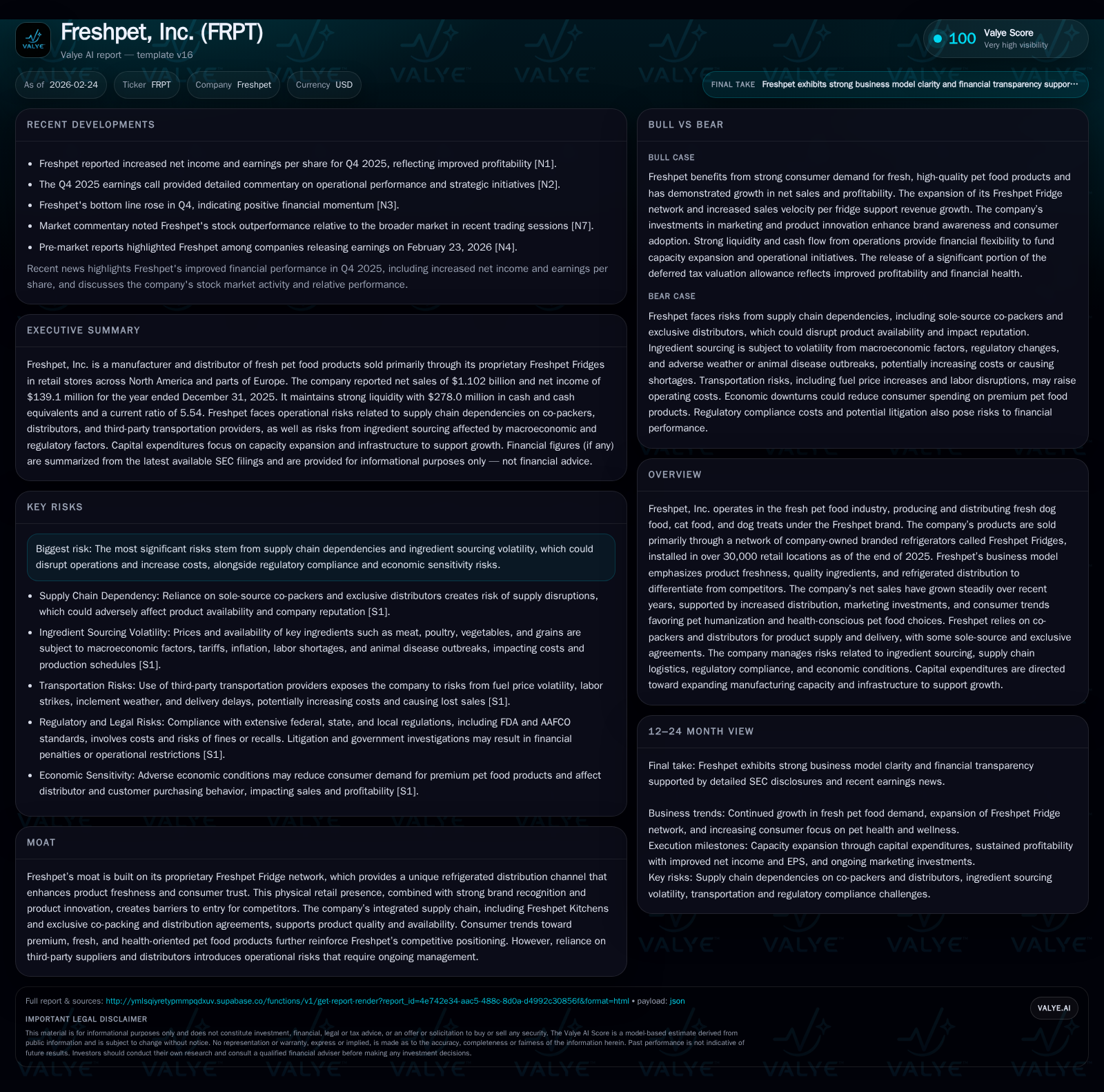
Freshpet, Inc. has transformed its financial trajectory by moving from operating losses in 2022-2023 to posting substantial operating income and net income gains through 2024-2025. Central to this success is its unique Freshpet Fridge network that ensures product freshness and brand differentiation, supported by expanding retail presence across over 30,000 locations. The company faces complex supply chain risks from input cost inflation, volatile commodity markets, and capacity investment decisions. Strong operating cash flows coupled with disciplined capital spending underpin consistent free cash flow generation, although the absence of dividends or buybacks signals reinvestment priority. Key metrics reflect an approximate 11.5% return on equity and sustained margin expansion, while recent earnings beats highlight cautious optimism amid ongoing external headwinds.
From Losses to Operating Income: Charting Freshpet’s Financial Turnaround
Freshpet’s financial performance demonstrates a marked recovery starting FY2024. After operating losses of approximately -$52 million in FY2022 and -$30 million in FY2023, the company achieved positive operating income of about $38 million in FY2024 which nearly doubled to around $76 million in FY2025 (+99% YoY) [F1]. Net income followed a similar trajectory with losses of roughly -$59 million in FY2022 turning into a substantial profit of $139 million by FY2025 (+196.5% YoY vs. FY2024) [F1].
Operating cash flow (CFO) improved significantly from negative -$43 million in FY2022 to positive $154 million in FY2024 and further increased modestly by 4% to approximately $161 million in FY2025 [F1][S13]. Capital expenditures (capex) have trended downwards from peak levels—$239 million in FY2023 to $148 million last year (-20.8%)—reflecting a strategic moderation aligned with demand conditions and operational efficiencies [F1][S17].
This financial discipline supports sustainable growth while transitioning away from heavy investment phases toward profitability.
Proprietary Refrigerated Distribution: The Freshpet Fridge Network
A cornerstone of Freshpet’s business model is its proprietary refrigerated retail network—Freshpet Fridges—installed in over 30,000 stores as of December 31, 2025 [S10]. These branded refrigerators maintain product freshness critical to brand differentiation within the fresh pet food category.
The fridge rollout spans grocery chains, mass merchants, pet specialty retailers, clubs, digital channels including direct-to-consumer fulfillment, and international locations. This physical asset provides Freshpet with control over product quality at point-of-sale—a significant competitive advantage difficult for others to replicate given the capital intensity and logistical complexity involved.
Supply Chain Risks: Ingredient Volatility and Operational Challenges
Freshpet faces persistent supply chain risks involving key inputs such as meat, poultry products, vegetables, fruits, carrageenans, whole grains, packaging materials, and energy—all subject to market volatility [S1]. Inflationary pressures are intensified by geopolitical tariffs impacting trade relations with countries like Canada, Mexico, and China; labor shortages exacerbated by immigration policies; and disease outbreaks including Highly Pathogenic Avian Influenza (HPAI) affecting livestock availability [S14][S20].
Dependence on certain exclusive third-party co-packers and distributors adds operational risk requiring ongoing supplier management and contingency planning. Rising freight costs also impact margins.
Price increases must be carefully balanced against consumer sensitivity; trade promotions remain necessary to sustain volume despite cost inflation [S1].
Manufacturing Capacity: Navigating Growth Versus Utilization
Capacity expansion is a critical strategic element with the risk-reward balance between meeting growing demand and avoiding underutilized assets. Freshpet has invested heavily in manufacturing expansion including the Freshpet Kitchens Ennis Phase developments expected to require around $150 million annually near-term capex [S17][S6].
Management acknowledges risks associated with overbuilding capacity leading to reduced margins or underinvestment causing lost sales opportunities due to stockouts or supply constraints [S1]. Operational leverage depends on tightly coordinated execution among innovation pipelines, marketing efforts driving adoption velocity at fridge endpoints, and manufacturing-supply chain integration.
Capital Allocation: Cash Flow Generation Without Dividends or Buybacks
In FY2025 Freshpet generated strong operating cash flow ($161 million), enabling significant reinvestment into growth initiatives while producing positive free cash flow estimated at approximately $12 million after capex [F1][S13][S17].
The company has not declared or paid dividends since going public nor conducted share repurchases recently (last known repurchase was minimal in FY2018), signaling capital prioritization toward infrastructure investment including fridge deployment and manufacturing capacity rather than shareholder returns at this stage [S12][F1].
Return on equity reached an approximate level of 11.5% for FY2025 based on net income relative to shareholder equity exceeding $1.2 billion—an improvement reflecting enhanced profitability alongside continued reinvestment for growth [F1].
Historical Financial Performance Summary
Historical performance (annual)
| FY | Net ($mm) | CFO ($mm) | OpInc ($mm) | Capex ($mm) | Net YoY |
|---|---|---|---|---|---|
| 2025 | 139 | 161 | 76 | 148 | +196.5% |
| 2024 | 47 | 154 | 38 | 187 | +239.6% |
| 2023 | -34 | 76 | -30 | 239 | +43.5% |
| 2022 | -59 | -43 | -52 | 230 |
Note: Omitted columns lack sufficient annual XBRL coverage in the provided tags (need ≥2 annual points): Rev, Div, Buybacks. Source: SEC companyfacts cache [F1].
Capital returns and efficiency (annual)
| FY | FCF ($mm) | ROE% |
|---|---|---|
| 2025 | 12 | 11.5 |
| 2024 | -33 | 4.4 |
| 2023 | -163 | -3.5 |
| 2022 | -273 | -5.8 |
Source: SEC companyfacts cache [F1].
Note: Revenue figures are not available from provided data tags.
Q4 FY2025 Earnings Beat: Market Reaction and Management Commentary
On February 23, 2026 Freshpet reported Q4 results surpassing analyst estimates highlighting sustained demand growth despite inflationary headwinds and supply chain vigilance [N1][N2][S3]. Non-GAAP reconciliations were provided for transparency on earnings quality.
Management emphasized continued momentum driven by fridge expansion alongside cautious monitoring of input cost inflation. Supply chain initiatives focus on diversifying suppliers while pricing strategies aim to preserve margins without deterring consumer uptake.
Investor Considerations: Growth Drivers and Risk Factors Ahead
Key factors for investors include monitoring:
- The rollout speed and effectiveness of Freshpet Fridges across multiple retail channels as primary growth drivers;
- Supply chain risk mitigation strategies addressing input volatility;
- Pricing power balanced against consumer price sensitivity;
- Manufacturing capacity utilization aligned with demand forecasts;
- Ability to sustain free cash flow generation amid ongoing capital investments;
- Regulatory compliance costs including Extended Producer Responsibility laws that could increase expenses over time.
This comprehensive view is grounded exclusively on disclosed filings without extrapolation beyond available data.
Disclaimer: This is research-only, informational analysis and not investment advice. It may include AI-generated interpretation and general industry context. Always verify important details using primary sources.

Comments