
Ekso Bionics' Struggle with Revenue Declines and Liquidity Risks
A focused look at Ekso Bionics’ sharp 2025 revenue drop, margin resilience, expense pressures, and looming liquidity concerns.
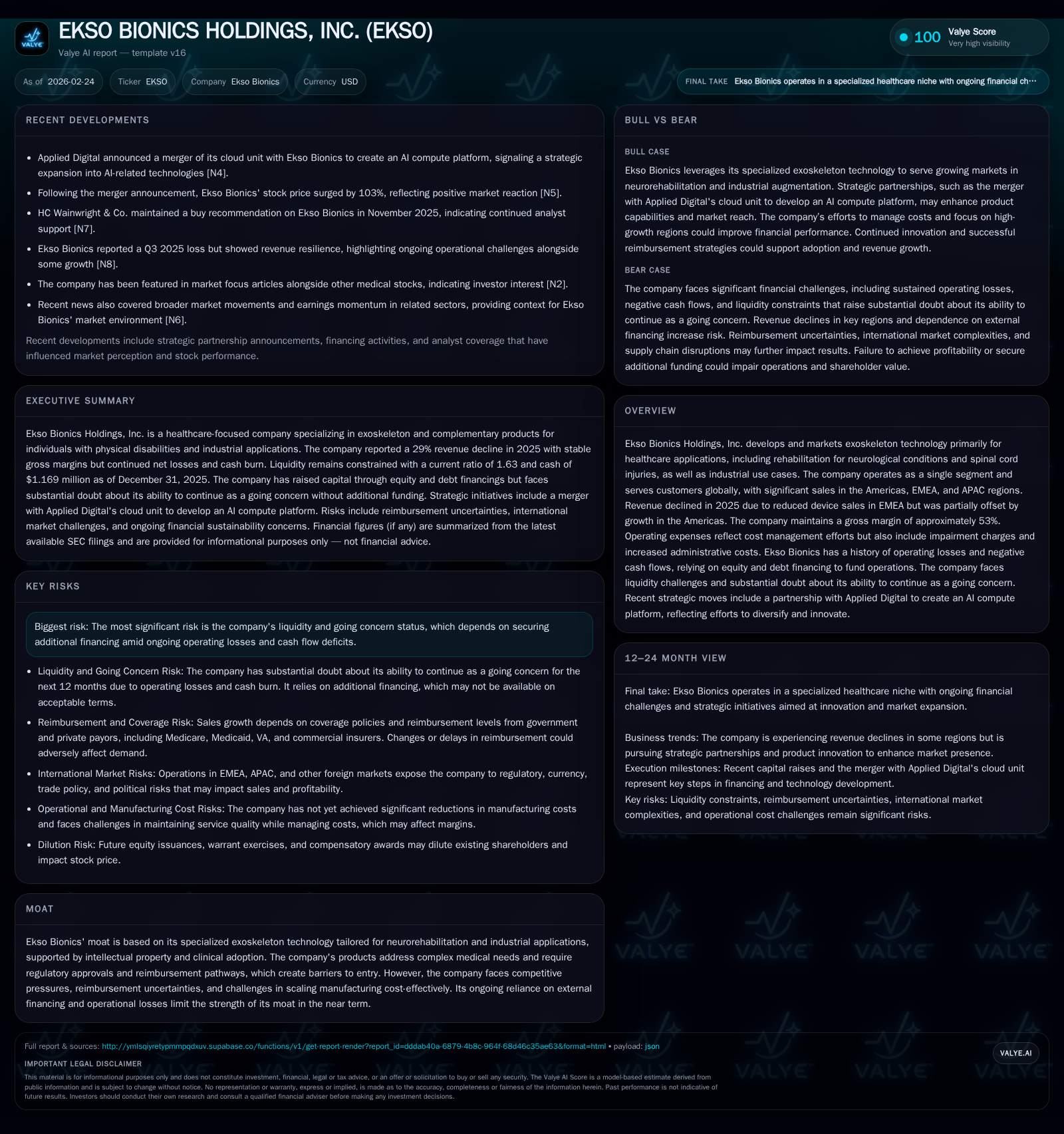
Ekso Bionics Holdings, Inc. faced a notable 29% revenue contraction in 2025 largely due to weakening device sales in the EMEA region, partially offset by growth in the Americas. Despite this top-line pressure, gross margins held steady around 53%, reflecting disciplined cost control. Operating losses widened as general administrative expenses rose and impairment charges were recorded, exacerbating existing cash flow deficits. The company’s liquidity position remains precarious, with only $1.17 million in cash against $8.6 million in current liabilities and substantial doubt cast on its going concern status. Ekso continues to depend on external financing, including a secured promissory note due in late 2026, while navigating reimbursement challenges and competitive pressures in the neurorehabilitation exoskeleton market.
Historical Performance and Revenue Drivers: Device Sales and Geographic Shifts
Ekso Bionics reported a sharp revenue decline of approximately 29% year-over-year (YoY) for fiscal year (FY) 2025, dropping to $12.8 million from $17.9 million in FY2024 [F1][S1][S6]. The primary driver was a significant downturn in Enterprise Health device unit sales within the Europe, Middle East & Africa (EMEA) region — revenues there fell from approximately $5.9 million in FY2024 to $3.8 million in FY2025 [S6]. This regional weakness was partially offset by increased sales of Personal Health devices in the Americas, which rose as customers sought rehabilitation exoskeleton solutions amid growing neurological condition prevalence [N2][S1]. The Asia-Pacific (APAC) region saw modest declines as well.
Device sales remain the company's largest revenue contributor compared to ancillary services such as support or parts supplies [S6]. The geographic sales mix shift toward the Americas signals potential strength in markets with more mature reimbursement pathways but also highlights vulnerability to regional healthcare funding dynamics.
Historical performance (annual)
| FY | Net ($mm) | CFO ($mm) | OpInc ($mm) | Capex ($) | Net YoY |
|---|---|---|---|---|---|
| 2025 | -12 | -12 | -13 | 188000 | -3.2% |
| 2024 | -11 | -10 | -10 | 37000 | +25.5% |
| 2023 | -15 | -12 | -15 | 157000 | -0.8% |
| 2022 | -15 | -15 | -16 | 194000 |
Note: Omitted columns lack sufficient annual XBRL coverage in the provided tags (need ≥2 annual points): Rev, Div, Buybacks. Source: SEC companyfacts cache [F1].
Capital returns and efficiency (annual)
| FY | FCF ($mm) | ROE% |
|---|---|---|
| 2025 | -12 | -129.6 |
| 2024 | -10 | -89.2 |
| 2023 | -12 | -120.6 |
| 2022 | -15 | -59.3 |
Source: SEC companyfacts cache [F1].
Gross Margin Stability Amid Topline Pressure
Despite the material drop in revenue volume, Ekso Bionics maintained a stable gross margin around 53% for FY2025, matching its prior-year performance [F1][S1]. This stability amidst reduced volumes suggests effective cost controls across manufacturing and supply chain operations. Cost of goods sold declined roughly in line with revenue decreases [S1], highlighting some operating leverage despite specialized production processes.
Operating Expenses and Impairment Dynamics
Total operating expenses slightly increased by about $200K or ~1% YoY despite reductions in research & development (R&D) (-22%) and sales & marketing (-2%) expenditures [S1]. These decreases were driven by headcount reductions and payroll savings partly supported by employee retention credits (ERC). Conversely, general and administrative expenses rose nearly 14%, reflecting higher legal/audit fees and impairment charges related to intangible assets alongside severance costs [S1].
Operating losses widened by approximately 27% YoY to $13.3 million for FY2025 compared to $10.5 million for FY2024 [F1][S1], continuing a multi-year trend of significant negative profitability.
Liquidity Crisis and Going Concern Considerations
Liquidity remains a critical risk for Ekso Bionics. As of December 31, 2025, cash on hand totaled only $1.17 million versus current liabilities exceeding $8.6 million [F1][S7]. The company reported negative operating cash flows of approximately $11.8 million for FY2025 [F1], underscoring cash burn concerns.
Management has expressed substantial doubt regarding the company's ability to continue as a going concern beyond one year without additional financing [S7]. Recent private placement proceeds (~$5.3 million net) combined with secured debt provide runway only through mid-2026 [S8]. Continued reliance on external capital raises execution risk amid volatile markets.
Capital Structure and Financing Strategies
Ekso's capital structure includes no dividends or share repurchases given its developmental stage and ongoing losses [F1][S17]. Equity raises through public offerings have been vital for operations.
In September 2025, Ekso secured a $2 million promissory note facility with B. Riley Commercial Capital bearing a high interest rate of 10% plus an exit fee equating to $200K due September 14, 2026 [S5][S10][S23]. This loan is collateralized by substantially all personal property assets except intellectual property itself and contains restrictive covenants limiting additional indebtedness or asset dispositions.
Additional debt includes the Parker Hannifin Promissory Note with principal outstanding around $2.19 million split between current and long-term portions as of end-2025 [S8]. High effective interest rates have increased finance costs recognized during FY2025 compared to prior periods [S4][S23].
Capital allocation prioritizes working capital needs over shareholder returns given an accumulated deficit nearing $262 million at FY-end [F1][S7][S17].
Reimbursement Landscape Impacting Market Adoption
Ekso’s medical exoskeleton products depend heavily on third-party reimbursement policies from government payors including Medicare, Medicaid, Veterans Administration (VA), as well as private insurers [S2][S7]. Coverage variability across regions complicates consistent adoption.
Recent federal budget cuts have disrupted funding channels for hospital systems purchasing through durable medical equipment providers (DMEs), limiting purchasing decisions tied to reimbursement adequacy or pricing agreements [S2]. Ongoing policy shifts could further constrain market growth potential.
Technology Differentiation and Competitive Moat Evaluation
Ekso’s competitive advantage stems from proprietary exoskeleton technology targeting neurorehabilitation patients with neurological impairments such as spinal cord injury alongside secondary industrial use cases [S7]. Regulatory approvals create entry barriers; however sustained losses and reimbursement uncertainties temper moat strength.
Intangible assets supporting technology rights extend into late 2030s but face amortization risks amid market challenges [S16]. Continuous investment is needed for clinical adoption support.
Growth Prospects and Market Access Constraints
Growth opportunities hinge on stabilizing Enterprise Health device sales if reimbursement improves alongside expanding Personal Health product uptake domestically due to rising neurological disability prevalence [N2]. Geographic focus on North America offers upside potential.
Challenges include liquidity constraints limiting R&D investment; manufacturing scalability hurdles; reimbursement volatility; and competition from firms advancing robotic rehabilitation technologies faster than Ekso can capitalize upon.
No recent formal guidance has been issued; stakeholders should monitor upcoming financing outcomes as key indicators for operational continuity.
Key Milestones and Indicators to Monitor
- Success of additional financing rounds impacting liquidity beyond Q2-2026 horizon [S3][S8]
- Updates on third-party reimbursement policies including CMS coverage decisions affecting Medicare pathways [S2]
- Operational efficiency improvements reducing per-unit costs via scaled manufacturing or supply chain enhancements
- New product launches expanding addressable markets particularly within Personal Health segments visible through service or subscription revenue growth [N2]
- Monitoring impairment or legal contingency developments signaling asset value risks affecting balance sheet strength.
Note: Return on equity (ROE), dividend payments, free cash flow after capex breakdowns are not available from provided tags; analysis is based solely on disclosed financial statements [F1] and SEC filings up to February 23rd, 2026 ([S#]).
Disclaimer: This is research-only, informational analysis and not investment advice. It may include AI-generated interpretation and general industry context. Always verify important details using primary sources.

Comments