
Western Alliance Bancorporation Balances Loan Growth with Rising Credit and Regulatory Complexities
WAL’s diversified lending and unified brand underpin solid earnings growth despite operating cash flow pressures and tightening regulatory environment.
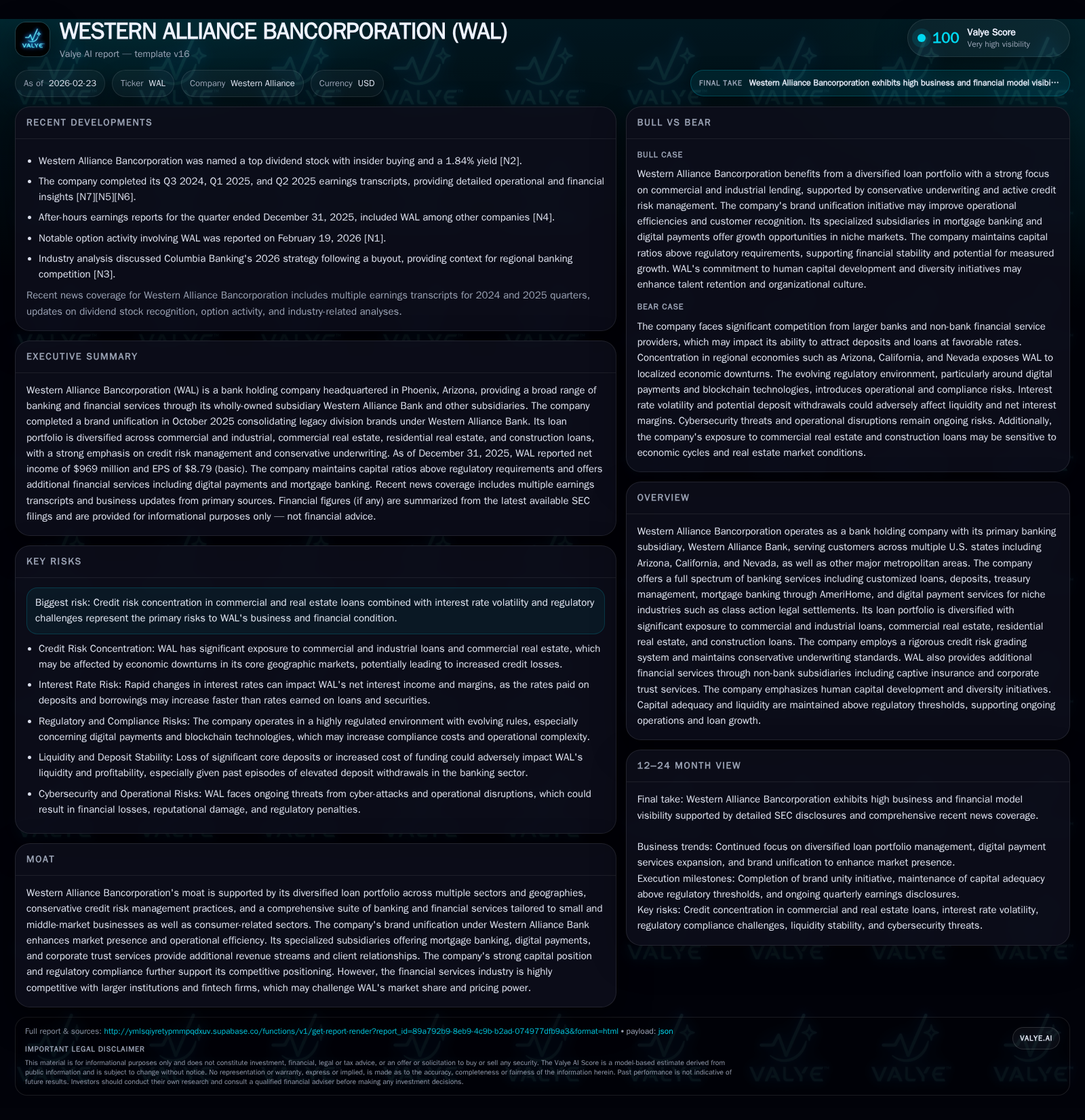
Western Alliance Bancorporation (WAL) has demonstrated robust net income growth, supported by expanding commercial and industrial loan portfolios and strategic brand unification completed in late 2025. While the company faces headwinds from growing provisions for credit losses and negative operating cash flows, its conservative underwriting standards and disciplined risk management partially mitigate these challenges. WAL continues to ratchet up capital levels but will soon confront intensified regulatory oversight after surpassing the $100 billion asset threshold. Monitoring loan quality trends, deposit stability, and costs of funds will be crucial as the bank navigates a competitive banking landscape alongside emerging fintech disruptions.
Introduction
Western Alliance Bancorporation (NYSE: WAL), headquartered in Phoenix, Arizona, operates primarily via its wholly-owned subsidiary Western Alliance Bank, complemented by specialized subsidiaries offering mortgage banking through AmeriHome, digital payments for niche markets like class action settlements, captive insurance, and corporate trust services [S1][S12]. The company completed an extensive brand unification project in Q4 2025 consolidating several legacy bank brands under the single Western Alliance Bank umbrella [S1], simplifying market identity and potentially fueling operational synergies.
Historical Performance and Growth Drivers
WAL's net income has exhibited steady growth over recent years with a notable 23% increase year-over-year to $969 million in FY2025 from $788 million in FY2024 [F1]. This uplift corresponds with a deliberate expansion in commercial and industrial loans which now constitute approximately 48% of the held-for-investment (HFI) portfolio (up from 43% in 2024), underscoring the bank’s focus on middle-market business clients [S5][S16]. Residential real estate loans represent a significant albeit slightly declining slice (~25%), while CRE (commercial real estate) and construction loans account for about 27%, tightly aligned with WAL’s strategic footprint centered around Arizona, California, and Nevada [S16][S9].
Despite net income strength, operating cash flow has been negative for two consecutive years ending at -$2.68 billion in FY2025 [F1]. This counterintuitive metric largely reflects elevated provisioning against credit losses as economic uncertainties persist across relevant regional markets [S19]. Capital levels have grown consistently alongside net income gains; stockholders’ equity expanded from about $5.36 billion in FY2022 to over $7.65 billion by end-2025 [F1]. This supports a respectable return on equity near 12.7%, revealing effective capital utilization though signaling moderate pressure compared with more aggressively leveraged peers.
Historical performance (annual)
| FY | Net ($mm) | CFO ($bn) | Net YoY |
|---|---|---|---|
| 2025 | 969 | -2.7 | +23.0% |
| 2024 | 788 | -2.7 | +9.0% |
| 2023 | 722 | -0.3 | -31.7% |
| 2022 | 1057 | 2.2 |
Note: Omitted columns lack sufficient annual XBRL coverage in the provided tags (need ≥2 annual points): Rev, OpInc, Capex, FCF. Source: SEC companyfacts cache [F1].
Capital returns and efficiency (annual)
| FY | Div ($mm) | Buybacks ($mm) | ROE% |
|---|---|---|---|
| 2025 | 68 | 12.7 | |
| 2024 | 177 | 11.7 | |
| 2023 | 172 | 11.9 | |
| 2022 | 166 | 0 | 19.7 |
Source: SEC companyfacts cache [F1].
Note: Revenue and Operating Income not available; CFO = Operating Cash Flow; YoY % calculated where possible.
Business Segments and Market Positioning
WAL segments its operations into Commercial Banking (small/middle-market businesses), Consumer Related (including residential mortgages), and Corporate & Other (investment portfolios, borrowing costs). Loan approvals follow disciplined tiered authority structures emphasizing risk-grade certifications to maintain overall asset quality [S13][S17].
The company's conservative underwriting philosophy extends across its diverse loan types including specialized sub-segments like warehouse lines for mortgage products and niche digital payment services for legal settlements through DST [S12]. The geographic concentration in major western states accompanied by selective branching into other metro areas like Atlanta, Boston, Chicago, New York, Seattle underpins diversified yet focused growth exposure [S9].
Credit Quality and Risk Management
Credit risk remains a central focus given substantial exposures to CRE non-owner occupied loans (about 18%) predominantly secured by multi-family residential properties, industrial facilities, retail centers, hotels—in line with regional development trends [S24]. The underwriting conservatively caps initial loan-to-value ratios generally below 75%, complemented by active collateral re-appraisals especially on value-add office bridge loans [S24].
Allowance for credit losses (ACL) expanded significantly to $460 million funded loans provision as of December-end 2025 reflecting strategic padding against potential defaults within construction/land development segments which have seen a modest portfolio decline but remain noteworthy at nearly 7% of loans held [S19][S22]. Loan grading employs nine-category segmentation allowing early identification of substandard credits enabling prompt remedial engagement [S11][S19]. These rigorous processes aim to curtail net charge-offs even if macroeconomic volatility or localized stress intensifies.
Funding Profile and Deposit Composition
As of year-end 2025, total deposits stood at approximately $77.2 billion with a balanced composition: roughly one-third non-interest-bearing demand deposits providing low-cost funding advantage versus interest-bearing transaction accounts plus savings/money market accounts comprising the remainder [S6][S16]. Retail brokered deposits above FDIC limits are notably part of ‘Other time deposits,’ though declined year-on-year reflecting cautious liquidity management [S6].
WAL supplements deposit funding with borrowings chiefly from the Federal Home Loan Bank system totaling approximately $4.8 billion as of December 31, although no Federal Reserve borrowings were outstanding then [S25]. Maintaining stable core deposits remains critical as past episodes of idiosyncratic volatility post-SVNB/Signature Bank closures highlighted potential liquidity risks requiring active ALCO oversight on pricing and deposit mix strategy [S10][S16].
Capital Adequacy and Regulatory Landscape
Exceeding $90 billion assets at December-end puts WAL near critical scale thresholds triggering enhanced prudential standards imposed on Category IV bank holding companies upon surpassing $100 billion assets [S21]. This entails biennial supervisory stress testing requirements alongside bolstered capital buffer mandates and increased scrutiny on liquidity risk management creating incremental compliance cost burdens.
At end-2025 WAL's Common Equity Tier 1 ratio was robust at approximately 11%, above regulatory well-capitalized minimums though management acknowledges continuing capital build efforts may constrain near-term growth pacing to optimize ratios further [S10][S29]. Capital allocation practices include regular dividends with modest buyback support authorized under a recent program totaling up to $232 million repurchase capacity remaining as of year-end [F1][S7]. Preferred stock issuance introduces some seniority considerations around dividend distribution flexibility for common shares.
Competitive Dynamics and Industry Trends
Competition is intense across WAL’s product suite spanning established banks along western U.S. corridors as well as non-bank fintech entrants increasingly encroaching on deposit gathering fees and transactional payments through blockchain innovations or digital wallets threatening traditional intermediary roles [S15].
WAL leverages niche positioning through specialized subsidiaries such as AmeriHome's mortgage banking platform offering both conforming/non-conforming residential products carefully underwritten based on high FICO scores demonstrating differentiated credit risk approach compared to peers [S24][N2]. Digital payment solutions tailored to legal claim settlements represent an unusual but potentially sticky revenue vertical supporting fee diversification beyond interest margins.
Outlook Considerations
While explicit forward guidance is not detailed beyond upcoming Investor Day scheduled for May 12, 2026 where management presentations will clarify strategic initiatives [S3], key performance drivers to watch include:
- Trajectory of loan growth amid evolving economic cycles especially within CRE and construction segments.
- Deposit stability metrics given regional concentration risk profiles.
- Operating efficiencies gained from brand unification absorbing legacy brand overheads.
- Impact from enhanced capital requirements post-$100B asset mark affecting growth leverage decisions.
- Credit loss provisioning trends sensitive to market volatility or borrower stress signals.
- Competitive responses especially fintech disruption affecting fee-based revenues.
Conclusion
Western Alliance Bancorporation faces a balancing act—leveraging regional expertise, conservative underwriting rigor, diversified service offerings while preparing for more stringent regulatory standards. Historic net income momentum juxtaposed against challenging cash flow patterns signals near-term credit cost vigilance is paramount. The cohesive brand strategy combined with diversified operations positions WAL well; however future success depends heavily on navigating macro headwinds while adapting to rapidly changing competitive landscapes encompassing both traditional banks and nimble fintech challengers.
This analysis is based solely on publicly available information obtained from regulatory filings such as the company’s most recent Form 10-K dated February 23, 2026 ([S1]) along with associated transcripts ([N2], [N3]), news reports ([N1], [N8]), and XBRL financial statement data ([F1]). It does not constitute investment advice or recommendations.
Disclaimer: This is research-only, informational analysis and not investment advice. It may include AI-generated interpretation and general industry context. Always verify important details using primary sources.

Comments