
Restaurant Brands International's Revenue Momentum Challenges Profit Efficiency
RBI’s expanding franchise footprint fuels top-line growth while operating income declines amid margin pressures and heavy leverage.
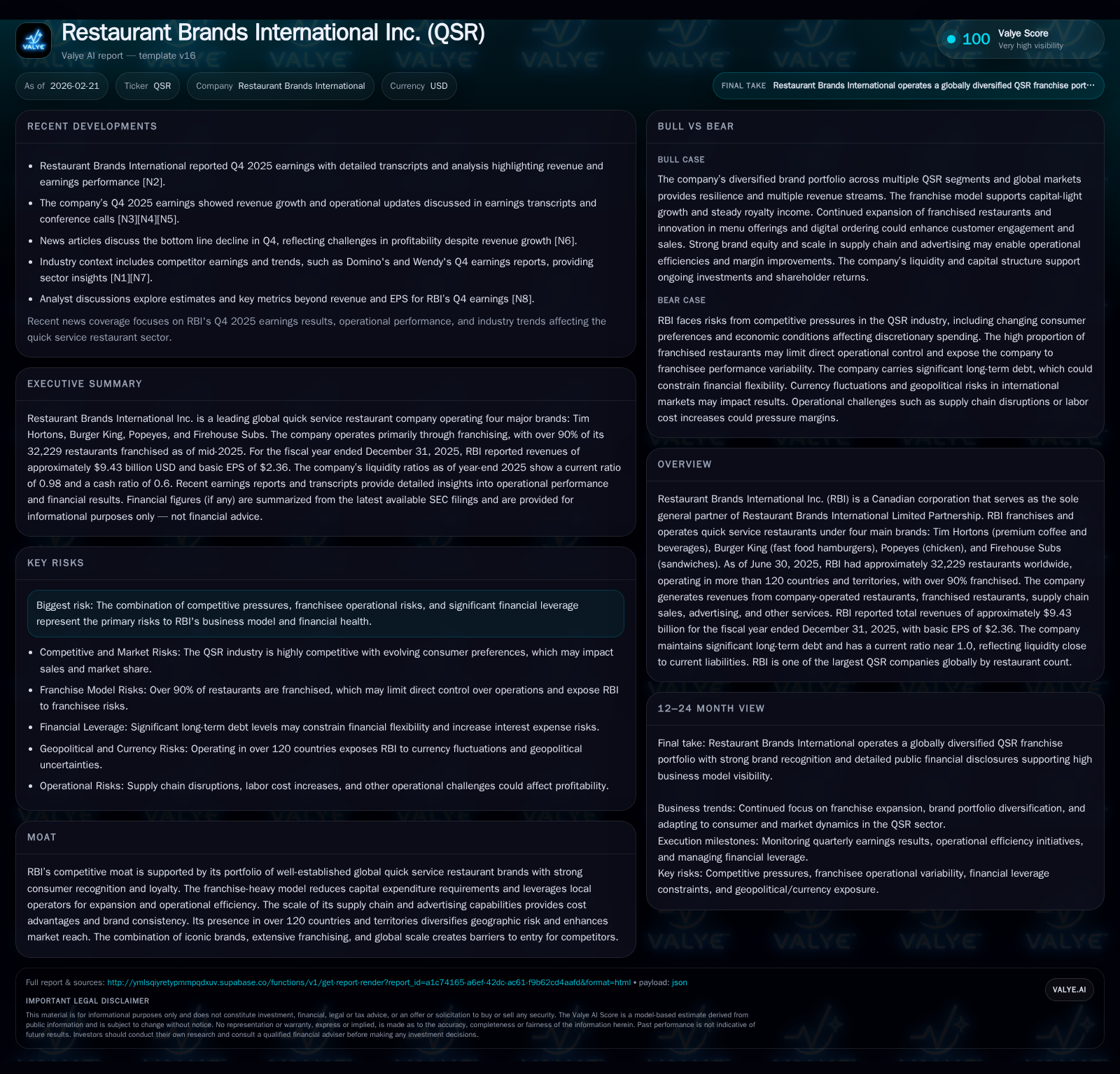
Restaurant Brands International Inc. (RBI) has delivered robust revenue growth over the last four years, propelled by its globally recognized portfolio of quick service restaurant brands and a high franchise penetration model. Despite this, the company faces ongoing challenges in translating top-line momentum into operating profit expansion, with a 9% operating income decline in fiscal 2025 and a near halving of net income relative to prior periods. Elevated raw material costs, franchise economics shifts, and operational expenses alongside significant financial leverage constrain profitability. Moving forward, RBI’s diversified brand mix and international reach provide avenues for continued expansion, though close attention to margin dynamics, debt servicing capacity, and franchisee performance will be critical.
Historical Growth Trajectory Supported by Iconic Franchise Brands
Historical performance (annual)
| FY | Rev ($bn) | CFO ($mm) | OpInc ($bn) | Capex ($mm) | Rev YoY |
|---|---|---|---|---|---|
| 2025 | 9.4 | 1714 | 2.2 | 265 | +12.2% |
| 2024 | 8.4 | 1503 | 2.4 | 201 | +19.7% |
| 2023 | 7.0 | 1323 | 2.1 | 120 | +7.9% |
| 2022 | 6.5 | 1490 | 1.9 | 100 |
Note: Omitted columns lack sufficient annual XBRL coverage in the provided tags (need ≥2 annual points): Net, ROE%. Source: SEC companyfacts cache [F1].
Capital returns and efficiency (annual)
| FY | Div ($mm) | Buybacks ($mm) | FCF ($mm) |
|---|---|---|---|
| 2025 | 1108 | 0 | 1449 |
| 2024 | 1029 | 0 | 1302 |
| 2023 | 990 | 500 | 1203 |
| 2022 | 971 | 326 | 1390 |
Source: SEC companyfacts cache [F1].
Restaurant Brands International has established itself as a global powerhouse within the quick service restaurant (QSR) sector through its flagship brands: Tim Hortons, Burger King, Popeyes, and Firehouse Subs. Combined with a franchise-heavy business model exceeding 90% franchised units as of mid-2025, RBI has effectively leveraged local operators' capital and insights to drive rapid geographical expansion while limiting corporate capital expenditure intensity. From fiscal year 2022 through 2025, RBI's consolidated revenue surged from $6.51 billion to $9.43 billion representing an approximate annualized compound growth rate of 12.2% [F1], illustrating the powerful scaling effect of its multi-brand diversification.
This rapid revenue growth also reflects strategic investments in product innovation across segments—from premium coffee offerings at Tim Hortons to Popeyes' growing footprint in chicken QSR category—and robust global marketing programs which capitalize on extensive supply chain scale economies [S1]. Notably, the number of franchised restaurants topped over 29,000 units globally by mid-2025 within a total system count exceeding 32,200 locations worldwide operating across more than 120 countries — underscoring RBI's extensive international reach.
Dissecting The Drivers Behind Revenue Expansion and Operating Profit Adjustments
Despite commendable top-line expansion, RBI's operating income profile reveals emerging systemic challenges. Operating income increased steadily through fiscal years ending 2023 and peaked at roughly $2.42 billion in FY24 before contracting by approximately 9% to $2.20 billion in FY25 [F1]. This deceleration stems primarily from elevated input cost inflation impacting raw materials such as beef and poultry supplies exacerbated by lingering global supply chain disruptions documented during recent earnings calls [N2][N3][S3].
Additionally, changes in franchise economics including increased royalty fees reinvested into brand support programs alongside heightened labor and marketing expenses further compressed operating margins despite revenue gains — suggesting reduced operating leverage within existing contracts.
Supply chain efficiencies continue to evolve but have yet to fully offset inflationary pressure resulting in net margin softness amid broad cost headwinds affecting not only directly operated restaurants but also fee income derived from franchised locations.
Emerging Constraints from Financial Leverage and Operating Dynamics
One of RBI’s more pronounced risks lies within its financial structure characterized by substantial long-term indebtedness nearing $13.4 billion net of current portions as of mid-2025 alongside short-term liabilities roughly equating current assets producing a current ratio near unity (0.98) [F1][S5][S6]. This elevated leverage exposes the company to interest expense burdens which have contributed materially to compressed net earnings.
Net income data is sparse post-FY20 but historical figures illustrate significant volatility—in that period showing nearly a 46% decline compared to prior year benchmarks—primarily on the back of financing costs affecting returns to equity holders [F1][N12]. With long-dated maturities clustered throughout late-2020s along with associated covenants documented extensively in filings [S23], RBI’s financial flexibility is constrained impacting operational investment decisions.
The combination of working capital tightness reflected in cash conversion cycles aligned with high leverage underscores an imperative for disciplined capital management particularly as macroeconomic conditions remain volatile.
Assessing Future Growth Outlook Through Brand Diversification and Market Reach
Looking ahead, RBI signals confidence derived from its portfolio heterogeneity spanning distinct consumer categories—premium coffee (Tim Hortons), fast food burgers (Burger King), seasoned fried chicken (Popeyes), and sandwiches (Firehouse Subs). As emphasized in recent conference calls and filings, growth catalysts include continued global store expansions especially outside North America where underpenetration remains substantial [N2][S1].
Innovation efforts such as menu modernization initiatives and digital platform rollouts aim to enhance customer experience and frequency driving same-store sales improvement prospects though these are partially offsetting ongoing inflationary pressures.
The multi-brand approach coupled with geographic diversification across over 120 countries strategically mitigates localized risk while enabling cross-brand synergies such as shared distribution infrastructure and centralized advertising investments providing cost advantages at scale.
Capital Deployment Strategy: Dividends, Buybacks, and Debt Management Realities
RBI maintains a disciplined shareholder return policy anchored by steadily increasing dividends which reached approximately $1.1 billion paid out during fiscal year 2025 evidencing commitment despite profit headwinds [F1][S15][S17]. Conversely, unlike prior years where share repurchases were a component of capital deployment—abolished since FY24 with zero buybacks reported—focus has transitioned decisively towards deleveraging strategies reducing outstanding debt principal balances [N2].
This strategic pivot prioritizes improving credit metrics over distributing excess cash via repurchases amid interest rate uncertainties while maintaining dividend stability — balancing shareholder interests with financial prudence.
Key Performance Metrics: Margin Trends, ROE, And Free Cash Flow Generation
Key performance parameters illustrate nuanced operational realities: Though revenues showed double-digit growth annually between FY22-25 at approximately +12%, operating income margins contracted marginally reflected in the -9% YoY decline from FY24-25 highlighting incremental pressure on profit efficiency metrics [F1]. Return on equity approximates at about 3.8% owing principally to squeezed net income returns relative to expanded equity base corroborated by publicly filed data.
Operational cash flows accelerated commensurately with scale reaching roughly $1.71 billion for FY25 supporting capital expenditure increases consistent with expansion efforts (capex up nearly +32% YoY), yielding solid free cash flow generation near $1.45 billion fostering internal reinvestment capacity despite constrained profitability levels.
What Investors Should Monitor Next: Earnings Signals and Franchise Developments
Absent explicit forward-looking guidance beyond broad qualitative commentary provided in latest earnings transcripts [N2], stakeholder attention should concentrate on quarterly sales trajectory segmented by brand and geographies—especially international unit openings versus domestic market pacing—as an indicator of sustained revenue momentum.
Monitoring evolving margin trends particularly how effectively inflation mitigation programs unfold remains critical alongside franchisee throughput performance which directly influences royalty fee bases impacting overall EBIT scalability.
Additionally prudent surveillance is warranted regarding any material adjustments around RBI’s capital structure or liquidity profile including refinancing risk given clustered debt maturities approaching within next few years . Regulatory or litigation developments highlighted periodically could further influence operational continuity or cost frameworks instilling additional risk vectors.
Disclaimer: This analysis is prepared solely for informational purposes based on publicly available data up to February 21, 2026. It does not constitute investment advice or recommendations. Readers should consider all available information when forming conclusions about Restaurant Brands International Inc.
Disclaimer: This is research-only, informational analysis and not investment advice. It may include AI-generated interpretation and general industry context. Always verify important details using primary sources.

Comments